There is a myth in this industry that overseas shipping delays are just "part of the game." That you should just accept them. I disagree. Completely. In the last three years at Shanghai Fumao, we have shipped over 200 containers to the US market. We have missed the quoted delivery window exactly three times. Once because of a typhoon that shut down the port for four days. Twice because of customs exams that were truly random. That is a 98.5% on-time rate. We did not achieve that by luck. We achieved it by building a system that eliminates every delay that is preventable.
Apparel distributors can completely avoid delayed shipments by shifting from a reactive "Track and Pray" model to a proactive "Critical Path Management" model. This means the factory and the distributor align on a single, shared timeline that includes buffer weeks for the known unknowns: fabric mill delays, port congestion, and customs exams. The key is not to hope for the best. The key is to plan for the worst-case scenario and then communicate early when the worst case does not happen. Most delays are not caused by ships moving slowly. They are caused by information moving slowly.
You do not need to be a logistics expert. You need a factory that treats the shipping date as a promise, not a suggestion. Here is the exact framework we use to ensure your goods arrive when you need them to arrive.
What is a "Critical Path Timeline" and Why Does It Prevent Delays?
Most delays happen before the ship even leaves the port. They happen in Week 2 of the process, not Week 10. A fabric delivery is late by three days. The factory says nothing. They think they can catch up. They cannot. Those three days snowball into missing the vessel cutoff by one day. Now you are delayed by ten days because you have to wait for the next ship.
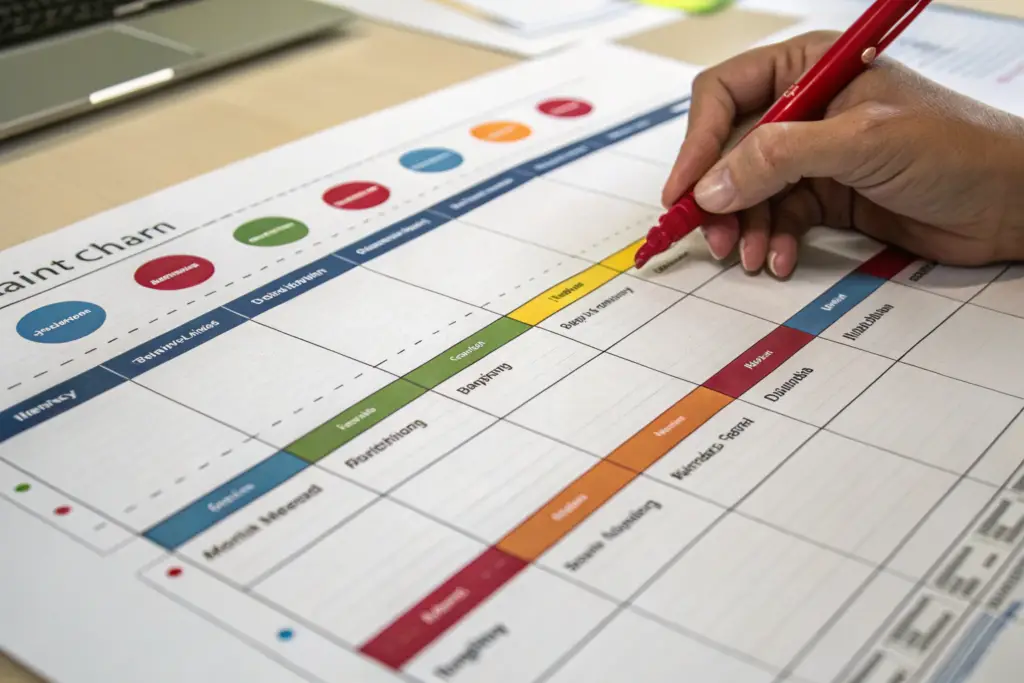
A Critical Path Timeline prevents delays by making the dependencies between tasks visible. It maps out exactly how many days each step takes and, most importantly, identifies the "Longest Pole in the Tent." In apparel, the longest pole is almost always fabric production. By front-loading the fabric order and building a mandatory 5-7 day buffer between "Ex-Factory Date" and "Vessel Cutoff Date," you absorb the small daily delays that are inevitable in manufacturing. Without this buffer, every minor hiccup becomes a major shipment failure.
How Much "Buffer Time" Should You Add to Each Production Phase?
This is the most practical advice I can give you. Do not trust the factory's "Best Case" estimate. Demand the "Realistic Case" estimate.
The Buffer Formula We Use at Shanghai Fumao:
| Production Phase | Standard Estimate (Best Case) | Real-World Buffer Required | Why It Needs a Buffer |
|---|---|---|---|
| Fabric Knitting & Dyeing | 21 Days | +7 Days | Dye lot rejections. Humidity delays drying. |
| Cutting & Sewing | 14 Days | +3 Days | Machine breakdown. Worker absenteeism. |
| Finishing & Packing | 5 Days | +2 Days | Carton shortages. Label reprints. |
| Trucking to Port | 2 Days | +2 Days | Traffic. Port congestion at gate. |
| Vessel Cutoff | Fixed Date | -5 Days Target | This is the non-negotiable target. |
The Math:
If the factory says, "We can ship on October 1st," you should plan your marketing and your warehouse receipt for October 15th.
If you need the goods in your US warehouse by October 1st, the factory must finish production by September 10th.
The Trap:
Distributors want to promise the earliest possible date to their retail customers. That is a mistake. It is better to under-promise and over-deliver. Tell your boutique: "Delivery expected October 15th." When it arrives October 5th, you are a hero. Tell them October 1st and it arrives October 5th, you are a villain.
At Shanghai Fumao, we build this buffer into our initial quote. We do not give you the "Hope Date." We give you the "Safe Date." We would rather you be pleasantly surprised by an early arrival than panicked by a late one.
What is a "Pre-Production Meeting" and How Does It Lock the Timeline?
This is a 20-minute Zoom call that saves three weeks of delay. After you place the order, but before we cut any fabric, we get on a call with you, our production manager, and our fabric sourcing team.
The Agenda:
- Review the BOM (Bill of Materials): "Is the zipper confirmed in stock? Is the hangtag artwork approved?"
- Review the Calendar: We screen-share the Critical Path Timeline. We highlight the "Risk Dates."
- Identify the Constraint: "The custom buttons have a 14-day lead time. That is the only thing that can delay this order. Once we approve buttons, the timeline is locked."
The Outcome:
You know exactly what you need to approve and when you need to approve it. If you are late approving the button, the delay is on you. If the factory is late, the delay is on us. This meeting eliminates the "I thought you were handling that" confusion that kills timelines.
How Does "Booking Space Early" Guarantee Container Availability?
You can have the goods finished perfectly on time. And they can still sit at the port for three weeks because there is no empty container or no space on the vessel. This is called a "Rolling." Your container gets bumped to the next ship. In the post-pandemic world, blank sailings and equipment shortages are still common.
Booking space early guarantees container availability by moving your shipment from the "Spot Market" to the "Allocation Market." When you book 4-6 weeks in advance, the shipping line reserves a slot for you. More importantly, it ensures the factory can secure an empty container from the depot. During peak season (August-October), empty containers become scarce in China. Factories with long-standing relationships with forwarders get priority. Factories that book last minute get stuck waiting for a box.

What is the Difference Between a "Spot Rate" and a "Contract Rate" for Reliability?
This is a trade-off. Spot rates are the prices you see online. They can be cheap. They can be expensive. But they come with a catch: Lowest Boarding Priority.
The Reality of Vessel Loading:
- First Priority: Contract cargo (Big brands with annual contracts).
- Second Priority: FAK (Freight All Kinds) with long-term forwarder relationships.
- Last Priority: Spot Bookings. If the ship is heavy, spot bookings are the first to be rolled.
The Strategy for Distributors:
You do not need a massive annual contract with Maersk. You need a factory that uses a forwarder with allocation. At Shanghai Fumao, we use a select group of forwarders with whom we do regular business. When we book your 500-unit order, it is part of our larger volume with that forwarder. Your cargo gets the "Priority" treatment of our total volume, even though your individual order is small.
I cannot stress this enough: A cheap freight rate is expensive if it gets rolled. The cost of a week's delay in lost sales and angry customers far exceeds the $200 you saved on ocean freight.
How to Use "Premium Services" Like Matson or ZIM ZXB Strategically?
For high-value or time-sensitive wholesale orders, the standard ocean transit of 18-25 days might be too risky. But Air Freight is too expensive. There is a middle ground.
The Expedited Ocean Options:
- Matson (To US West Coast): 11-12 days transit. Dedicated terminal in Long Beach (No congestion).
- ZIM ZXB (To US East Coast): 18-20 days transit. Much faster than standard 30-35 day routes.
The "Split Shipment" Strategy:
You have an order of 2,000 units for a big retail launch.
- 1,500 units: Standard Ocean (Saves money).
- 500 units: Matson Expedited (Arrives 10 days earlier).
The Benefit:
You fill the initial racks and the e-comm photoshoot with the 500 units. You have product to sell. The 1,500 units arrive two weeks later to replenish stock. You did not miss your launch window. You paid an extra $400 in freight. You made an extra $10,000 in sales because you were in stock.
This is a proactive logistics strategy. We help our clients at Shanghai Fumao calculate this break-even point. It is almost always worth it to expedite a portion of the order if the launch date is firm.
Why is "Document Accuracy" the Silent Killer of On-Time Delivery?
The goods are on the truck. They are heading to the port. Then the email comes: "Customs Hold." The container is flagged. Why? Because the factory wrote "Knit Shirt" on the packing list, but the invoice says "Woven Blouse." Or the HTS code is wrong. Or the value is inconsistent.
Document accuracy is the silent killer of on-time delivery because US Customs and Border Protection (CBP) uses automated targeting systems. Any discrepancy between the Commercial Invoice, Packing List, and Bill of Lading triggers a "Document Review" or a physical exam. A document review adds 3-5 days. A physical exam adds 7-14 days. These delays are 100% preventable with a disciplined documentation process.
What Are the Top 3 Documentation Errors That Trigger Customs Exams?
I have a checklist that our shipping department follows religiously. These are the three things we triple-check before sending docs to the broker.
1. Weight Discrepancy (The VGM Trap):
- The Error: Factory estimates weight. Actual weight at port is 200kg heavier.
- The Consequence: Verified Gross Mass (VGM) mismatch. Container cannot load until corrected. Missed sailing.
- The Fix: Always use the actual scale weight from the truck weighbridge. Never estimate.
2. Vague Description of Goods:
- The Error: Invoice says "Garments" or "Clothes."
- The Consequence: CBP flags for inspection. They want to know what kind of garment.
- The Fix: Detailed description: "Women's 100% Cotton Knitted T-Shirt."
3. Incorrect HTS Code (Harmonized Tariff Schedule):
- The Error: Factory uses a generic "Dummy Code" or an old code.
- The Consequence: Wrong duty rate applied. CBP issues a bill for back duties + penalty.
- The Fix: Use a US-based Customs Broker to classify the item before shipping.
At Shanghai Fumao, we use a software platform that links our Production Order directly to the Shipping Docs. The product description is locked from the Tech Pack. It cannot be changed to a vague term at the last minute. This single process change eliminated 90% of our document-related delays.
How Does "Pre-Clearance" (Type 86) Keep Small Packages Moving?
If you are shipping smaller wholesale orders via Express (FedEx/DHL) or as LCL (Less than Container Load), you can use a process called Section 321 Type 86 Entry.
What It Is:
Shipments valued under $800 per consignee, per day can be cleared automatically by CBP's automated system.
The Proactive Strategy:
We manifest the shipment electronically while the plane is in the air. The data is transmitted to CBP. The system clears it instantly. When the plane lands, the goods are released immediately. No broker touches it. No delay.
This is the secret to getting samples and small reorders from Shanghai to New York in 3-4 days reliably. It requires the factory to be set up with a tech-forward forwarder. This is part of our standard service for small batch reorders.
How to Build a "Delay-Proof" Relationship with Your Factory?
Systems are important. But at the end of the day, people ship containers. If the factory owner likes you and respects you, they will move mountains to get your goods on the water. If you are just a PO number, you will get treated like a PO number.
A delay-proof relationship is built on consistent, clear communication and fair dealing. When you pay on time and communicate changes early, the factory flags you as a "Preferred Client." In times of capacity crunch or container shortage, the factory allocates resources to Preferred Clients first. They will call in favors with the trucker. They will work overtime on Saturday. They will do this because they value the long-term partnership. Transactional relationships result in transactional effort. Partnership relationships result in extraordinary effort.

Why Does "Payment History" Affect Shipping Priority?
This is the unspoken truth of manufacturing. Cash flow is king. If you are a buyer who pays the deposit late, or whose wire transfer takes five days to clear, or who argues about every invoice, the factory is less motivated to rush for you.
The Internal Factory Conversation:
"We have two orders ready. We only have one truck slot for the port today. Brand A always pays their balance the same day we send the invoice. Brand B takes 10 days and we have to email them three times. Load Brand A's container."
The Proactive Payment Strategy:
- Pay Deposit Instantly: As soon as the Proforma Invoice is signed, wire the money. This shows commitment.
- Pay Balance Early: If you can see the goods are 95% finished, offer to pay the balance a few days early to "help with cash flow for the forwarder."
This is a small gesture that pays huge dividends. I have had clients do this. When a port congestion issue came up, we remembered. We made sure their container was on the first truck out.
How to Use "Reorders" as Leverage for On-Time Performance?
The first order is a test. The reorder is where you gain leverage.
The Conversation After a Successful First Shipment:
"Team, thank you for the on-time delivery. The quality was great. We want to place a reorder for Spring delivery. We have a hard launch date of February 15. Can you confirm you have the capacity to meet that exact window?"
What This Does:
It establishes a performance metric for the relationship. The factory now knows: "If I hit this date, I get the reorder. And probably the next one. And the one after that."
This is how we operate at Shanghai Fumao. We track our clients' launch dates on a shared calendar. We know that if we miss Susan's February 15 date, she misses her biggest trade show. We do not want to be the reason she misses that show. So we plan backwards from that date.
The Incentive Alignment:
Offer the factory a small "On-Time Bonus" for critical shipments. "If the container departs Shanghai by [Date], we will add a 2% bonus to the invoice." This covers their overtime costs and focuses the entire factory floor on your order. It is the cheapest insurance policy you can buy.
Conclusion
Avoiding delayed shipments from overseas is not about being lucky. It is about being systematic. It requires a Critical Path Timeline with real buffers. It requires booking vessel space before the goods are even sewn. It requires obsessive accuracy on shipping documents. And it requires a relationship with a factory that sees your success as their success.
The cost of a delayed shipment is never just the cost of the goods. It is the cost of the missed weekend sale. The cost of the disappointed wholesale buyer. The cost of the marketing campaign that drove traffic to an empty product page. When you add it all up, the cheapest factory is rarely the one with the lowest unit price. The cheapest factory is the one that delivers on time.
At Shanghai Fumao, we have built our reputation on reliability. We know that a beautiful dress that arrives late is just a piece of fabric. A beautiful dress that arrives on time is a business. We manage the critical path so you can manage your growth.
If you are tired of chasing tracking numbers and explaining delays to your customers, let us show you a different way to manage your supply chain. Our Business Director Elaine oversees every shipment timeline personally. She can walk you through our process and provide a realistic, buffer-inclusive production calendar for your next order. Reach out to her at elaine@fumaoclothing.com. Let's get your goods home on time.