You scroll through your brand's Instagram feed. It is beautiful. It is curated. It looks like a magazine. And it is also... quiet. The likes are there, but the comments are sparse. The same five loyal customers tag you every week, but it feels like a small echo chamber. You are spending hours in Photoshop or Canva creating content that feels increasingly disconnected from the actual people wearing your clothes. You want the feed to feel alive. You want proof that real people love what you make. You want to stop guessing what content works and start knowing.
Seamlessly incorporating User Generated Content (UGC) into your apparel marketing requires building a systematic "rights management" workflow and a visual curation strategy that blends the raw authenticity of customer photos with the polished consistency of your brand aesthetic. The most effective methods involve automated post-purchase email flows that solicit specific types of photos, the strategic use of branded hashtags on Instagram, and the integration of a "Social Proof" widget directly on your product detail pages (PDPs) to show real customers wearing the exact item being viewed.
I am the owner of Shanghai Fumao. I work with brands every day who make incredible product but struggle to tell the story of that product once it leaves the warehouse. I have watched brands double their conversion rates not by changing their ads, but by changing the source of their images. UGC is not just a marketing tactic. It is the closest thing to a word-of-mouth recommendation in the digital space. Here is how you collect it, curate it, and deploy it to sell more clothes.
What Is the Simplest Way to Start Collecting UGC from Real Customers?
You have shipped thousands of orders. That means thousands of people have your product in their hands. But if you do not have a system to ask for their photos, you are leaving a massive content library on the table. You might think, "I don't want to bother my customers." The reality is, the customers who love your brand want to share it. They just need a nudge and an easy way to do it.
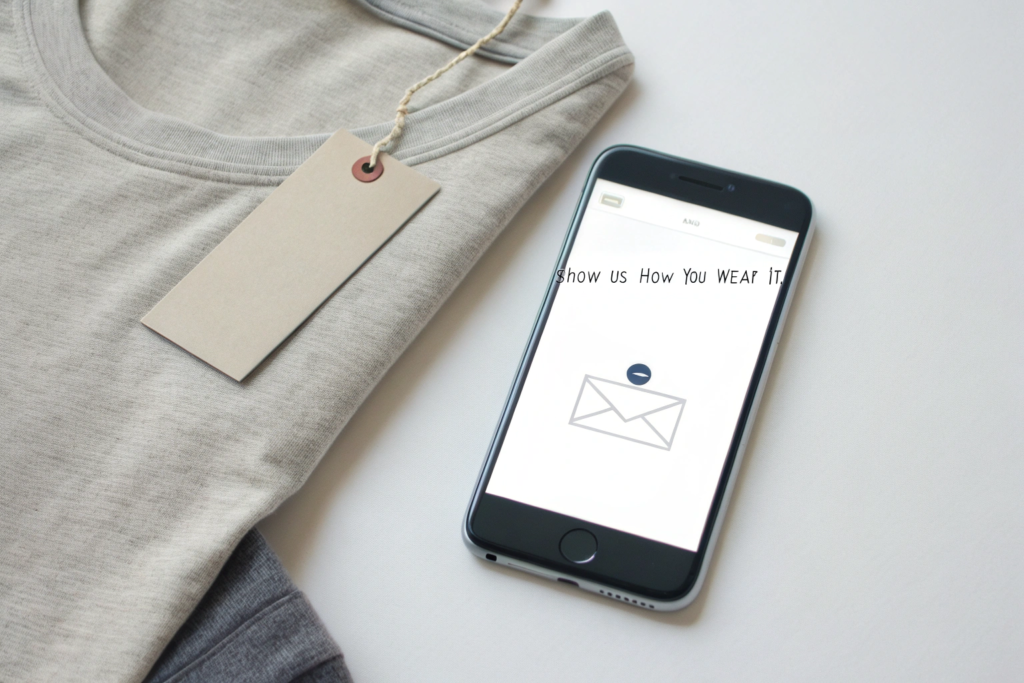
The simplest and most scalable way to start collecting UGC is through a "Post-Purchase" automated email sequence. This email is triggered 7-14 days after the delivery confirmation, giving the customer time to wear and wash the item. The email should not just say "Tag us." It should provide a direct upload link and a clear incentive, such as entry into a monthly giveaway or a small discount on their next order. This removes the friction of having to post publicly on social media if they are shy.
Why Does Timing Your "Post-Purchase" Email 10 Days After Delivery Work Best?
Timing is everything. If you send the email the day the package arrives, the shirt is wrinkled. The customer hasn't worn it out yet. If you send it 60 days later, the excitement has faded.
We have analyzed the engagement data for several of our brand clients. The Sweet Spot is Day 10.
- Day 1-3: Customer is unboxing. The item is likely tried on but not styled for a full day out.
- Day 7-14: The customer has likely worn the item at least once. They have washed it (a crucial test for quality garments). They may have received a compliment on it. They are at peak "product satisfaction."
- Day 30+: The item is just part of the wardrobe. The impulse to share has diminished.
Here is a specific example. A client of ours who makes women's workwear basics added a Day 10 automated email using a platform like Klaviyo. The email subject line was: "How's the new blouse treating you? 🪴"
The body was simple: "We'd love to see how you're styling the Daphne Blouse. Upload a photo here for a chance to win a $200 store credit. No Instagram required."
The link went to a simple Upload Form (we recommend tools like Tweak or UGC Factory for this). The results were immediate. They went from receiving 3-5 tagged photos a month to receiving 40-50 uploaded photos a month. Many of these customers were not active on social media. They were professional women who didn't post outfit photos publicly. But they were happy to share privately with the brand they liked. This unlocked a whole new demographic of visual content.
The key is the Direct Upload Link. Do not just say "Tag us on Instagram @yourbrand." That is a barrier. Provide the path of least resistance.
How Can You Incentivize Quality Photos Without Just Giving Away Free Clothes?
You might worry that offering discounts trains customers to only engage for a reward. This is a valid concern. You want authentic love, not paid promotion. But there is a middle ground between "free clothes" and "nothing."
Non-Monetary Incentives That Drive High-Quality UGC:
- Feature & Fame: The promise of being featured on the brand's main feed. For many customers, this is more valuable than a 10% discount code. It validates their style.
- Community Status: A "Top Fan" badge or access to a private Facebook/Instagram group.
- Charitable Donation: "For every photo you share, we donate $1 to [Relevant Cause]." This aligns the ask with your brand values.
A brand we work with in the outdoor apparel space does this brilliantly. They do not offer discounts. They offer "Trail Credits." When a customer uploads a photo of them hiking in the gear, they log it in a system. After 5 photo submissions, they unlock a limited-edition patch or sticker that only "Photo Contributors" get. It costs the brand pennies. But the community is obsessed with collecting these patches. It drives an enormous amount of high-quality, adventure-lifestyle UGC.
Here is a comparison of incentive structures:
| Incentive Type | Volume of Submissions | Quality of Content | Risk of Inauthenticity |
|---|---|---|---|
| Monthly $200 Raffle | Very High | Mixed (Some mirror selfies) | Low (It's a game of chance) |
| Exclusive Access Group | Medium | High (Community norms) | Very Low |
| 20% Off Next Order | High | Low (Rushed, low effort) | Medium (Feels transactional) |
| Charity Donation Trigger | Medium | Medium-High | Very Low (Feels good) |
The goal is to make the customer feel like an Insider, not a Salesperson.
Where Should You Actually Place UGC on Your Website to Boost Trust?
You have collected 100 beautiful customer photos. Now what? If you just let them sit in a "Fan Gallery" buried in the footer of your site, they are doing nothing for your bottom line. UGC is not just decoration. It is a Conversion Tool. You need to place it where the buying decision is actually made.
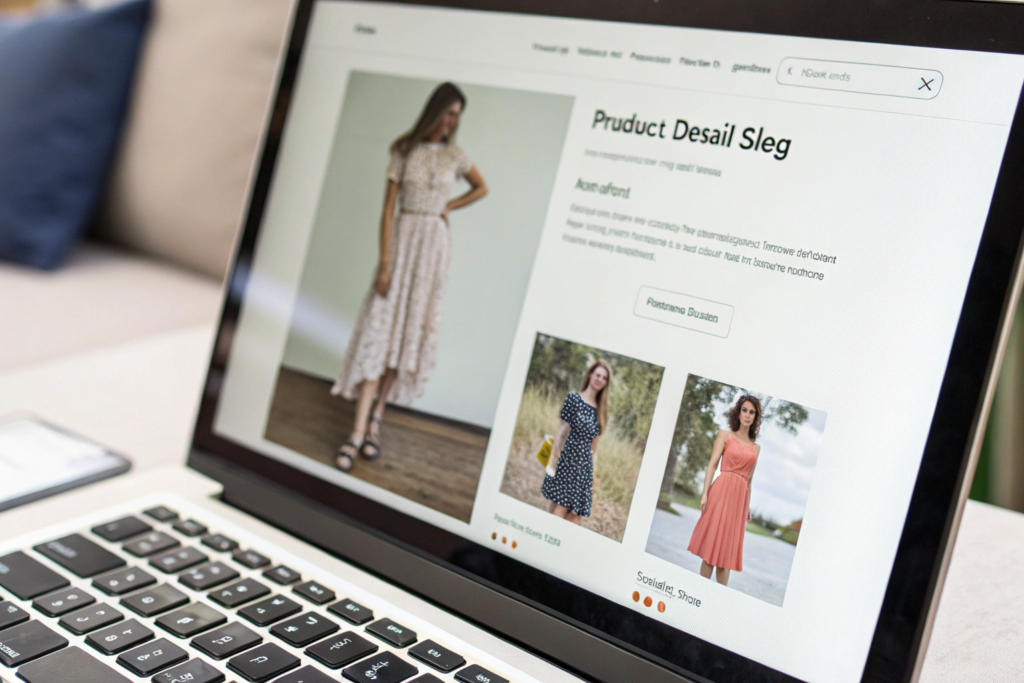
The highest-converting placements for UGC on an apparel website are directly on the Product Detail Page (PDP) and in the Shopping Cart. On the PDP, UGC acts as "Social Proof," validating the fit and fabric in ways a studio model cannot. A grid of customer photos showing the item on diverse body types and in different lighting conditions reduces return rates by answering the unspoken question: "But how will this look on me?"
Why Does a "Styled by You" Gallery Reduce Return Rates on Fit-Sensitive Items?
You sell a beautiful pair of wide-leg trousers. Your model is 5'10" and a size 2. She looks amazing. Your customer is 5'4" and a size 10. She is not sure if these pants will make her look like she is swimming in fabric. She hovers over the "Add to Cart" button. She hesitates. She leaves.
This is the Representation Gap. Studio photography, while essential for the catalog, only tells one story.
When you add a "Styled by You" gallery directly below the main product image, you fill that gap. Suddenly, the hesitant customer sees a photo from "Sarah in Austin." Sarah is 5'4", size 10. Sarah looks great. The pants don't drag on the floor. They look intentional.
We saw this impact with a client who sells midi dresses. Their return reason #1 was "Too Long." They added a UGC gallery specifically asking customers to tag their height in the photo caption (e.g., "Loving this dress! I'm 5'3" for reference."). They placed this gallery high up on the PDP.
The Result: Their return rate for "Length Issues" dropped by 22% over six months. The UGC did the work of a thousand size chart measurements. It showed the reality of the garment on a real body. This is the kind of data that directly improves the relationship with the factory. When we see less returns due to fit, we know the pattern grading is working for a wider range of bodies.
Here is a checklist of what makes a PDP UGC gallery effective:
- Placement: Above the "You May Also Like" section, but below the main product images. It must be visible without scrolling too far.
- Sorting: Default sort to "Most Recent" to keep the gallery fresh.
- Moderation: You must approve photos. Keep the quality high. Blurry mirror selfies belong in the backend, not on the PDP.
- Link to Purchase: Ensure the widget allows customers to "Shop This Look" directly from the UGC photo.
How Can You Use UGC in Abandoned Cart Emails to Recover Lost Sales?
The abandoned cart email is a battleground. The customer has already shown high intent. They just got distracted or had a moment of doubt. The standard email says: "You left something behind! Here's 10% off." This trains the customer to abandon carts for a discount.
A smarter approach is to Inject Social Proof instead of a discount.
Subject Line: "See how others are wearing the [Item Name] you loved..."
Email Body: A clean, simple grid of 3-4 UGC photos of that specific item. No hard sell. Just a caption: "Real people. Real style. Your cart is waiting."
This email does not devalue the product. It reinforces the desire for the product. It says, "Look at all these cool people. You want to be one of them."
A brand we work with tested this. They split their abandoned cart flow.
- Group A: Received the standard 10% off email.
- Group B: Received a UGC gallery email (no discount).
Group A had a higher recovery rate on that specific purchase. But Group B had a Higher Lifetime Value (LTV) . The customers who bought from the UGC email were less likely to return the item and more likely to pay full price in the future. They were buying the lifestyle, not just the deal.
This is a long-term play. You are building a brand, not just clearing inventory. UGC helps you do that by showcasing the community around your product.
How Do You Ethically "Whitelist" Customer Content for Paid Ads?
You see a stunning photo from a customer. It is better than anything your photographer took. You want to put $5,000 behind it on Meta Ads. You download it and run the ad. Stop. That is illegal and unethical. You do not own that photo just because the customer tagged you. Using it in a paid promotion without explicit permission is a violation of the user's copyright and can get your ad account suspended.
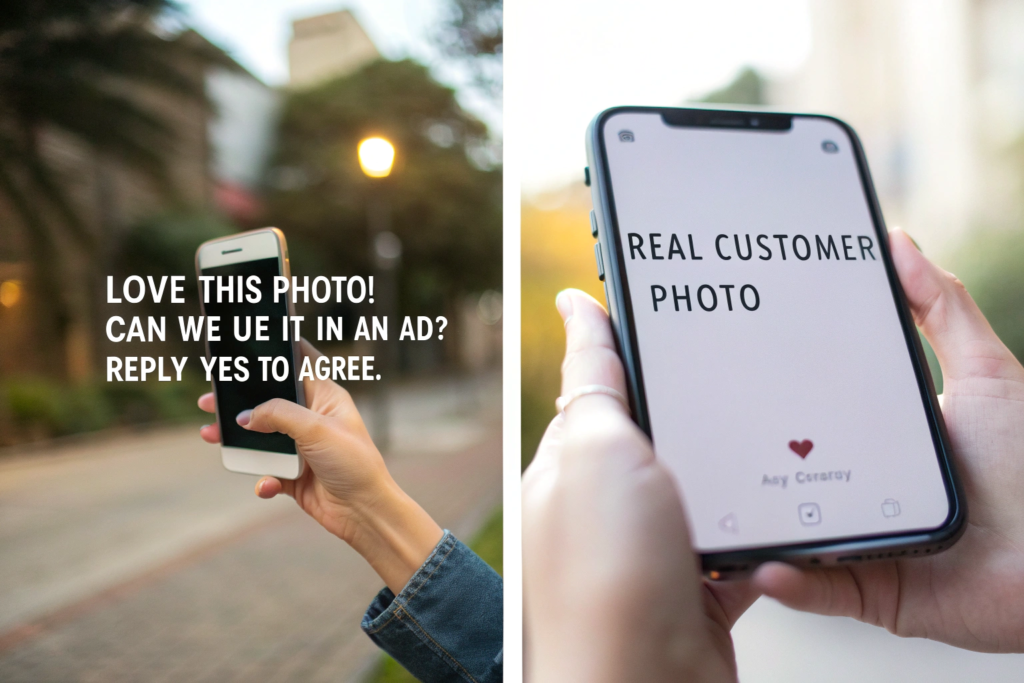
Ethically "whitelisting" customer content for paid ads requires obtaining explicit, written permission through a "Rights Management" process. This involves reaching out to the customer, explaining exactly where the content will be used (e.g., "Instagram and Facebook Ads for 30 days"), and getting a clear "Yes" response. Tools like Aspire or GRIN automate this, but even a simple Instagram DM reply of "#YesBrandName" is legally sufficient if documented properly.
What Is the Exact Language You Need to Use to Get Permission?
You do not need a 10-page legal contract. You need a Clear Disclosure. Here is the template we recommend to our clients for DM outreach:
"Hey [Name]! We LOVE this photo. The way you styled the [Item Name] is perfect. Our team was wondering if we could have your permission to feature this photo in some of our social media ads? It would just run for a few weeks. We'd credit your handle in the ad. If that's cool with you, just reply #YesFumao. Thanks for being awesome!"
Why this works:
- Specificity: "Social media ads" is specific. "Feature this photo" is vague.
- Temporary: "Run for a few weeks" sets an expectation that it is not forever.
- Simple CTA: "#YesFumao" is easy to track. We can search that hashtag in our DMs to build a database of approved content.
What NOT to do:
- Do not assume permission. Silence is not consent.
- Do not offer a "gift card" in exchange for ad rights. This changes the relationship from "UGC" to "Paid Sponsorship." This requires different legal disclosures (FTC guidelines). Keep UGC for ads Organic and Unpaid if you want the authentic feel.
Why Does UGC in Ads Often Outperform Professional Studio Shots?
The data from Meta and TikTok is consistent on this point. The human eye has become incredibly good at scrolling past "advertising." A polished studio shot with perfect lighting triggers the brain's Banner Blindness filter. We see it and think, "Ad. Scroll."
A slightly imperfect UGC photo—maybe the lighting is a bit warm, maybe the background is a messy living room—does not trigger that filter. The brain processes it as Social Information. "Oh, a real person wearing that. Let me look."
We ran a split test for a client's hoodie campaign.
- Ad A: Professional model in a warehouse studio. Click-Through Rate (CTR): 1.2%.
- Ad B: Customer photo of a woman wearing the hoodie on a couch with a dog. Same copy. Same budget. CTR: 2.8% .
The UGC ad had more than double the engagement. And the Cost Per Acquisition (CPA) was 35% lower. The audience trusted the "couch photo" more because it was relatable. It answered the question, "How does this hoodie look when I'm just relaxing at home?"
At Shanghai Fumao, we encourage our brand partners to think about this during product development. The fabrics we choose—those with a good drape and recovery—are the ones that look good in both studio lights and iPhone flash. When you make a high-quality garment, it does the heavy lifting in UGC. The customer's phone camera can't hide good fabric.
What Are the Legal Pitfalls of Reposting Customer Photos Without Asking?
You might think, "It's just a repost on my Story. It's free marketing for them." While many customers are flattered, you are playing with fire. Copyright law gives the photographer (the customer) ownership of the image the moment they click the shutter. Using it for commercial purposes (and promoting your brand is commercial) without a license is copyright infringement.
The primary legal pitfalls of reposting UGC without permission are copyright infringement claims (which can lead to DMCA takedown notices or lawsuits) and violations of platform Terms of Service (which can result in your social media account being suspended). Furthermore, if the photo contains a recognizable person, you also need a "Right of Publicity" release to use their likeness to sell a product.

How Does a Simple "Repost App" Expose You to Copyright Claims?
Many brands use repost apps that automatically copy the image and add a watermark. These apps do not solve the legal problem. They actually make it worse by creating a new copy of the image, which is a clear act of Reproduction under copyright law.
If a customer decides to be difficult, they can file a DMCA (Digital Millennium Copyright Act) takedown notice with Instagram. Instagram is legally obligated to remove the post. If you get multiple DMCA strikes, your account can be permanently deleted. You can lose years of built-up followers and content because you didn't send a 10-second DM asking for permission.
The only safe way to repost:
- DM/Comment: "Love this! Can we repost to our feed? Reply #ShareMyStyle."
- Wait for Reply.
- Repost using the native Instagram Share feature (which links back to the original post, which is a safer practice legally than downloading and re-uploading).
We had a situation where a brand client reposted a photo of a child wearing their kids' line. The parent had taken a beautiful photo. But they were a private person and did not want their child's face in the brand's marketing. They demanded the post be taken down immediately. The brand complied. It was a minor embarrassment. But if the parent had been a lawyer, it could have been a Right of Publicity lawsuit. Children cannot consent, and parents have strict control over their image. This is a high-risk area for kids' apparel brands. Always. Get. Permission.
What Is the Difference Between "Organic Repost" and "Commercial Use"?
This is where brands get confused. "I just put it on my Story. That's not an ad."
Legally, the line is blurry. If you are a business account and you post content to promote your goods, a court will likely view it as Commercial Use. The fact that you did not pay to "boost" the post does not make it non-commercial.
To protect yourself, your website's Terms of Service should include a clause about User Generated Content License. This is standard practice for major retailers.
A standard clause might read: "By tagging [Brand Name] or using the hashtag #BrandNameStyle, you grant [Brand Name] a non-exclusive, royalty-free license to use, reproduce, and display your content on our website and social media channels."
This is a Passive Opt-In. If a customer uses the hashtag, they are agreeing to the terms. This is a solid first line of defense, but it is not bulletproof for paid ads. For paid ads, you still want the explicit "Yes" DM. But for organic reposts, a clear TOS and a branded hashtag provide a strong legal foundation.
Conclusion
Seamlessly incorporating User Generated Content into your apparel marketing is about building a system that respects the customer while leveraging their authentic voice. You started this article with a beautiful but quiet feed. Now you have a playbook to fill it with the voices and faces of the people who actually love your product.
We explored the mechanics of the ask—how a well-timed post-purchase email with a direct upload link unlocks a flood of content from customers who are too shy to post on social media. We looked at where to place this goldmine of content on your site, seeing how a "Styled by You" gallery directly on the PDP reduces the anxiety of fit and lowers return rates. We navigated the ethical and legal minefield of using UGC in ads, learning that a simple DM with a clear #YesBrandName hashtag is the key to unlocking high-converting, low-cost ad creative.
Most importantly, we confronted the legal realities. In the rush for content, it is easy to forget that behind every photo is a person with rights. Treating those rights with respect is not just a legal requirement. It is the foundation of the trust that makes UGC so powerful in the first place.
The best UGC starts with a product that people want to show off. It starts with a garment that fits well, drapes beautifully, and holds up in the wash. That is where we come in.
If you want to fill your supply chain with products that are worthy of being shared, let's talk. We build the quality. You build the community.
Reach out to our Business Director, Elaine. She can help you get the production right so your customers can't wait to show off what they bought. Email her at elaine@fumaoclothing.com. Let's create something worth sharing with Shanghai Fumao.