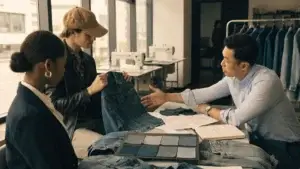
You have received the final sample of your beautiful new collection. The color is a rich, vibrant jewel tone, and you love it. You are ready to place your bulk order. But a nagging voice in your head asks: "Will this color bleed all over my customer's white sofa? Will it fade to a dull, washed-out mess after three laundries?" A brand owner told me, "I learned the most important rule in apparel the hard way: 'Color that cannot stay on the fabric is not color; it's a liability.' A single colorfastness failure can destroy a brand's reputation overnight."
Testing the colorfastness of a sample garment is a non-negotiable, scientific process that must be completed before committing to a bulk order. It involves subjecting the sample to specific, standardized tests that simulate real-world consumer use. The essential tests are: 1) Crocking (rubbing) to check for dry and wet color transfer, 2) Wash Fastness to assess color change and bleeding during laundering, and 3) Perspiration Fastness to check reaction to sweat. These tests are graded using standardized Grey Scales to produce an objective, pass/fail result.
At Shanghai Fumao, we perform these rigorous colorfastness tests on every new fabric and every PP Sample as a standard part of our quality control. We know that a beautiful color that bleeds is a ticking time bomb for your brand's reputation. Let me explain the essential tests, how they work, and why they are your ultimate insurance policy before you commit to bulk production.
What Is the "Crocking Test" and Why Is It the First Line of Defense?
The most common and embarrassing colorfastness failure is crocking—the transfer of dye from the dry or wet fabric onto another surface. It is the reason a dark denim turns your white leather handbag blue, or a vibrant red shirt leaves a pink stain on a light-colored sofa. This is often the first test a professional will perform because it is fast and reveals a fundamental problem with the dye's adhesion to the fiber.
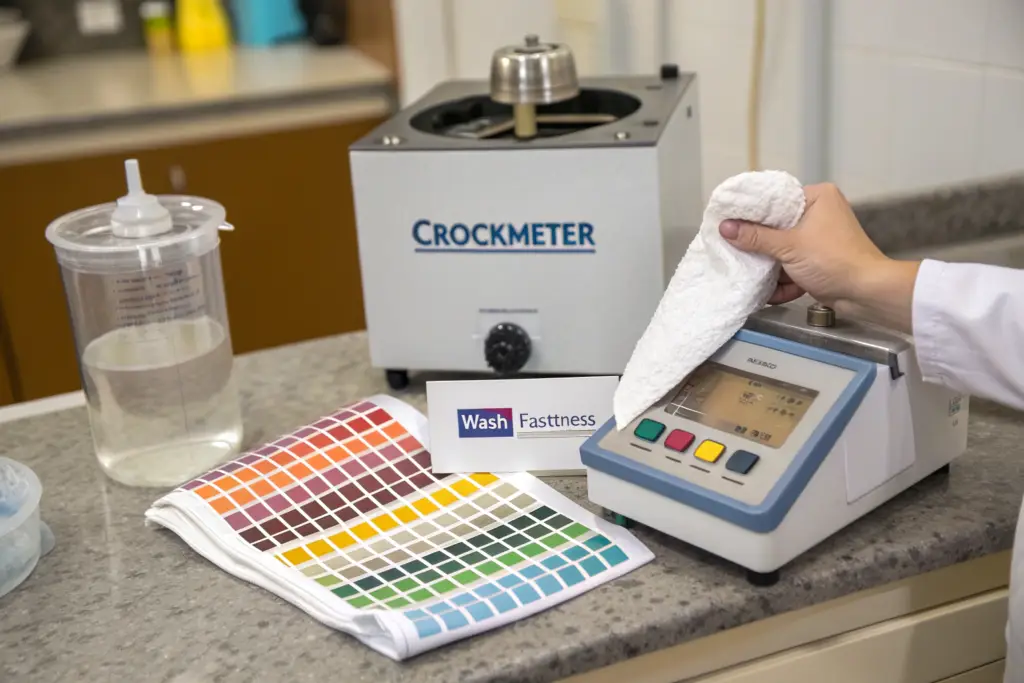
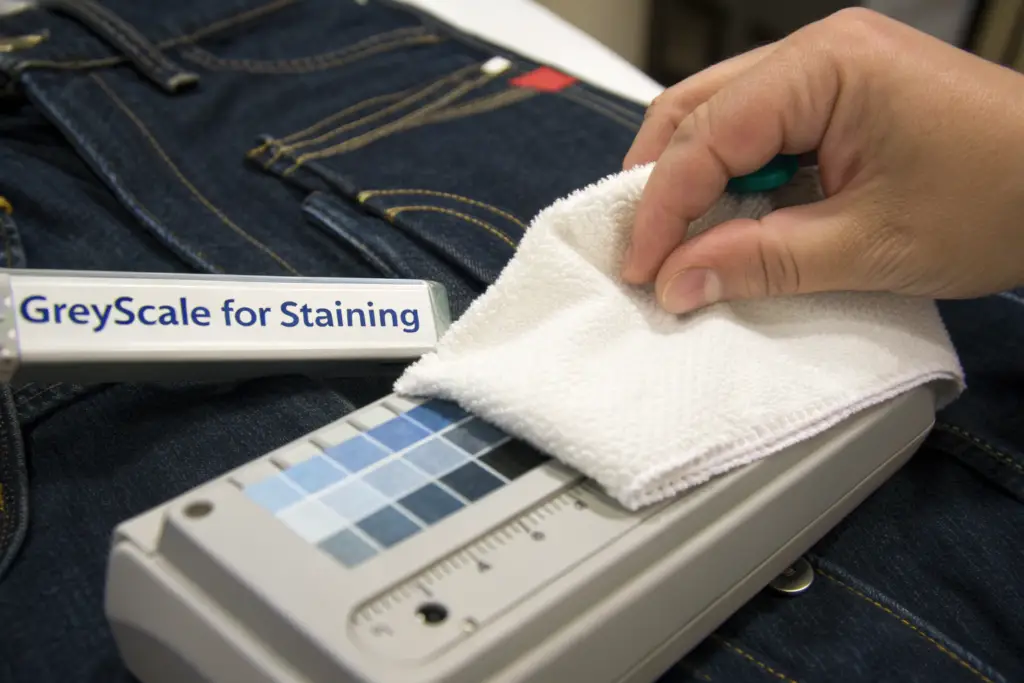
The Crocking Test (AATCC 8 or ISO 105-X12) is the essential first defense against color transfer. It uses a machine called a crockmeter, which rubs a standard white cotton cloth against the dyed fabric sample under a controlled pressure for a set number of strokes. This is performed once with a dry cloth ("Dry Crocking") and once with a wet cloth ("Wet Crocking"). The amount of color transferred to the white cloth is then visually compared against a standardized "Grey Scale for Staining." A rating of 3-4 or higher is generally considered acceptable for most apparel.
I recall a brand that produced a beautiful line of dark indigo cotton shirts. The pre-production sample looked perfect. They were about to place a 2,000-unit order when our QC team performed a routine dry crocking test. The white rubbing cloth came back with a significant, noticeable blue stain. The dye was sitting on the surface of the fiber and had not been properly fixed. We alerted the client immediately. The mill had to re-process the fabric to fix the dye properly. If we had skipped this test, those 2,000 shirts would have stained countless customers' clothes and furniture, leading to a catastrophic return rate. This is the power of a simple crocking test .
What Is the Difference Between a Dry Crock and a Wet Crock Test?
A dry crock test measures the transfer of loose dye particles due to friction alone. A wet crock test measures color transfer when the fabric is damp, which often simulates the effect of sweat or a light rain. The wet crock test is more aggressive and will almost always yield a slightly lower (worse) rating. Both are essential for a complete picture of color performance. This is a key part of our fabric performance testing .
How Is the Grey Scale Used to Grade Colorfastness?
This is an objective visual standard. The Grey Scale for Staining is a card with pairs of grey and white chips representing increasing levels of visual contrast. A rating of 5 means zero color transfer. A rating of 1 means severe transfer. The inspector compares the stained white cloth to the scale under a standardized D65 light source to assign an objective grade. This removes subjective opinion from the assessment.
How Does the Wash Fastness Test Simulate the Consumer's Laundry?
A color that looks beautiful on day one but fades to a dull, uneven mess after five washes is a disaster for customer satisfaction. The Wash Fastness test is an accelerated, controlled simulation of this exact scenario. It is designed to predict how the dye will withstand repeated exposure to the consumer's laundry process—water, detergent, heat, and mechanical agitation.
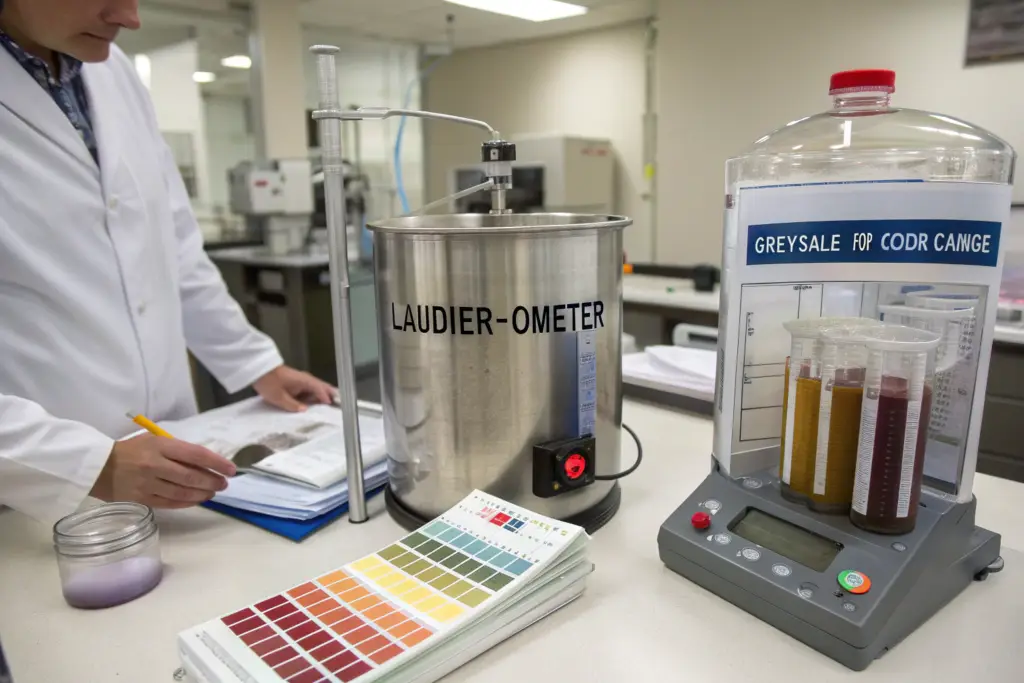
The Wash Fastness test (AATCC 61) uses a machine called a Launder-Ometer to simulate multiple home launderings in a short amount of time. A swatch of the dyed fabric is sealed in a canister with a standard detergent, steel balls for agitation, and a multi-fiber test strip. The canister is then subjected to a controlled temperature and time cycle. One 45-minute test cycle can simulate roughly five home machine washes. The change in the sample's color is graded against a "Grey Scale for Color Change," and any staining on the multi-fiber strip is graded against the "Grey Scale for Staining."
A brand we work with was developing a line of vibrantly colored activewear. They were about to approve a sample when our wash fastness test revealed that the color faded by 2 full shades after just a 3-cycle test. The dye was not suitable for the high-performance, frequent-wash environment of activewear. We worked with the mill to reformulate the dye. The new, more wash-fast color was a huge success with customers who praised how the garments "looked new after months of workouts." This is the value of a data-driven wash testing protocol .
What Is a Multi-Fiber Test Strip and Why Is It Crucial?
A multi-fiber strip is a narrow piece of fabric woven with strips of several different standard fiber types (e.g., acetate, cotton, nylon, polyester, acrylic, wool). It is sewn into the test sample during the wash test. It reveals whether the loose dye will stain other types of fabrics that the garment might be washed with. For example, a red cotton shirt might not fade much itself, but could bleed and stain a white nylon jacket in the same load. This test exposes that risk. This is a key part of our comprehensive color analysis .
What Is an Acceptable Wash Fastness Rating for a Quality Garment?
For a premium garment, you should expect a rating of at least 4 on the Grey Scale for Color Change and a 3-4 or higher for Staining. A rating of 4 means there is a slight color change that is only noticeable to a trained eye when compared directly to the original. A rating of 3 or below means the color change is noticeable to the average consumer and is generally unacceptable for a quality product.
What Other Colorfastness Tests Are Critical for Specific Products?
Crocking and wash fastness are the universal tests for all apparel. However, depending on your product's end-use, you may need to perform specialized tests to simulate other real-world conditions. A failure in one of these specific tests can be just as damaging as a laundry failure, as it represents a broken promise to your customer about the product's intended performance.
For specific product categories, additional colorfastness tests are essential. Activewear and intimate apparel must pass a Perspiration Fastness test (AATCC 15) to ensure the dye does not bleed when exposed to acidic or alkaline sweat. Swimwear and outdoor gear must pass a Lightfastness test (AATCC 16) to ensure the color will not fade quickly after prolonged sun exposure. Swimwear must also be tested for colorfastness to chlorinated water (AATCC 162). These tests verify the product's fitness for its intended purpose.
A swimwear brand we work with learned this the hard way early in their journey. They launched a beautiful line of neon swimsuits without performing a chlorine fastness test. After a few trips to the pool, their customers' vibrant bikinis had faded to a pastel, patchy mess. The returns were a flood. They now use only chlorine-resistant dyes and we rigorously test every single color in a chlorine bath before approval. Their current line is known for its fade-resistant quality. This is the value of end-use-specific performance testing .
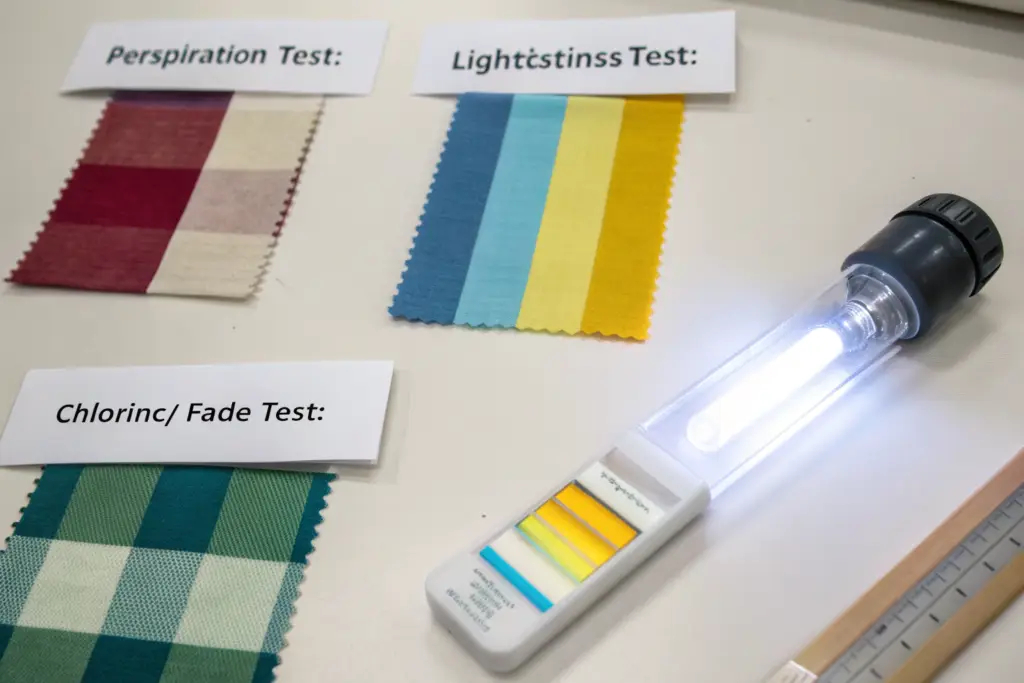
Why Is the Perspiration Test Crucial for Activewear and Intimates?
These products are worn directly against the skin and are exposed to sweat. Human sweat is a complex chemical solution that can react with certain dyes, causing bleeding or fading. The perspiration test simulates both acidic and alkaline sweat to ensure the color will not break down or stain the wearer's skin or other garments. This is non-negotiable for any product worn during exercise. This is a standard part of our activewear quality assurance .
How Is Lightfastness Tested and Why Does It Matter for Outdoor and Swimwear?
A garment left in a store window or worn on a sunny day should not fade. The Lightfastness test uses a powerful Xenon arc lamp to simulate weeks of exposure to natural sunlight in a matter of hours. The sample is partially covered, and the fade is evaluated against the unexposed original. A rating of 4 or higher is standard for quality apparel. This is essential for any product marketed for outdoor use. This is a key part of our performance fabric validation .
How Does Fumao's In-House Color Testing Protect Your Brand Before Production?
Colorfastness testing should never be an afterthought or a gamble. It must be a systematic, documented, and non-negotiable part of the pre-production process. Our in-house color lab is equipped to perform these critical tests quickly and provide you with objective, data-driven results that empower you to approve your bulk order with absolute confidence.
Fumao's in-house color testing protects your brand by making colorfastness a non-negotiable, documented pre-production gate. We perform Crocking, Wash Fastness, and other relevant tests on a swatch from your actual bulk fabric or on your final PP Sample. We provide you with a complete "Colorfastness Test Report" showing the numerical grades, not just a "pass/fail" opinion. If a fabric fails, we work with the mill to find a solution before a single bulk unit is cut. We ensure your colors are not just beautiful, but durable.
A new brand partner was incredibly anxious about the colorfastness of a dark, saturated wool they had chosen for a coat. Our lab performed all the relevant tests on their PP sample and provided a comprehensive report showing excellent grades across the board. The founder was visibly relieved. They told us, "That report was the most important document I received. It gave me the confidence to approve a huge bulk order. I knew the color wouldn't bleed or fade." That is the peace of mind we provide. This is the value of our quality assurance partnership .
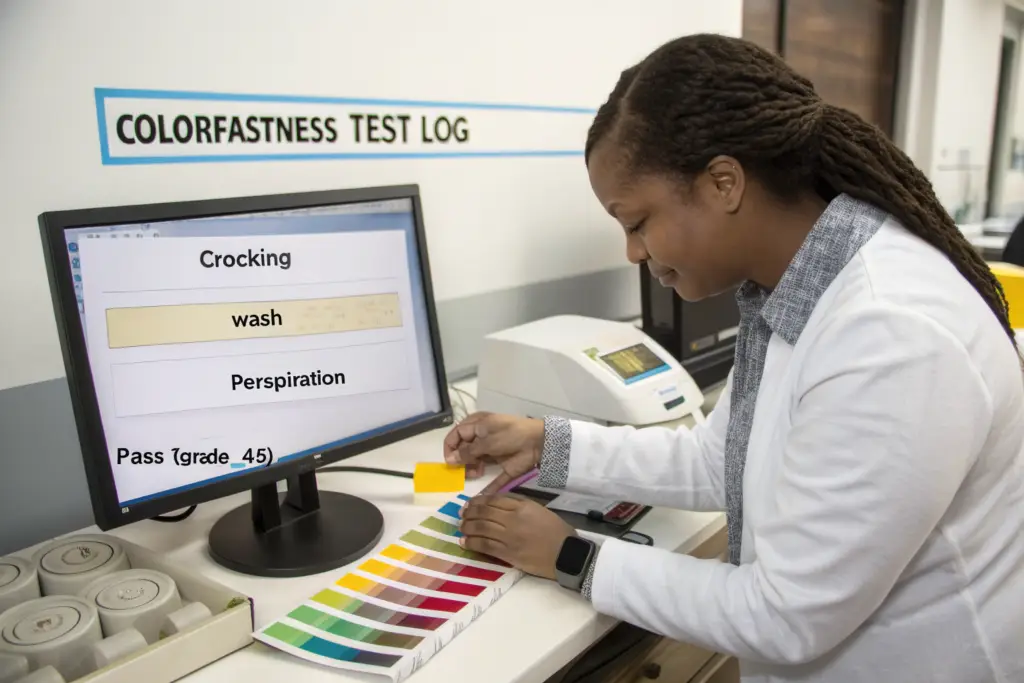
What Is Included in Our Standard "Colorfastness Test Report"?
Our report is a clear, data-driven document. It includes:
- The Test Methods Used: (e.g., AATCC 8 for Crocking, AATCC 61 for Wash).
- The Results: The specific numerical grade for each test (e.g., Dry Crock: 4.5, Wet Crock: 4.0, Wash Fastness: Color Change 4.5, Staining 4.5).
- The Standard: The minimum acceptable grade for your product category.
- A Clear Pass/Fail Assessment.
We provide you with the objective data, not just a subjective opinion. This is the standard of our transparent QC reporting .
What Happens If a Fabric Fails Our Internal Colorfastness Test?
We do not proceed. We immediately flag the failure to you, with the test data. We then work with the mill or dye house to diagnose the root cause and implement a corrective action. This might involve reformulating the dye, using a dye-fixing agent, or re-processing the fabric. We then re-test until the fabric passes. We never ship a product with a known colorfastness risk. This is our commitment to brand protection .
Conclusion
Testing the colorfastness of your sample garments is not an optional step; it is an essential, scientific investigation into your product's long-term durability. A color that bleeds or fades is a guarantee of customer disappointment and a direct threat to your brand's reputation. The Crocking, Wash, and other specialized tests are the tools that predict real-world performance and prevent a catastrophic quality failure.
At Shanghai Fumao, we make this scientific process a seamless, transparent, and non-negotiable part of our B2B service. Our in-house testing capabilities and our systematic approach to color quality ensure that the beautiful colors you design are the colors your customer enjoys, for the life of the garment.
If you want a manufacturing partner who treats color durability as a core science, let's talk. Our Business Director, Elaine, can walk you through our colorfastness testing protocols. Please email Elaine at: elaine@fumaoclothing.com.