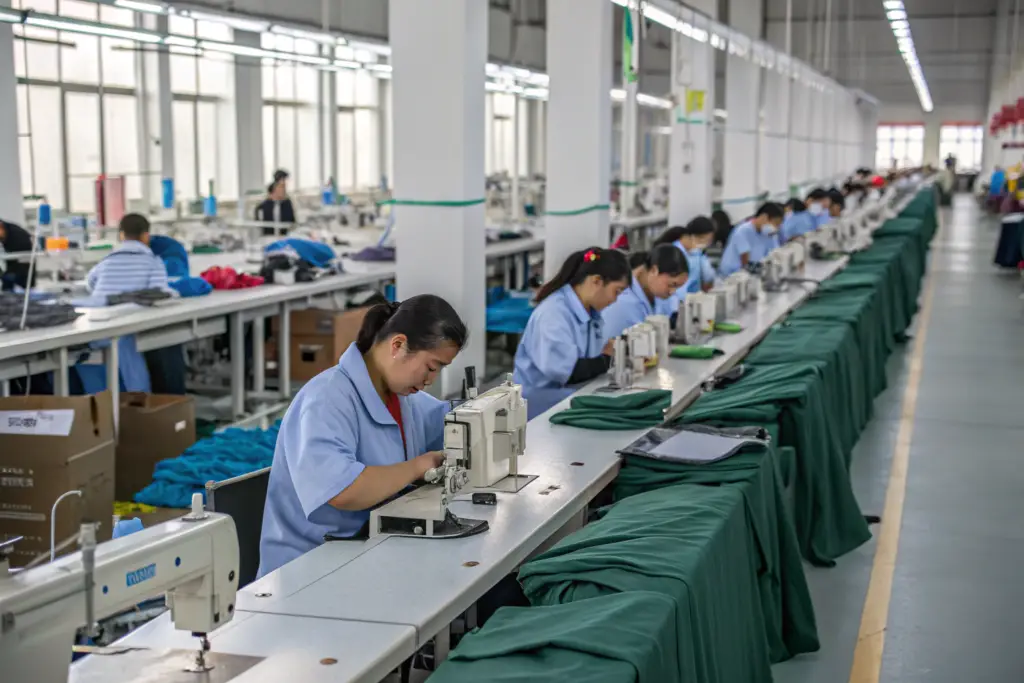
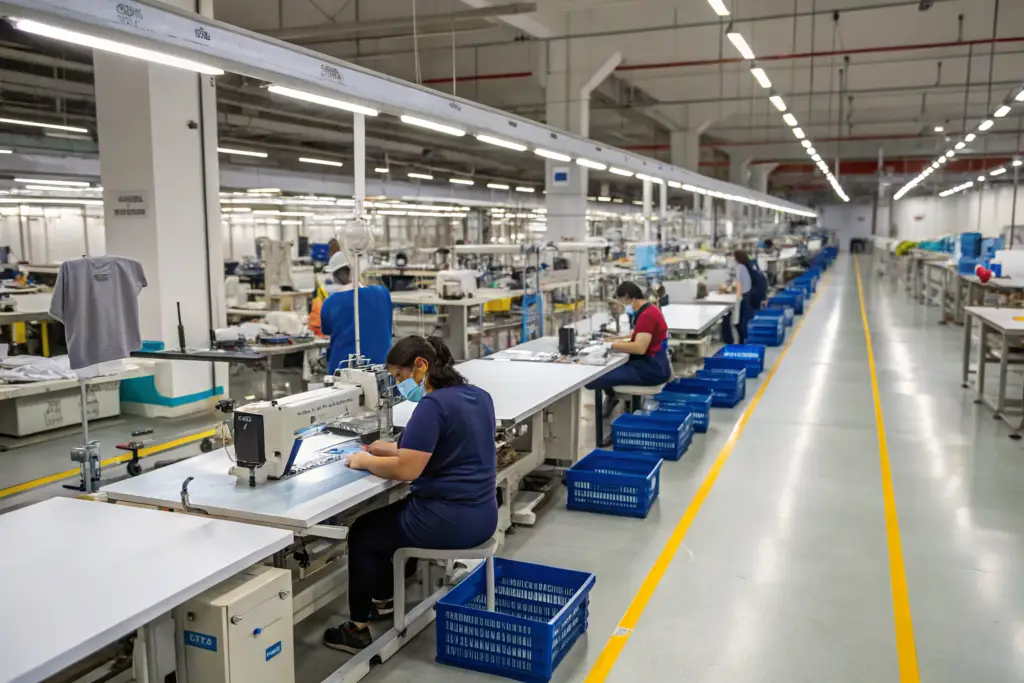
When a factory tells you they have "five production lines," it sounds like a sales pitch. I know. I used to think the same thing before I owned a factory. I thought: "So what? More machines just means more overhead." Then I tried to run a custom clothing business with just two lines. It was a disaster. A big order from one client would clog the whole system. Small orders from boutique brands would get pushed back for weeks. We were always late on something. Adding those third, fourth, and fifth lines did not just increase our capacity. It changed how we could schedule work. It is the difference between a one-lane country road and a five-lane highway. Traffic moves differently.
Five production lines guarantee faster custom clothing manufacturing because they enable "Parallel Processing" and "Line Specialization." Instead of one line stopping and starting to switch between a complex woven shirt and a simple T-shirt, the work is split. One line can be dedicated to a long-run basic order. Another line can be dedicated to a small-batch, high-detail custom order. A third line can be kept flexible for rush reorders. This structure eliminates "Changeover Time"—the silent killer of speed. Changeover time is when machines sit idle while workers re-thread machines and switch patterns. Five lines minimize this downtime.
This is not just about having more people. It is about having a smarter workflow. As the owner of Shanghai Fumao, let me show you exactly how those five lines translate into faster samples and faster bulk production for your brand.
How Does "Parallel Processing" Cut Lead Times in Half?
The traditional way to make clothes is in sequence. Cut everything. Then sew everything. Then finish everything. If you have one line, you do this in a single file. Your 500 units of Style A must be 100% finished before you can even start cutting the 200 units of Style B. That is slow.
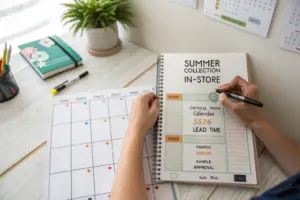
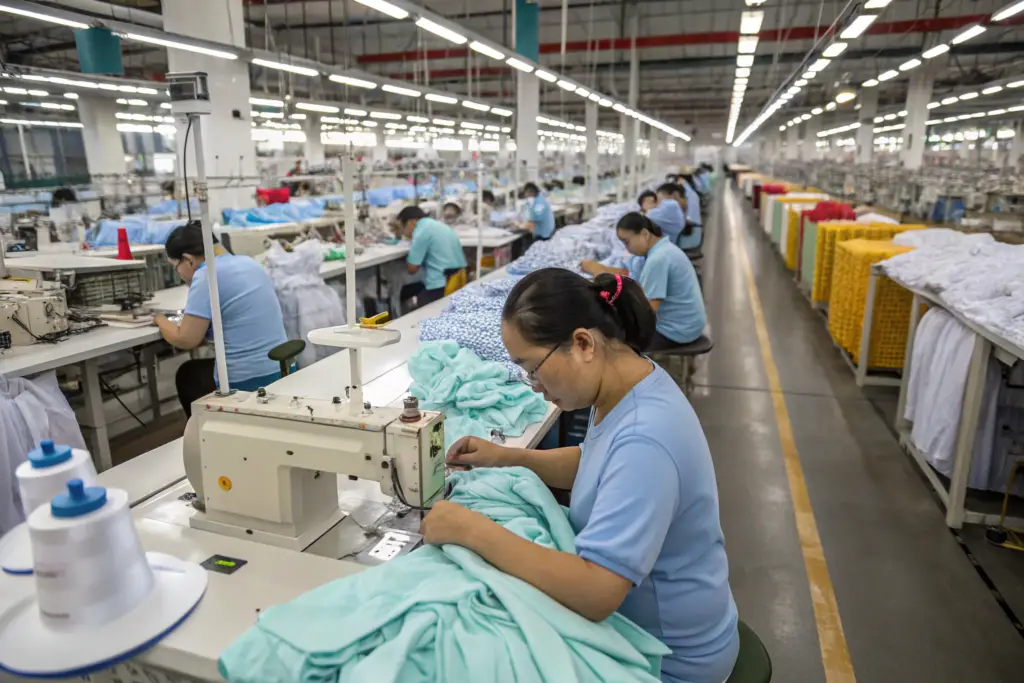
Parallel processing cuts lead times by allowing multiple orders to be in production simultaneously. At Shanghai Fumao, Line 1 might be sewing 1,000 units of a basic men's T-shirt. Line 2 is simultaneously sewing 300 units of a complex women's blouse with ruffles. Line 3 is in the middle of a 150-unit reorder for a hot-selling dress. Because these lines operate independently, the smaller order does not have to wait for the larger order to finish. It ships faster. This means we can promise a 4-week lead time on a reorder even while the factory is busy with a 10,000-unit program.
What is "Changeover Time" and How Do Five Lines Minimize It?
This is the most expensive time in a factory. It is when the machines are on, the lights are on, the workers are standing there, but no clothes are being made.
Changeover Tasks:
- Removing the previous color thread and re-threading 20 machines.
- Changing the needle type (from ballpoint for knits to sharp for wovens).
- Moving the pattern pieces and work-in-progress bins.
- Re-calibrating the stitch length.
Time Cost: 45 minutes to 2 hours per line.
The Single Line Trap:
If you have 1 line and 3 styles, you have 2 changeovers. You lose 2-4 hours of production time per day just switching tasks.
The Five Line Solution:
We dedicate lines.
- Line 1: Dedicated to Light Knits (T-shirts). Needles set for knits. Thread stays basic colors. Zero changeover for basic tees.
- Line 2: Dedicated to Wovens (Shirts). Needles set for wovens. Specialized fusing machines for collars. Zero changeover for woven shirts.
- Line 3: Flex Line. Handles the small custom batches and reorders. This is the only line that changes over frequently.
Because Lines 1 and 2 never stop, their output per hour is 20-30% higher than a factory that uses one line for everything. That efficiency is why we can offer faster turnaround without charging a rush fee.
At Shanghai Fumao, we track SAH (Standard Allowed Hours) . Our dedicated lines consistently beat the industry standard by 15% because they are not wasting time on setup.
How Does Line Specialization Improve Quality and Speed?
There is a common myth that speed kills quality. In a disorganized factory, yes. In a specialized factory, the opposite is true.
The Human Factor:
A sewer on Line 1 makes the same type of T-shirt neckline every day. She has done it 10,000 times. Her hands move automatically. She spots a twisted seam instantly. She is fast and perfect.
A sewer in a general line makes a T-shirt neckline this hour, a buttonhole next hour, and a zipper fly the hour after. She is slower. She makes more mistakes.
The Benefit for Your Custom Order:
When you place a custom order for 200 Hoodies, we do not put it on the T-shirt line (Line 1). We put it on the Flex Line (Line 3) with a team that specializes in small batch outerwear. They know how to handle the heavier fabric. They know how to set the tension for the hood seam. They do it right the first time.
This specialization means we do not have to re-do 5% of the order because of rookie mistakes. Re-doing work is the biggest cause of late shipments. By getting it right the first time, we actually ship faster even if the sewing machine runs a little slower.
Why Are Five Lines Essential for Handling "Mixed Order Quantities"?
This is the reality of custom clothing manufacturing. You are not a giant brand ordering 50,000 units of one black T-shirt. You are a growing brand. You need 800 units of Style A, 300 units of Style B, and maybe a rush reorder of 150 units of Style C. A factory with one or two lines cannot handle this mix efficiently. They will make you wait until they can "batch" your small order with someone else's.
Five lines are essential for mixed order quantities because they allow the factory to segregate "High Volume/Low Complexity" orders from "Low Volume/High Complexity" orders. The long-run lines (Lines 1 and 2) handle the bulk, keeping costs low. The short-run lines (Lines 3, 4, and 5) handle the smaller batches and reorders, keeping speed high. This structure allows a factory to be both a cost-effective bulk producer and a responsive custom shop under one roof.
How to Handle a "Rush Reorder" Without Disrupting the Main Production?
You have a hot seller. You need 200 more units in 21 days. You call a factory with 2 lines. They say: "We have a 2,000-unit order running. We cannot stop the line. We can slot you in 4 weeks." You lose sales.
The Five Line Reality at Shanghai Fumao:
- Line 1: Running 2,000 units of Client A. Does not stop.
- Line 2: Running 1,000 units of Client B. Does not stop.
- Line 3: Finished a job yesterday. Sitting idle or on maintenance for 2 days.
- Action: We move your 200-unit reorder onto Line 3.
Result: Client A and B are unaffected. They get their goods on time. You get your reorder in 2 weeks because Line 3 was available. Everyone is happy.
This is the value of Slack Capacity. A factory running at 100% utilization on 2 lines is a fragile factory. A factory running at 80% utilization on 5 lines is a resilient, responsive factory. We keep that extra capacity precisely so we can say "Yes" to rush reorders.
I have a client who built her entire business model on this. She does small initial runs. She tests the market. When she gets a winner, she needs a reorder immediately. She came to us because her previous factory made her wait 8 weeks for reorders. With us, she gets them in 3-4 weeks. That speed allows her to capture the trend before it fades.
What is "Cellular Manufacturing" and How Does It Apply to Custom Orders?
This is a modern production technique that works beautifully with the 5-line model, especially for small custom orders.
Traditional Line (Progressive Bundle):
One worker sews the shoulder. The next sews the sleeve. The garment moves down a long line of 20 people. Problem: If one person is slow or makes a mistake, the whole line stops.
Cellular Manufacturing (Used on Lines 3, 4, 5 at Shanghai Fumao):
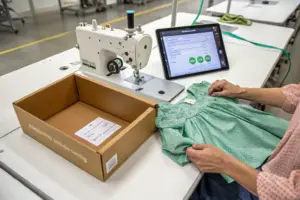
We group 4-5 cross-trained workers into a "Cell." This small team takes one garment from cut pieces to finished product. They stand in a U-shape and pass it among themselves.
The Advantage for Custom Work:
- Speed: The garment does not travel 100 feet down a line. It moves 5 feet in a circle. Throughput time drops by 50%.
- Quality: The team sees the whole garment. They take pride in it. If there is a custom detail, they all know about it.
- Flexibility: You want 50 units of a complex dress? We set up one Cell. You want 50 units of a simple top? We set up a different Cell. We can run multiple small batches at the same time on different lines.
This is how we achieve "Fast Fashion Speed with Custom Quality." It is the secret weapon of a multi-line factory.
How Do Five Lines Protect Against Supply Chain Disruptions?
What happens if a key worker gets sick? What happens if a machine breaks down? In a one-line factory, production stops. In a five-line factory, production shifts.
Five lines protect against disruptions by providing built-in redundancy. If a critical machine on Line 1 fails, we do not shut down the factory. We re-route the cut pieces to Line 4, which is set up for similar work. Or we borrow a worker from Line 5 to cover the absentee on Line 2. This operational flexibility means that a localized problem does not become a systemic delay. The larger number of lines provides a buffer of both equipment and skilled labor.
What Happens When a Machine Breaks Down in a Small Factory?
In a small factory, there is one specialized buttonhole machine. It breaks. The mechanic takes 4 hours to fix it. The entire line stops because garments cannot be finished without buttonholes. You lose a day of production. That day might mean missing the Friday vessel cutoff.
The Five Line Solution:
At Shanghai Fumao, we have multiple buttonhole machines spread across the lines. If the machine on Line 1 breaks, the operator on Line 4 (who is on a different schedule) can run the buttonholes for Line 1 during her downtime. We do not lose a day. We might lose 30 minutes of coordination time.
The Worker Absenteeism Factor:
In any factory, on any given day, 5-10% of workers might be out sick or on leave. In a 20-person line, losing 2 people is a 10% slowdown. In a 100-person, 5-line operation, we can shift 1 person from a slower line to a busy line to balance the workflow. We call this "Line Balancing."
This is a daily routine for our production manager. Every morning at 8:30 AM, she walks the floor. She looks at the attendance board. She moves 2 or 3 workers to ensure every line hits its hourly target. This proactive management is only possible because we have the depth of staff across five lines.
How Does "Cross-Training" Across Five Lines Create a Super-Team?
We invest in training our sewers to work on different types of machines. A sewer on Line 1 might be an expert at the Overlock machine. But we also train her on the Single Needle machine used on Line 3.
The Benefit for Your Order:
When we get a rush custom order that needs a specific skill set (e.g., attaching a delicate lace trim), we do not hire a temp. We pull the "A-Team" from across all five lines. We assemble a temporary super-cell of the best lace sewers in the factory. They knock out your 200-unit order in record time. Then they go back to their regular lines.
This is a level of agility that a small factory simply cannot match. They have one team. If that team is busy, you wait. Our depth of talent across five lines means we can always find the right person for the right job at the right time.
Conclusion
Five production lines are not just a number on a brochure. They are the engine that drives speed, flexibility, and reliability in custom clothing manufacturing. They allow us to process multiple orders in parallel without the costly delays of constant changeovers. They allow us to segregate large bulk orders from small custom batches, ensuring that neither type of client suffers from delays. And they provide the operational redundancy to absorb the daily disruptions of factory life without missing a shipping deadline.
When you are choosing a manufacturing partner, look beyond the price per unit. Ask about the factory's structure. Ask how many lines they run and how they use them. A factory with a thoughtful, multi-line setup is a factory that can scale with you. It is a factory that can handle your first 200-unit test order and your 5,000-unit reorder with equal competence.
At Shanghai Fumao, those five lines are the reason we can promise the lead times we do. They are the reason we can accept rush reorders when other factories say "No." They are the backbone of our commitment to being a true partner in your growth.
If you are looking for a manufacturing partner who has the capacity and the system to keep your brand moving fast, I encourage you to reach out to our Business Director Elaine. She can explain exactly how we would slot your specific project into our production calendar and give you a realistic, rapid timeline. Her email is elaine@fumaoclothing.com. Let's get your line moving.