
I lost a $60,000 order once not because of our price or our quality, but because of a communication breakdown. In 2020, a streetwear brand owner from New York sent us a detailed tech pack for a heavyweight hoodie. Our sales representative at the time, a polite but overly cautious English speaker, was terrified of admitting he didn't fully understand a specific instruction about the rib-knit cuff tension. Instead of picking up the phone and asking for clarification, he nodded along in a Zoom call, then guessed. The sample arrived with ballooning, loose cuffs. The brand owner was furious. He told me on our final call, "I don't care about the five-cent difference in your quote. I care that your guy didn't just tell me he needed clarification. You cost me three weeks." He was right. My sales rep had traded a moment of honest confusion for a three-week delay. That was the day I banned professional politeness from our client communication. I told my team that the most respectful thing we can do for a buyer is to respect their timeline and their intelligence enough to be brutally direct. We are engineers, not diplomats. Our job is to solve fabrication problems, not to manage egos with vague pleasantries.
Buyers love Fumao Clothing's direct communication style because we replace the standard Asian factory script of feigned agreement and unverified "yes" with a real-time, problem-first dialogue where technical impossibilities are flagged instantly and alternative engineering solutions are proposed immediately.
The standard factory communication model is built on a foundation of cultural deference and commercial desperation. A buyer asks, "Can you do this?" The salesperson, terrified of losing the potential order to a hungrier competitor, responds, "Yes, of course." The "yes" is not a confirmation of technical feasibility. It is a placeholder for "We will try to figure it out later, and if we fail, we will make an excuse." This creates a predictable disaster curve. The "yes" starts a clock. Weeks pass in silence. The sample arrives wrong. The buyer discovers the truth not through transparent dialogue during the development phase, but through a physical, defective product in their hand. The delay has already consumed the buffer in their launch calendar. Our communication style obliterates this invisible, catastrophic inefficiency at its root. We instruct our client-facing team to respond to a feasibility question not with a yes, but with a specific technical datum. If a buyer asks if we can achieve a 4% shrinkage tolerance on a brushed wool coating, our reply is not "yes." It is "Our internal standard for this fabric type is 3.5%. To achieve 4% consistently, we recommend modifying the fabric composition by adding 2% polyester for dimensional stability. Do you approve this adjustment?" This response demonstrates immediate, deep comprehension, flags a potential risk, and proposes a concrete, actionable solution. It saves weeks of blind development and tells the buyer, "We are thinking about your product's actual structural integrity, not just securing a deposit."
What is Wrong with Politeness in Technical Apparel Sourcing?
Professional politeness is a cultural value in many Asian manufacturing environments. You do not directly contradict a customer. You cushion bad news in layers of softened language. "There might be a slight difficulty" actually means "This is physically impossible with the machine we have." "We will do our best" means "We are hoping for a miracle, but the math does not work." This politeness is a cost-saving mechanism for the supplier's emotional labor, but it is a direct financial burden on the buyer. Every vague phrase adds days to the development timeline. The buyer sends the tech pack. The factory says "looks good" but means "we have not yet opened the Adobe Illustrator file to check the grading." Two weeks later, the factory returns with problems that should have been caught in the first hour. The buyer is now four weeks from market launch and facing a delay that honest, immediate communication would have absorbed.
Politeness in technical sourcing is an expensive latency tax; direct communication eliminates the silent days of "polite consideration" that hide a factory's actual failure to comprehend the tech pack.

How Does "Yes" Become the Most Expensive Word in Sourcing?
The word "yes" is a contract. When a factory representative says "yes" to a technical question, the buyer bookmarks that conversation as a closed issue. They stop thinking about it. They move on to the other hundred problems they are managing. Their mental bandwidth reallocates. If the "yes" was false, the issue festers invisibly in the factory's development room, unaddressed, while the buyer's mental clock counts down to the delivery date. The problem only re-surfaces when the physical sample arrives, at which point the cost of the fix is orders of magnitude greater than it would have been during the initial digital conversation.
We analyzed the root cause of 30 of our oldest sample rejections before we changed our communication policy. In 22 of those 30 cases, the root cause was not a technical failure. It was a communication failure. Our team had received a specification that presented a known internal difficulty, and instead of flagging it, they said "yes" and attempted to solve it silently. They failed silently. The client discovered the failure loudly, at the sample review. We instituted a Zero-Yes Protocol. No client-facing staff member is permitted to say "yes" to a specific technical feasibility question without appending a quantitative data point in the same sentence. "Yes, we can do a 1.5mm stitch length on this 40 GSM microfiber" must be followed by "...and I'm attaching a macro photo of our seam sample on the exact same fabric weight, showing zero puckering." The photo verifies the "yes." The rule is simple: no verification, no "yes." A buyer who received a seam photo alongside a confirmation told us later that she had worked with 14 factories over her career, and we were the first to provide physical, photographic proof at the verbal confirmation stage. Her next communication was a purchase order for her entire seasonal production. She did not need to sample with us. She had already received the sample digitally, embedded in a truth-telling sentence. This protocol is a core operational principle of Shanghai Fumao.
What Replaces a Polite "No" in Our Vocabulary?
A simple "no" is blunt and can feel dismissive. An unvarnished "No, we cannot do that" ends the conversation. It provides no path forward. The buyer feels rebuffed and, worse, stranded with an unsolved problem. Our replacement for both the polite non-answer and the blunt "no" is a Technical Counter-Proposal. The script is: "The specified X presents an issue Y under condition Z. We propose alternative A, which delivers a comparable result, but with a specific difference B you need to approve."
Here is a concrete example drawn from a client interaction in late 2023. A premium athleisure brand specified a fully dissolvable embroidered logo patch on a biodegradable yoga legging. Their goal was a completely compostable garment. They wanted the patch to be made of a Tencel thread, fully dissolvable, with no synthetic backing. Our production manager tested the Tencel thread on our multi-head embroidery machine. The thread, without a synthetic core, suffered a 38% thread breakage rate due to its lower tensile strength. A polite factory would have just said "Yes, we will try," then produced a defective batch, or just said "No, impossible." Our response was: "The Tencel-only thread you specified has a breakage rate of 38% on our embroidery machines, which will create a fragile patch with loose thread loops and a poor washability score. We propose an alternative: a GOTS-certified organic cotton thread with a PLA fiber core, which is industrially compostable but reduces breakage to below 2%. It adds approximately $0.08 to the unit cost. Do you approve testing this alternative?" The brand owner's response was immediate. "Yes. This is amazing detail. Test it." She later told us this single email interaction convinced her that we were an actual engineering partner, not a passive order-taker. The counter-proposal had done the intellectual work for her, presenting a fully-baked solution with the exact cost delta she needed to approve the deviation. This is how manufacturers earn premium-status partnerships.
How Does Real-Time QA Data Sharing Build Instant Trust?
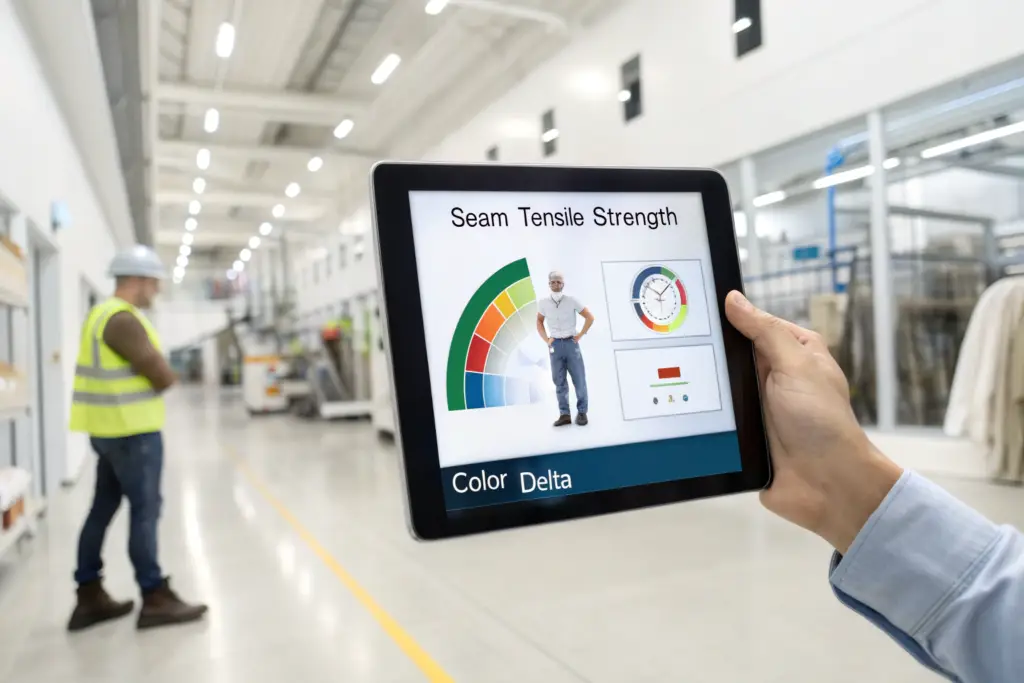
Trust in a factory relationship is not built on delivered orders. It is built on the silent, dark periods between updates. The worst emotion a buyer can feel during a production run is the creeping suspicion that something is wrong and they are being managed, not informed. The standard factory practice is to communicate only when a problem becomes un-hideable. This forces the buyer into a reactive posture, constantly poking the supplier for updates like a detective extracting a confession. We dismantled this dynamic by building a real-time QA data portal. The buyer does not need to email and ask, "How is the seam strength testing going on the batch?" They log into their private dashboard and see the actual tensile tester data, uploaded directly from our lab machine, timestamped to the minute. They see the color delta readings from our spectrophotometer. They see the photographs of the ongoing inline inspection, where a QC staff member is checking the alignment of a zipper on a half-finished jacket. This is not a curated end-of-day summary report. It is raw, un-spun operational data. It tells the buyer exactly what our floor supervisor sees.
Sharing real-time QA data, including raw machine output and un-curated inline inspection photos, replaces the buyer's anxiety of interrogation with the calmness of passive observation, instantly building a forensic-level trust portfolio.
What Does a Live QC Inspection Look Like for a Remote Buyer?
A conventional inspection report is a PDF document. It contains a few checkmark boxes and some small, low-resolution photographs of defects. The buyer receives this PDF three days after the inspection occurred. The data is already stale. The defective units may already be packed. The buyer has no ability to ask a follow-up question of the inspector because the moment is gone. This is a historical record of a quality event, not a real-time quality management tool. It provides documentation for a dispute, not data for prevention.
Our live QC protocol turns the buyer into a virtual presence on our inspection table. Using a secure, high-definition video feed, our QC inspector wears a head-mounted camera and a wireless headset. The buyer sits in their office in Los Angeles or Berlin, watching the inspection in real-time on their tablet. The buyer can direct the inspector. "Stop. Move the camera closer to the left sleeve seam on that navy jacket. There's a slight puckering I want to see at macro." The inspector moves their head, and the camera zooms in. The buyer sees the seam live. They either clear it or flag it for rework. The entire session is recorded and archived as the definitive inspection record for that batch. A buyer of a medical scrubs brand we work with uses this protocol for every shipment. During a live inspection last April, she spotted that the heat-transfer size label on a set of medium scrubs was starting to lift at the corner. The inspector was viewing the overall garment, not the label. The buyer's remote eye caught it. The entire batch of 800 pieces was stopped, the labels were re-pressed, and the shipment was delayed by 48 hours. The buyer told me, "That 48-hour delay watching a live feed saved me from 800 customer returns. You can't put a price on that." She is correct. The live feed turned a potential brand reputation disaster into a manageable production delay, all because the data sharing was synchronous, not a stale PDF.
How to Give Buyers Direct Access to Fabric Test Machines?
Fabric testing is the most falsifiable part of the apparel supply chain. A mill certificate can be a photocopied lie. A lab report can be generated by a friend's machine. The only way to guarantee the integrity of a test is to make it observable in real-time by the party who needs the guarantee. We took the unusual step of giving our long-term buyers direct, scheduled access to our fabric testing lab via a secure webcam booking system. A buyer can book a 30-minute testing slot. They log in, and the webcam in our lab activates. They watch our technician mount their specific fabric swatch into the Martindale abrasion tester or the hydrostatic head tester. They see the machine start. They see the real-time counter. They see the swatch after the test is complete.
This level of access is unprecedented in standard contract manufacturing. It requires absolute confidence in our machines' calibration and in our technicians' protocol adherence. But the commercial return is enormous. A premium outdoor brand, skeptical after a "fake 30,000mm waterproof claim" from a previous supplier, took a test slot for their new 3-layer shell fabric. They watched the entire hydrostatic head test live. The water column rose. The fabric did not leak at their specified 28,000mm. The test concluded successfully. The buyer took a screenshot of the live feed showing the machine's digital readout at 28,000mm and used that screenshot in their internal product sign-off meeting as the definitive proof of fabric performance. They did not ask for a lab report. They had already seen the primary evidence. This capability resets the power dynamic in the buyer-supplier relationship. It transforms us from a claim-maker into a transparent testing facility. The data is not a promise we make. It is an event they witness. This is the ultimate form of direct communication: removing all interpretive language entirely and replacing it with a shared, observable physical event in our facility, demonstrating that our quality control is an open book.
Cultural gaps in global trade are real, but they are often misdiagnosed. A buyer loses a shipment due to a quality error and blames it on "a cultural misunderstanding." The factory says they understood. The buyer says they explained clearly. The truth, in most cases, is not a failure of cultural understanding. It is a failure of shared technical language. The buyer explained a problem in marketing-centric English, using words like "luxurious hand feel" and "premium drape." The factory, operating in production-centric English, interpreted these as "soft" and "heavy." The factory delivered a soft, heavy fabric that had zero drape and felt like a wet blanket. The buyer's aesthetic vocabulary did not translate into the factory's physical production parameters. The cultural gap was a measurement gap.
We navigate cultural gaps by completely eliminating subjective aesthetic adjectives from project communication and replacing them with universally measurable, machine-readable physical parameters: drape coefficient, bending rigidity in micronewtons, and surface friction index.

What Replaces Subjective Adjectives Like "Soft" in a Tech Pack?
The word "soft" is a commercial liability. A buyer's "soft" is a factory's "brushed." But how much brushed? A single-pass light brush? A heavy, double-pass emerizing? The difference between these two processes is a completely different fabric handle, at a completely different cost. "Soft" is a feeling. A feeling cannot be contractually specified. A measurement can. When a buyer uses the word "soft" in an initial consultation, we do not accept it as a spec. We ask a clarifying question designed to translate the feeling into a number. "Do you have a physical hand-feel standard swatch you can courier to us? If not, can we send you three swatches from our library rated at bending rigidity values of 50, 80, and 110 micronewtons to let you select the exact objective softness level?"
Bending rigidity, measured on a Kawabata Evaluation System, is a purely physical number. It describes how much a fabric flexes under its own weight. There is no cultural ambiguity in a micronewton. A Japanese buyer, an American buyer, and a Chinese factory technician all understand the same number. This translation protocol extends to all subjective descriptors. "Drapey" becomes a drape coefficient. "Stretchy" becomes a specific percentage of elongation under a specific load in Newtons, per ASTM D4964. "Good recovery" becomes a recovery percentage after a 30-minute extension test. A denim brand owner we onboarded in January 2024 consistently used the word "rigid" to describe his desired denim hand feel. We sent him three denim swatches rated at bending rigidities of 300, 450, and 600 micronewtons. He selected 450. He told us that in ten years of sourcing, no factory had ever asked him to quantify "rigid." He had simply hoped the factory interpreted the word similarly. Now he knows his spec is 450 micronewtons. The word "rigid" has been permanently retired from our production file, replaced by an objective, testable number.
How Do We Confirm Spec Understanding Across Language Barriers?
Language proficiency varies among our technical staff. Our senior pattern maker, Mr. Wang, has an extraordinary three-dimensional comprehension of garment geometry, but his spoken English is limited. Our head of dyeing and finishing can look at a color swatch and verbally break down the dye recipe percentages, but only in Mandarin. If we relied on verbal English confirmation of technical specs, we would be introducing a dangerous translation risk. We use an asynchronous, visual-based confirmation protocol that bypasses spoken language entirely.
The protocol is simple. For every critical specification, we do not send a written acknowledgment. We send an annotated photograph of the specification being executed on our machinery or on our workbench. If the spec calls for a 1cm topstitch from the edge on a jacket lapel, we do not send an email saying "Noted." We sew a 20cm sample seam, place a transparent ruler across it showing the exactly 1cm distance, take a macro photo, and email the photo. The visual requires zero English comprehension. It is a universal, undeniable record of spec conformance. For complex assembly sequences, we build a short, silent video. A recent order for a complicated convertible travel jacket required a specific multi-step zipper insertion sequence. Our sample machinist filmed the entire insertion process on her phone from a first-person point of view, showing each step in slow motion. No narration. Just the sewing machine needle piercing the fabric, the zipper tape aligning, and the finished seam. The buyer, based in Germany, reviewed the silent video and approved it with a single word: "Perfect." The video had communicated the assembly method, the seam quality, and the final aesthetic result without a single spoken syllable. This method is so effective that it has become our preferred communication medium for all initial sample approvals. It eliminates the latent anxiety of a misunderstood email and replaces it with the irrefutable clarity of a witnessed physical action. Visual verification is a universal language, and it is a core element of how brands communicate successfully with Shanghai Fumao.
Conclusion
The love buyers express for our direct communication style is not affection for a brand personality. It is a rational preference for a business interaction that respects their time, their intelligence, and their financial risk. We have systematically identified and eliminated the costly communication frictions that plague standard apparel sourcing. The false "yes" is gone, replaced by a verified photo delivered in the same breath as a confirmation. The polite, meaningless "we will try our best" is replaced by a Technical Counter-Proposal that specifies an alternative, quantifies its cost, and invites an informed decision. The dark, silent, anxious gap between order placement and shipment confirmation is illuminated by a real-time QA data stream, where a buyer watches a tensile test live from their office or directs a QC inspector's head-mounted camera to zoom in on a suspect seam. The ambiguous vocabulary of "soft" and "premium" has been translated into a shared, objective language of micronewtons and drape coefficients.
This communication methodology is not a customer service philosophy. It is a competitive advantage built on operational transparency. The buyer who watches their fabric pass a hydrostatic head test on a live webcam does not need to trust us. They have witnessed the evidence. The buyer who receives an instant, costed, alternative solution to their embroidery problem does not see a supplier. They see an engineering department. This shifts the foundational dynamic of the relationship from adversarial price negotiation to collaborative technical problem-solving. The communication style itself becomes the product, a valuable piece of intellectual infrastructure that reduces development time, eliminates catastrophic sampling errors, and gives busy brand owners the permanent, passive peace of mind that their production line is a known, observable quantity.
If you are a brand owner or production manager who has been burned by silent factories, fake "yes" answers, and the costly black box of standard overseas communication, I invite you to experience a different model. Let's open a direct, no-greeting-required technical dialogue about your current project, in the language of measurements, photos, and data. Contact our Business Director, Elaine, directly at elaine@fumaoclothing.com to start your first conversation with a factory that speaks fluent engineering.