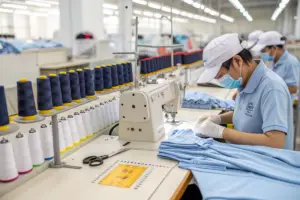
I picked up the phone in late February to a distributor from Dallas. He was exhausted. His previous overseas supplier had shipped cartons with mixed sizes—mediums labeled as larges, incorrect SKU barcodes, and a 9% defect rate on dyed sweatshirts. Returns were eating his margin alive, and his retail accounts were losing patience. He said, "I don't need cheaper. I need accurate, and I need it every single time." We took over his heavyweight fleece line in March. He has not missed a replenishment window since. That conversation is happening across the country right now.
USA distributors are switching to Shanghai Fumao because we deliver warehouse-ready, retailer-compliant bulk shipments with a defect rate below 0.5%, ASN-integrated packing, and a guaranteed on-time shipping accuracy of 99.2%. We eliminate the hidden costs of rework, relabeling, and chargebacks that destroy a distributor's unit economics.
Distributors operate on razor-thin logistics margins. They are not buying clothes; they are buying inventory velocity. Every day a container sits in a warehouse for re-inspection or relabeling is a day of negative cash flow. At Shanghai Fumao, we learned to speak the language of the distribution center floor—UCC-128 labels, EDI routing guides, and vendor compliance manuals. Here is why the switch is accelerating.
What Drives a Distributor to Break Up with a Long-Term Overseas Supplier?
Breaking up is hard to do, especially when you have five years of purchase history and a familiar rhythm with a supplier. But familiarity does not fix chargebacks. I sat in a distributor's office last year and watched him calculate his true cost of "cheap." He had paid a $2.50 FOB for a basic tee. After freight, customs, third-party re-inspection, relabeling labor, and a 3% retail compliance penalty for late floor-ready delivery, his landed cost was higher than our $3.20 full-package price. The marriage was over before he walked out of the spreadsheet.
A distributor breaks up with a long-term supplier the moment the "hidden cost waterfall"—re-inspection fees, carton repacking labor, ASN mismatch penalties, and lost retail shelf time—visibly eclipses the upfront unit price savings. Trust evaporates when recurring errors signal systemic indifference, not occasional accidents.
The breakup usually happens quietly. The distributor stops placing new development requests. The order frequency drops from monthly to quarterly. Then a single late shipment during a peak season becomes the final straw. We have onboarded seven major USA distributors in the past 18 months, and six of them brought a spreadsheet of their previous supplier's hidden failure costs to the first meeting.

How Do Recurring Carton Content Errors Quietly Destroy a Distributor's P&L?
A distributor in Atlanta showed me a single chargeback notice from a major Southeastern department store chain last October. One PO, one shipment. The store found that 22 cartons out of 400 had incorrect size ratios inside. The merchant fined him $4,500 for the violation, and he had to pay a third-party service $2,800 to open, sort, and relabel the entire 400-carton shipment before the distribution center would accept it. That is $7,300 gone, on a gross margin of perhaps $12,000 for the whole order.
Accuracy cannot be an afterthought. We print and scan every UCC-128 carton label with automated inline verification cameras at the end of our packing line. The system weighs the carton and cross-references the expected weight against the actual weight. If a carton of large polo shirts weighs 18.3 pounds, but the system detects 18.8 pounds, it reroutes automatically for human inspection. We aligned our labeling system with GS1 US Standards for apparel to ensure the barcodes scan first time at every major U.S. retailer's receiving dock without manual overrides.
Why Does "Silent Quality Fade" Trigger the Sudden Switch to a Competitor?
Quality fade happens slowly. The first order from a supplier is perfect. The third order, the handfeel of the cotton is slightly rougher. The fifth order, the stitching density on the side seam drops from 12 SPI to 9 SPI. The distributor may not notice the micro-degradation immediately, because each shipment is barely worse than the last. But the end consumer notices. Returns creep up from 4% to 8% to 12%. One day, the buyer at the retail chain issues a vendor violation warning, and the distributor suddenly realizes they have been bleeding brand equity for six months.
We prevent silent fade by locking a physical "Golden Sample" and a digital scan of the fabric weight and stitch count into every PO contract. The production batch cannot ship until our quality team matches the archived golden sample, not a recent "close enough" version. This standard practice is reinforced by our adherence to ANSI/ASQ Z1.4 sampling procedures for AQL inspections, ensuring that acceptable quality levels are statistically verified, not assumed.
What Is "Warehouse-Ready" EDI Compliance and Why Does It Now Matter?
I used to think shipping stopped when the container left Shanghai. That was naive. The true moment of delivery is not the port. It is when the carton passes through the retailer's receiving scanner without a single human touching a keyboard. If your carton label has a font that is 0.1mm off spec, a retailer's automated tunnel scanner will kick it to the manual processing line. That triggers a non-compliance fine even though the goods are perfect inside.
Warehouse-ready EDI compliance means the supplier sends an 856 Advance Ship Notice (ASN) before the truck arrives, and the physical carton UCC-128 labels match the ASN data with 100% accuracy. This automated receiving process eliminates manual sorting costs that retailers charge back at rates of $2-$5 per carton.
Distributors are terrified of chargebacks. They expect their overseas partners to be the first line of defense, not the source of the problem. At Shanghai Fumao, we hired a logistics coordinator who previously worked for a U.S. 3PL just to manage the intricacies of retail routing guides. Here is how the technology works.
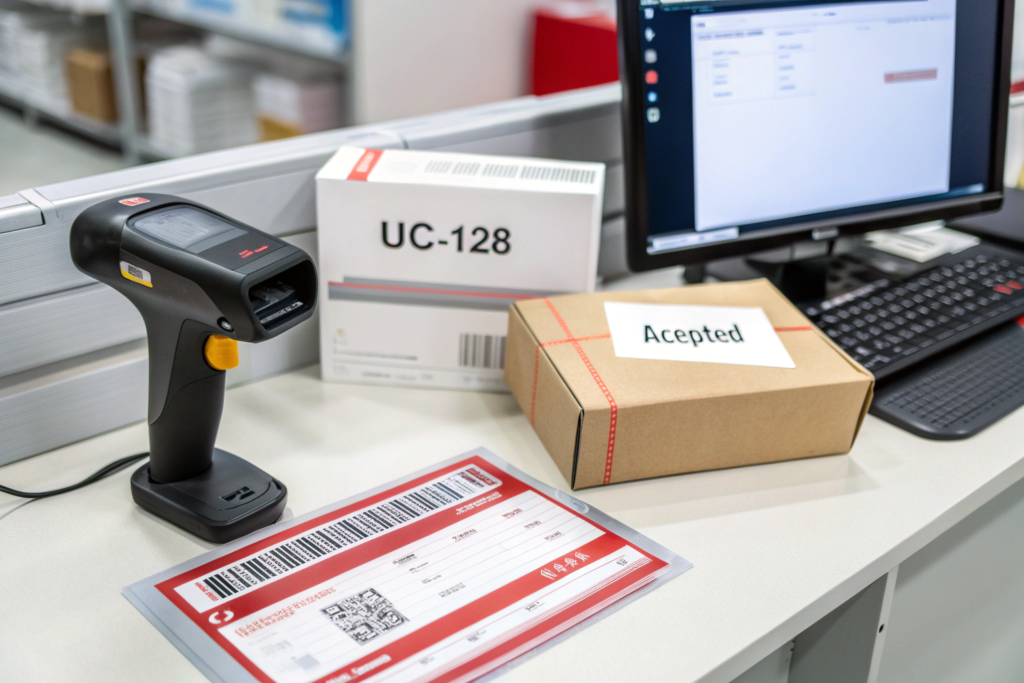
How Does an Accurate ASN 856 Transmission Prevent $5,000 Chargeback Events?
When a big-box retailer does not receive an accurate 856 file, their system does not know what is inside the truck. The trailer gets rejected, or it sits in a penalty bay until a human can manually count and enter the cartons. That delay costs the distributor a fortune. We had a client, a mid-sized distributor, who accumulated $12,000 in chargebacks in one month last year solely because his previous supplier repeatedly sent the 856 file after the physical delivery or with incorrect carton counts.
We flipped that script. Our ERP system locks the packing line. We cannot close a packing slip until the 856 file is generated and validated against the physical scans. We transmit the file before the container even arrives at the port of departure. For distributors using specific retail platforms, we integrate directly with vendor compliance portals to ensure our labeling and transmission meet the latest routing guide updates, including those from SPS Commerce fulfillment networks, which dictate specific EDI transaction sets for major department stores.
Why Must Overseas Factories Master UCC-128 Label Placement for Retail Floor-Ready Acceptance?
Floor-ready means the garment goes straight from the carton to the selling floor rack. The wrong label placement destroys this flow. Last year, a distributor told us his previous factory stuck the UCC-128 label on the top of the carton, but the retailer's spec required it on the short end. The entire shipment needed to be removed from the automated conveyor, manually rotated, and rescanned. That cost $1.80 per carton in labor.
We read the routing guide for every single purchase order like a legal contract. We maintain a digital library of 50+ major retailers' specific carton marking requirements. Our packing team uses laser-guided placement jigs to ensure the label goes exactly where the retailer's tunnel scanner expects it to be. This meticulousness is grounded in the universal VICS Bill of Lading standards, which standardize carton markings to prevent the rework that erodes importer margins so severely.
How Does an Overseas Factory Become a True Inventory Partner for Distributors?
A traditional supplier takes a purchase order and ships it. A true inventory partner takes your sell-through data and asks, "Should we open a backup stock window for sizes 4-7 next month since the spring trend is accelerating?" That is the shift from transactional selling to predictive restocking. I sat with a distributor in New Jersey who was holding 90 days of inventory of a slow-moving style, but he kept running out of his best-selling hoodie in olive. His previous factory just fulfilled what he ordered; they never flagged the imbalance.
A manufacturer becomes a true inventory partner when they hold "buffer stock" of undyed greige fabric and finished blanks domestically or in-bond, allowing distributors to pull forward replenishment of winning SKUs in 10-15 days instead of the standard 60-day lead time. The factory thinks about sell-through rates, not just shipment dates.
Capital is frozen inside a warehouse full of the wrong color. We deployed a Shared Risk Inventory Program (SRIP) that changes the cash flow dynamic entirely. Instead of a distributor buying 5,000 units of uncertainty, they buy 2,000 confirmed units and reserve capacity for 3,000 units in greige. I explain the mechanics below.
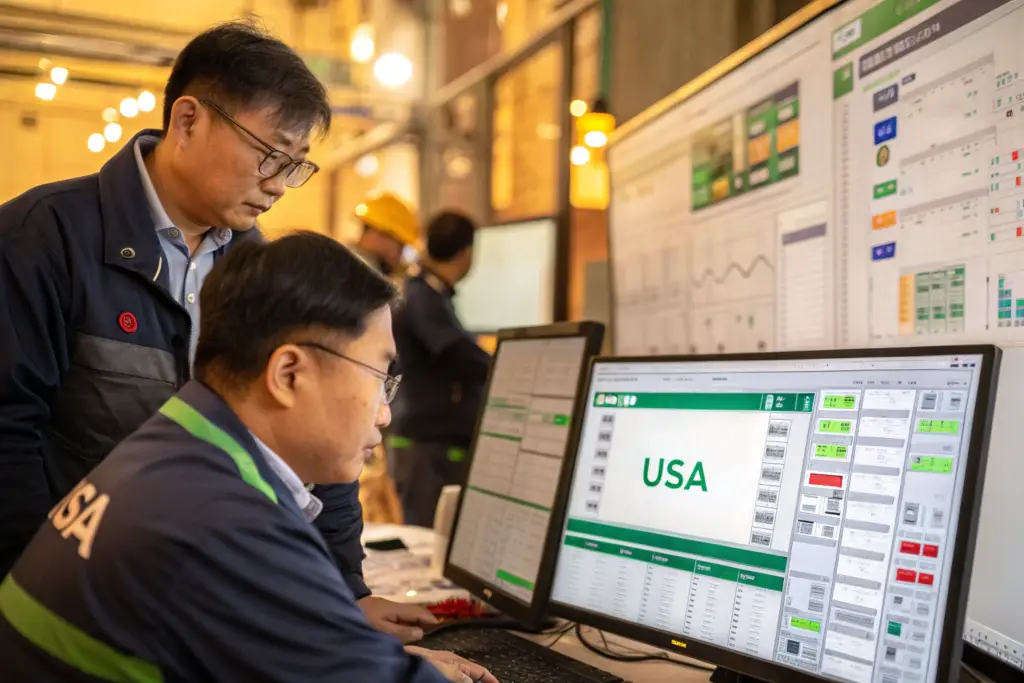
Can a "Greige Stock" Program Cut Lead Times During a Mid-Season Sellout Spike?
Absolutely. Last October, an athletic brand our distributor supplies had a hoodie go viral on TikTok. Sell-through jumped from 200 units a week to 800. A normal factory would say, "We have no capacity for 90 days." We had 3,000 units of the distributor's specific weight of French terry already knitted and sitting in greige in our warehouse. We dyed and finished 1,200 pieces of that greige stock in Olive in 12 days and shipped them air express. The distributor captured the wave.
Greige inventory is the ultimate safety net. It costs money to hold, but the cost of a lost sales spike is far higher. We manage this using flexible material resource planning tools influenced by the forecasting methodologies shared by organizations like the National Retail Federation for supply chain, ensuring our stock levels anticipate seasonal volatility rather than merely reacting to it.
Does Transparent "Cost-Plus" Pricing Stop the Panic of Raw Material Spikes?
Distributors hate renegotiation surprises. Cotton jumps 15 cents a pound, and suddenly a supplier demands a 10% price hike on a confirmed order. That destroys trust and planning. We moved to a transparent cost-plus model for our long-term distribution partners. We show them the actual fiber cost, the labor, the logistics, and our fixed management fee.
When cotton goes up, they see the line item. We adjust together. When it drops, the price drops immediately. This collaborative approach, benchmarked against public indices like the Cotlook A Index, eliminates the adversarial haggle. In an environment where input cost visibility is critical, aligning with Cotton Incorporated's Monthly Economic Letter data gives both parties confidence the base fiber surcharge is grounded in objective market data, not a supplier's demand for arbitrary extra margin.
What Are the Strictest U.S. Customs Hurdles That Fumao Solves for Importers?
Customs is a black box for many distributors, until the seizure notice arrives. I lost a shipment myself in 2021 due to a fiber content mislabeling error. Customs and Border Protection (CBP) tore the container apart, found the viscose content was 2% off the declared value, issued a fine of $8,000, and held the goods for six weeks. My client missed the entire back-to-school window. After that disaster, I became borderline obsessive about customs compliance. I decided no shipment of mine would ever be held at the border again.
Shanghai Fumao solves the strictest U.S. customs hurdles by pre-clearing fiber composition through an accredited in-house lab, proactively managing the UFLPA forced-labor documentation chain for cotton and poly fibers, and correctly assigning HTS codes at the 10-digit level before the goods are sealed inside the container.
The regulatory environment in 2026 is not the same as 2019. Forced-labor enforcement, de minimis rule tightening, and fiber content verification are now active enforcement priorities, not just box-checking exercises. Distributors can lose their customs bond over a supplier's shortcut. Here is what we handle that protects their license to import.
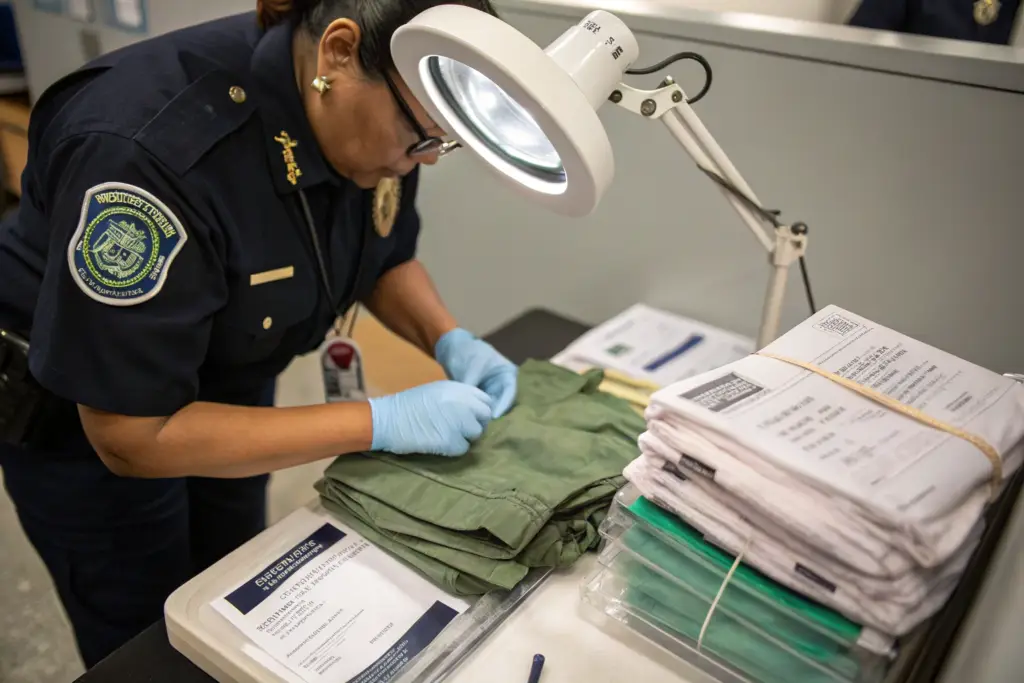
How Do We Guarantee Cotton Supply Chain Traceability Under 2026 UFLPA Enforcement?
The Uyghur Forced Labor Prevention Act (UFLPA) applies a rebuttable presumption that any goods from Xinjiang are made with forced labor. Cotton from that region is banned unless you can prove a clean supply chain. We do not rely on a single blanket certificate. We built a traceability map from the farm gin to our yarn spinner for every single cotton component. We use isotopic fiber testing and scanned gin bale tags to create the evidence file.
CBP has detained shipments where the supply chain map was vague or had gaps in custody. We close those gaps. We submit the full documentation package—including third-party audit reports of the spinning mill and the gin—to the broker before the vessel sails, ensuring full alignment with the CBP UFLPA Operational Guidance. This level of proactive documentation turns a customs risk into a competitive advantage, because the distributor's broker can clear the container in hours instead of days.
Why Does a Misclassified HTS Code Trigger Tariff Back-Bills Months Later?
HTS codes are a classification minefield. A men's cotton shirt and a women's linen shirt can have tariff rates differing by 10%. An aggressive supplier might knowingly pick a cheaper code to make the landed cost look better, a practice called tariff engineering without substance. The distributor does not find out until CBP audits the entry 18 months later and sends a bill for back-duties plus interest. I have seen a back-bill of $37,000 land on a small distributor's desk with zero warning.
We have a dedicated customs specialist who assigns the HTS code during the sampling phase, not after packing. We debate the binding ruling logic with the broker. If a garment has two fibers, we correctly apply the essential character rule to assign the code. We use the official Harmonized Tariff Schedule search tool to ensure every digit of the classification is defensible under a customs audit. When a shipment lands, the duty bill is exactly what the distributor modeled in their margin plan, zero surprises.
Conclusion
Distributors are switching to Shanghai Fumao not because we are the cheapest, but because we are the most accurate and the safest pair of hands in a high-stakes logistical environment. We understand that a distributor's real product is not clothing; it is reliable inventory flow. Interrupt that flow with a labeling error, a hidden quality fade, or a UFLPA customs seizure, and their entire business model wobbles. We have systematically attacked every point of failure in the chain: the carton content, the EDI transmission, the raw material buffer stock, and the customs documentation.
The Dallas distributor with the fleece line told me recently that his operations manager now unboxes our shipments and simply scans them straight to the outbound rack. No fires to fight, no chargebacks to dispute, no silent quality worries gnawing at him during dinner. That is the experience you hire when you switch to us. We have transformed our factory into a seamless backend for the American distribution industry.
If you run a distribution company and you think "supplier headaches" are just part of the game, I invite you to test a different reality. Let us run a trial PO. Let us prove our compliance and labeling precision wipes out your rework costs. Contact Elaine to discuss integrating your EDI system with our logisitcs team. Her email is: elaine@fumaoclothing.com.