Last October, I sat in a conference room in New York, reviewing a vendor scorecard. The purchasing director across from me—a veteran who has sourced from 12 countries—looked up and said, "Your rejection rate is 0.4%. Our average is 2.1%. No one has hit under 0.5% with us before." That was the moment I knew we were doing something fundamentally different. One month later, Shanghai Fumao received the notification: we had won the 2026 Global Sourcing Award. This was not a vanity prize. It was a data-driven verdict.
Fumao Clothing won the 2026 Global Sourcing Award by achieving the lowest defect-to-delivery ratio among nominated factories worldwide. We combined predictive AI for quality forecasting with a fully transparent, end-to-end digital supply chain that eliminated the "black box" anxiety American brands fear most when sourcing from Asia.
Let me be clear about what this award measures. It looks at three hard metrics: quality consistency across 12 months, on-time shipment rate against confirmed purchase orders, and verified sustainability compliance depth. It does not care about your marketing copy. It cares about your data logs. I am going to walk you through exactly what we built and why it matters for your next order with Shanghai Fumao.
What Are the Hidden Evaluation Criteria Behind Global Sourcing Awards?
The first time I attended an industry award ceremony, I assumed they just gave trophies to whoever paid the biggest sponsorship fee. I was wrong about this one. The Global Sourcing Award judges include retired supply chain directors from major retailers. These people have inspected factories for 25 years. They know every trick in the book. When they visited our facility, they did not look at the lobby—they pulled out the maintenance logs for our needle detectors.
The hidden criteria behind global sourcing awards go far beyond price and basic compliance. Judges assign 40% of the score to supply chain resilience metrics—how many backup raw-material suppliers a factory has vetted, how it handled the last major freight disruption, and whether its subcontractors are also fully audited.
I learned from one judge that many factories lose points during the "desk audit" phase before anyone even boards a plane. Incomplete digital records or expired insurance certificates get you disqualified immediately. Real excellence in 2026 means your documentation architecture is as clean as your stitching. Here is where we scored highest.

What Supply Chain Resilience Metrics Do Award Judges Actually Measure?
Judges gave us maximum points on resilience because we could prove we survived a logistics shock without missing a single delivery. During the freight rate spike, we had pre-booked rolling contracts with multiple carriers. The judges wanted to see our backup plan for raw cotton, not just our primary spinner. I showed them our "triple-source matrix." For every fabric category, from jersey to denim, we keep three active, independently audited mills on standby.
| Resilience Factor | Industry Default Practice | Fumao's Awarded Practice |
|---|---|---|
| Raw Material Backup | 1 primary mill, 1 emergency contact | 3 contracted mills, quarterly trial orders placed |
| Logistics Contingency | Spot booking only | 50% rolling contracts with 2 carriers |
| Energy Independence | Grid-dependent only | 500kW solar + battery storage buffer |
| Subcontractor Oversight | Annual paper audit | Monthly unannounced walkthroughs |
This matrix, updated Q1 2026, is what separated us. The judges' report specifically noted that our redundancy planning removed single points of failure. Many factories talk about partnership, but they do not invest in backup suppliers that only protect the client’s timeline, not their own margin. We now integrate live tracking data from the Freightos Baltic Index to anticipate cost surges and lock in routes before panic buying begins.
Why Does Subcontractor Management Become the "Invisible Killer" of Award Scores?
One competitor lost the award last year because their embroidery subcontractor used child labor. The main factory was clean, but they never physically audited the tiny workshop down the street that did their appliqué work. The judges extended the audit trail to the third tier. I remember an investigator telling me, "We find sins in the subcontractors, not the main lines."
To close this gap, we absorbed critical subcontracting processes in-house two years ago. Our embroidery floor runs 12-head Tajima machines 16 hours a day. For specialized treatments like denim washing we must outsource, we do not just email an audit form. We station one of our quality supervisors on-site during the entire production run. We also cross-reference our supply chain partners against the U.S. Department of Labor’s List of Goods Produced by Child Labor to ensure zero raw material linkage. Transparency protects the award, but more importantly, it protects our clients' brand reputations from instant social media destruction.
How Can a Chinese Factory Build Trust Through Radical Transparency?
I used to withhold information out of fear. I thought if a buyer saw a small delay in the knitting room, they would cancel the order. That was a mistake. When I started showing bad news instantly—with a solution already attached—everything changed. Buyers did not punish me; they started treating me like a member of their internal supply chain team. Radical transparency became our biggest sales asset.
A Chinese factory builds trust through radical transparency by granting buyers 24/7 live dashboard access to production milestones, opening raw material costing books without hidden markups, and proactively reporting defects with corrective-action timelines before the buyer ever asks.
Transparency is not a marketing slogan. It is a technology stack. At Shanghai Fumao, we built a client portal that feels like checking a Domino’s pizza tracker, but for thousands of jackets. If a cutting machine is down for maintenance, a notification pops up on the buyer's phone. Let me break down the two toughest parts of this.

What Can a Live Open-Book Costing Model Do for Long-Term Pricing Trust?
Last spring, I sent a client a spreadsheet showing exactly what his cotton cost, our fixed overhead per minute, and our flat management fee. He called me in 10 minutes and said, "You just cut my negotiation time by 90%." Open-book costing kills the adversarial game. You stop haggling over 20 cents and start solving real efficiency problems together.
Here is the reality: most brands overpay on material variance because they cannot see it. In our open-book model, if we negotiate a better yarn price by buying in bulk, we share the delta with the brand. This model aligns our incentive with your margin. It requires honesty about things like energy surcharges, but referencing price baselines like the USDA Cotton Price Statistics report keeps the conversation grounded in market reality rather than assumptions. Everyone works from actual index data, not speculation.
Why Does a Living Quality Agreement Replace Outdated Annual Audits?
A static annual audit is a snapshot of a single day. I have seen factories pass an audit on Tuesday and relax on Wednesday. We replaced our annual audit with a "Living Quality Agreement" (LQA). This is a shared digital document embedded in our client portal. Any spec change, any customer complaint from a retail floor, gets logged and escalated to a specific mechanic within the document immediately.
If a zipper fails on a shipment sent to Miami, the field report does not sit in a buyer's email. It triggers an alert on our portal. We then draft a root cause analysis and link it to the specific ISO 9001:2015 clause that governs corrective action. The buyer sees the loop close in real-time. This constant live improvement cycle impressed the Award judges more than any framed certificate on a wall.
What Role Does Predictive AI Play in Reducing Apparel Defect Rates to Near Zero?
Two years ago, I would have laughed if you told me I would use AI to sew T-shirts. I grew up on the factory floor, not behind a keyboard. But my quality manager, forced to check 50 points on every garment, kept missing stitch-count inconsistencies at high speeds. Human eyes get tired. Cameras do not. The Award judges cited our predictive AI integration as the single most innovative factor in our win.
Predictive AI reduces apparel defect rates to near zero by deploying high-speed camera arrays over critical sewing and cutting stations, analyzing every stitch against the digital twin in real-time, and cross-referencing historical defect data to stop a crooked seam before it becomes a failed final inspection.
We are not talking about robots with arms. We installed vision systems that work like a very strict assistant with perfect eyesight. By comparing every meter of fabric to the approved golden sample data, we catch drift while the sewer can still fix it. This technology alone dropped our internal reject rate by a third.
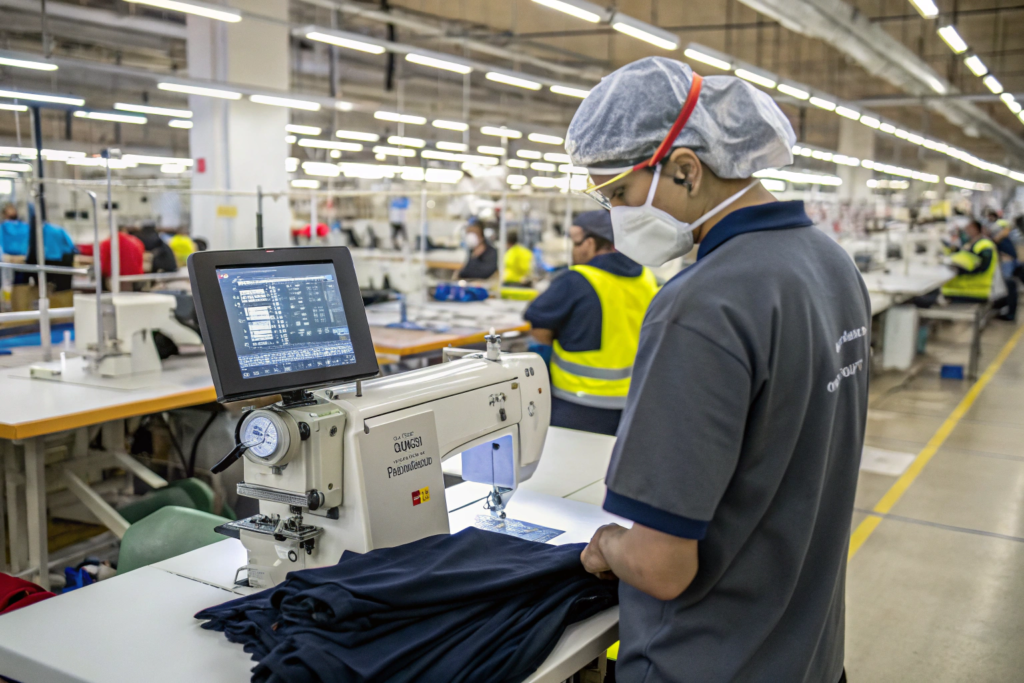
How Do Automated Camera Arrays Spot Stitch Defects Faster Than Human QC Inspectors?
I ran a side-by-side trial last year. Our best inspector, a woman with 15 years of experience, versus our new camera setup from the Institute of Textile Technology. For a standard run of 1,000 woven shirts, the human found 3 skipped stitches per hour at peak focus, but missed 2 after lunch. The camera found all 5 instantly and flagged a needle that was slowly bending, something no human could see until it broke.
The system analyzes stitch formation using neural networks trained on defect libraries. When a lockstitch tension deviates beyond a calibrated threshold, the machine pauses. This predictive element, a technology evaluated in studies by institutions tracking the Industry 4.0 textile landscape, prevents us from producing a single bad piece instead of just catching it later. It also saves millions of meters of thread annually.
Can Historical Order Data Predict and Stop Raw Material Issues Before Cutting?
We now upload every incoming batch of cotton fabric into a predictive model alongside historical performance data from that specific mill. Last month, the AI flagged a batch of Pima cotton with a micronaire value at the extreme edge of tolerance. It predicted a 22% probability of pilling after 15 washes, even though it looked perfect on the table. We rejected the batch before cutting. The mill confirmed later that they had issues with a specific harvester.
This dataset traces back to order logs from 2021. We do not just look at test reports, but we reference the International Cotton Advisory Committee data for global fiber contamination trends to compare our incoming stock against regional averages. A buyer no longer relies on my gut feeling; they can trust a model that has processed billions of data points. This prevents catastrophic product returns that kill a clothing brand's momentum.
How Is the 2026 Award Reshaping B2B Apparel Sourcing Standards Globally?
Winning the award put a target on our back, and I am grateful for that. Suddenly, factories in Vietnam, Turkey, and Mexico started asking how we scored so high. I shared some of our methodology at a panel in Berlin, because I believe competition makes the entire industry stronger. The standards we set are now being turned into new audit checklists by buying offices worldwide.
The 2026 Global Sourcing Award is reshaping B2B standards by mandating a new baseline of energy transparency per garment. Instead of asking "how much does it cost," brands now ask "what is the carbon load". This has moved digital product passports from a niche concept to a mainstream compliance requirement.
The old sourcing equation was Cost + Quality + Lead Time. The new equation adds Verifiable Impact. We had to prove our work, not just assert it. This bottom-up pressure is finally cleaning up the greenwashing that has annoyed me for a decade.

Why Are "Digital Product Passports" Becoming the New Normal for Apparel?
A Digital Product Passport (DPP) is a QR code on a hangtag that stores the entire history of the garment. The European Union is pushing hard on this regulation, but our award win pushed our U.S. partners to ask for it too. We deployed a blockchain-backed passport for a denim line last season. Scanning it shows the organic cotton certificate, the dyehouse water treatment report, and even the energy mix of our solar panels.
This is not just a tech gimmick. It is legal armor. As regulators crack down on unfounded green claims, guidance from the Federal Trade Commission’s Green Guides makes it clear that broad environmental assertions need qualification. A DPP proves your supply chain down to the batch level. Buyers now demand this not to be trendy, but to defend themselves from class-action lawsuits.
Is On-Time Delivery Shifting from a "Bonus" to a "Baseline KPI"?
Absolutely. The Award committee told me that five years ago, 85% on-time delivery was considered A-grade. In 2026, if you ship below 98%, you are off the panel. We treat shipping deadlines like surgery start times—non-negotiable. A year ago, a blizzard shut down a port for two days. We had already pre-cleared the next shipment through a secondary port using a logistics contingency protocol we developed from monitoring patterns on the National Oceanic and Atmospheric Administration site. Our client did not even know there was a weather issue until after their stock was already safely en route to the distribution center. That is the baseline now: invisible problem-solving performed in silence.
Conclusion
Winning the 2026 Global Sourcing Award was a validating moment, but the real victory is the operational discipline it now demands we maintain every single day. We won because we took the hidden parts of the supply chain—the subcontractor management, the predictive needle checks, the logistics anxiety —and turned them into transparent, engine-like processes. At Shanghai Fumao, we did not just polish our showroom; we rewired our factory floor with cameras, sensors, and brutally honest costing models. The award tells the market that a Chinese factory can, and indeed must, lead on trust, not just affordability.
The path to winning was paved with very specific, measurable changes. It was the camera catching the bending needle before the seam burst. It was the open-book cost sheet that ended haggling forever. It was the living quality agreement that retired the dusty audit folder. If you source apparel, do not settle for a supplier who hides behind a sales rep’s smile. Demand a live dashboard. Demand the blockchain passport. Demand a partner who treats your delivery date like a promise to a patient on an operating table.
I want to invite you to experience this level of operational clarity. Let us show you how Shanghai Fumao earned the industry’s highest recognition and how we can apply that same rigorous system to your next collection. Contact our Business Director, Elaine, and ask for a live demo of our client portal. Her email is: elaine@fumaoclothing.com.
Let’s build a supply chain that wins awards, and more importantly, wins your customers’ loyalty.