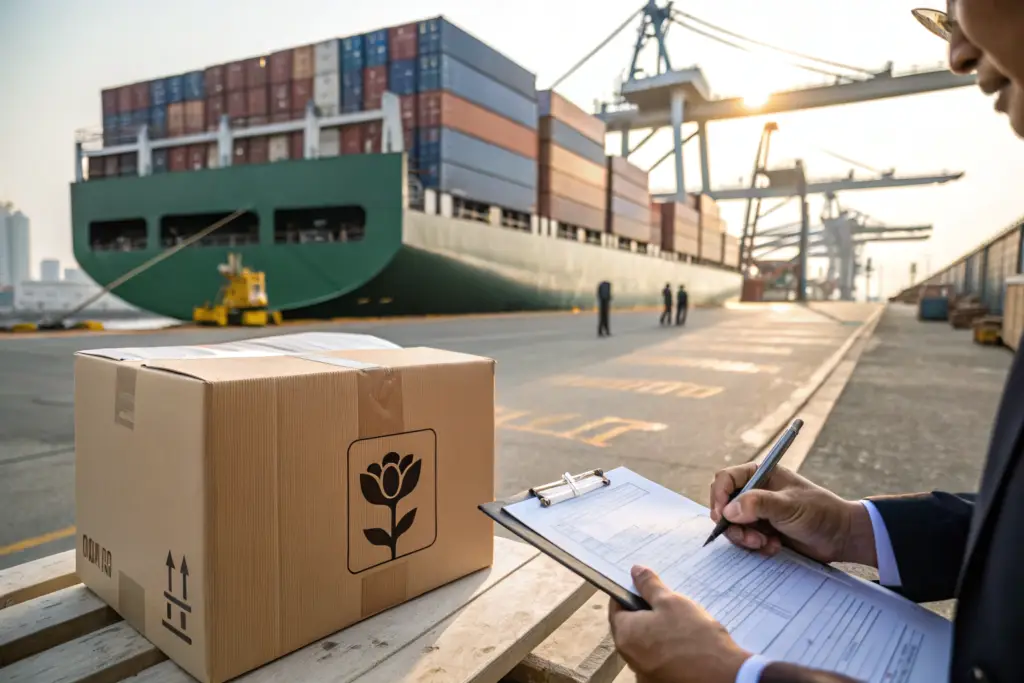
A brand owner from Miami called me in March last year. She had ordered 2,000 A-line floral dresses from a supplier on an FOB basis. The FOB price was fantastic. She thought she had negotiated a great deal. The dresses shipped from Shanghai. They arrived at the Port of Miami. Then the bills started arriving. Terminal handling fees. Customs brokerage fees. Import duty at 16.5% because of the rayon content. A surprise USDA inspection because the dresses had wooden buttons. Storage fees because the broker was slow. The final trucking invoice. Her "great deal" FOB price of $12 per dress became a landed cost of $18.50 per dress. She paid an extra $13,000 she had not budgeted for. She told me later, "I would have paid more upfront just to know the final number."
DDP shipping is crucial for bulk floral dress orders because it converts an unpredictable multi-party import process into a single, guaranteed, door-to-door price. Under DDP, the factory is responsible for all freight, customs clearance, duties, and taxes until the dresses arrive at your warehouse. You pay one invoice. You face zero surprise charges. Your profit margin per dress is locked before the container ship even leaves the port.
I have shipped thousands of DDP orders for my apparel clients. I know the logistics chain from factory floor to US warehouse better than most forwarders. Let me explain exactly why DDP is not just a convenience. It is a financial control tool that protects your floral dress margins from the chaos of international shipping.
What Hidden Fees Does DDP Eliminate from Your Floral Dress Budget?
An FOB quote is a partial quote. It covers the product and the transport to the port of export. Everything after that point is your responsibility. The ocean freight. The destination port charges. The customs bond. The brokerage. The duty. The tax. The final mile trucking. Each of these comes from a different company with a different invoice. Some arrive weeks after the dresses are already in your hands. You have no chance to negotiate. You just have to pay.
DDP eliminates every single post-port cost. The DDP price includes the sea freight, the origin and destination terminal handling, the customs clearance fee, the import duty calculated on the correct HS code, and the trucking to your final address. There are no separate invoices. No storage fees because a broker is slow. No demurrage charges because your trucker missed the appointment. The price we quote is the price you pay.
Let me break down the real costs that vanish under DDP.
How Do Port Storage and Demurrage Fees Eat Your Profit?
In the FOB world, time is a hidden cost. The container arrives at the Port of Los Angeles. Your customs broker has 5 free days to clear the goods and move the container out of the terminal. On day 6, the port charges storage. On day 8, the shipping line charges demurrage. The fees start at $75 per day and escalate quickly. A 5-day delay costs $500. A 10-day delay costs $1,500.
Why would a delay happen? Your broker is busy. The customs officer selected your container for a random exam. Your trucker had a scheduling conflict. These are normal, everyday occurrences in international logistics. Under FOB, they are your problem. You pay. Under DDP, they are my problem. I pay. My forwarder is contractually obligated to clear the goods and deliver them on schedule. If they fail, the storage fees are on their invoice, not yours.
Last year, a shipment of floral dresses for a client in Texas was selected for an X-ray exam at the port. The exam took 7 days. The storage and exam fees totaled $1,100. My client never saw that bill. She paid the DDP price. I settled the fees with the forwarder. The DDP price absorbed the random misfortune of a customs exam. This is the value of DDP. You buy certainty in an uncertain process.
What About Customs Brokerage and Bond Fees?
Every shipment entering the US requires a customs broker to file the entry with Customs and Border Protection. The broker charges a fee for this service, typically $125 to $250 per entry. You also need a customs bond, which is an insurance policy that guarantees the duties will be paid. A single-entry bond costs $50 to $100.
Under FOB, you must find a broker. You must vet them. You must set up the bond. You must provide them with the commercial invoice, the packing list, and the Bill of Lading. You must coordinate with them. This is administrative work. It takes time. It is a learning curve for a new brand owner. Under DDP, my broker handles everything. They are pre-vetted. They specialize in textile imports. The brokerage and bond fees are included in the DDP price. You do not need to find a broker. You do not need to talk to a broker. The dresses just arrive.
A client in New York told me DDP saved her 10 hours of administrative work per shipment. She used that time to design her next collection. The broker fees under FOB would have been $200. The 10 hours of her time were worth $1,000. The math made DDP the obvious choice.
How Does DDP Simplify the Complex US Customs Process for Textiles?
Textile imports into the United States are not simple. Dresses are classified by fiber content, by gender, and by construction. A floral A-line dress made of rayon has a different duty rate than one made of cotton or polyester. The Harmonized Tariff Schedule code must be precisely correct. If the code is wrong, the shipment is flagged. The officer examines the goods. The officer assesses a penalty. The shipment is delayed. The selling season burns.
Under DDP, the factory's customs broker, who specializes in textile classification, handles the HS code determination, the duty payment, and all communication with US Customs and Border Protection. The broker is the Importer of Record. They are legally responsible for the accuracy of the entry. This shields you from classification errors and customs penalties.
You are the consignee, not the importer. The legal burden shifts to the DDP broker.

How Is the Correct HS Code Determined for a Floral Dress?
A floral dress is not just "a dress." It is a specific article under Chapter 62 of the Harmonized Tariff Schedule. If the dress is 100% rayon woven fabric, it falls under HS code 6204.44. The duty rate is 6.9%. If the dress is 100% cotton woven fabric, it falls under HS code 6204.42. The duty rate is 4.4%. If the dress is a blend, the classification is based on the predominant fiber by weight.
A wrong classification is a legal violation. The customs officer can seize the goods. The officer can issue a penalty of up to 20% of the declared value. The shipment is delayed indefinitely.
My DDP broker classifies the dress before the shipment leaves the factory. We send the fabric composition, the design spec, and a physical swatch to the broker. They issue a binding classification ruling if necessary. The correct HS code is printed on the commercial invoice and the customs entry. The duty is calculated and paid. The entry is clean. The risk of a classification challenge drops to near zero. This expertise is included in the DDP price.
What Is an ISF Filing and Who Is Responsible for It?
The Importer Security Filing, or ISF-10, is a requirement of US Customs. It must be filed at least 24 hours before the container is loaded onto the ship in the foreign port. The filing includes information about the manufacturer, the seller, the buyer, the ship, and the cargo. Failure to file the ISF on time results in a $5,000 penalty from CBP.
Under FOB, the buyer is often responsible for the ISF filing. You must collect the information from the factory and submit it to your broker. If the factory is slow to provide the data, you miss the deadline. You pay the penalty. Under DDP, my broker files the ISF. It is their responsibility. They have all the data. They file it days in advance. There is no risk of a late filing penalty.
A client in San Francisco learned about ISF the hard way on her first FOB shipment. The factory did not send the packing list in time. The ISF was filed 2 hours late. CBP issued a $5,000 penalty. She appealed. The appeal was rejected. The penalty stood. Her entire profit on that shipment was wiped out by a paperwork delay. She switched to DDP with Shanghai Fumao the next season.
Why Does DDP Protect Your Seasonal Selling Window?
Floral dresses are seasonal. The spring selling window opens in March and peaks in April and May. The summer window peaks in June and July. If your bulk shipment of 3,000 A-line floral dresses arrives on May 15th instead of April 15th, you have missed 30% of the peak selling season. The dresses that were supposed to sell at full price for $88 are now competing with markdowns. They sell for $59. The delay cost you $87,000 in lost revenue on a single shipment.
DDP protects your seasonal window by consolidating accountability. Under FOB, delays happen at handoff points. The factory blames the forwarder. The forwarder blames the port. The port blames the trucker. No one is responsible for the door-to-door timeline. Under DDP, one entity is responsible: the factory's logistics chain. If a delay happens anywhere, we fix it immediately because our money is on the line. You do not chase three different parties. You have one point of contact.
The structure of DDP aligns the factory's incentives with your deadline.
How Does DDP Reduce the Risk of a Missed Launch Date?
When I ship DDP, I am responsible for the delivery date, not just the ship date. The ship date is when the container leaves Shanghai. The delivery date is when the dresses are at your warehouse door. These are two very different dates.
In an FOB scenario, the factory books the cheapest available vessel to keep their freight cost down. The ship might transship through Busan. It might sit at anchor outside Long Beach for four days. The transit time is variable. The factory has no incentive to pay for a faster vessel. Their job ends at the Shanghai port.
Under DDP, I choose the most reliable vessel, not the cheapest. My forwarder knows which shipping lines have the best on-time performance for the US West Coast or East Coast. We book space on vessels with direct routes and minimal transshipment. We pay a slight premium for reliability. The transit time is predictable. The delivery date holds. Your launch date is protected because my logistics decisions are optimized for reliability, not minimal cost.
What Happens to Your Cash Flow When a Shipment Is Stuck?
A delayed shipment is a frozen asset. You paid a 30% deposit three months ago. You paid the 70% balance a month ago. Your cash is gone. Your inventory is on a ship. You have nothing to sell. Your marketing campaigns are live. Your customers are asking when the dresses will restock. You are losing sales every single day.
The financial damage is not just the markdown later. It is the lost full-price sales during the delay. If you sell 50 dresses per day on your website at an $88 retail price, a 10-day delay costs you $44,000 in missed revenue. The markdown damage comes later. The lost sales damage is immediate and invisible.
DDP minimizes the delay risk. The accountability is single-threaded. The vessel is chosen for reliability. The customs process is smooth. The final trucking is pre-booked. The dresses arrive on the date they are supposed to arrive. Your cash flow converts into revenue exactly when your spreadsheet predicted. This predictability is priceless for a growing brand.
Is DDP More Cost-Effective Than FOB for Small to Mid-Size Brands?
There is a myth in the sourcing world that DDP is always more expensive. The logic is: the factory marks up the freight, so you pay a premium. This logic is true only if you are a giant brand importing 100 containers a year with a dedicated logistics team and negotiated freight contracts. For a brand importing 2,000 to 10,000 dresses per season, the math is different.
For small to mid-size apparel brands, DDP is often more cost-effective than FOB when the total cost of ownership is calculated. The hidden FOB costs, the brokerage minimum fees, the small-volume freight surcharges, and the cost of your own time spent managing logistics all stack up. The DDP price bundles these costs at a wholesale rate that a small brand cannot negotiate independently.
The factory ships volume. The factory gets volume discounts. The factory passes a portion of those discounts to you through the DDP price.
How Does the Factory's Shipping Volume Lower Your DDP Rate?
I ship hundreds of containers and LCL shipments every year. My forwarder gives me rates that are 25% to 35% lower than the spot rate a small brand would pay for a single shipment. My customs broker charges me a per-entry fee that is half of what a one-time customer pays. My trucker gives me contracted rates because I provide consistent weekly business.
When I calculate a DDP price for a client, I use my volume rates. I add a small margin for the management service. The total DDP price is often equal to or lower than what the client would pay if they managed the logistics themselves at spot rates.
A client from Chicago shipped 2,000 floral dresses FOB with her own forwarder last spring. Her landed logistics cost, all in, was $3,900. She sent me the breakdown. The same shipment under my DDP would have been $3,200. My volume rates saved her $700. She uses DDP now. The factory's scale is your advantage.
What Is the Value of Not Hiring a Freight Forwarder?
Your job is designing, marketing, and selling floral dresses. Your job is not negotiating freight contracts, tracking vessel schedules, resolving customs holds, or coordinating trucking appointments. Every hour you spend on logistics is an hour you are not spending on your brand.
The opportunity cost is real. If you spend 15 hours managing an FOB shipment, and you value your time at $75 per hour, that is $1,125 in lost brand-building time. The DDP premium, if it exists, is often less than the opportunity cost.
A brand owner in Austin told me DDP was the best business decision she made. "I used to dread shipment weeks. Now I just wait for the truck to show up. I used that mental energy to launch a new print. The new print generated $15,000 in pre-orders. DDP paid for itself in creative output." This is the strategic value. DDP frees you to focus on your zone of genius. The logistics are delegated to a partner who does logistics as their zone of genius. The partnership creates more value than either party working separately.
Conclusion
DDP shipping is a margin protection tool disguised as a logistics service. It eliminates the surprise port fees that destroy a carefully planned floral dress budget. It navigates the US customs process with a specialist broker who classifies your rayon or cotton dress correctly and files the ISF on time. It locks in your seasonal delivery window by aligning the factory's incentives with your launch date. And for a small to mid-size brand, it is often genuinely cheaper than managing the logistics yourself, once you account for hidden fees and the value of your own time.
The floral dress market is seasonal, competitive, and time-sensitive. You cannot afford a shipment that arrives three weeks late because of a customs hold. You cannot afford a $1,500 port storage bill that you never planned for. You need a single landed cost, a single delivery date, and a single accountable partner.
If you want a DDP quote for your next bulk floral dress order, I am ready to provide one. Our Business Director, Elaine, can calculate the exact DDP price for your specific styles, quantities, and delivery address. Email her at elaine@fumaoclothing.com. Tell her your order size and your target delivery date. She will send you a transparent DDP price with every cost included. No surprises. Just dresses at your door, ready for your customers.