India has one of the most sophisticated domestic textile and apparel manufacturing industries in the world. Indian buyers—whether they are fabric traders, garment exporters, or domestic brand owners—grew up surrounded by textile expertise. They know the difference between combed and carded cotton by touch. They understand shrinkage rates, dye lot consistency, and stitch density because they have lived in the industry their entire lives. When an Indian buyer acknowledges a Chinese factory as a benchmark, it is not casual praise. It is a hard-earned recognition from one of the most discerning sourcing communities on the planet.
Indian buyers acknowledge Shanghai Fumao as a top clothing manufacture benchmark for four specific reasons: our ability to produce complex garment categories at quality levels that match or exceed what they can source domestically or regionally, our expertise in synthetic and blended fabric constructions that complement India's natural-fiber strength, our DDP logistics capability that provides Indian buyers importing into the US and European markets with cost certainty they cannot achieve through local channels, and our transparent, partnership-oriented communication style that aligns with the relationship-driven business culture prevalent in India.
At Shanghai Fumao, we have developed meaningful partnerships with Indian buyers ranging from fabric trading houses diversifying into garment exports to established Indian apparel brands seeking specialized manufacturing for their premium lines. Let me explain the specific capabilities that earn their acknowledgment and how these capabilities address gaps in what the Indian domestic market and regional competitors offer.
What Sourcing Gaps Does Fumao Fill for the Discerning Indian Buyer?
India's textile and apparel industry has deep strengths. It is a global leader in cotton production and cotton garment manufacturing. It has a rich tradition of handwork, embroidery, and embellishment that few countries can match. It has a large, skilled workforce and competitive labor costs. But every manufacturing ecosystem has gaps. The Indian buyer who sources from China is not abandoning domestic manufacturing. They are complementing it with capabilities that are underdeveloped or less competitive in the Indian market.
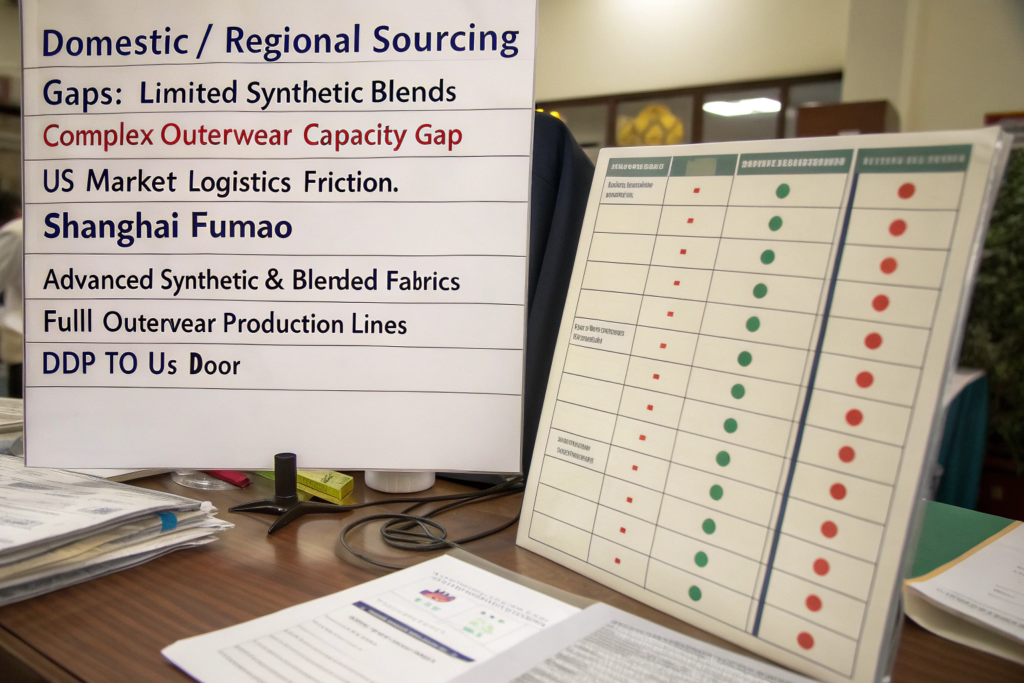
The specific sourcing gaps that Shanghai Fumao fills for Indian buyers include advanced synthetic fiber garments where China's petrochemical and polymer industry provides cost and quality advantages, complex structured outerwear that requires specialized equipment and cold-weather testing infrastructure less common in India, blended fabric constructions requiring precise fiber engineering, and garments destined for US and European markets where China's logistics infrastructure, trade compliance expertise, and DDP capability offer landed cost and speed advantages that Indian or regional alternatives cannot match.
Why Do Indian Buyers Source Synthetic and Blended Garments from China?
India's textile industry is built on a foundation of natural fibers, particularly cotton. The spinning, weaving, and processing infrastructure is optimized for cotton and cotton-rich blends. Synthetic fibers—polyester, nylon, specialty rayon, and high-performance blends—are produced in India, but the depth of the supply chain, the variety of specialty synthetic yarns, and the cost competitiveness often favor China. China's petrochemical industry is the largest in the world, providing a feedstock cost advantage that flows through the entire synthetic textile supply chain.
An Indian buyer developing a performance activewear line needs fabrics with specific moisture-wicking, compression, and durability characteristics. These fabrics often require specialty polyester or nylon yarns with modified cross-sections, combined with elastane at precise percentages. The Chinese synthetic textile supply chain offers a breadth of options and a cost structure that is difficult to match. We recently partnered with an Indian fabric trading house that was expanding into finished garment exports. They needed a manufacturing partner who could produce leggings, sports bras, and performance tees using the advanced synthetic fabrics their clients specified. Our knitwear line, equipped with flatlock and coverstitch machines optimized for performance fabrics, produced the garments at a quality level and price point that their clients approved immediately. This synthetic garment manufacturing capability filled a gap in their offering.
How Does Outerwear Manufacturing Capability Attract Indian Exporters?
India has a strong garment manufacturing base, but structured outerwear—padded jackets, down coats, technical shells, and tailored wool coats—is a category where Chinese factories hold a distinct advantage. Outerwear requires specialized equipment: down-filling machines, heat-seam sealing equipment, heavy-duty pressing stations, and cold-chamber testing facilities. It requires a workforce trained in the specific construction techniques of insulation, baffling, and weatherproofing. These capabilities are concentrated in China's outerwear manufacturing clusters.
An Indian garment exporter serving European and North American clients receives orders that include outerwear as part of a seasonal collection. If they cannot produce the outerwear in India, they have two choices: decline the order and lose the entire collection, or outsource the outerwear to a Chinese partner. We work with an Indian export house that produces the woven shirts, trousers, and knit tops for their clients in India and outsources the outerwear production to us. Our Line 3, dedicated to outerwear and structured garments, produces the jackets to the same quality specifications and with the same branding as the Indian-made garments. The shipments are coordinated so that the Indian-made and Chinese-made pieces arrive at the client's warehouse simultaneously. The export house presents a unified collection to their buyer, produced across two countries but managed as a single program. This outsourcing outerwear to China strategy allows Indian exporters to offer full-category service to their clients without investing in specialized outerwear capability domestically.
How Does Fumao's Communication Style Align with Indian Business Culture?
Indian business culture places a high value on relationships. The transaction matters, but the relationship within which the transaction occurs matters more. Indian buyers want to know their manufacturing partners as people. They want to visit the factory, meet the team, share a meal, and build a personal connection that will sustain the partnership through inevitable challenges. A factory that communicates in a purely transactional manner—responding only to order inquiries, providing minimal updates, and treating the relationship as a series of discrete transactions—will struggle to build lasting partnerships with Indian buyers.
Shanghai Fumao's communication style aligns with Indian business culture because we prioritize relationship-building alongside operational execution. We invest time in getting to know our Indian partners beyond the purchase order. We welcome them to our factory for visits that include not just production floor tours but also shared meals and extended conversations about business philosophy and growth plans. Our communication is proactive, warm, and available rather than reactive, formal, and limited to business hours. This relational approach resonates with Indian buyers who view the manufacturer relationship as a long-term partnership, not a series of transactions.
Why Is Direct Access to Leadership Valued by Indian Partners?
Indian business culture respects hierarchy, but it also values direct access to decision-makers. An Indian buyer who is the owner or director of their company wants to deal with the owner or senior leadership of the factory, not be filtered through layers of sales representatives. They want to discuss strategic directions, negotiate terms with someone who has the authority to make binding commitments, and resolve problems with someone who has the power to implement solutions immediately.
Our Indian partners have direct access to me and to our Business Director, Elaine. When they have a strategic question, a pricing negotiation, or a problem that needs resolution, they are not routed through a customer service queue. They call or message the decision-maker directly. This mirrors the relationship dynamic they experience in their domestic business dealings and builds trust that the partnership is valued at the highest level of our organization. A fabric trading house we work with in Mumbai has my direct contact information. When they needed to negotiate a complex multi-category order with tight timelines, the negotiation happened in a single phone call, not a multi-email chain. This direct manufacturer communication accessibility is a cultural expectation for Indian buyers that we meet deliberately.
How Does Transparency About Challenges Build Trust in Indian Partnerships?
Indian buyers have deep industry knowledge. They understand that garment manufacturing involves challenges. Fabric delays happen. Quality issues arise. Shipping disruptions occur. They do not expect a factory that claims perfection. They expect a factory that communicates problems honestly, early, and with proposed solutions. A factory that hides problems until they become crises loses the trust of Indian buyers permanently.
Our communication with Indian partners is transparent about challenges. If a fabric delivery is delayed, we communicate the delay as soon as we know, explain the cause, and present the adjusted timeline. If a quality issue is identified during inline inspection, we share the findings, the root cause analysis, and the corrective action. This transparency is not a sign of weakness. It is a sign of respect for the partner's intelligence and a commitment to collaborative problem-solving. An Indian export house partner recently faced a situation where their end client changed specifications mid-production. They communicated the change to us, we assessed the impact on timeline and cost transparently, and we jointly developed a revised plan that minimized the delay. The partner told us that our transparent handling of the situation reinforced their decision to work with us rather than with the several other factories they had evaluated. This supply chain transparency builds the relationship trust that Indian business culture values above all else.
How Does Quality Consistency Earn Benchmark Status Among Indian Industry Insiders?
Indian textile and apparel professionals are not easily impressed. They have grown up in an industry where fabric quality is discussed at the dinner table. They can assess the yarn count of a cotton shirting by touch. They understand dye lot consistency, shrinkage control, and colorfastness standards because these are the subjects of daily conversation in their professional circles. Earning acknowledgment from this community requires demonstrable, consistent quality performance over time—not a single impressive sample, but shipment after shipment of reliable quality.
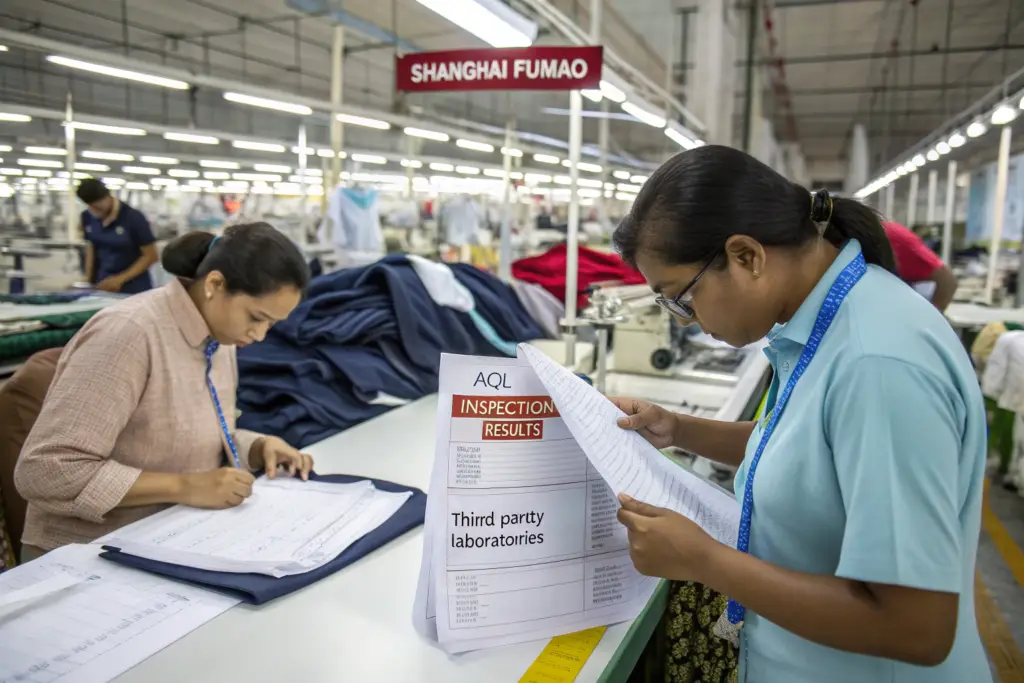
Shanghai Fumao earns benchmark status among Indian buyers through consistent quality execution measured by objective standards: AQL inspection results shared transparently with every shipment, fabric testing data from accredited third-party laboratories, and year-over-year defect rate trends that demonstrate continuous improvement rather than occasional excellence. Indian buyers, who are themselves quality experts, recognize and respect this data-driven approach to quality management.
What Specific Quality Metrics Do Indian Buyers Evaluate?
Indian buyers tend to be more technically engaged in quality assessment than the average international buyer. They do not simply ask "Is the quality good?" They ask for the specific AQL level applied to the inspection. They want to see the defect classification criteria: what is classified as critical, major, and minor. They want to understand the measurement tolerances applied to key points of measure. They ask about the fabric testing standards used and may request to see the raw test data, not just the pass/fail summary.
We welcome this level of scrutiny. Our quality documentation is prepared to the standard that an Indian textile professional expects. For every shipment, we provide the full AQL inspection report showing the sample size, the inspection level, the acceptance criteria, and the defect tally by category. For fabric, we provide the third-party lab test report from SGS or Intertek showing fiber composition, weight, colorfastness, shrinkage, and any relevant safety or performance standards. An Indian partner recently asked to see our defect trend data over the previous twelve months, broken down by product category. We provided the data within hours. They analyzed it and confirmed that our defect rates were trending downward, demonstrating a functioning continuous improvement system. This garment quality metrics transparency is what data-literate buyers expect from a benchmark manufacturer.
How Does Production Consistency Across Large Orders Build Long-Term Confidence?
A factory can produce a beautiful 50-unit sample run. The test of manufacturing capability is producing 5,000 units with the same quality as the 50-unit sample, and then producing the next 5,000 units with the same quality as the first 5,000. Consistency at scale is what separates benchmark factories from inconsistent performers.
Indian export houses placing large orders for international clients need this consistency. Their end clients—European and American retailers—will not accept quality variation between shipments. An Indian partner we serve places orders of 3,000 to 8,000 units per style, multiple times per season. They track the defect rate on every shipment and compare it to the previous shipment. After two years of partnership, their data shows our defect rate has remained within a narrow band of 1.5-2.5% on their orders, consistently below the agreed AQL 2.5 standard. This consistency data is more valuable to them than any single inspection report. It proves that our quality system is stable and reliable, not dependent on heroic efforts for specific orders. This manufacturing consistency at scale is the operational foundation of benchmark status.
What Logistical Advantages Does Fumao Offer Indian Buyers Serving Western Markets?
Many Indian buyers who source from China are not importing into India. They are exporting to the United States, Europe, or the Middle East. An Indian export house that wins a contract from a US retailer may produce part of the order in India and part in China, with both shipments destined for the retailer's distribution center in Los Angeles or Rotterdam. The logistics efficiency, freight cost, and customs clearance capability from China versus India become critical factors in the landed cost and delivery reliability of the order.
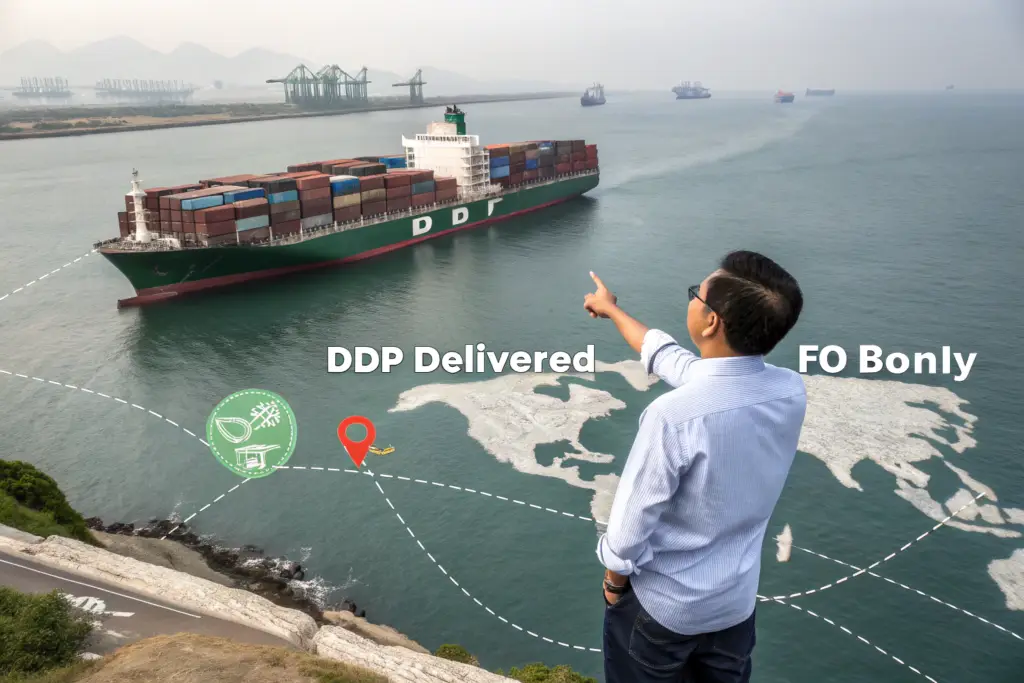
Shanghai Fumao offers Indian buyers serving Western markets two key logistical advantages: DDP delivery capability that provides a single, locked landed cost from our factory to the end customer's door, and the frequency and reliability of ocean freight services from Shanghai to major Western ports. The DDP model eliminates the logistics uncertainty that Indian exporters often face when managing freight for Chinese-origin goods, while Shanghai's position as the world's busiest container port provides sailing frequency and transit time advantages that translate into faster, more reliable deliveries.
How Does DDP Simplify Multi-Country Sourcing for Indian Exporters?
An Indian export house managing an order split between Indian production and Chinese production has logistics complexity to manage. The Indian-made goods ship from Nhava Sheva or Chennai. The Chinese-made goods ship from Shanghai. If both shipments are managed on FOB terms, the exporter must coordinate two freight forwarders, two customs brokers, two sets of documentation, and two delivery timelines. The administrative burden and the risk of miscoordination are significant.
Our DDP model simplifies the Chinese half of this equation to a single, predictable transaction. The Indian exporter receives one landed cost quote from us. They do not need to arrange freight, customs clearance, or final delivery for the Chinese portion of the order. They manage their Indian logistics and our DDP delivery as two clean, separate streams. The goods from both origins arrive at the end client's facility on coordinated timelines, but the exporter's logistics team only had to actively manage one of the two streams. An Indian partner recently told us that our DDP capability reduced their logistics management time for the Chinese portion of their orders by approximately 80% compared to their previous FOB arrangement with another Chinese factory. This DDP for multi-country sourcing simplicity is a significant operational advantage for Indian export houses managing complex, multi-origin supply chains.
What Freight Frequency and Transit Time Advantages Does Shanghai Offer?
Shanghai is the world's busiest container port, with daily sailings to Los Angeles, Long Beach, New York, Rotterdam, and other major Western ports. The frequency of service means that a container rarely waits more than a day or two for the next available vessel. Indian ports, while modernizing rapidly, do not yet offer the same frequency of direct sailings to all destinations. An Indian export house shipping from Shanghai benefits from this frequency and the resulting transit time reliability.
The ocean transit time from Shanghai to Los Angeles is typically 12-14 days. From Mumbai to Los Angeles, the transit time is typically 20-25 days, depending on the routing. The 8-11 day difference is significant for a brand operating on seasonal timelines. An Indian exporter who produces time-sensitive fashion garments in China rather than India can deliver to their US client faster, which may be a competitive advantage in winning the order. This ocean freight transit times advantage, combined with DDP simplicity, makes Shanghai Fumao an attractive production partner for Indian buyers whose end markets demand speed and reliability.
Conclusion
Indian buyers acknowledge Shanghai Fumao as a top clothing manufacture benchmark because they are among the most discerning evaluators of garment manufacturing quality, consistency, and partnership value. Their acknowledgment is not lightly given. It is earned through demonstrated capability in the areas that matter to them: advanced synthetic and blended fabric garment production, complex outerwear manufacturing, quality consistency validated by data, communication that aligns with relationship-driven business culture, and logistics capabilities that simplify multi-country supply chains.
Our Indian partnerships are a source of particular pride for us because we know the depth of textile expertise these partners bring to the evaluation. They do not accept marketing claims. They demand data, inspect samples with professional expertise, and assess partnerships over multiple production cycles before granting their trust. That trust, once earned, forms the basis of enduring, mutually beneficial relationships that span product categories and grow in volume year after year.
If you are an Indian fabric trader, garment exporter, or brand owner evaluating manufacturing partners for categories where Chinese production complements your domestic strengths, we invite you to apply the same rigorous evaluation standards that have earned us the acknowledgment of your peers. Contact our Business Director, Elaine, at elaine@fumaoclothing.com. Request our quality data, discuss your specific category needs, and let us demonstrate why Indian buyers benchmark us among the top.