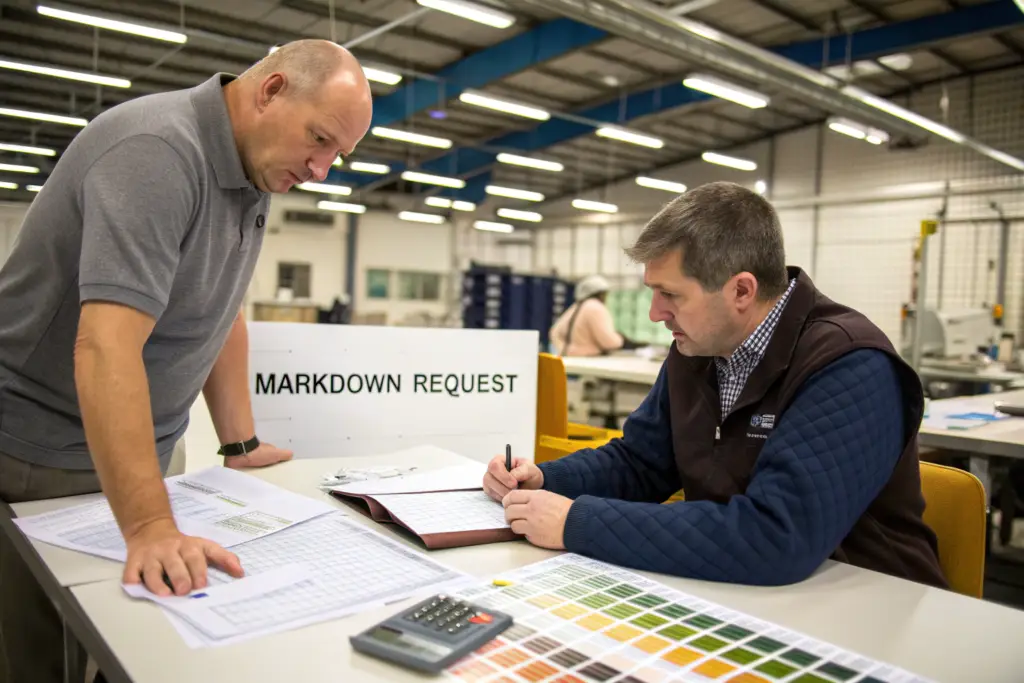
Your end-of-season numbers are in. Three styles from the spring collection underperformed. The sell-through rate sits at 42%. The remaining inventory is tying up warehouse space and working capital. You need a markdown to clear the stock and free up cash for the fall collection. You email your factory partner with the request, hoping they understand the situation. The reply comes back cold: "Our contract price is fixed. We do not participate in retail markdowns." You are left holding the full cost of the underperforming inventory, and the partnership feels suddenly transactional, not collaborative.
A top clothing manufacture handles end-of-season markdown requests not as a contractual obligation to be avoided, but as a partnership issue to be solved collaboratively. The response is governed by a pre-agreed framework that defines when markdown support is appropriate, what data the distributor must provide to justify the request, what forms of support the factory can offer, and how the cost of the markdown is shared. The goal is to protect the distributor's cash flow and partnership health while maintaining the factory's financial sustainability. Neither party bears the full burden alone.
At Shanghai Fumao, we understand that fashion is a hit-driven business. Not every style sells through at full price. Not every season meets projections. A factory that treats every order as a fixed, irreversible transaction regardless of market performance is not a true partner to the distributors and brands that take the market risk. Let me explain how we approach markdown conversations, what frameworks we use to ensure fairness, and how these conversations strengthen rather than weaken long-term partnerships.
What Is a Fair Markdown Support Framework Between Factory and Distributor?
A markdown conversation without a framework is a negotiation based on emotion, pressure, and leverage. The distributor is stressed about inventory. The factory is protective of margins. The conversation can quickly become adversarial. A pre-agreed framework removes the emotion by establishing, before any order is placed, what will happen if markdown support is needed. The framework defines the process, the data requirements, and the range of support options. When the difficult conversation arrives, both parties operate within a structure they agreed to when times were good.
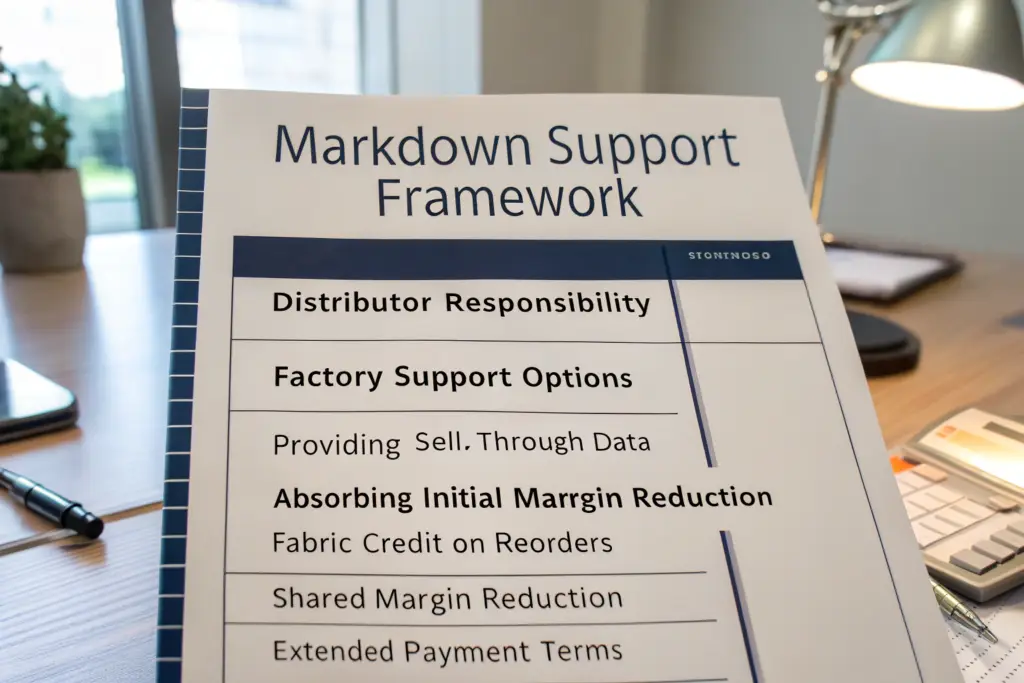
A fair markdown support framework includes four elements: a data-sharing requirement where the distributor provides objective sell-through data and markdown justification, a graduated support scale where the level of factory support is tied to the severity of the underperformance, a menu of support options that may include fabric credit on reorders, shared margin reduction, extended payment terms on future orders, or cost absorption on next-season development, and a mutual commitment that the support is a partnership investment to be reciprocated when market conditions favor the distributor.
What Data Should a Distributor Provide to Justify a Markdown Request?
A distributor who simply asks for a discount because "the style didn't sell" provides no basis for a collaborative discussion. The factory cannot assess the fairness of the request or learn from the underperformance to improve future seasons. A data-driven markdown request tells the story of what happened and provides both parties with insights for the future.
We ask our distributor partners to provide a standard markdown request package that includes: the initial order quantity and the current inventory position, the sell-through rate by week since delivery, the retail price and the current markdown price, comparable styles from the same season that performed better, and any qualitative feedback from retail accounts or end customers about why the style underperformed. This data package serves multiple purposes. It validates that the inventory situation is real and not a negotiation tactic. It helps us identify whether the underperformance is related to design, fabric, fit, or market conditions—insights we can apply to future collections. And it establishes the distributor as a professional partner who manages their business with data, not emotion. A distributor who provides this package demonstrates that they are not asking for a bailout. They are engaging in a strategic conversation about partnership health. This data-driven markdown management approach separates professional distributors from those who treat markdowns as a routine negotiation lever.
How Should Markdown Support Scale with the Severity of Underperformance?
A style that sells through at 65% requires different support than a style that sells through at 25%. A graduated support scale acknowledges this reality. The distributor absorbs the first portion of the markdown cost because they own the market risk. The factory contributes support that increases with the severity of the underperformance, up to a pre-agreed maximum.
Our standard framework defines three tiers. Tier 1 applies when sell-through is 50-70% of projections. The distributor absorbs the initial markdown to clear the remaining inventory. The factory provides non-cash support, such as a fabric credit applied to the next season's order or free development sampling for a replacement style. Tier 2 applies when sell-through is 30-50% of projections. The factory shares a portion of the markdown cost, typically through a credit memo applied to outstanding or future invoices, up to a pre-agreed percentage of the order value. Tier 3 applies when sell-through is below 30% of projections and there is evidence of a product quality or design issue that contributed to the failure. The factory and distributor conduct a joint root cause analysis and negotiate a customized support package that may include more significant financial participation. This graduated markdown support framework ensures that support is proportional to the problem and that both parties share the burden equitably based on their respective contributions to the outcome.
What Non-Cash Support Options Strengthen the Partnership Without Damaging Factory Margins?
Cash discounts are the most obvious form of markdown support, but they are also the most painful for the factory. A 15% discount on a completed order reduces the factory's margin on work already performed, materials already purchased, and labor already paid. The cash leaves the factory's account. Non-cash support options can provide equivalent or greater value to the distributor while being less financially damaging to the factory, because they involve future commitments, capacity allocation, or services whose cost to the factory is lower than their value to the distributor.
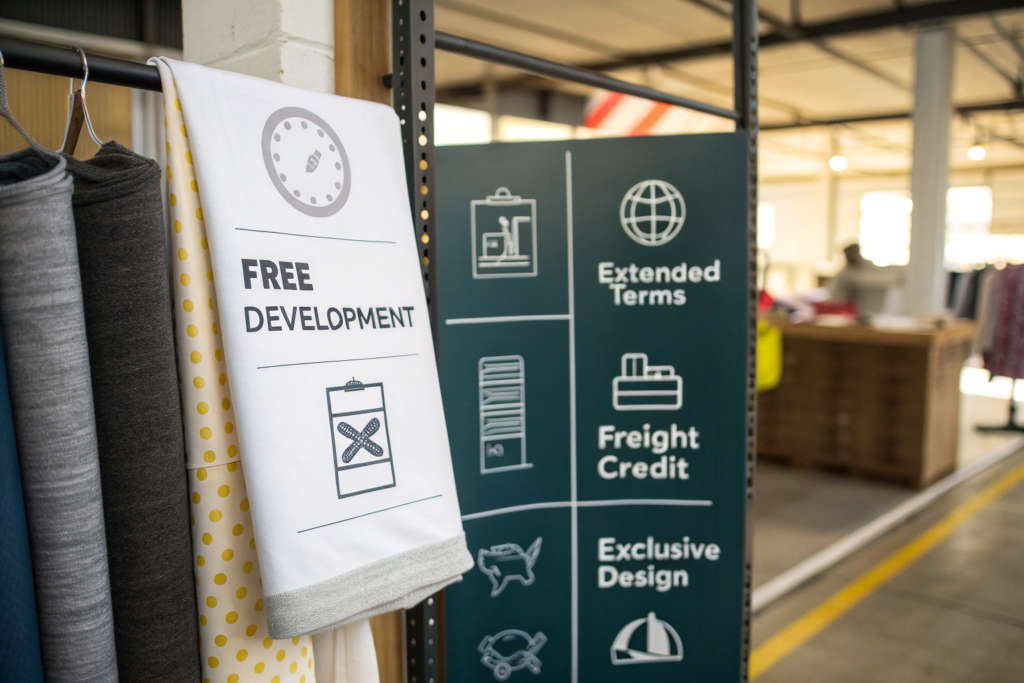
Non-cash markdown support options include fabric credit applied to the next season's production order, free or discounted development sampling for new styles, extended payment terms on future orders that improve the distributor's cash flow, freight cost absorption on the next shipment, priority production scheduling for the upcoming season, and exclusive design collaboration where the factory contributes design resources to develop a style specifically for the distributor. These options provide tangible value to the distributor while preserving the factory's cash position and margin on completed work.
How Does Fabric Credit on Reorders Work as a Markdown Support Tool?
Fabric is the largest cost component in garment manufacturing, typically representing 50-60% of the total production cost. A fabric credit applied to a reorder allows the distributor to offset a portion of their next season's production cost without the factory writing a check from the current season's completed order.
Here is how it works in practice. A distributor has a style that underperformed at Tier 2 level. Their next season order includes a style that uses a similar base fabric. We agree to apply a fabric credit of $1,200 against the new order, representing the fabric cost component of a negotiated support amount. The distributor's next season order is $1,200 less expensive, improving their margin on the new season's products. Our cost to provide this support is the wholesale fabric cost, not the retail value. We preserve our labor margin and overhead contribution on the current season's order. The distributor receives tangible financial relief that improves their cash flow and profitability on the next season. Both parties win. This fabric credit for markdown support mechanism is a creative alternative to cash discounts that we have used successfully with several distributor partners.
Why Do Extended Payment Terms Provide Meaningful Cash Flow Relief?
Inventory that is not selling consumes working capital. The distributor paid for the goods when they shipped. The cash is tied up in warehouse stock. Extended payment terms on future orders provide cash flow relief by delaying the outflow of cash for new inventory while the distributor clears the old inventory through markdowns.
If a distributor has a $50,000 order for the upcoming season, standard terms might require 30% deposit and 70% before shipment. Extended terms might adjust this to 30% deposit and 70% at 60 days after shipment, or even 30% deposit and 70% at 90 days. The distributor receives the new inventory, begins selling it, and generates revenue before the payment is due. The cash flow timing improvement helps offset the cash trapped in the underperforming inventory. The factory carries the receivable for a longer period, which has a cost, but it is a financing cost, not a margin write-down. For a factory with a strong balance sheet, extending payment terms to support a valued distributor partner through a difficult season is a manageable investment in the relationship. This extended payment terms for distributors approach requires trust and a strong financial foundation on the factory's part, which is why it is offered within established, long-term partnerships rather than to new or transactional accounts.
How Does a Top Manufacturer Prevent Markdown Situations Before They Occur?
The best markdown conversation is the one that never needs to happen. A top clothing manufacture does not simply respond to markdown requests generously. It invests in pre-season collaboration, data analysis, and production flexibility that reduces the probability of severe underperformance in the first place. The factory leverages its cross-brand perspective to identify patterns that a single distributor, focused on their own market, might miss.
Markdown prevention strategies include collaborative range planning where the factory provides sell-through data from comparable styles across its brand portfolio, small-batch test production that allows the distributor to validate demand before committing to volume, rapid reorder capability that reduces the need for large upfront inventory commitments, and fabric reservation programs that allow the distributor to hold material without committing to full production. These strategies shift the model from "produce large quantities and hope they sell" to "produce small quantities, test, and scale what works."
How Does Cross-Brand Sell-Through Data Inform Better Range Planning?
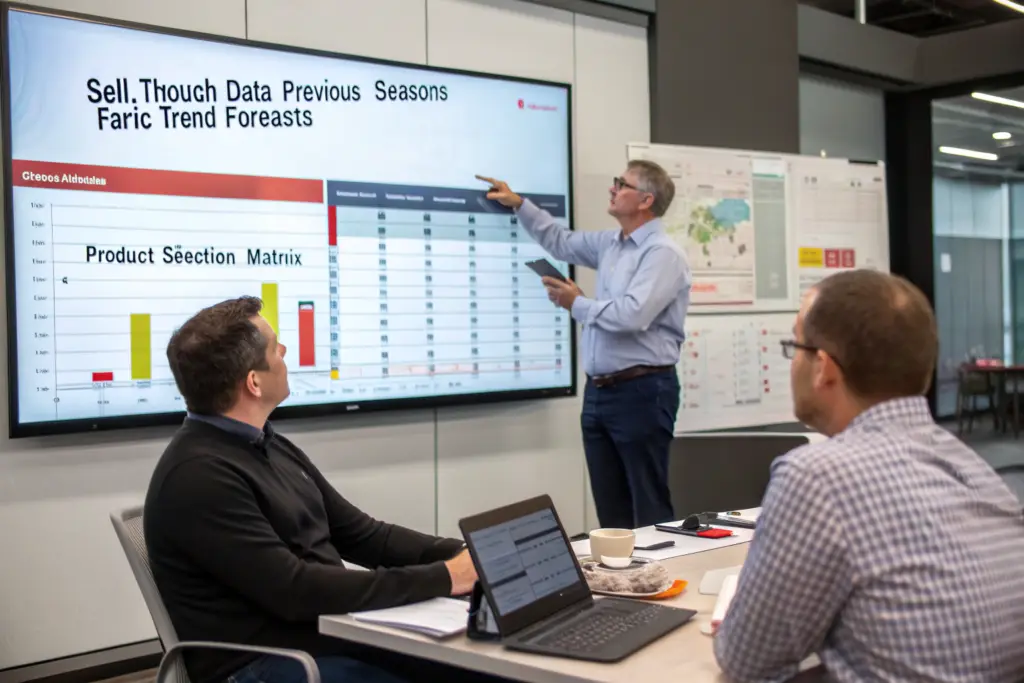
A factory that produces for multiple brands and distributors sees sell-through patterns across markets, categories, and price points that no single distributor can observe. This aggregated, anonymized data is a strategic asset that can help each partner make more informed product decisions.
We share aggregated trend insights with our distributor partners during the range planning phase. For example, data across our brand portfolio might reveal that heavyweight cotton hoodies in earth tones are outperforming lightweight hoodies in bright colors across multiple markets. A distributor planning their hoodie range can use this insight to adjust their color and weight mix. They are not copying any specific brand's design. They are responding to a market signal that their individual sales data might not yet reveal. This collaborative planning reduces the risk of committing volume to styles that are already showing market weakness. This collaborative range planning with manufacturers is a value-added service that transforms the factory from a production vendor into a strategic planning partner.
How Does the Test-and-Scale Model Reduce Overproduction Risk?
The traditional model of placing large seasonal orders months in advance forces the distributor to predict demand with limited information. Some styles will exceed expectations and sell out quickly, leaving revenue on the table. Other styles will underperform and require markdowns. The test-and-scale model reduces this forecasting burden by enabling smaller initial orders with the ability to scale winners rapidly.
Our flexible production line, Line 4, is specifically designed to support test-and-scale programs. A distributor can order 200 units of a new style, test market response, and if the style performs well, place a scaled reorder that we produce and deliver within three to four weeks. The initial inventory commitment is smaller. The risk of large-scale markdown is reduced because volume is only committed after demand is validated. A distributor we work with shifted three of their seasonal styles to the test-and-scale model. Two of the three styles performed well and were scaled. One underperformed, but the markdown exposure was on 150 units instead of 2,000 units. The cost of the markdown was minimal. The factory did not need to provide markdown support because the distributor's risk was already managed. This test-and-scale production model is the ultimate markdown prevention strategy because it aligns production volume with demonstrated demand rather than speculative forecasting.
How Do Markdown Conversations Strengthen Rather Than Weaken Long-Term Partnerships?
A markdown conversation is a stress test for a manufacturing partnership. When the market turns difficult and money is at stake, the true character of the relationship reveals itself. A factory that handles the conversation with fairness, transparency, and a genuine commitment to the partner's long-term success emerges with a stronger relationship. The distributor learns that their factory partner will support them when times are hard, not just when orders are flowing. This learning is more valuable than any single transaction.
Markdown conversations strengthen partnerships when they are handled with five principles: the factory acknowledges the distributor's market risk and approaches the conversation with empathy rather than defensiveness, both parties operate from a pre-agreed framework rather than ad-hoc negotiation, the support package includes elements that help the distributor succeed in the next season, not just clean up the current season, the conversation includes a learning component where both parties analyze the underperformance to improve future outcomes, and the factory follows through on commitments made during the conversation with the same reliability as on production commitments. These principles transform a potentially adversarial interaction into a trust-building moment.

How Does the Factory's Response to Difficulty Predict Future Partnership Quality?
Every distributor knows that the factory will be responsive and accommodating when orders are large and margins are healthy. The test of the partnership is how the factory responds when the distributor is struggling. A factory that offers support during a difficult season demonstrates commitment to the relationship beyond the transaction. A factory that refuses all support and hides behind the contract demonstrates that the relationship is purely transactional.
Several of our longest-standing distributor partnerships were strengthened by a markdown conversation early in the relationship. The distributor experienced a difficult season. We provided support within our framework. The distributor saw that we were willing to share the burden. When their business recovered and grew, they remembered who stood with them during the difficult period. The partnership deepened because it had been tested and had passed the test. A distributor partner once told me, "I knew you were a good factory when the orders were easy. I knew you were a great partner when the orders were hard." This partnership resilience in manufacturing is built through difficult conversations handled well, not avoided.
What Mutual Commitments Should Emerge from a Markdown Resolution?
A markdown resolution should not be a one-way concession. It should be a mutual commitment to improved outcomes in the future. The factory commits to specific support. The distributor commits to specific actions that reduce the probability of a similar situation recurring. Both parties exit the conversation with a shared plan.
The mutual commitments might include: the distributor commits to earlier sell-through data sharing so the factory can adjust production pacing, the factory commits to holding greige fabric inventory to enable faster reorders of winning styles and reduce the need for large upfront orders, the distributor commits to a test-and-scale approach for a portion of the next season's range, and the factory commits to a specific sampling timeline for replacement styles. These mutual commitments transform the markdown conversation from a backward-looking negotiation about who pays for past mistakes into a forward-looking collaboration about how to build a more resilient business model. This collaborative inventory risk management approach is the mark of a true manufacturing partnership, where the factory and the distributor view themselves as joint participants in the market's uncertainty rather than adversaries on opposite sides of a transaction.
Conclusion
End-of-season markdown requests are an inevitable feature of the apparel industry's hit-driven, seasonal business model. No amount of planning can eliminate the risk that some styles will underperform. A top clothing manufacture does not pretend otherwise or hide behind contractual language when the distributor faces inventory pressure. It engages the situation as a partnership challenge to be solved collaboratively, within a pre-agreed framework that balances the distributor's need for relief with the factory's need for financial sustainability.
At Shanghai Fumao, our approach to markdown support is an extension of our broader partnership philosophy. We invest in prevention through data sharing, test-and-scale production models, and collaborative range planning. When prevention is not enough, we provide support through a graduated framework that scales with the severity of the underperformance. We offer creative non-cash support options that provide meaningful value to the distributor while preserving our operational health. And we conduct every conversation with the respect and empathy that a valued long-term partner deserves.
If you are a distributor who has experienced cold, transactional responses to markdown requests from previous factory partners, or if you are building a sourcing strategy that values partnership resilience alongside price and quality, let us discuss how our approach to markdown management fits with your business. Contact our Business Director, Elaine, at elaine@fumaoclothing.com. Let us establish a markdown support framework, collaboratively plan a resilient product range, and build a partnership that handles both the hits and the misses with equal professionalism.