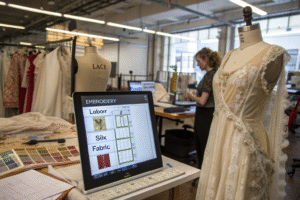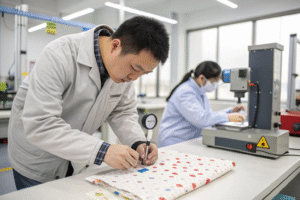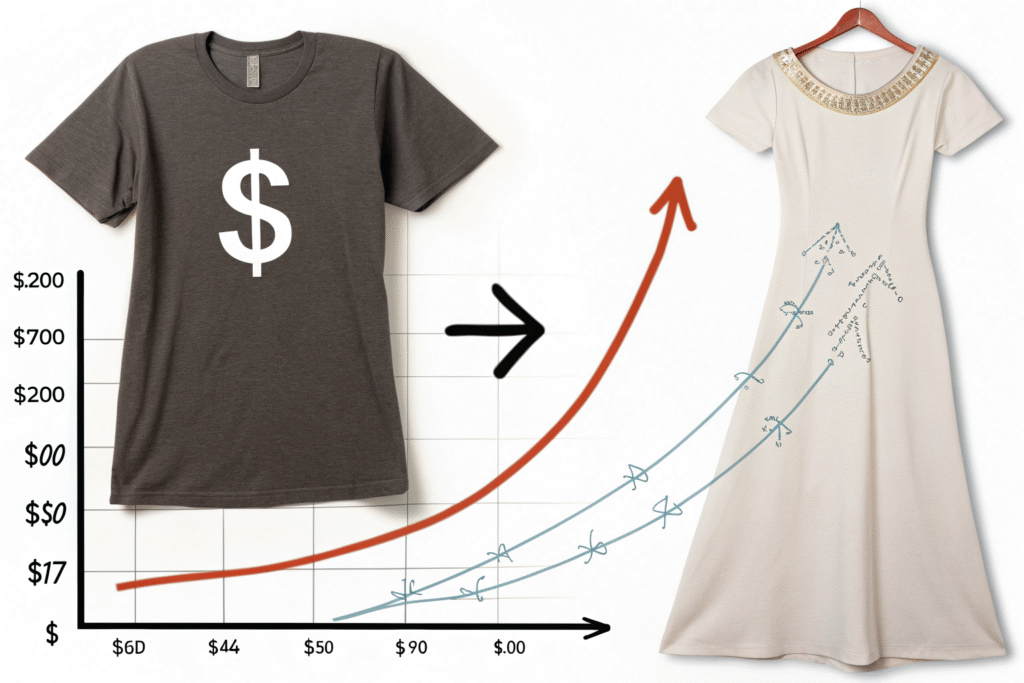
You've sketched a masterpiece: a dress with asymmetrical draping, hand-placed lace appliqués, and a hidden structural corset. It's stunning. Then you get the first production quote, and the number seems to belong to a different garment entirely. This shock isn't unusual—it's the direct, quantifiable impact of design complexity on production cost. Many designers see complexity as purely aesthetic, but in manufacturing, every creative decision translates into time, material, and skill, each with a clear price tag.
Design complexity exponentially increases production cost through four primary channels: inflated material consumption, extended labor time requiring higher skill levels, the need for specialized equipment/processes, and a significantly higher risk of error and rework. The cost impact is not linear; adding a second intricate feature often costs more than the first due to compounded production challenges. Understanding this relationship is not about stifling creativity, but about making empowered, strategic design choices.
At Shanghai Fumao, a client presented a design for a blouse with a delicate, multi-tiered ruffled sleeve. Their previous factory had quoted it as a "basic woven blouse with extra detail." In production, the ruffles consumed 2.5 times more fabric than a standard sleeve, required a specialized gathering attachment and highly skilled operators, and had a 30% rejection rate in quality control due to uneven gathers. The "extra detail" doubled the garment's cost. We re-engineered the pattern and construction method, achieving a similar visual effect with a layered-cut technique that reduced fabric waste by 40% and brought the reject rate under 5%. The client's cost fell by 35%. This is the power of understanding complexity's true cost.
How Does Complexity Directly Inflate Material Costs?
Material cost is often the largest line item, and complexity attacks it from multiple angles. It's not just about using more expensive fabric; it's about using more fabric inefficiently and requiring more ancillary materials.
The relationship between design and material consumption is geometric, not arithmetic.

Why Does Fabric Waste Skyrocket with Complex Patterns?
Simple garments use rectangular or nearly rectangular pattern pieces that can be nested efficiently on fabric, like a puzzle. Complex designs break this efficiency:
- Bias Cuts & Curved Seams: Pieces cut on the bias (45° to the grain) or with deep curves cannot be placed close together, leading to significant fabric utilization loss. A bias-cut skirt can have 25-40% more waste than a straight-cut one.
- Pattern Matching: Designs with stripes, plaids, or large motifs require aligning the pattern at seams. This often means cutting single layers and moving the pattern piece to find the perfect match, which can increase fabric consumption by 15-30%.
- Asymmetrical Designs: You cannot "mirror" pattern pieces, effectively doubling the number of unique pieces to lay out.
- Large Pieces & Draping: Voluminous designs (e.g., a circle skirt, cascading ruffles) simply use more square footage of fabric.
How Do Trims and Embellishments Create a Cost Cascade?
Every added element has a procurement and application cost:
- Custom Developed Trims: A unique button requires a mold (tooling fee of $500-$2000) and a high minimum order quantity (MOQ).
- Multi-Material Construction: Combining lace, mesh, satin, and neoprene in one garment means sourcing and managing four different fabrics, each with its own lead time, testing, and handling requirements.
- Embellishment Materials: The cost of beads, sequins, or specialty threads adds up quickly, but the larger cost is often the stabilizers, backing fabrics, and adhesives required to apply them correctly.
How Does Labor Time and Skill Level Drive Cost?
Labor cost is a function of time and skill. Complexity dramatically increases both. The Standard Allowed Minute (SAM) is the universal metric, and complex designs have a high SAM that isn't just a sum of operations—it's a multiplier of difficulty.
Skilled labor is a scarce and expensive resource. Complex designs demand it.

What Makes a Garment "High SAM"?
Let's break down the labor for a common complex feature: a set-in sleeve with a placket and functional buttonholes on a dress shirt.
- Basic Sleeve Attachment: ~2.5 minutes.
- Adding a Placket: Cuts, folds, and stitches a precise rectangle. Adds ~3.5 minutes.
- Adding Functional Buttonholes: Marking, machine programming, stitching, cutting open. Adds ~1 minute per buttonhole (e.g., +4 minutes).
This one feature can more than triple the sleeve attachment time. Now apply this to every complex element.
Why Is Skilled Labor More Expensive?
Complex operations require senior operators who command higher wages. They also work slower to ensure precision.
- Handwork: Hand-sewn finishes (hemming chiffon, attaching beads) are measured in hours/garment, not minutes.
- Specialized Machine Operation: Operating a computerized embroidery machine or a programmable bias binding attachment requires training. The machine itself is a capital investment.
- Quality Focus: Complex garments have more points of potential failure. Skilled operators have the experience to self-inspect and correct minor issues as they work, reducing downstream rejection rates.
The Hidden Labor: Pre-Production and Engineering
Labor cost isn't just sewing. It includes:
- Pattern Engineering: Grading a complex pattern across a full size run (XS-3X) is an expert task that can take 3-5 days vs. 1 day for a basic tee.
- Sample Making: A skilled sample maker may spend a full day constructing one complex prototype, iterating on construction order.
- Production Planning: Factories must plan more buffer time and potentially dedicate a separate line or team to complex styles to avoid disrupting the flow of simpler items.
At Shanghai Fumao, we categorize styles by complexity level (A, B, C) for scheduling and pricing. A "C" style (high complexity) has a labor cost multiplier of 2.0x to 3.5x that of an "A" style (basic).
What Is The Role of Specialized Processes and Equipment?
Some designs can't be made on standard assembly lines. They require dedicated spaces, specialized machines, or external subcontracting. Each of these adds a significant premium, often as a fixed cost that must be amortized over your order quantity.
This is where "makeability" meets "cost."

What Are Common Specialized Processes and Their Cost Impact?
| Process | Why It's Complex | Cost Impact |
|---|---|---|
| Embroidery | Requires digitized artwork, machine setup per color/design, stabilizer fabric, skilled operator. | High fixed setup cost + cost per 1,000 stitches. Small runs are very expensive per unit. |
| Garment Washing/Dyeing | Stone washing, enzyme washing, garment dyeing. Requires specialized facilities, chemicals, and expertise. Results are less predictable. | Per-kg or per-piece charge. Risk of shade variation adds cost of rework or sorting. |
| Technical Bonding/Taping | For seamless or waterproof garments. Uses heat presses, specialized tapes, and precise temperature control. | High machine cost, skilled labor, and additional material (tape). |
| Hand Embellishment (Beading) | Completely manual, time-consuming, requires artisan-level skill. Impossible to fully automate. | Highest labor cost per unit. Often subcontracted to specialist studios at a premium. |
How Does Subcontracting Affect Cost and Control?
When a factory doesn't have a process in-house (e.g., laser cutting, Swiss embroidery), they must subcontract. This adds:
- A Markup: The factory adds a management fee.
- Logistics Cost & Time: Transporting goods to/from the subcontractor.
- Quality & Timeline Risk: You are now dependent on another vendor's reliability.
Vertical manufacturers like Shanghai Fumao who have invested in in-house embroidery and washing facilities remove this layer, offering better cost control and faster turnaround for clients who frequently use these processes.
How Does Complexity Multiply The Risk of Error and Rework?
This is the most insidious cost driver. Complexity doesn't just make production more expensive; it makes it more prone to failure. The defect rate for a complex garment can be 5-10x higher than for a basic one. Each defect means a garment is either scrapped (losing all materials and labor) or requires costly rework.
Rework is the most destructive cost, as it burns time and resources without creating new value.

Where Do Errors Most Commonly Occur?
- Material Handling: Delicate fabrics (chiffon, lace) are easily snagged or distorted during cutting and sewing.
- Construction Sequence: A complex garment has a specific, unforgiving order of operations. Missing a step or doing it out of order can make later steps impossible.
- Embellishment Placement: Misaligned embroidery or beading is often impossible to fix without damaging the base fabric.
- Fit Issues: Complex draping or tailoring is harder to grade accurately across sizes, leading to fit failures in some sizes that weren't caught in sampling.
How Does This Impact Quality Control (QC) Costs?
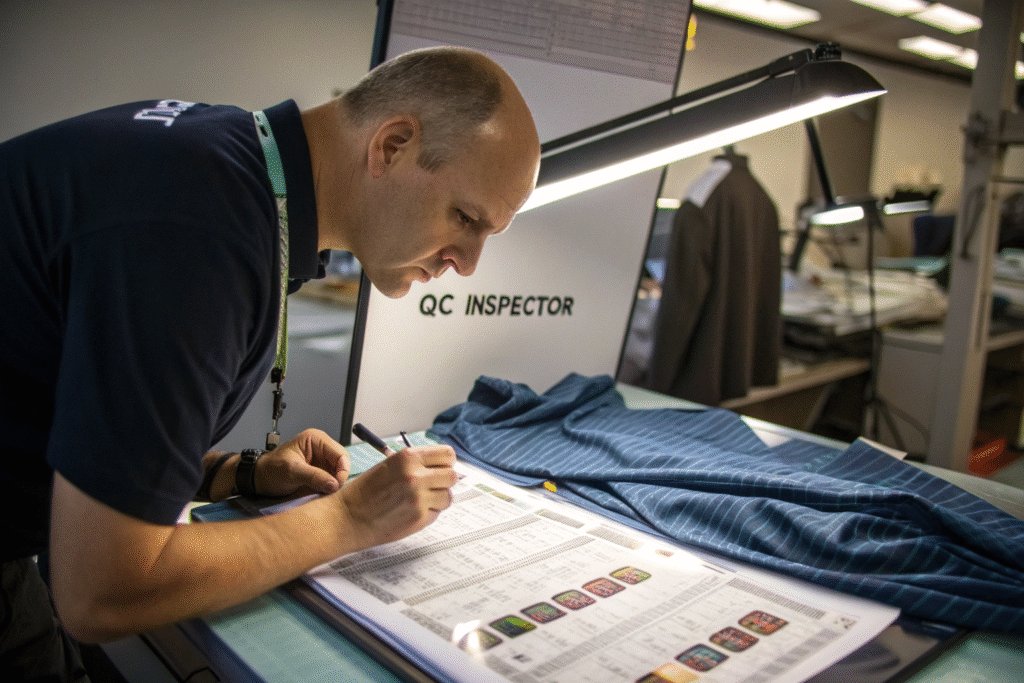
QC for complex garments is more intensive:
- More Inspection Points: Requires in-process checks (IPQC) at almost every stage.
- Stricter AQL Standards: You may need to use a tighter Acceptable Quality Level (e.g., Level I instead of Level II), meaning more pieces are inspected.
- Skilled Inspectors: The QC staff must understand the intricate construction to properly evaluate it.
A real example: We produced a batch of dresses with a hidden internal waist-stay. One operator sewed it in backwards on 50 pieces. The error wasn't visible until the final inspection. Fixing it required partially disassembling the lining of each dress—a rework cost that added 15% to the effective labor cost of that batch.
How Can You Strategically Manage Complexity for Cost Control?
Understanding the cost impact is the first step. The second is learning to manage it. This doesn't mean avoiding complexity, but deploying it strategically where it delivers the highest perceived value to the customer and brand identity.
Smart design is as much about engineering as it is about aesthetics.
What is "Value Engineering" in Garment Design?
This is a collaborative process with your manufacturer to simplify construction without simplifying the look.
- Simplify Seam Construction: Can a French seam be replaced by a flat-felled seam that is faster to produce but equally durable?
- Redesign Pattern Pieces: Can two pattern pieces be combined into one, reducing seams and cutting time? We often use 3D pattern simulation software to test this.
- Standardize Components: Can you use the same custom button across multiple styles to increase order volume and lower its unit cost?
- Optimize Embellishment Scope: Instead of all-over beading, can a concentrated motif on the collar or cuff create the same luxe impact for 30% of the cost?
How Does Volume Planning Mitigate Complexity Cost?
Fixed costs (pattern engineering, digitization, tooling) are amortized over quantity.
- For a very complex style, a higher Minimum Order Quantity (MOQ) is often necessary for the factory to justify the production line setup and for you to achieve a viable unit cost.
- Consider a "Hero & Support" Collection Strategy: Launch one breathtaking, complex hero piece that defines the collection's vision, supported by simpler, high-margin basics that carry the financial load.
Why is Early Manufacturer Collaboration Critical?
Involving a technical expert like Shanghai Fumao at the sketch or tech pack stage is the single most effective cost-control measure. We can flag a design feature that will triple the SAM or suggest a minor tweak that saves 20% in fabric. This early collaboration turns cost from a surprise into a planned variable.
Conclusion
The impact of design complexity on production cost is profound, multiplicative, and often underestimated. It permeates every aspect of manufacturing: materials, labor, processes, and risk. However, this relationship is not a barrier to beautiful design; it is the fundamental framework within which creative and commercial success must be balanced. By quantifying complexity through detailed costing, engaging in value engineering, and collaborating early with a technically adept manufacturer, you can make informed choices that allow your most ambitious designs to be realized profitably.
The most successful brands are those that master this balance, using their understanding of cost drivers not to limit creativity, but to focus it with precision and strategic intent.
If you are designing complex apparel and seek a manufacturing partner who provides not just a price, but deep technical insight and collaborative cost engineering, we are built for this challenge. At Shanghai Fumao, we combine creative problem-solving with precise costing to help you navigate the true impact of complexity. Contact our Business Director Elaine to turn your intricate designs into commercially viable realities: elaine@fumaoclothing.com.