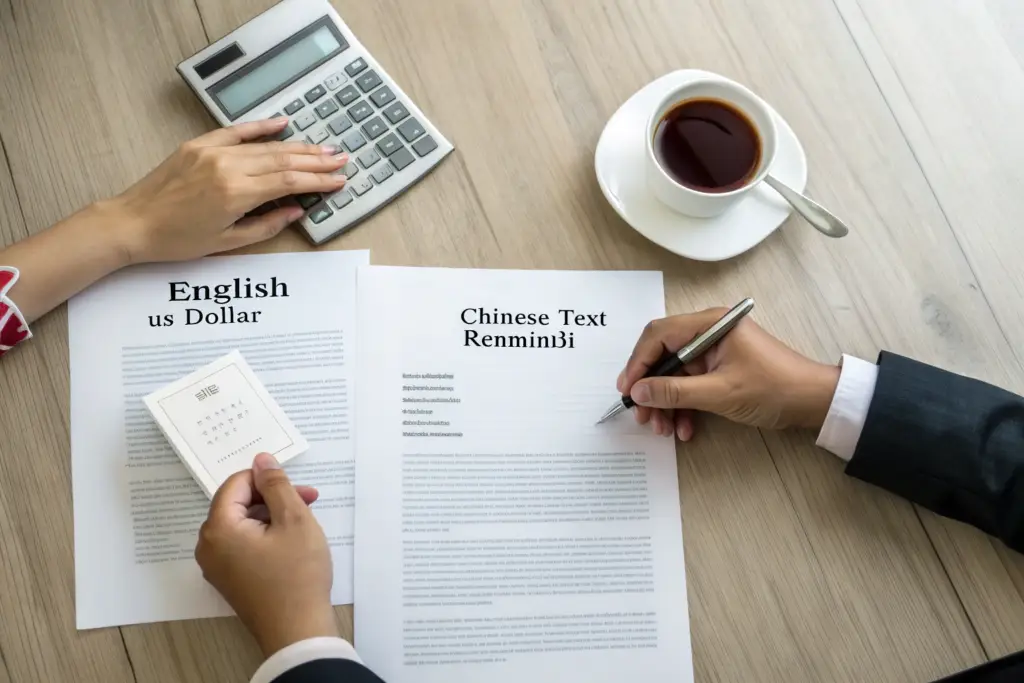
A brand owner from Chicago sat in my office six months ago, arms crossed, expression hard. He had been burned. His previous supplier had demanded a 50% deposit, then gone silent for three weeks. When the supplier finally resurfaced, the ship date had slipped by a month. The supplier blamed a "fabric delay," but my client suspected his deposit had simply been used to finish another brand's order. He told me, "I will never pay more than 10% upfront again. I don't trust any Chinese factory now." I understood his anger. But I also knew his 10% demand would lock him out of every quality factory in China. His previous supplier was a bad actor. The payment term was not the problem. The lack of transparency and trust was.
The most common misunderstandings about Chinese garment payment terms are that 30% deposit and 70% against shipping documents is inflexible, that larger deposits indicate a factory in financial trouble, and that all payment methods carry the same level of buyer protection. In reality, these terms are structured around the factory's genuine raw material procurement costs, and the standard terms can be adjusted when the buyer provides verifiable financial security or order history. The misunderstanding is not about the percentage. It is about the underlying economics and risk allocation.
Payment terms are a negotiation, not a declaration. They reflect the cost structure of the order, the history of the relationship, and the balance of power between the factory and the buyer. When both sides understand what drives the numbers, the negotiation becomes collaborative rather than confrontational. At Shanghai Fumao, our payment terms are a starting point for a conversation, not a wall. But that conversation requires understanding the factory's perspective, which I will share with you now.
Why Is the 30/70 Payment Structure So Standard in Chinese Manufacturing?
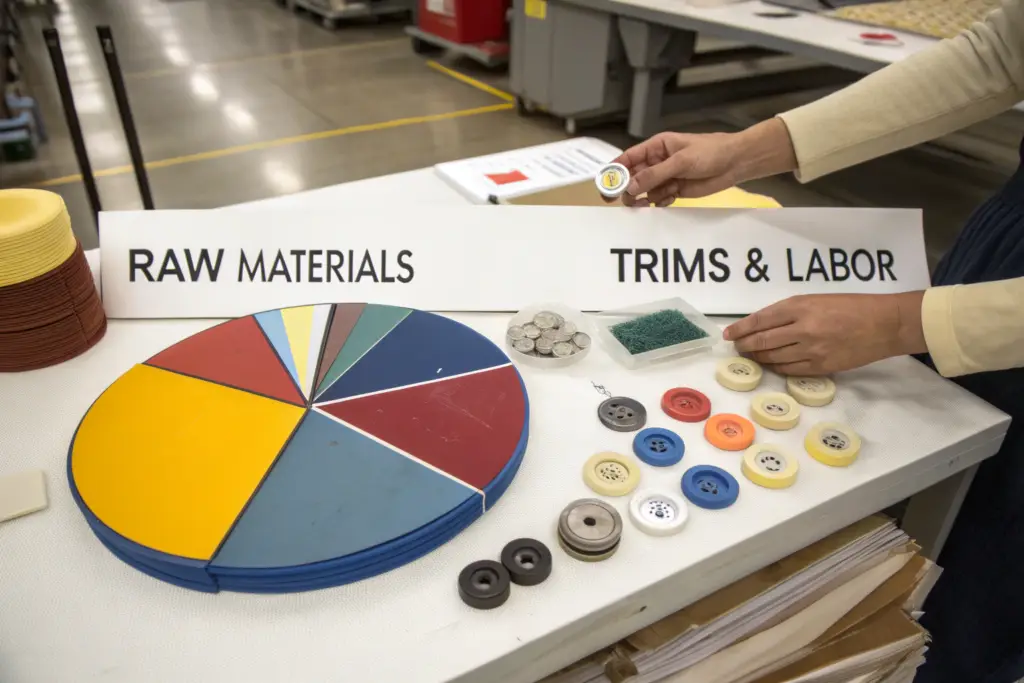
When a US buyer hears "30% deposit," they often hear "risk." They imagine the factory taking their money and disappearing. When a Chinese factory says "30% deposit," they are saying "fabric." The deposit is not profit. It is not operating cash flow for other projects. It is the exact amount of money the factory must pay to the fabric mill and trim suppliers before a single meter of your specific material is produced. The factory is not asking for a loan. They are asking you to fund the raw materials that will become your unique product.
The 30/70 structure is standard because fabric and trims typically represent 30% to 40% of the total garment cost, and these materials are ordered specifically for each client's order. The factory cannot return custom-dyed fabric to the mill. The deposit protects the factory against the catastrophic loss of buying expensive raw materials for an order the buyer later cancels. The 70% balance paid against shipping documents ensures the buyer does not pay the full amount until the goods are proven to exist and are ready to ship.
The structure is a balanced risk allocation. The buyer risks 30% on the factory's integrity and capability. The factory risks 70% of the production cost, including all the labor, overhead, and finishing, on the buyer's commitment to accept the finished goods. Both parties have skin in the game. Both parties have an incentive to complete the transaction successfully.
How Does the Deposit Directly Fund Your Specific Raw Material Procurement?
Let me show you the actual math for a typical order. A distributor orders 1,000 units of a women's linen dress. The FOB price is $12 per unit. The total order value is $12,000. The 30% deposit is $3,600. Where does that $3,600 go?
The fabric consumption is 1.5 meters per dress, so 1,500 meters total. The linen fabric costs $4 per meter from the mill. The fabric bill is $6,000. The deposit of $3,600 covers 60% of the fabric bill. The factory pays the remaining 40% from its own working capital. The trims, the buttons, the labels, the thread, the zippers, cost another $800. The factory pays this upfront as well.
The mill will not begin weaving your specific linen until they receive payment, or a firm purchase order backed by a payment guarantee. The mill has the same concern the factory has: producing a custom product for a buyer who might cancel. The deposit flows through the factory to the mill. It is the fuel that starts your production engine. When a buyer resists the deposit, they are asking the factory to finance their raw materials. Most factories simply do not have the working capital to do this, especially for custom fabrics in non-standard colors or compositions.
I once had a client who asked if we could reduce the deposit to 10%. I asked him a simple question. "Would you be willing to prepay the fabric mill directly?" He was surprised. He had never thought about the deposit as a pass-through cost. When I explained that the deposit goes to the mill, not to our profit margin, he understood. We reached a compromise. He paid the 30% deposit, but we provided the mill's invoice as proof that his funds were used exclusively for his fabric. The transparency solved the trust issue. The standard structure remained, but the understanding behind it changed.
What Happens to Your Deposit If a Factory Suddenly Closes Before Shipping?
This is the nightmare scenario that keeps brand owners awake. The deposit is paid. The factory goes silent. Weeks pass. Then the factory is simply gone. The money is lost. This does happen, and it is the core fear behind the resistance to larger deposits.
The protection against this risk is not in the payment term percentage. It is in the due diligence you perform before paying any deposit. A 10% deposit lost to a fraudulent factory is still a loss. A 30% deposit paid to a verified, stable factory with a long track record is secure. The percentage is less important than the counterparty's integrity.
Verify the factory's business license, export history, and physical premises before paying a deposit. Use the verification techniques we discussed in a previous article. Check their US import records. Conduct a live video walkthrough. Confirm their legal business name matches their bank account name. A factory with a 15-year operating history, a factory building they own, and verifiable shipments to known US brands is extremely unlikely to disappear with a $5,000 deposit. The cost of disappearing would be far greater than the deposit they could steal.
A factory that is financially unstable may not be fraudulent, but it may still fail to deliver. Warning signs include a factory that is desperate for the order, that agrees to any price and any term without negotiation, or that pressures you to wire the deposit to a personal account or a different company name. A professional factory's bank account name matches its business license name exactly. Any deviation is a red flag. The security of your deposit depends far more on the quality of the counterparty than on the size of the percentage.
Can Letter of Credit Terms Be Negotiated with Mid-Sized Chinese Manufacturers?
The Letter of Credit, or L/C, is often presented to Chinese factories as the gold standard of payment security for the buyer. An irrevocable L/C at sight means the buyer's bank guarantees payment once the factory presents compliant shipping documents. The factory is assured of payment. The buyer is assured the goods shipped before payment is released. In theory, it is a perfect instrument. In practice, it is often a point of friction.
Letter of Credit terms can be negotiated with mid-sized Chinese manufacturers, but they are not universally accepted. An L/C imposes documentary compliance burdens and banking fees on the factory. It also ties up the factory's credit line with their own bank. Factories will accept L/C terms when the order value is large, the buyer is a new relationship, or the buyer's creditworthiness is established through a reputable issuing bank. For smaller orders or established relationships, the administrative cost of an L/C often outweighs its protective benefit for both parties.
The factory's perspective on an L/C is pragmatic. An L/C requires the factory to produce a precise set of documents, a commercial invoice, a packing list, a Bill of Lading, a certificate of origin, perhaps an inspection certificate, with zero discrepancies. If a single document contains a typo, the bank can refuse payment until the discrepancy is resolved. This creates a cash flow delay. The factory also pays L/C advising and negotiation fees, which reduce their margin. For a $15,000 order, the L/C fees can be a significant percentage of the profit. For a $150,000 order, the fees are negligible.
What Are the Hidden Bank Fees and Documentary Risks for the Factory?
The buyer often does not see the cost an L/C imposes on the factory. The advising bank charges a fee to authenticate the L/C. The negotiating bank charges a fee to examine the documents. If discrepancies are found, there is a discrepancy fee. If the L/C is amended, there are amendment fees. These fees can total several hundred dollars, which is meaningful on a small to mid-sized order.
The documentary risk is the bigger concern. The factory must present documents that comply exactly with the terms of the L/C. The L/C might specify "Shipment from Shanghai Port to Los Angeles Port." If the Bill of Lading says "Port of Loading: Shanghai, China" instead of "Shanghai Port," that is a discrepancy. The bank can refuse payment. The factory has shipped the goods but has not been paid. The goods are on the water. The factory is in a weak negotiating position.
I have seen factories refuse L/Cs not because they distrust the buyer, but because their internal documentation team is small and they fear making a costly clerical error. They prefer the simplicity of a T/T transfer against a copy of documents. The buyer gets the same security, the documents prove the goods exist, but without the rigid documentary compliance regime of a formal L/C.
A compromise that works well is a "T/T against copy of documents" arrangement. The factory produces the commercial invoice, packing list, and Bill of Lading. They email scanned copies to the buyer. The buyer transfers the 70% balance upon receiving the copies. The factory then releases the original documents or telex-releases the cargo. This gives the buyer payment security, they only pay when the goods are proven shipped, and the factory avoids L/C bank fees and documentary risk. It is the most common compromise in my experience.
How Can a "Partial L/C" Structure Balance Risk for Both Sides?
A partial L/C structure splits the transaction into two payment streams. A percentage, often the deposit or a portion of the balance, is paid by T/T. The remaining balance is covered by an irrevocable L/C. This hybrid model addresses the concerns of both parties.
A common structure is 30% T/T deposit, with the 70% balance covered by an L/C at sight. The buyer protects the 70% balance with the bank's guarantee. The factory receives the 30% deposit immediately for raw material procurement, without waiting for L/C documentation. The L/C covers the larger balance, giving the buyer security on the majority of the order value.
Another structure is the opposite: 30% by L/C, 70% T/T against copy of documents. This is less common but can work when the factory needs the cash flow from the balance more quickly than an L/C negotiation allows.
The partial L/C is a signaling mechanism. A buyer who offers a partial L/C is demonstrating financial sophistication and a commitment to a fair transaction. A factory that accepts a partial L/C is demonstrating confidence in their documentation processes and a willingness to share the banking burden. The negotiation of the split is a test of the relationship's maturity.
I facilitated a partial L/C deal for a first-time transaction between a US distributor and a mid-sized Chinese knitwear factory. The order was $85,000. The distributor was nervous about wiring a large deposit to a new partner. The factory was nervous about the L/C documentary burden on a complex order with multiple styles. We structured it as 20% T/T deposit, 80% irrevocable L/C at sight. The deposit was low enough to reduce the buyer's risk. The L/C covered the factory's full production cost. The factory assigned one person to manage the L/C documentation for that single order. The transaction closed cleanly. The next season, with trust established, they switched to 30/70 T/T. The L/C was a bridge to a simpler, trust-based payment model.
How Can You Build Trust to Negotiate More Flexible Payment Schedules?
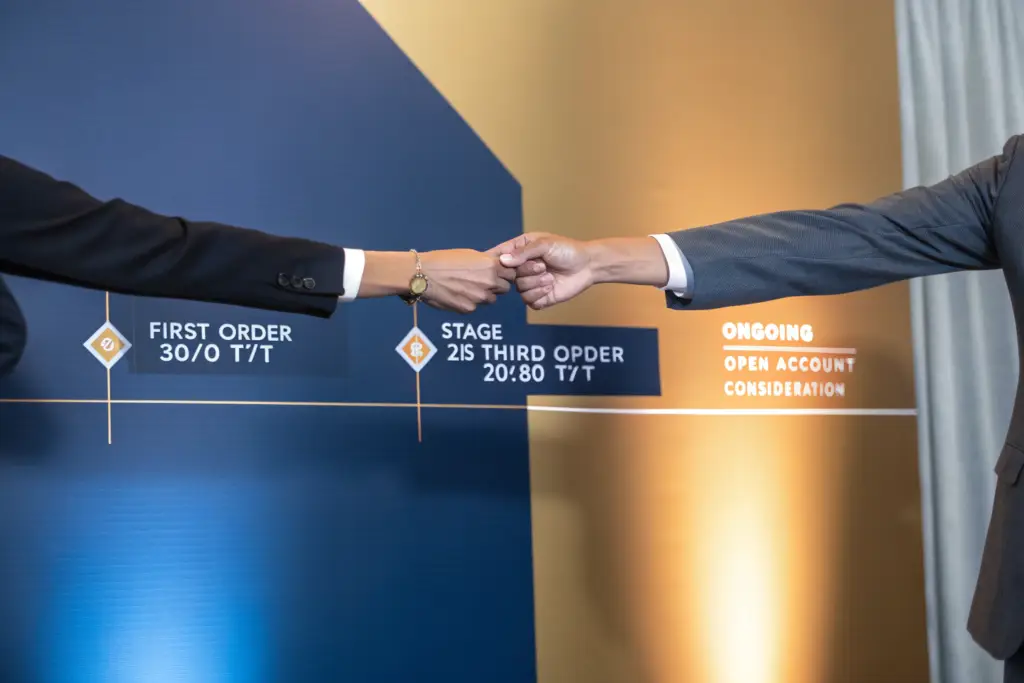
Payment terms are not static. They should evolve as the relationship matures. The first order terms protect both parties against the unknown. The third order terms reflect the track record that has been established. The tenth order terms reflect a deep partnership where payment is almost a formality because the mutual dependency is so strong. Too many buyers approach every factory interaction as a one-off transaction. That mindset locks both sides into rigid, defensive payment terms forever.
Building trust to negotiate more flexible payment schedules requires demonstrating consistent order history, providing trade references from other suppliers, and being transparent about your own business financials. Flexibility is earned, not demanded. A factory that sees a buyer as a reliable, long-term revenue stream will willingly adjust terms to accommodate that buyer's cash flow needs because the lifetime value of the relationship far outweighs the marginal risk of slightly relaxed terms.
The goal is to move from a transaction-based risk assessment to a relationship-based risk assessment. A transaction-based assessment asks, "What could go wrong with this single order?" A relationship-based assessment asks, "What is the probability this partner will default across our entire ongoing business?" The second probability is much lower because the cost of default is much higher. The factory understands this calculus.
How Does a Track Record of On-Time Balance Payments Improve Your Leverage?
Every time you pay a balance invoice on time, you are making a deposit in a trust account. The factory's accounting team notes it. The factory owner notes it. Reliable payers are rare and valuable. A factory will go to great lengths to keep a reliable payer happy because cash flow predictability is one of the hardest problems in manufacturing.
After three seasons of on-time payments, a client of mine asked to shift from 30/70 to 20/80. He had paid every balance within 48 hours of receiving the shipping documents. He had never disputed an invoice. He had never made a partial payment. He had built a spotless payment record. We agreed to the 20/80 structure without hesitation. His track record had eliminated the risk the extra 10% deposit was designed to cover.
The leverage works both ways. A buyer with a history of late payments, disputed invoices, or last-minute deductions will find the factory tightening terms, not loosening them. The factory will increase the deposit requirement to protect against the buyer's unpredictability. Payment discipline is a strategic asset. Treat every payment as an opportunity to strengthen your negotiating position for the next order.
After a year of working with Shanghai Fumao, a distributor client asked if we could offer net-30 terms on the balance payment. This is a significant concession, essentially providing the buyer with a month of free credit. We reviewed his payment history. Twelve invoices. All paid early or on time. Zero disputes. We agreed to a trial of net-15, with a review after three orders. His track record earned him credit. His ongoing reliability has maintained it. He now has payment terms that most of his competitors cannot access, giving him a cash flow advantage.
What Role Does a Personal Relationship with Factory Ownership Play?
The garment industry, especially in China, is still a relationship-based business. The legal contract is important, but the personal relationship often determines how the contract is interpreted when something goes wrong. A buyer who has only interacted with a sales representative over email has a transactional relationship. A buyer who has visited the factory, shared a meal with the owner, and shown genuine respect for the operation has a personal relationship.
When a payment issue arises, a delivery delay, a quality dispute that requires a financial adjustment, the personal relationship determines the tone and the outcome. A factory owner will extend flexibility to a buyer they know and respect. They will accommodate a one-time payment delay caused by the buyer's cash flow crunch. They will absorb a small cost to fix a problem. They will do these things because the relationship has value beyond the transaction.
This is not about guanxi in a corrupt sense. It is about basic human psychology. We are more willing to help people we know and like. A video call where you show the factory owner your warehouse, introduce your team, and talk about your business vision builds more payment flexibility than any contract clause ever could.
A client from the UK visits our factory once a year. He spends two days with us. He walks the production floor. He talks to the pattern maker who works on his designs. He has dinner with me and my family. When his business had a tough season and he needed an extra two weeks to pay his balance, there was no question. I knew him. I knew his character. I knew he would pay. The personal relationship allowed a flexibility that the contract did not explicitly provide. That is the intangible value of being more than an email address.
Conclusion
Payment terms are a language. When you understand the grammar, the conversation becomes productive. The 30/70 structure is not a power play. It is a direct reflection of the raw material cost that the factory must pay to your specific fabric mill before your production begins. The deposit is not profit. It is a pass-through. When you understand this, you can ask better questions. You can ask for proof that your deposit went to the mill. You can negotiate based on actual material costs, not abstract percentages.
The Letter of Credit is a tool, not a weapon. It has a place in large, first-time transactions where both parties need the security of a bank intermediary. But it imposes real costs and documentary risks on the factory. For ongoing relationships, simpler structures like T/T against copy of documents provide equivalent security with less friction. The partial L/C is an elegant bridge between these two worlds.
The most powerful payment term negotiator is not a lawyer. It is a track record. Every on-time payment you make is a brick in a foundation of trust. A foundation strong enough to support 20/80 terms, net-15 terms, or even open account terms. The goal is not to win a one-time concession. The goal is to build a partnership where payment terms become less relevant because both parties have absolute confidence in each other's integrity and capability.
At Shanghai Fumao, we start new relationships with standard, balanced terms. We are transparent about where the deposit goes. We are flexible on the balance payment mechanism. We are willing to discuss L/Cs for appropriate transactions. And we are committed to evolving our terms as your trust in us grows, and as our trust in you grows. Payment should never be a point of fear. It should be a reflection of a fair, transparent partnership.
If you have been burned by payment terms in the past, or if you are negotiating with a factory and want to understand what is reasonable, I invite you to contact our Business Director, Elaine. She can explain our standard terms in detail, walk you through the specific material costs behind a deposit for your product type, and discuss how terms can evolve as our relationship develops. Reach Elaine at elaine@fumaoclothing.com. Let's build a payment partnership that feels secure, fair, and transparent for both of us.