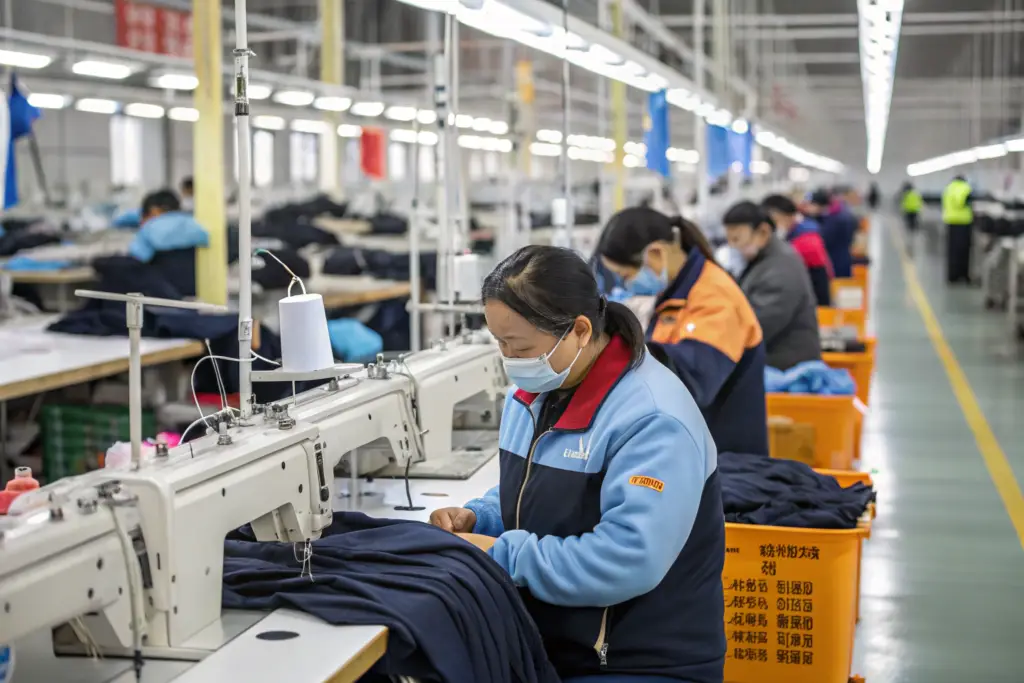
September is our war room month. Every factory owner in China knows it. The emails from Europe are frantic. The Fall/Winter collections that were confirmed in April are suddenly urgent. The Summer 2027 samples need to be squeezed in. A fabric delay from one mill cascades into a scheduling nightmare for three different brands. The phones ring constantly. Every client believes their order is the most important. And we have five production lines. Not six. Not ten. Five. The math is unforgiving. Capacity is finite. Time is finite. The only variable we control is how we allocate those finite resources.
A factory with five production lines prioritizes orders during peak seasons using a weighted triage system based on three criteria: committed ship date proximity, client relationship tier, and order completion proximity. Orders that are closest to their ship date, for long-term strategic partners, and nearest to completion receive priority. This system is transparent, data-driven, and communicated proactively to all clients so that no one is surprised by their production schedule.
Priority is not favoritism. It is survival. If we do not have a system, chaos rules. The loudest voice gets the capacity. The client who complains most aggressively gets their order pushed ahead. That is not fair. It is not sustainable. And it destroys trust with the quiet clients who are just as important but less demanding. At Shanghai Fumao, our priority system is designed to maximize the number of orders that ship on time, minimize the number of clients who are disappointed, and protect the long-term health of our production ecosystem. Let me show you how the machine works when the pressure is highest.
What Triage Criteria Determine Which Orders Get Production Priority?
When five lines are fully booked and a crisis hits, a fabric delay, a machine breakdown, a sudden urgent reorder from a key client, we cannot just "work harder." The lines are already at maximum throughput. We must make a choice. Which order moves? Which order waits? That choice is guided by a triage framework we developed over years of managing peak seasons. It removes emotion from the decision and applies consistent, defensible logic.
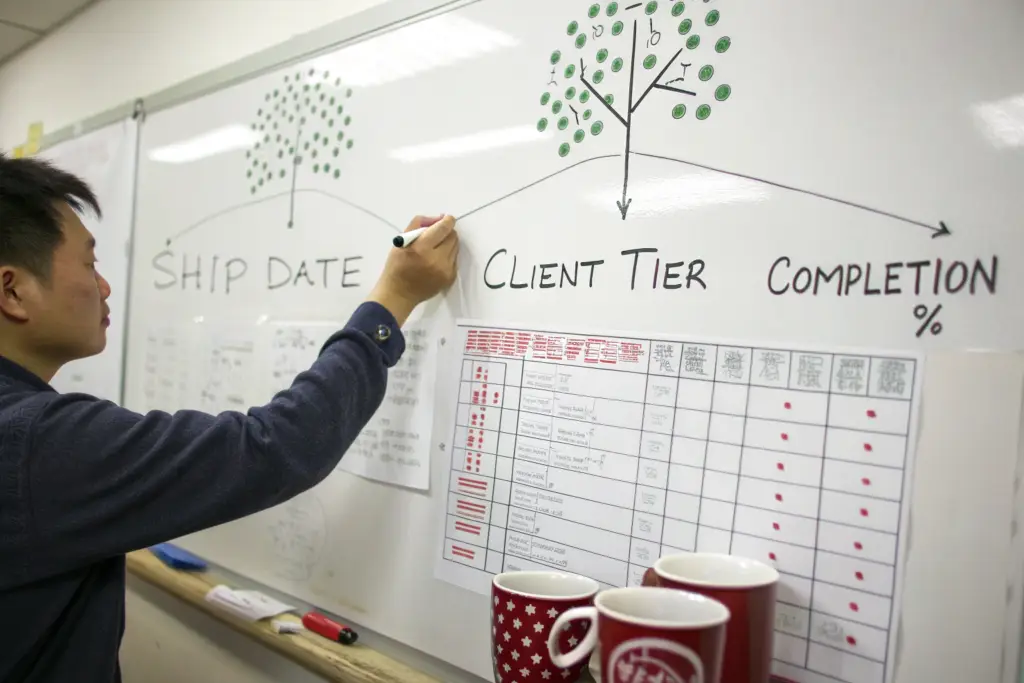
The three triage criteria are Ship Date Criticality, measured by the number of working days remaining before the committed ex-factory date; Client Strategic Value, measured by the annual order volume, payment reliability, and relationship longevity; and Order Completion Proximity, measured by the percentage of the order already cut, sewn, or finished. Each criterion is weighted and scored. The total score determines the line allocation and the sequence within each line.
This is not a theoretical exercise. Our production manager runs a priority scoring meeting every Monday morning during peak season. Every active order is on the table. Every order has a score. The scores determine the week's production sequence. If a client calls to demand priority, we can show them exactly where their order sits in the queue and why. The transparency usually defuses the tension. They may not like their position, but they understand it.
How Does "Ship Date Criticality" Override Most Other Factors?
The ship date is the ultimate arbiter. A garment that must leave the factory on October 1st to make a Black Friday retail floor set has an immutable deadline. If it ships on October 10th, the client misses the selling window. The garments become dead stock. The financial damage to the client is catastrophic. This order gets priority over an order that ships on October 15th for a brand with a more flexible delivery window, even if the October 15th brand is a larger client.
We calculate Ship Date Criticality as a countdown. An order with five working days remaining before the ex-factory date has a criticality score of 10. An order with twenty working days remaining has a score of 3. The scores are updated daily. As a ship date approaches, the criticality score automatically rises, and the order moves up the priority queue. This ensures that no order accidentally slips through the cracks simply because it was booked earlier and forgotten.
This system also protects the factory. When a fabric delay pushes an order's start date back by a week, we immediately recalculate the criticality score. If the score jumps, we flag it in the Monday meeting and allocate additional line capacity, perhaps overtime on a specific line, to recover the lost week before the ship date. The criticality score is an early warning system that prevents small delays from becoming missed shipments.
A client from London had an order of women's wool coats scheduled for a September 15th ship date. The wool melton fabric arrived five days late from the mill. Our system automatically flagged the order as criticality 10. We shifted the coat order onto two lines simultaneously for three days, pulling capacity from an earlier-stage order with a later ship date. The coats shipped on September 16th, one day late. The other order shipped on time as well, because it had buffer built into its schedule. Without the triage system, both orders would have been late. The criticality score allowed us to make a precise, surgical intervention.
Why Does "Strategic Client Value" Matter Without Being Unfair?
A factory that treats all clients identically is making a business mistake. A client who places $500,000 in orders annually, pays on time, and has partnered with us for five years is not the same as a client placing a $15,000 one-time trial order. The strategic client has earned a higher level of service. This is not unfair. It is a reflection of the mutual commitment in the relationship.
Strategic Client Value is scored based on objective criteria: annual order volume, payment reliability, relationship duration, and growth trajectory. A high score does not mean the client can demand unreasonable deadlines. It means that when two orders have the same Ship Date Criticality score, the strategic client's order gets the capacity first. It is a tiebreaker, not a bypass.
This scoring also serves the smaller client. The triage system prevents a large client from bullying the factory into prioritizing their order at the expense of smaller clients. The rules apply to everyone. A large client with a ship date three weeks away cannot demand priority over a small client with a ship date three days away. The system says no. The factory manager can point to the score and hold the line. The triage system protects the small client from the power imbalance in the relationship.
We had a situation where a major client requested a last-minute design change that would delay their order by two weeks. Their Strategic Value score was the highest in our system. But the delay pushed their Ship Date Criticality into the red zone, and they wanted us to bump another client's order to accommodate them. We showed them the triage board. The other client's order had a higher criticality score and a solid Strategic Value score of its own. We could not bump them. The major client was frustrated, but they respected the system. They accepted the delayed ship date. The other client shipped on time, unaware that their order had been defended by an algorithm.
How Do Modular Line Setups Allow for "Dynamic Capacity Shifting"?
A traditional production line is a fixed entity. Line 1 makes shirts. Line 2 makes pants. If shirt orders are overflowing and pants orders are light, Line 1 is overwhelmed while Line 2 is underutilized. The factory cannot easily shift pants sewers to shirt sewing because the skills, machines, and workflow are different. This rigidity is a major source of peak season bottlenecks.
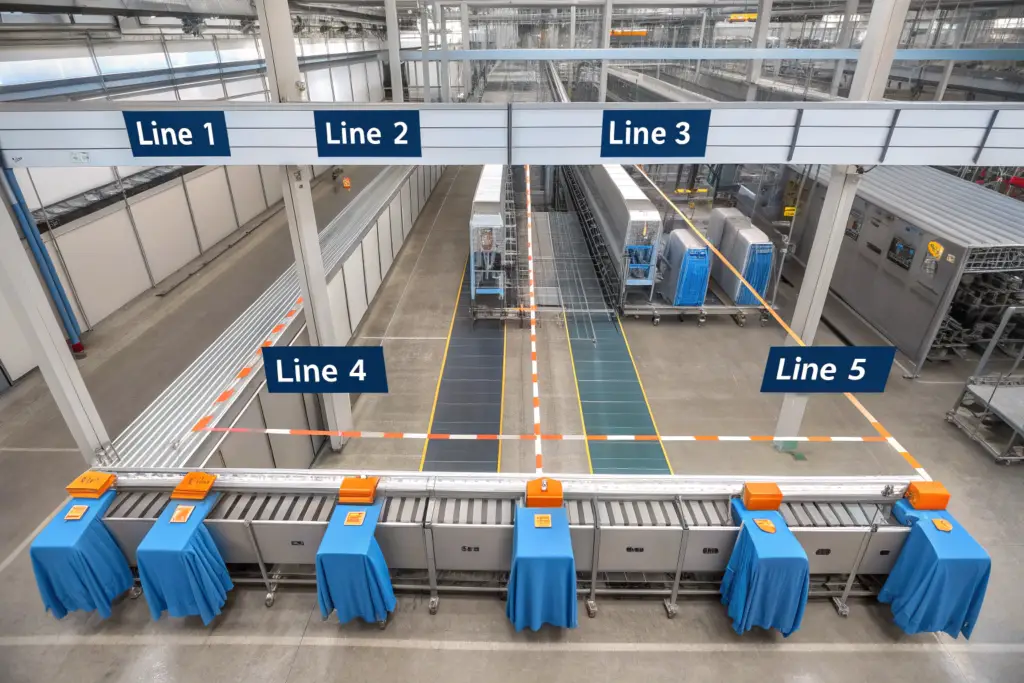
Modular line setups allow dynamic capacity shifting because each line is staffed with cross-trained operators and equipped with flexible machinery that can handle multiple garment types. When one product category experiences a surge, capacity can be reallocated from lighter-loaded lines by shifting operators or by converting an entire line to the high-demand product. The modular design treats the five lines not as five separate factories, but as a single, fluid capacity pool that can be reconfigured daily.
We invested in modularity three years ago, and it has transformed our peak season management. Each line is a self-contained mini-factory capable of producing a complete garment. The operators on each line are trained on at least three different product types. The sewing machines are mounted on mobile tables with quick-connect power and air. A line can be reconfigured from woven shirts to knit tops in under two hours. This flexibility is the difference between shipping 95% of orders on time during peak season and shipping 80%.
Can Operators Be Cross-Trained to Shift Between Knits and Wovens Quickly?
The technical gap between sewing a knit t-shirt and sewing a woven dress shirt is significant. Knits require an overlock machine and a coverstitch machine. They stretch. The operator must manage the fabric tension constantly. Wovens require a lockstitch machine. They are stable. The operator focuses on seam accuracy and pressing. Historically, operators specialized in one or the other. A knit sewer could not sew a woven collar. A woven sewer would stretch a knit neckline out of shape.
Cross-training breaks this barrier. We invest in training programs that teach operators both skill sets. It takes time. An operator proficient in wovens needs about four to six weeks of supervised practice to become competent in basic knit construction, and vice versa. But once trained, that operator becomes a flexible asset. During peak season, if knit orders are surging, we can shift cross-trained operators from the woven lines to the knit lines without a loss of quality or efficiency.
The key is to maintain a core of specialist operators on each line. We never shift 100% of a line's staff. We keep a core of three to four highly experienced specialists who provide quality control and mentorship for the cross-trained operators who rotate in. The specialists ensure the standard is maintained. The cross-trained operators provide the flexible capacity.
During the September peak last year, our knit lines were overloaded with a surge of women's resort wear orders. Our woven lines were at 70% capacity. We shifted eight cross-trained operators from the woven lines to the knit lines for four days. The knit output increased by 25%. The woven output dipped slightly but remained within schedule because the remaining operators focused on the most time-sensitive woven orders. At the end of the week, we shifted the operators back. Every order shipped on time.
What Is the "Feeder Line" Concept for Handling Small Rush Orders?
A feeder line is a small, temporary production unit that handles overflow or rush orders without disrupting the main five lines. It is not a full sixth line. It is a skeleton crew of three to four highly experienced operators, a sample room sewer, a pattern maker, a finishing specialist, assembled specifically to process a small, urgent batch. The feeder line operates in a designated corner of the factory floor, using mobile equipment pulled from the training room or the sample room.
The feeder line concept solves the problem of the small rush order. A key client calls on Monday. They need 150 units of a bestselling style to restock a sold-out retail partner. The order is tiny. It does not justify setting up a full line. But it is urgent. If we slot it into a main line, it will disrupt the flow of the larger order already running. The feeder line absorbs it. The skeleton crew processes the 150 units in two days, using the pre-cut fabric and pre-sourced trims from the original production run. The main lines continue uninterrupted.
We activate the feeder line perhaps six times during a peak season. It is an emergency release valve. It prevents small, high-priority requests from becoming large, line-disrupting problems. The cost per unit on the feeder line is higher because the labor is less efficient. We absorb some of that cost for strategic clients as part of the partnership. For other clients, we quote a transparent rush surcharge. The feeder line is available to anyone who needs it, if they are willing to pay the true cost of disrupting our normal workflow.
How Should Brands Communicate Urgent Changes Without Disrupting the Schedule?
The peak season phone call I dread is not the one about a delay. It is the one that starts, "I know the fabric is already cut, but can we just change the button?" The word "just" is the most expensive word in garment manufacturing. It minimizes the disruption in the brand owner's mind. It obscures the cascade of changes that single button modification triggers in the factory. The thread color changes. The buttonhole size changes. The operator retraining changes. The QC checklist changes.
Brands should communicate urgent changes through a formal Design Change Notice protocol that specifies the exact change, the affected components, and the impact acceptance. The change must flow through a single point of contact on the factory side who assesses the schedule impact before the change is executed. Urgent changes communicated informally through multiple channels, a WhatsApp to the merchandiser, a call to the production manager, create confusion and scheduling chaos. A structured channel ensures the change is evaluated and implemented with minimal disruption.
The factory's responsibility is to respond, not to react. A reaction is emotional and immediate. "Yes, we will fix it!" without assessing the cost. A response is measured and informed. "We have assessed the impact. The change affects Line 3 only. It will cost four hours of production time. We can absorb it within the existing schedule. Please confirm you accept the cost." The DCN protocol forces a response, not a reaction.

What Information Should a "Design Change Notice" Contain to Be Actionable?
A Design Change Notice that arrives during peak season must be complete and self-contained. The factory does not have time to ask clarifying questions. The DCN must answer every operational question before the production manager reads it. An incomplete DCN is worse than no DCN. It creates an interruption without providing the information needed to resolve it.
The DCN must specify the affected style number and order number. It must describe the change precisely, with a before and after. "Change button from 24L matte black resin to 24L horn-look resin." It must include a photograph or sketch of the new button. It must specify whether the change applies to the entire order or only a subset of sizes. It must state the reason for the change, which helps the factory assess whether similar changes might be coming. It must be signed by the authorized brand representative.
Crucially, the DCN must include an impact acknowledgment. A sentence that reads: "I understand that this change may impact the production schedule and cost. Please advise the new ship date and any cost variation." This acknowledgment transforms the DCN from a demand into a request. It signals that the brand owner understands the factory's reality and is prepared to accept the consequences of their change.
A brand owner from Amsterdam submitted a DCN during our peak season that was a model of clarity. She wanted to change the pocket bag fabric on a line of trousers from a cotton twill to a recycled polyester mesh. Her DCN included the order number, a photo of the new fabric, the mill contact for ordering a sample yardage, and the impact acknowledgment. Our production manager assessed it in ten minutes. The change affected only the pocket bag attachment station. The new fabric was in stock. The schedule impact was zero. The DCN was executed the same day. The brand owner's clarity and completeness made a potentially disruptive change completely seamless.
How Can You Negotiate a "Frozen Zone" That Protects Both Your Timeline and Your Design?
The Frozen Zone, as we discussed in a previous article, is the point in production beyond which changes cannot be made without causing a delay. During peak season, the Frozen Zone is even more critical because there is zero slack in the schedule to absorb disruption. The brand owner and the factory must have a shared, explicit understanding of when each component freezes.
Negotiate the Frozen Zone timeline during the order confirmation, not during the peak season panic. The contract should state: "Design changes to the body panels are frozen 14 days before the cut date. Changes to trims are frozen 10 days before the cut date. Changes to labels and packaging are frozen 5 days before the ship date." These are specific, calendar-linked commitments.
When a brand owner calls with an urgent change during peak season, the first question from the factory side is, "Is that component still in the flexible zone?" If the answer is yes, the change is processed. If the answer is no, the change requires a formal schedule impact assessment and a renegotiation of the ship date. The Frozen Zone concept removes the emotional negotiation. The component is either frozen or it is not. The date was agreed in advance. The contract is the referee.
A client once called me in late September, during our absolute peak, wanting to change the collar shape on a wool coat that was scheduled to cut the following morning. The collar was frozen. The cut date was the trigger, and we were hours away. I said no. She was upset. I reminded her of the Frozen Zone agreement we had both signed in May. She had forgotten. She took a breath and accepted it. The coats shipped on time with the original collar. The collar, by the way, sold extremely well. The "urgent change" was pre-launch jitters, not a genuine design flaw. The Frozen Zone protected her from her own anxiety.
How Do You Keep Smaller Clients from Being Squeezed Out by Larger Accounts?
The fear of the small brand owner is real and justified. They imagine a factory where the 10,000-unit order from the major department store brand gets the best line, the best operators, and the most attention, while their 300-unit order gets pushed to the back of the queue every time a larger client sneezes. In many factories, this is exactly what happens. It is a short-term profit maximization strategy. It is also a long-term business destroyer. Small brands grow. The small brand you squeezed today is the 5,000-unit account of tomorrow, and they will remember how you treated them when they were small.
Smaller clients are protected from being squeezed out by the triage system's reliance on Ship Date Criticality as the primary priority driver, not order size. A small order with an imminent ship date outranks a large order with a distant ship date. Additionally, we allocate capacity to small clients through a "reserved capacity" model. A percentage of each line's weekly capacity is ring-fenced specifically for orders under 500 units. This ensures that small brands always have a path to production, regardless of the volume demands of larger accounts.
This is not charity. It is a strategic choice. A factory that only serves large accounts is fragile. If one large account leaves, the factory loses a huge percentage of its revenue. A factory with a diversified portfolio of large, medium, and small accounts is resilient. The small accounts are the factory's insurance policy against the loss of a major client. They deserve to be treated accordingly.

What Is a "Reserved Capacity" Slot and How Can Small Brands Access It?
A reserved capacity slot is a block of production time on a specific line that is designated exclusively for orders below a certain volume threshold. For example, Line 3 might reserve 20% of its weekly capacity for orders under 500 units. This block cannot be taken by a large order, no matter how large or how urgent. It is a protected space for small brands.
Small brands access reserved capacity by booking it in advance, just like a large brand books full-line capacity. The reserved capacity schedule is published seasonally. A small brand can see that Line 3 has small-batch capacity available in Weeks 18, 22, and 26. They commit to a specific week. Their 300-unit order runs during that week, with full line efficiency, at a standard per-unit cost.
The reserved capacity model does not eliminate the MOQ challenge, which we addressed in a previous article on grouped production runs, but it does solve the scheduling access problem. The small brand knows they have a guaranteed production slot. They can plan their design calendar, their fabric ordering, and their marketing around that fixed production date. The certainty is as valuable as the access itself.
A small brand owner from Portland produces a line of organic cotton baby clothes with us. Her orders average 400 units per style. She books reserved capacity slots for her two seasonal collections a year in advance. When a major client tried to push a 5,000-unit order into her reserved week, our system blocked it. The production manager told the major client that Week 22 was fully committed. The small brand's slot was protected. She shipped on time. Her business has grown 30% year over year, partly because she has a reliable production cadence her competitors lack.
How Does the Triage System Prevent a Single Large Order from Monopolizing All Five Lines?
A single massive order, 15,000 units of a basic t-shirt, could theoretically consume all five lines for several weeks. If we allowed that, every other client would be delayed. The triage system prevents this through a capacity allocation limit. No single client, regardless of size, can consume more than 60% of total factory capacity in any given week without explicit exception approval.
This rule forces the factory to spread large orders across multiple weeks or to run them on a subset of lines while reserving the remaining lines for other clients. The large client gets their production, but on a schedule that allows other clients to coexist. The large client may prefer to have all 15,000 units produced in one week. The factory's responsibility is to balance that preference against the needs of the entire client portfolio.
The large client usually understands when the logic is explained. "If we give you five lines for three weeks, we will miss the ship dates of twelve other clients. Some of those clients are your retailers. Their empty shelves hurt your brand too. We propose running your order on three lines for five weeks. You get the same total output. Your ship dates are met. Our other clients' ship dates are met." The large client agrees because the logic is sound.
We implemented this rule after a painful season three years ago when a single large order for a promotional t-shirt run consumed our entire factory for two weeks. Three small clients missed their ship dates. Two of them left us. The lost lifetime value of those two clients far exceeded the profit on the large order that displaced them. The capacity allocation limit is a direct lesson from that mistake. It is now embedded in our triage algorithm.
Conclusion
A five-line factory during peak season is a complex organism. It breathes in raw materials and exhales finished garments. Its heartbeat is the production schedule. Its health depends on keeping that heartbeat steady when every external force is trying to make it race. The triage system, the modular lines, the feeder line, the DCN protocol, the reserved capacity slots. These are the systems that maintain the steady heartbeat.
We have seen how Ship Date Criticality provides the objective, non-negotiable priority framework that overrides emotion and favoritism. We have seen how modular, cross-trained lines allow capacity to flow to where it is needed most, not where it was originally allocated. We have seen how a structured change management protocol prevents peak season panic from becoming production line chaos. And we have seen how reserved capacity and allocation limits protect the small brand from being crushed by the volume of the large brand.
All of this rests on a foundation of transparency. The factory that hides its prioritization logic from its clients breeds suspicion. The factory that opens its triage board to its clients breeds trust. When a brand owner sees their order on the board, sees its score, and understands why it is where it is, they become a partner in the process, not an adversary.
At Shanghai Fumao, our five lines are an open book. Our triage criteria are published. Our capacity allocation rules are transparent. Our clients know that during peak season, their order will be treated fairly, not necessarily favorably, but fairly. They know the rules before the game starts. That predictability is worth more than any promise of special treatment.
If you are planning production for the upcoming season and want to understand how your order would fit into our scheduling system, I invite you to contact our Business Director, Elaine. She can share our seasonal capacity calendar, explain where your order volume fits within our reserved capacity model, and provide a realistic production timeline based on your ship date needs. Reach Elaine at elaine@fumaoclothing.com. Let's ensure your order has a secure, predictable place on the line, no matter how chaotic the season becomes.