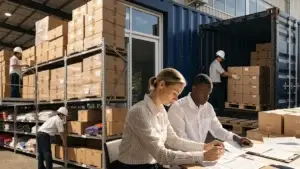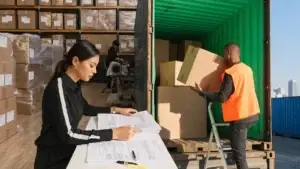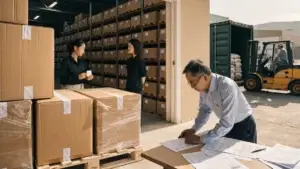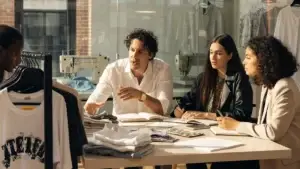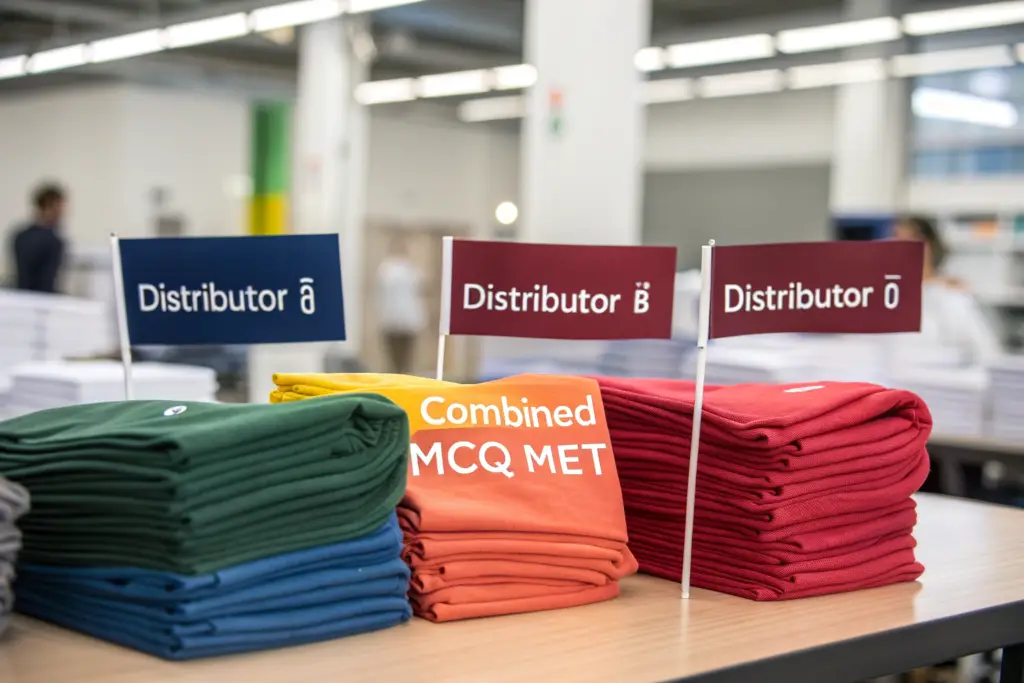
A distributor from Austin, Texas, called me last November with a problem I hear constantly from smaller operators. She had found the perfect fabric, a heavy organic cotton fleece, for a women's loungewear collection she wanted to launch. The fabric mill required a minimum order of 500 meters per color. She needed three colors, but her sales forecast only supported 200 meters of each. She was 300 meters short on every color. The mill would not budge. She was stuck. Either she over-ordered and prayed the inventory sold, tying up precious cash in dead stock, or she abandoned the collection entirely. She asked me, almost pleading, "Is there any way around this?"
Smaller distributors can meet MOQs without excess inventory by participating in grouped production runs, utilizing factory-held greige goods programs, and collaborating with non-competing distributors on shared fabric bases. The key is to separate the common elements of production, like base fabric and generic trims, from the unique elements, like color, print, and branding. By sharing the common elements across multiple distributors, each party gets the MOQ benefit without carrying the full inventory burden alone.
MOQs are not arbitrary cruelty. They exist because mills and factories have fixed setup costs. A dye machine must be filled to a certain level for the dye to take evenly. A knitting machine requires a minimum run time to be profitable. A cutting table requires a minimum lay height for efficiency. But these physical and economic constraints can be navigated creatively when you work with a factory that thinks like a partner, not just a production line. At Shanghai Fumao, we have developed several structured programs specifically to help smaller distributors access premium manufacturing without the crushing weight of excess inventory. Let me walk through exactly how these programs work.
What Is a "Grouped Production Run" and How Can It Slash Your Fabric Commitment?
A grouped production run is exactly what it sounds like. Multiple distributors place orders for different garments that share the same base fabric. The factory aggregates these individual small orders into a single production batch large enough to meet the mill's MOQ and to run efficiently on the factory floor. Each distributor gets the exact quantity they need, not a meter more. The factory manages the aggregation, the ordering, and the allocation. The distributor simply places their order as if the MOQ did not exist.
A grouped production run slashes your fabric commitment by pooling your base fabric needs with those of other distributors placing orders in the same production window. You commit only to the yardage your specific order requires. The factory assumes the responsibility of aggregating demand across multiple clients to meet the mill's minimum. The trade-off is some loss of scheduling control; your order runs when the grouped run is scheduled, not necessarily on your exact ideal timeline.
The key enabler is fabric standardization. A grouped run works when multiple clients agree to use the same base fabric. This does not mean they all get identical garments. The fabric is the same. The garment design, the color, the wash, the trims, and the branding are all unique to each client. A 200 GSM organic cotton jersey can become a t-shirt for Client A, a tank dress for Client B, and a hoodie lining for Client C. The fabric is shared. The products are distinct.
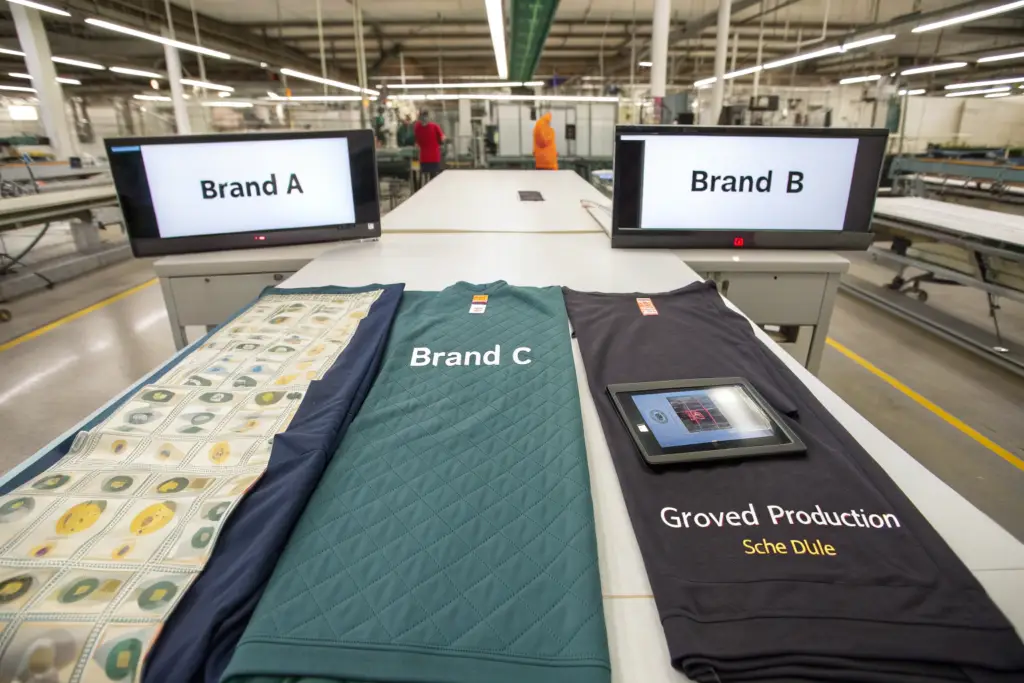
The biggest concern distributors have about grouped runs is competition. "If I share a fabric base with another distributor, will we end up selling identical products to the same customers?" The answer, when the program is managed correctly, is no. The factory acts as a matchmaker, grouping distributors who serve different markets, different channels, or different end-consumer demographics.
The factory's merchandising team looks at the distributor profiles. Distributor A sells women's loungewear to boutique hotels. Distributor B sells unisex basics to online direct-to-consumer. Distributor C sells private label uniforms to yoga studios. All three need a premium organic cotton French terry. Their end markets do not overlap. They are not competitors. The factory can confidently group them on the same fabric base because the final products will never appear on the same retail shelf.
We manage this process transparently. We tell each distributor, "We have a grouped run for this organic French terry scheduled for Week 12. Two other distributors are participating, one in the hotel sector, one in activewear. Your markets do not conflict. If you join this run, your fabric MOQ drops from 500 meters to your actual need of 150 meters. The cut-off date is Week 10. Would you like to participate?" The distributor gets the MOQ benefit without the competitive risk.
A distributor from Portland joined one of our grouped runs for a linen-cotton blend she wanted for a summer shirt dress. Her order was only 250 meters. She was grouped with a distributor making men's casual shirts for a fishing tackle brand and another distributor making women's beach cover-ups for a resort chain. Three completely different markets. Three completely different garments. One shared fabric base. Her fabric cost dropped by 35% per meter compared to trying to run the fabric alone. She told me it was the first time she felt like a small distributor had access to the same supply chain economics as a large brand.
What Are the Scheduling Trade-Offs You Must Accept for Grouped Pricing?
The grouped run model requires flexibility on timing. When you order independently and meet the MOQ yourself, you dictate the production schedule. The factory cuts your order when you want it cut. In a grouped run, the factory sets the schedule based on the optimal aggregation of multiple clients' orders. The run date is a compromise that works for the group, not the ideal date for any single member.
This means you must plan further ahead. If you need fabric in Week 12 for an April delivery, but the grouped run is not scheduled until Week 14, you either adjust your delivery timeline or you opt out of the grouped run and pay the solo MOQ premium. The scheduling trade-off is the price of the MOQ saving.
The factory should provide a seasonal calendar of planned grouped runs for its most popular base fabrics. "Our 200 GSM organic cotton jersey grouped run will be in Week 8, Week 16, and Week 24. Our linen-cotton blend grouped run will be in Week 12 and Week 20." This calendar allows distributors to plan their development timelines around the grouped run schedule. The predictability is essential.
For the distributor from Austin I mentioned earlier, the scheduling trade-off was workable. She needed the organic cotton fleece for a November launch. Our grouped run for that fabric was scheduled for August, which was slightly earlier than her ideal September start. She adjusted her design calendar forward by three weeks and joined the run. The fabric cost saving was $1,400. She used part of that saving to pay for a faster shipping method, and her launch timeline ended up being exactly what she originally planned. The scheduling shift was a minor inconvenience for a major financial benefit.
How Do Factory-Held "Greige Goods" Programs Solve the Color Variety Problem?
The MOQ problem is most acute when a distributor wants multiple colors in small quantities. The fabric mill says, "500 meters per color." The distributor wants five colors but only 100 meters per color. The total volume is 500 meters, which meets the aggregate MOQ, but the per-color volume does not. This is where greige goods programs transform the economics.
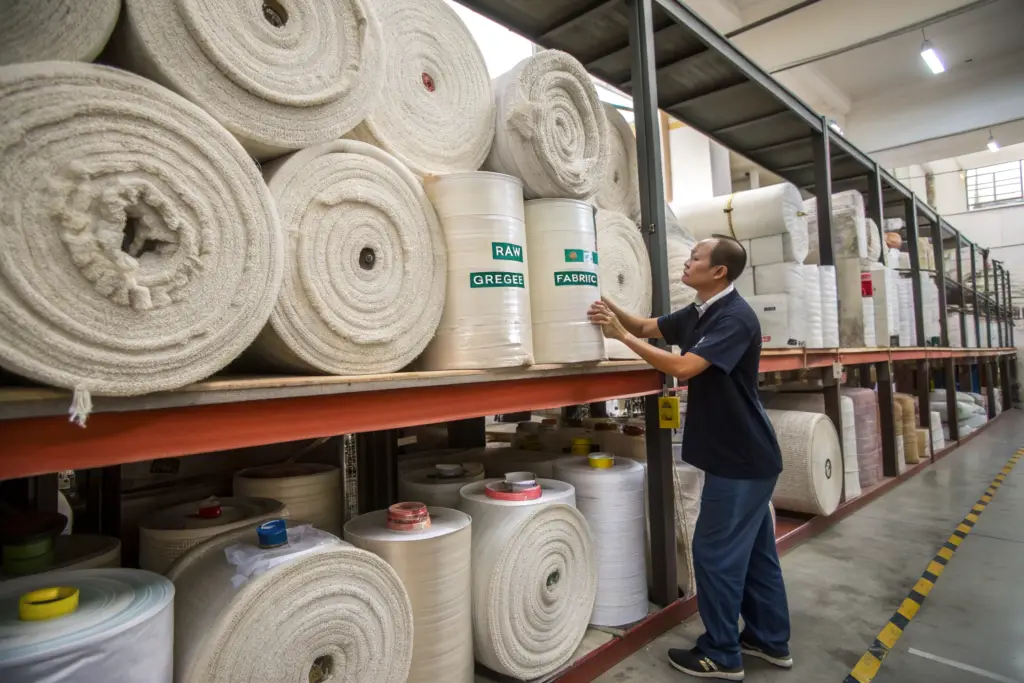
Factory-held greige goods programs solve the color variety problem by stocking large quantities of undyed, unfinished base fabric. Distributors can order small quantities of multiple colors because the factory dyes the fabric in small batches from the greige stock. The greige fabric was purchased in bulk, meeting the mill's MOQ. The dyeing is done in smaller lots at the factory's in-house or partner dye facility. The distributor only pays for the dyed yardage they actually need.
This model decouples the fabric production MOQ from the color MOQ. The fabric is made once, in a large, cost-efficient batch. It sits in its raw, undyed state until a distributor specifies a color. Then a small quantity is pulled from the shelf, dyed to the exact Pantone match, finished, and cut. The distributor gets 100 meters of Sage Green and 100 meters of Terracotta without paying for 500 meters of each.
What Is the Difference Between Greige, PFD, and Fully Finished Fabric Stock?
Understanding the three states of fabric inventory is essential to using a greige goods program effectively. Greige fabric, also called loom state, is raw fabric straight off the knitting machine or loom. It has not been bleached, dyed, or finished. It is the starting point. It is the cheapest to produce and the most flexible for downstream customization, but it requires the most processing before it can be cut.
PFD stands for Prepared for Dyeing. This fabric has been bleached and scoured to remove natural oils and impurities. It is white, clean, and ready to accept dye. It has not been dyed yet. PFD fabric is one step further along than greige. It is more expensive than greige but less expensive than fully finished fabric. It is ideal for distributors who want fast turnaround on small dye lots because the preparation step is already done.
Fully finished fabric is complete. It has been dyed, softened, sanforized, and finished to its final hand feel and appearance. It is the most expensive and the least flexible. It is what you buy when you order a specific color from a mill and meet the full MOQ. It sits in the factory, ready to cut. For a small distributor wanting many colors, fully finished fabric is the enemy of flexibility.
A distributor I work with uses our greige program for her line of women's bamboo-cotton blend tops. We stock the greige fabric in our warehouse. Twice a season, she sends us a list of colors and quantities. She might order 80 meters of Rose Quartz, 90 meters of Sea Foam, and 120 meters of Oatmeal. We pull the total 290 meters from the greige stock, dye the three lots, and deliver the finished fabric to the cutting room. She pays only for the 290 meters, dyed to her exact specification. If she had to order fully finished fabric from the mill, the minimum would be 500 meters per color, or 1,500 meters total. The greige program frees her to offer color variety without the inventory risk.
How Can You Test Multiple Colorways as a Small Distributor with Limited Budget?
Testing the market with multiple color options is essential for a small distributor. You do not have the data of a large brand to know which colors will sell. You need to spread your risk across several colorways to see what resonates with your customers. A greige goods program makes this market testing affordable.
Order 50 meters each of four colors for a small initial production run. That is a total of 200 meters, all dyed from the same greige batch. The per-meter dyeing cost for a small lot is higher than for a large lot, but you are not carrying 450 meters of dead stock in the colors that do not sell. You pay a higher per-unit cost on a smaller base. The total cash outlay is much lower, and the inventory risk is radically reduced.
One of my clients, a distributor selling women's dresses to small boutiques, uses this strategy every season. She launches a style in four colors, producing only 30 units per color. She watches the sell-through for the first two weeks. The colors that sell fast get an immediate reorder, still dyed from our greige stock, with a quick two-week turnaround. The colors that sell slowly are not reordered. She loses nothing on the slow colors because she had no excess inventory. She captures the upside on the winning colors by reordering quickly. Her business model is built on the flexibility of the greige program. Without it, she would have to guess the winning color six months in advance and bet her entire season's cash on that guess. She told me the greige program is the single biggest reason her business survived its first three years.
Why Should You Collaborate on "Open Production Lines" with Compatible Distributors?
Fabric is one part of the MOQ challenge. The production line itself has minimums. A factory cannot set up a sewing line for a 50-unit order without losing money on the setup time. The line requires a certain volume to run efficiently. For a small distributor, hitting the production MOQ can be as difficult as hitting the fabric MOQ. An "open production line" is a structured solution to this problem.
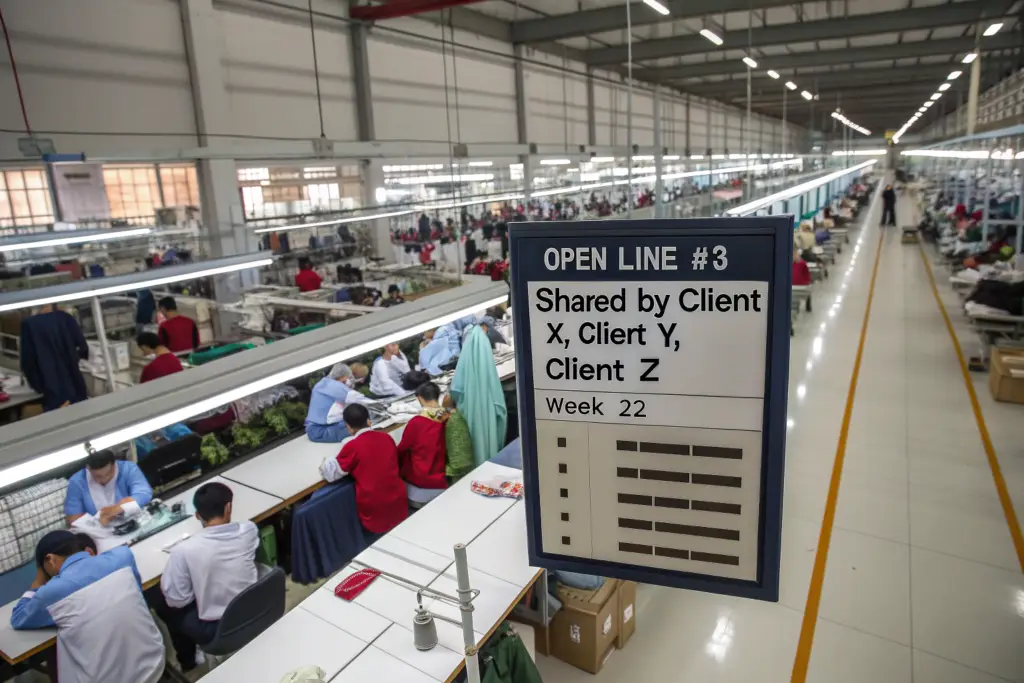
An open production line is a factory line dedicated for a specific period to multiple small orders that share common construction requirements. Distributors with similar garment types, basic t-shirts, simple shift dresses, unlined casual jackets, can share the line's capacity. Each order is small individually, but collectively the line runs at full efficiency. The factory achieves its volume target, and each distributor achieves production without paying a small-order surcharge.
The open line works because garment construction is standardized. A basic t-shirt, regardless of brand, involves the same core operations: shoulder seam, neckband attachment, sleeve attachment, side seam, hem. A factory can set up a line for "basic knit tops" and run four different distributors' orders sequentially on the same line in the same week. The setup time is amortized across all four orders. The operators stay efficient because they are repeating similar operations.
How Do You Structure a "Mini- Consortium" Without Losing Your Brand Identity?
An open production line does not mean your products look the same as another distributor's products. The brand identity is carried by the design details, the fabric, the color, the trims, and the branding. These are all unique to you. What you share is the production infrastructure.
Structure the mini-consortium through the factory, not directly between distributors. The factory identifies compatible orders and manages the line allocation. The distributors do not need to know each other's identities, though some choose to connect. The factory's role is to aggregate the orders and schedule the line so that each order runs cleanly, with a complete changeover between clients to prevent any mix-up of trims or labels.
A client who produces women's workwear tunics shared an open line with two other distributors last season. Her tunic had a unique mandarin collar, side slits, and custom corozo buttons. The other distributors made a basic polo shirt and a casual henley. All three garments were made from a similar weight cotton-pique fabric and shared the same fundamental body construction. The line ran for two weeks. Her 200 units, the polo's 350 units, and the henley's 150 units totaled 700 units, a very healthy volume for the line. She paid a standard per-unit cost with no small-order surcharge. Her tunic looked nothing like the polo or the henley. The shared production line was invisible to her end customer.
A legitimate concern with open production lines is traceability. If your order runs on a line shared with other brands, how do you prove to your customers, or to a social compliance auditor, that your specific units were made under ethical conditions? The answer is in the production documentation.
The factory should provide batch-specific production records that trace your specific units through the line. The cutting ticket, the sewing line bundle tickets, the QC inspection reports, and the packing list should all carry your unique order number. The factory's time and attendance records for the period your order was on the line should be available for audit. The social compliance certification, such as WRAP or BSCI, applies to the entire factory, regardless of which line your order ran on.
We provide a "production lot traceability report" for every order we produce. This report documents the date and time each operation was performed, the specific line and operators involved, and the QC checks passed. For a client using an open line, the report additionally confirms that their order was processed on Line 3 during the period when Line 3 was operating under our standard, certified ethical conditions. There is no ambiguity. The documentation creates a clean audit trail that separates your product from others on the same line. This documentation has been accepted by third-party auditors conducting brand social compliance assessments. The shared line does not dilute the ethical standard of production. It simply makes the economics of ethical production accessible to smaller brands.
Conclusion
The MOQ barrier is one of the most frustrating obstacles for a small distributor. It feels like a wall designed to keep you out of quality manufacturing. It is not. It is a volume threshold that can be reached collectively when individual volumes are insufficient. The strategies we have explored, grouped production runs, greige goods programs, and open production lines, are all mechanisms for pooling demand across multiple small distributors to achieve the scale that efficient manufacturing requires.
Grouped runs aggregate your fabric needs with those of non-competing distributors, slashing your per-meter cost and eliminating the overstock burden. Greige goods programs decouple fabric production from color customization, allowing you to offer color variety and test new shades without committing to MOQs per color. Open production lines aggregate your garment production with compatible orders, giving you access to efficient line pricing without the small-order surcharge.
The common thread in all these strategies is the factory's role as an aggregator and a partner. These models only work when the factory actively manages the consolidation, the scheduling, and the quality control across multiple clients. It is a more complex operational model than simply running large, single-client orders. It requires a factory that is organized, transparent, and genuinely committed to serving the small distributor segment.
At Shanghai Fumao, the small and mid-sized distributor is not an afterthought. Our grouped run calendar, our greige goods inventory, and our open production line scheduling are core parts of our business model. We built these programs because we saw talented distributors being locked out of quality manufacturing by arbitrary volume thresholds. Our own growth has been fueled by the success of these smaller brands as they scale.
If you are a distributor who has been told you are "too small" for premium manufacturing, or if you are tired of over-ordering and praying that the inventory sells, I invite you to contact our Business Director, Elaine. She can share our seasonal grouped run calendar, explain the greige fabric options currently in stock, and discuss which of your products would be a good fit for our open line program. Reach Elaine at elaine@fumaoclothing.com. Let's find a way to manufacture your collection without the MOQ headache, without the excess inventory risk, and without compromising on the quality your brand deserves.