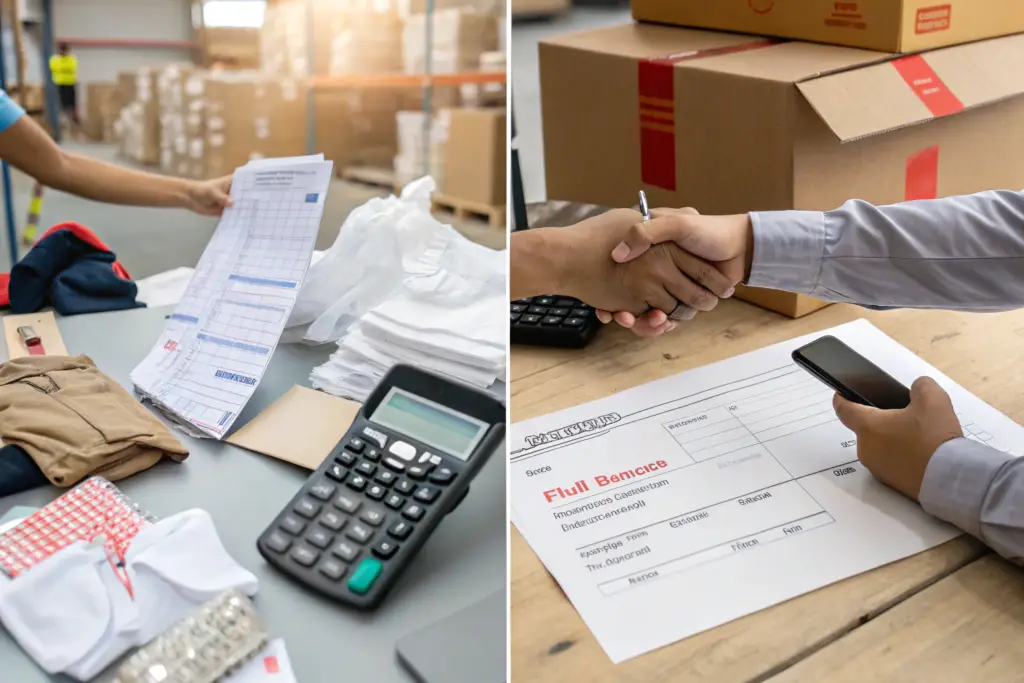
Three years ago, a first-time brand owner from Denver placed his first production order with a factory in Vietnam. He negotiated a great FOB price, found a freight forwarder online, and assumed the process would take care of itself. When the shipment hit the Port of Los Angeles, he received a phone call that made his stomach drop. Customs had flagged his container for inspection. There were additional duties he had not calculated. Port storage fees were accruing at $150 per day. His freight forwarder was unresponsive. By the time the shorts finally cleared and reached his warehouse, six weeks late and $4,200 over budget, his summer selling season was half over. He called me afterward and said, "I never want to see a customs form again in my life." That is when I introduced him to the DDP model.
The Delivered Duty Paid model benefits North American shorts importers by shifting all transportation risk, customs clearance complexity, and duty payment obligations from the buyer to the seller, transforming what is normally a fragmented, multi-vendor logistics nightmare into a single, predictable, door-to-door cost that allows brand owners to focus on sales and marketing rather than international shipping administration.
At Shanghai Fumao, we have shipped thousands of pairs of classic shorts to the United States and Canada using the DDP model. I have watched it transform the importing experience for brand owners who have no desire to become amateur customs brokers. The benefits are not theoretical. They are specific, calculable, and they directly address the pain points that cause small and mid-size brands to lose sleep and lose money. Let me break down exactly why this shipping model has become the preferred choice for our North American partners.
What Exactly Does the DDP Shipping Model Cover?
The confusion around DDP starts with its name. Most brand owners I speak with have heard the term but cannot explain exactly what it includes and what it does not. This confusion leads to incorrect cost comparisons. A buyer gets a DDP quote that is higher than an FOB quote and immediately rejects it, without realizing that the FOB quote covers only a fraction of the total landed cost. A proper comparison requires understanding exactly where the factory's responsibility ends under each model.
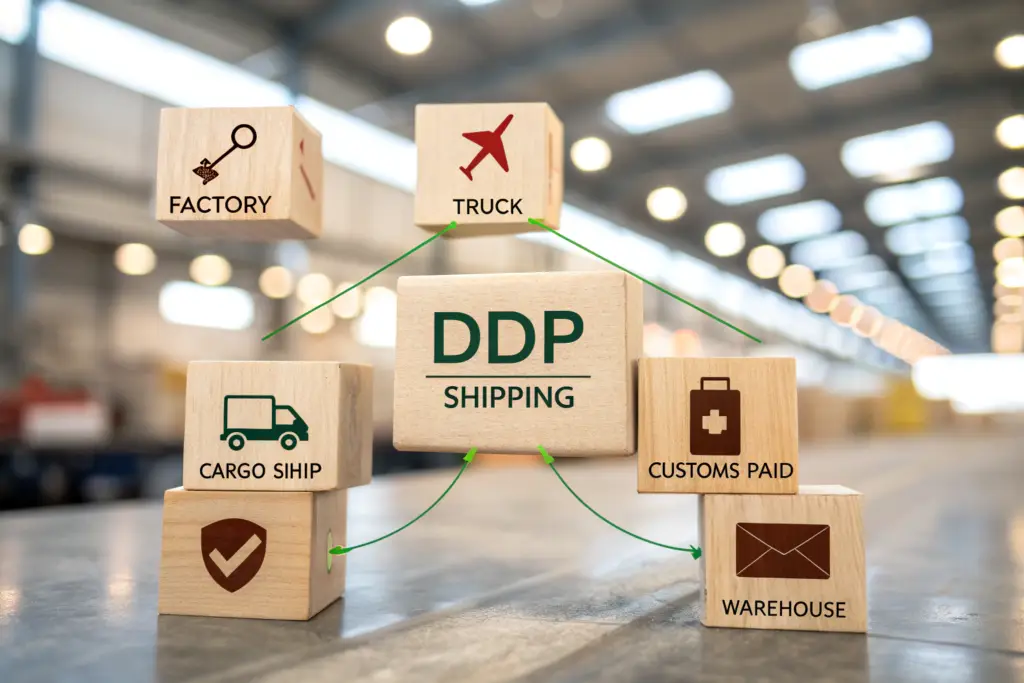
DDP shipping is a comprehensive door-to-door service where the seller bears the cost and risk of every single step from the factory loading dock to the buyer's nominated warehouse address, including export clearance, international freight, import customs brokerage, all import duties and taxes, and final domestic delivery, with the buyer's only responsibility being to receive the goods and unload them.
How Does DDP Differ from FOB and CIF in Practice?
The alphabet soup of Incoterms is not academic jargon. It is a risk allocation map, and the differences between FOB, CIF, and DDP have real financial consequences. Understanding these differences is the first step in making an informed shipping decision.
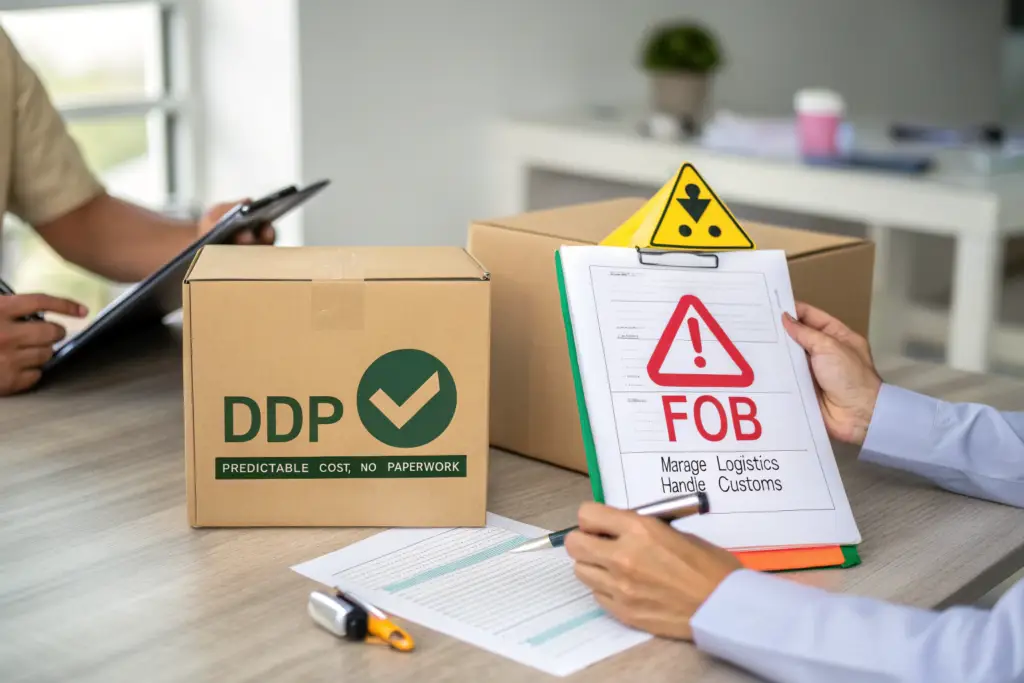
Under FOB, or Free On Board, the seller's responsibility ends the moment the goods cross the ship's rail at the port of origin. The buyer is responsible for booking the vessel, paying the ocean freight, arranging insurance, clearing customs at the destination port, paying all import duties and taxes, and arranging final delivery. For an experienced importer with a dedicated logistics team, FOB can offer cost savings. For a brand owner who is also the designer, the marketing director, and the customer service department, FOB is a part-time job in international logistics that they never wanted. Under CIF, or Cost Insurance Freight, the seller pays for the goods, insurance, and freight to the destination port, but the risk still transfers at the origin port, and the buyer must still handle customs clearance, duties, and final delivery. DDP eliminates this fragmentation entirely. The seller provides a single price that covers everything from factory to warehouse. The comparison between these Incoterms explained models is not about which is cheapest on paper. It is about which model aligns with the buyer's operational capacity and risk tolerance. For most small and mid-size apparel brands, the operational burden of FOB far outweighs any potential freight cost savings. The DDP vs FOB shipping decision should be driven by capacity, not just cost.
What Specific Costs Are Included in a DDP Quote?
The power of DDP is that it collapses a dozen separate cost items into one number. When I provide a DDP quote to a brand partner for a classic shorts order, I am not guessing. I am calculating specific line items that I have managed hundreds of times. The transparency of these line items is what allows a buyer to trust the quote.
A complete DDP quote for shorts imported from China to the United States includes: the factory FOB cost, which covers the garment itself and our margin; the origin port handling charges, including trucking from our factory to the port of Shanghai or Ningbo and the terminal handling fee; the ocean freight, which fluctuates but is locked in at the time of booking; the marine insurance, typically at 0.3% of the commercial invoice value; the destination port charges at Los Angeles, New York, or Savannah, including the terminal handling and the chassis fee; the customs bond and brokerage fee, which covers the licensed customs broker who files the entry on your behalf; the US import duty, which for most woven cotton shorts is 16.5% of the declared value; the Merchandise Processing Fee, a small US Customs charge; and the final trucking from the port to your warehouse address. This comprehensive DDP shipping costs structure means the buyer sees one price, pays one invoice, and opens their warehouse door to find their shorts. The alternative is receiving seven different invoices from seven different vendors in three different currencies, and trying to reconcile them while the product is already late.
How Does DDP Reduce Supply Chain Complexity for Apparel Brands?
Running an apparel brand is a full-time exercise in complexity management. You are managing design, fabric sourcing, sample approvals, e-commerce photography, social media marketing, customer service, and cash flow. Adding international logistics management to this list is not a value-add. It is a distraction that pulls you away from the activities that actually grow your revenue. The DDP model strips logistics complexity out of your weekly schedule and places it entirely with the party best equipped to handle it: your factory.
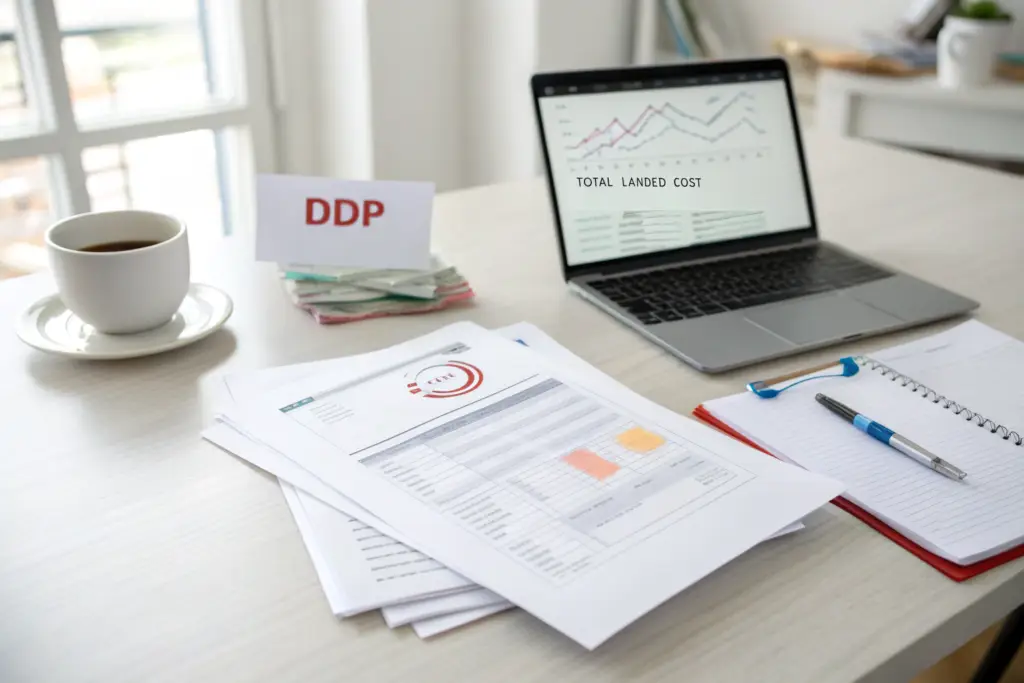
The DDP model reduces supply chain complexity by consolidating a multi-vendor logistics chain into a single point of contact and a single invoice, eliminating the need for the brand owner to source and manage relationships with freight forwarders, customs brokers, port warehouses, and domestic trucking companies, each of which represents a potential point of communication failure and delay.
Why Does a Single Point of Contact Matter in International Shipping?
In a typical FOB shipment arranged by the buyer, the communication chain looks like a game of telephone with money at stake. The buyer must coordinate with the factory to confirm the goods are ready. Then contact the freight forwarder to book the vessel. Then ensure the trucker picks up the container on time. Then chase the forwarder for the bill of lading. Then provide documents to the customs broker. Then pay the duty invoice. Then coordinate with the domestic trucker for final delivery. Each handoff between these parties is a point where information can be lost, delayed, or misinterpreted.
When a problem occurs—and in international shipping, problems are routine—the buyer must diagnose which vendor caused the delay and then try to resolve it. The forwarder blames the port. The port blames the trucker. The trucker blames customs. The buyer is in the middle, burning hours on international phone calls while his warehouse sits empty and his launch date approaches. With DDP, the factory is the single point of accountability for the entire chain. If the shipment is delayed, you call one person. You send one email. The factory's logistics team diagnoses and resolves the problem internally because they control the entire process. This supply chain visibility model has saved our brand partners countless hours of administrative time. One client told me that switching to DDP with Shanghai Fumao reduced his logistics-related email volume by 90%. He got those hours back to focus on marketing and product development.
How Does Customs Clearance Become the Seller's Problem Under DDP?
Customs clearance is the most intimidating part of importing for most brand owners. The paperwork is arcane. The Harmonized Tariff Schedule is a labyrinth of ten-digit codes that determine your duty rate. A classification error can trigger an audit. An undervaluation can result in fines and shipment seizure. Most small brand owners are not trained in customs compliance, and they should not have to be.
Under DDP, the seller takes full legal responsibility for customs clearance. This means our logistics team, which handles these procedures daily, manages the entire entry process. We assign the correct HTS code for your classic shorts. We prepare the commercial invoice and packing list in the exact format that US Customs and Border Protection requires. We ensure the declared value is consistent and defensible. We have a standing relationship with a licensed US customs broker who files the entry electronically and resolves any questions or holds before they become delays. This customs clearance process expertise is built into our operations. It is not a service we outsource to a third party and hope for the best. Under DDP, if customs flags the shipment for a random inspection, the demurrage and exam fees are our cost, not yours. This alignment of incentives is powerful. It means the party responsible for the shipment's documentation is also the party who pays if that documentation fails. This DDP customs responsibility eliminates the nightmare scenario of a buyer paying storage fees for a container stuck in customs limbo while a disengaged forwarder ignores their calls.
What Are the Financial Benefits of Predictable Landed Costs?
Cash flow anxiety is the background radiation of running an apparel brand. You are always waiting for a surprise bill. A port congestion surcharge appears. A customs exam fee hits. A trucking fuel surcharge gets added. These surprise costs are never budgeted, and they eat directly into the margin you calculated so carefully when you priced the product. The DDP model eliminates this unpredictability. The price you agree to is the price you pay. Full stop.
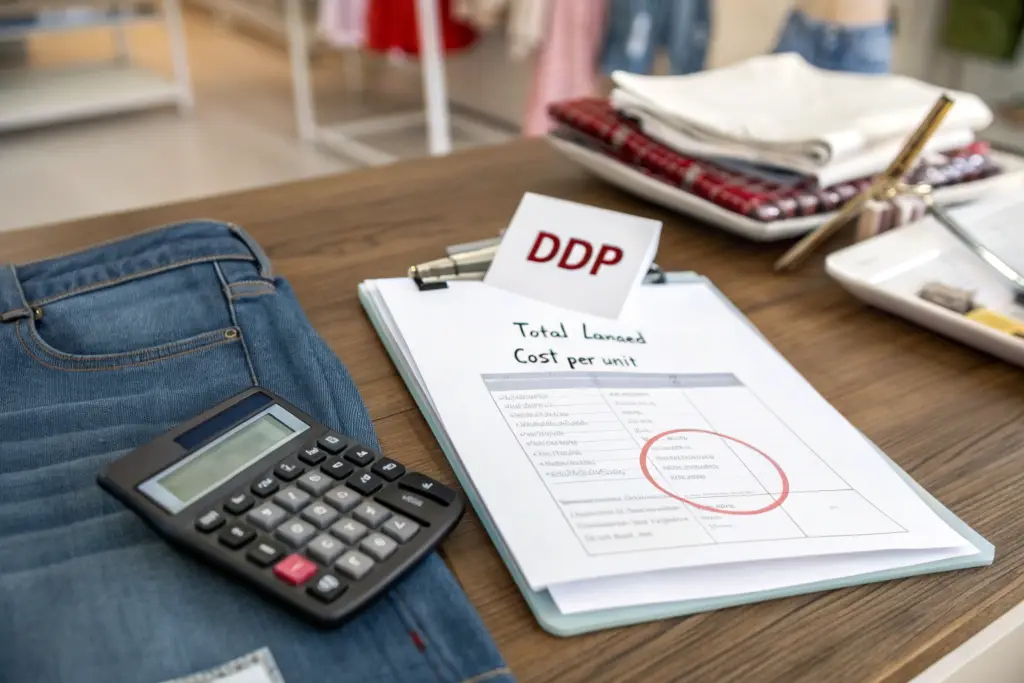
DDP provides financial predictability by transforming a variable-cost logistics process into a fixed-cost line item, allowing brand owners to calculate their true landed cost per unit with certainty before placing the order, price their products accurately to their wholesale and retail customers, and protect their margin from the unpredictable surcharges, storage fees, and duty adjustments that routinely ambush FOB buyers.
How Can You Calculate True Landed Cost Accurately with DDP?
I have sat with too many brand owners who proudly tell me their FOB cost, then admit they have no idea what their actual landed cost was until the shipment arrives and all the invoices trickle in. This is like a restaurant owner knowing the cost of the raw ingredients but not the cost of the gas, the rent, or the waitstaff. The number is incomplete and misleading.
True landed cost is the total of every dollar spent to get a pair of shorts from a sewing machine in China to a shelf in your warehouse. The formula should be simple: FOB cost plus freight plus insurance plus duty plus brokerage plus delivery. Under DDP, this formula becomes a single number on a single invoice, provided to you before you place your purchase order. You can calculate your margin with precision. You can set your wholesale price knowing exactly what your cost is. You can plan your cash flow with certainty. This landed cost calculation accuracy is not a minor convenience. It is a strategic advantage. A brand that knows its true costs can price confidently. A brand that is guessing will either leave money on the table by pricing too low or lose sales by pricing too high to cover unknown risks. Under the FOB model, a buyer often budgets a rough 15% to 18% on top of the FOB price for all destination costs, but then discovers that the actual import duty for his specific fabric composition is 16.5% alone, wiping out the entire logistics budget before a single other cost is added. With DDP, the true landed cost formula is fully known, fully quoted, and fully guaranteed.
How Does DDP Protect Your Margins from Unexpected Fees?
The international shipping industry is built on surcharges. Peak season surcharge. Bunker fuel surcharge. Port congestion surcharge. Chassis shortage surcharge. These fees are not disclosed when the original freight quote is given. They appear on the final invoice, and under FOB, the buyer pays them. There is no negotiation. The goods are already on the water, and the buyer has no leverage.
Under DDP, these surcharges are the seller's problem. When I provide a DDP quote for a classic shorts order, I build a buffer into the freight cost line that accounts for my experience with these unpredictable charges. If my buffer is sufficient, I make a small additional margin on the logistics. If it is insufficient, I lose money. The buyer's price does not change either way. This risk transfer is the core financial benefit of DDP. The seller, who ships containers weekly and understands the rhythm of surcharges and fees, is in a far better position to price and absorb these risks than a brand owner who imports twice a year. This freight cost management expertise is part of the value we provide. We also manage currency risk. Ocean freight is quoted in US dollars, but many origin charges are in Chinese RMB. Exchange rate fluctuations between quote and shipment can erode margin. Under DDP, the seller absorbs this currency risk as well. The buyer's price is fixed, regardless of what happens in global currency markets between the order date and the sailing date.
Is DDP the Right Choice for Your Specific Brand Profile?
DDP is not the right model for every brand in every situation. I have told some clients that they would be better served by FOB, usually because they have an established, high-volume logistics operation that can achieve freight economies of scale that I cannot match as a factory. But for a specific brand profile that describes the vast majority of small and mid-size apparel labels, DDP is the obviously superior choice. The decision comes down to a few simple questions about your team, your experience, and your priorities.
DDP is the optimal import model for brands that lack a dedicated in-house logistics team, are importing fewer than ten containers per year, value time and operational simplicity over squeezing the last possible cent out of the freight cost, and whose core business strength is product development and brand marketing rather than international supply chain management.
Which Brand Types Benefit Most from the DDP Model?
The brand that benefits most from DDP is the one run by a founder who wears every hat. This is the entrepreneur who designs the shorts, manages the Instagram account, handles customer emails, and packs boxes in the warehouse. For this person, becoming an expert in Incoterms and customs bonds is not a good use of time. Every hour spent chasing a freight forwarder is an hour not spent on revenue-generating activities.
First-time importers benefit disproportionately from DDP because the learning curve for international logistics is steep, and the cost of a mistake—a seized shipment, a massive storage bill—can be business-ending. Brands that sell direct-to-consumer online, where customer satisfaction and return rates are directly tied to receiving inventory on time and in perfect condition, also benefit from the reliability and simplicity of DDP. Brands that operate on a pre-order or crowdfunding model, where customers have already paid and are waiting, have zero tolerance for shipping delays and the predictable cost structure of DDP is essential for maintaining trust and cash flow. The e-commerce logistics needs of these brands align perfectly with the DDP value proposition. Conversely, a large brand importing fifty containers a year, with a full-time logistics manager on staff and negotiated annual freight contracts with multiple carriers, may achieve lower per-unit freight costs under FOB. The volume makes the administrative burden worthwhile. But that brand is a small fraction of the apparel industry.
When Might a Brand Be Ready to Transition Away from DDP?
DDP does not have to be a permanent choice. Many of our brand partners start with DDP for their first few production cycles, learn the rhythm of importing by observing our documentation and process, and then eventually transition to FOB or CIF when their volume justifies the investment in an internal logistics capability.
The trigger point for this transition is typically when a brand's annual import volume reaches the range where they can negotiate discounted freight rates directly with carriers. This usually starts around ten to fifteen forty-foot containers per year. At that volume, the brand can hire a logistics coordinator or outsource to a dedicated freight management company at a cost that is lower than the factory's built-in DDP logistics margin. However, I always advise brands to make this transition gradually. Run a single FOB test shipment while still shipping the bulk of your order DDP. Compare the actual all-in costs. Factor in your own time spent managing the process. Many brands do the math and decide that the modest premium for DDP is still worth the peace of mind. The importing for small business landscape is complex enough that simplifying it has real, calculable value. At Shanghai Fumao, we support our partners regardless of which Incoterm they choose. We provide the same production quality and communication transparency whether the shipment is DDP, FOB, or CIF. Our goal is to make you successful, not to lock you into a specific logistics model.
Conclusion
The DDP shipping model is, for most small and mid-size apparel brands importing classic shorts into North America, a financial and operational lifeline. It removes the brand owner from the business of international logistics—a business they never wanted to be in—and places the entire transportation chain under the control and accountability of the factory. The single-point-of-contact structure eliminates the finger-pointing between forwarders, brokers, and truckers that consumes weeks of administrative time under FOB. The predictable, fixed landed cost enables accurate pricing and margin protection that is simply impossible when surprise surcharges and port fees are arriving from unknown vendors.
The financial case is straightforward. DDP quotes a single, guaranteed price that covers every step from factory floor to your warehouse door, including the import duties and customs clearance that routinely ambush inexperienced FOB buyers. The time case is equally compelling. Every hour your team does not spend managing logistics is an hour invested in the design, marketing, and sales activities that actually build your brand. DDP is not the cheapest option on a per-container freight quote comparison, but it is frequently the most profitable option when the total cost of your time, your risk exposure, and your margin certainty are factored into the equation.
If you are tired of the logistics headaches and want to experience the simplicity of receiving your classic shorts with a single invoice and zero surprises, we are ready to help. At Shanghai Fumao, DDP is our standard shipping model for North American partners. For a direct conversation about your next production order and a transparent DDP quotation, contact our Business Director, Elaine, at elaine@fumaoclothing.com. Let's get your shorts delivered, so you can focus on selling them.