I remember the exact moment I learned how not to handle a quality dispute. It was 2011, and I was a young production manager. A furious American buyer called me directly. His 3,000 pairs of classic chino shorts had just arrived, and the fabric weight was clearly lighter than the sample he had approved. I got defensive. I told him the fabric was within "industry tolerance." I asked him to "just try selling it." He hung up, filed a chargeback with his credit card company, and I never heard from him again. He also left a review online that cost us several future clients. That was the day I learned that a quality dispute is not a battle to be won. It is a business problem to be solved collaboratively, with a structured, evidence-based process that protects the relationship even when the product has failed.
Disputing a shipment of classic shorts that does not match the approved sample requires an immediate, structured response: stop acceptance and document the discrepancies with photographic evidence comparing the bulk against the sealed sample within 24 hours of receipt, formally notify the supplier in writing with a clear description of the non-conformance and your proposed resolution, and negotiate a settlement—typically a discount, rework, or replacement—based on the commercial viability of the non-conforming goods rather than on emotional frustration.
At Shanghai Fumao, I have now sat on both sides of this table. I have been the factory receiving a dispute notification, and I have advised buyers on how to structure one effectively. The difference between a dispute that destroys a partnership and one that strengthens it lies entirely in the process. Let me walk you through that process step by step, so that if this moment ever arrives, you will know exactly what to do.
What Are the First Steps When You Discover a Quality Discrepancy?
When a container arrives at your warehouse, the clock starts ticking. Every day that passes before you raise a quality issue weakens your position. The supplier will reasonably ask why you did not notice the problem immediately. The shipping company's delivery receipt may have a limited window for noting damage. Your ability to claim that the goods were non-conforming on arrival depends on you acting as if the delivery is evidence in a potential case. Because legally and commercially, it is.
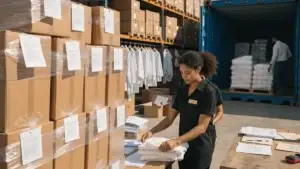
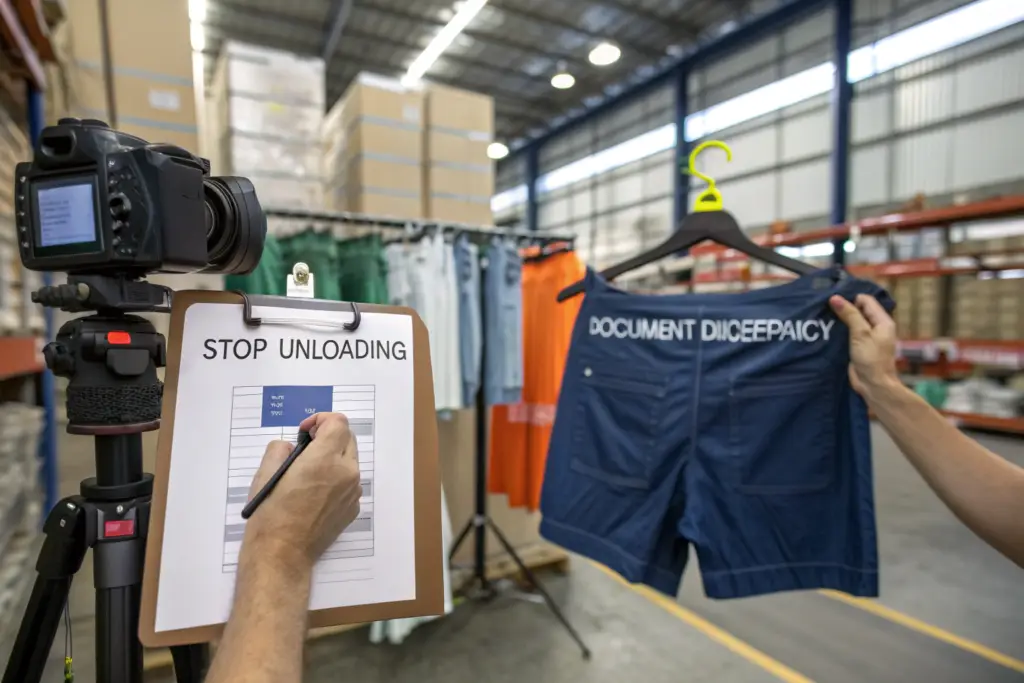
The first 24 hours after discovering a quality discrepancy must follow a strict protocol: immediately stop unpacking and photograph the unopened cartons and the packing slip, then perform a systematic AQL-style random sampling inspection comparing bulk units against the approved reference sample across the four critical dimensions of measurement, fabric, color, and workmanship, and finally lock the remainder of the shipment in a hold status so that no units are sold or distributed before the dispute is resolved.
Why Must You Stop Acceptance and Document Immediately?
Under the Uniform Commercial Code, which governs commercial transactions in the United States, a buyer has the right to inspect goods before acceptance. However, this right is not unlimited. If you continue to unpack, warehouse, and especially if you begin to sell the shorts, you may legally be deemed to have accepted the goods. Once acceptance occurs, your remedy shifts from rejection to a claim for damages, which is a much weaker position.
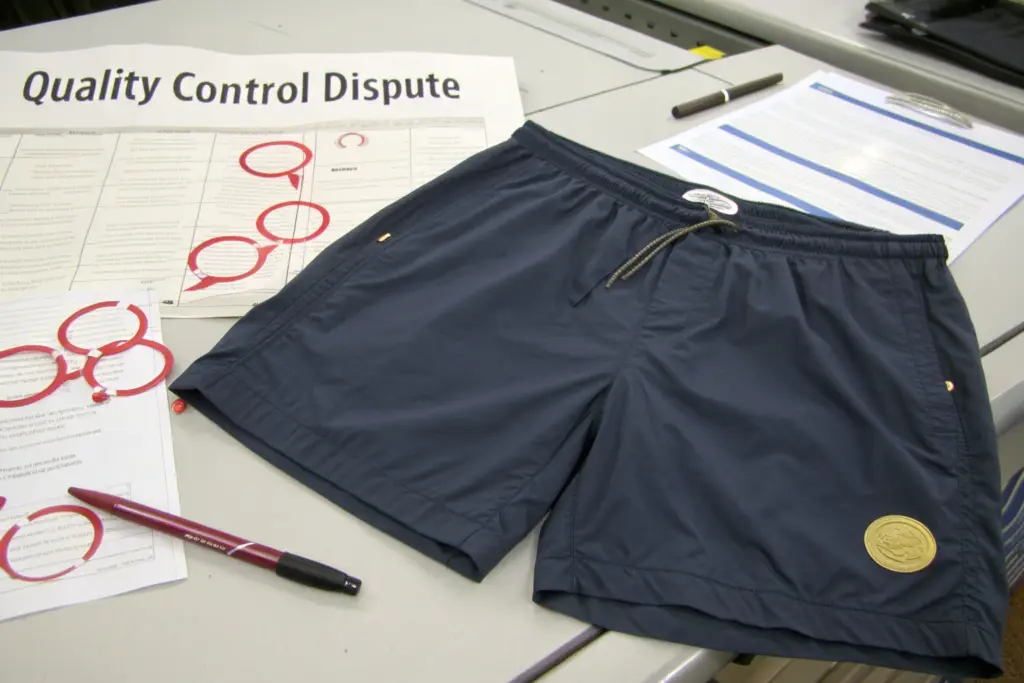
The first action is to stop. Stop opening cartons. Stop putting product on shelves. The shipment is now in quarantine. Then, document everything. Take wide-angle photos of the unopened cartons showing the shipping marks and carton numbers. Photograph the packing slip inside the first carton you opened. Then photograph the specific defect you found, with the bulk unit and the approved sample side-by-side in the same frame under the same lighting. The approved sample you should be referencing is the gold-seal sample, the final pre-production sample that both you and the factory signed off on physically or by written confirmation. If you never had a sealed, approved sample, your dispute is much harder to prove. This is why at Shanghai Fumao we always ship the final sealed sample back to the buyer before bulk production begins. The garment quality inspection process depends entirely on having an agreed reference standard. Without the sealed sample, the conversation becomes subjective. With it, the conversation is about objective deviation.
How Do You Quantify the Defect Rate Accurately?
A single defective pair of shorts in a shipment of 5,000 units is not a dispute. It is a statistical inevitability. The key question is the defect rate, and a supplier will only take a claim seriously if it is supported by a systematic count, not an emotional estimate.
Use the AQL sampling methodology. For a shipment of 5,000 shorts, pull a random sample of 200 units from cartons spread throughout the shipment. Do not just check the top carton on each pallet. Go deep. Examine each of the 200 units against your sealed sample and your quality checklist. Categorize each defect as critical, major, or minor. A broken zipper is critical. A waist measurement half an inch off spec is major. A loose thread is minor. Your contract or purchase order should specify your acceptable quality limits. A common standard is 2.5 for major defects and 4.0 for minor defects. If your inspection finds a defect rate exceeding the agreed AQL, you now have a statistically valid basis for your dispute. Present this data to the supplier in a clear table. State the sample size, the number of defects found in each category, and the resulting defect rate. This AQL sampling inspection data transforms a subjective complaint into an objective business case. A supplier who might dismiss a complaint about "some shorts being off" cannot dismiss a documented 6% major defect rate against an agreed 2.5% standard.
How Should You Structure the Formal Dispute Communication?
The email or letter you send to notify the supplier of the quality issue is possibly the most important document in the dispute process. It sets the tone, frames the facts, and establishes your legal position. I have seen disputes fail not because the buyer was wrong, but because their communication was so angry, vague, or legally aggressive that the supplier's management shut down and refused to engage. The goal of this communication is not to express your feelings. It is to secure a resolution.
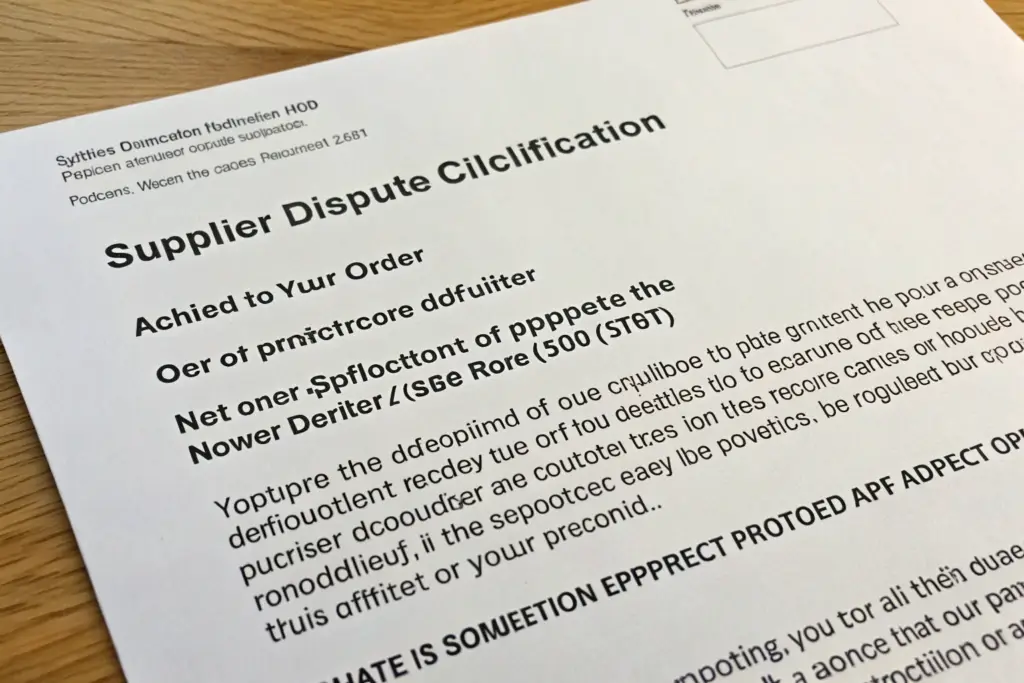
An effective formal dispute notification includes a clear subject line referencing the purchase order number, a factual description of each defect category with photographic evidence attached, a direct statement that the goods do not conform to the approved sample and are therefore rejected or accepted under reservation, a specific proposed resolution with a deadline for response, and a professional tone that signals a desire to solve the problem together rather than to assign blame and sever the relationship.
What Specific Information Must the Dispute Letter Contain?
Your dispute letter is a business document, and it should be structured like one. Start with the subject line. It should read something like: "Formal Notification of Quality Discrepancy – PO# 4521 – Classic Chino Shorts." This immediately tells the supplier what the email is about and which order is affected.
The body of the letter should open with the facts. State the purchase order number, the shipment date, the date of receipt, and the date of inspection. Then state the problem clearly. Instead of "the shorts look terrible," write "Upon inspection of a random sample of 200 units, 18 units were found to have a waistband measurement 0.5 inches below the approved specification, and 12 units exhibited seam puckering at the side seam inconsistent with the sealed sample." Attach the photographs. Label each photograph file descriptively: "PO4521-Bulk-vs-Sample-Waist-Measurement.jpg." State your proposed resolution. Do you want a price discount on the defective portion? A full rework of the shipment at the supplier's cost? A replacement order? Be specific. Finally, state your response deadline. Give a reasonable window, typically five to seven business days. This formal complaint letter structure ensures that the supplier has all the information needed to investigate internally and respond substantively, rather than sending a defensive acknowledgment that buys time.
How Do You Balance Firmness with Relationship Preservation?
The long-term value of a good manufacturing partner far outweighs the short-term cost of a single defective shipment. The tone of your dispute communication should reflect this reality. Your objective is to fix the problem and continue the partnership, not to win an argument and find a new factory.
Start with an acknowledgment of the relationship. "We value our partnership and have been very satisfied with the quality of previous shipments. This issue is unexpected, and I am confident we can resolve it together." This framing lowers the supplier's defenses. It signals that you are not preparing to sue them, you are presenting a solvable problem. Then, be direct and specific about the problem. Do not soften the language so much that the supplier does not understand the seriousness. Use objective data from your AQL inspection. Avoid emotional language. Do not write "I am so disappointed" or "this is unacceptable." Write "the defect rate of 6% exceeds the agreed AQL of 2.5%." Facts are firm without being aggressive. End with a collaborative tone. "Please review the attached documentation and provide your proposed corrective action and compensation plan within seven days. I am available to discuss by phone if that would be helpful." This supplier relationship management approach, which balances accountability with partnership, is the most reliable path to a fair settlement. At Shanghai Fumao, we respond best to disputes framed this way. It tells us the buyer is serious, prepared, and reasonable, which motivates us to move quickly to protect the relationship.
What Are the Standard Resolution Options for Defective Shorts?
Once the supplier has acknowledged the discrepancy, the conversation shifts from diagnosis to remedy. This is where many buyers make a strategic error. They fixate on one specific resolution—usually a full refund—and refuse to consider alternatives. The reality is that the best resolution depends on the nature of the defect and the commercial viability of the non-conforming shorts. A full refund and return is rarely the optimal outcome for either party. The shipping costs alone often exceed the recoverable value. There is a menu of standard, commercially reasonable resolutions that the apparel industry has developed over decades, and understanding this menu allows you to negotiate effectively.
The standard resolution options for a defective shorts shipment exist on a spectrum from the least to most disruptive: a price discount or allowance that enables the buyer to sell the non-conforming goods at a reduced margin, a partial or full rework where the supplier covers the cost of local repair or returns the goods for factory correction, and a full replacement order with the supplier bearing all shipping and disposal costs, with the appropriate choice depending entirely on the severity of the defect and the buyer's ability to sell the compromised product.

When Is a Price Discount the Right Solution?
The price discount is the most common resolution in the apparel industry, and for good reason. It is the fastest, least logistically complex solution, and it keeps saleable product in the buyer's hands where it can generate at least some revenue. The key judgment is whether the defect makes the shorts unsaleable or merely less profitable.
If the defect is a moderate color shading difference that is visible when compared directly to the sample but not obviously wrong to a retail customer, a discount of 15% to 25% on the affected units is likely the optimal outcome. The buyer sells the shorts, perhaps at a small markdown or through an outlet channel, and the supplier compensates the margin loss. If the defect is a minor measurement deviation—a waistband that is half an inch tighter than spec—the shorts may still be saleable, but the fit inconsistency could drive returns. Here, a discount combined with an extended return allowance from the supplier can work. The critical factor is whether the buyer can, in good faith, sell the shorts to their customer without damaging their brand reputation. If the answer is yes, take the discount. If the answer is no, a discount is the wrong solution. A quality dispute resolution guide would emphasize that accepting a discount is not a sign of weakness. It is a commercial decision that prioritizes speed and cash flow over principle. The money from selling discounted shorts today is more valuable than the promise of perfect shorts months from now.
When Should You Demand a Rework or Replacement?
Some defects cannot be sold through. A broken zipper on every unit. A fabric that pills after one wash. A seam construction so weak that the shorts split during normal wear. These are not margin problems. They are unsaleable product problems. In these cases, a discount is useless. The buyer cannot legally or ethically sell the goods, and the supplier must take full responsibility.
A rework is appropriate when the defect is repairable. If the waistband measurement is wrong but can be corrected by a local alteration service, the supplier should pay for that service. If the buttons are cracking and need replacement, the supplier can ship replacement buttons and cover the cost of a local sewing contractor to replace them. The buyer should get a quote for the local rework cost and present it to the supplier as the settlement amount. A full replacement is the nuclear option, reserved for catastrophic quality failures where the product is fundamentally unmerchantable. The supplier pays to return the defective goods or provides proof of destruction, and produces and ships a new order at their cost. This is expensive for the supplier and time-consuming for the buyer, who may miss a selling season entirely. At Shanghai Fumao, we have never had a dispute escalate to a full replacement, but our policy is clear. If the defect is our fault, we fix it. The garment rework process is part of our operational capability. Every reputable factory should have a documented procedure for handling rework and replacement disputes.
How Can You Prevent Quality Discrepancies Before They Occur?
The best dispute is the one that never happens. I have spent the last decade building quality systems at Shanghai Fumao specifically to prevent the gut-wrenching phone call I received in 2011 from ever occurring again. Prevention is not about trusting the factory more. It is about building a verification structure that makes trust unnecessary. The factory should assume the buyer will inspect. The buyer should assume the factory has missed something. This mutual skepticism, built into a transparent process, is the foundation of a reliable supply chain.
Preventing quality discrepancies on classic shorts requires a three-layer defense built into the production timeline: a mandatory sealed sample sign-off that locks the physical reference standard before bulk cutting begins, a third-party inline inspection during production that catches defects when they can still be corrected, and a pre-shipment AQL inspection that provides a final statistical quality report before the container is loaded, with the buyer reserving the right to appoint their own inspector or testing lab.
Why Is the Sealed Sample the Foundation of Quality Assurance?
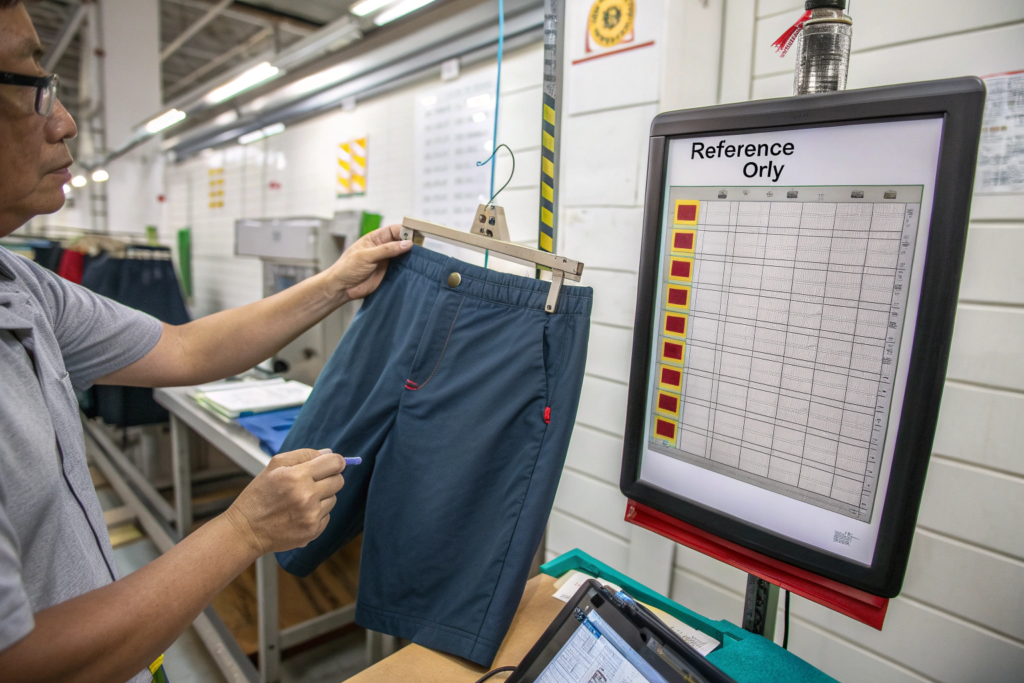
I have mentioned the sealed sample multiple times in this article because it is that important. The sealed sample is the physical contract between buyer and factory. Everything the factory produces must match this sample. If the sealed sample is not right, nothing that follows will be right.
The sealed sample process works like this. After all development is complete and the buyer has approved the final pre-production sample, the factory produces two identical copies. Both are signed, dated, and sealed in tamper-evident bags. One stays at the factory, displayed in the production manager's office where every sewing line supervisor can reference it. The other is shipped to the buyer, who keeps it in their office. Any future conversation about quality references this specific sample. When the bulk production is inspected, the inspector holds the bulk unit against the sealed sample. Any deviation is a discrepancy. No debate about what was agreed. This garment sample approval process is the single most effective quality dispute prevention tool available. At Shanghai Fumao, we do not cut a single meter of fabric until the sealed sample is physically signed by the buyer or confirmed by email with photographic acknowledgment.
How Do Third-Party Inspections Add a Layer of Security?
Even the best-intentioned factory has an inherent conflict of interest in quality control. The same management team that is responsible for delivering on time and on budget is also responsible for inspecting the quality of the output. When schedule pressure mounts, quality standards can slip, and internal QC teams can be overruled. An independent third-party inspection removes this conflict.
We encourage all our brand partners to commission a third-party inspection from a reputable firm like SGS, Bureau Veritas, or Intertek. We do not see this as a sign of distrust. We see it as a sign of a professional buyer. The third-party inspector visits our factory during production for an inline inspection, catching defects early. They return for a pre-shipment inspection, pulling a random AQL sample from the finished, packed cartons and inspecting against the sealed sample and the buyer's quality checklist. The inspection report goes directly to the buyer. It includes photographs of any defects found and a pass or fail recommendation. This third-party garment inspection report provides an objective quality verdict before the goods leave our factory. If a problem is found, it can be corrected here, before shipping, at a fraction of the cost and time of a post-delivery dispute. This is the final and most powerful layer of the prevention defense. It costs a few hundred dollars per inspection and can save tens of thousands in dispute costs, chargebacks, and lost customer goodwill.
Conclusion
Disputing a shipment of classic shorts that does not match the approved sample is a structured, evidence-based commercial process, not an emotional confrontation. The foundation of a successful dispute is laid long before the problem occurs, with a signed, sealed approval sample and a clear quality specification in the purchase order. When a discrepancy is discovered, the first 24 hours are critical. Stop acceptance, document the deviation with photographic evidence against the sealed sample, and perform a statistically valid AQL inspection to quantify the defect rate. Present this data to the supplier in a formal, factual, and professional communication that proposes a specific resolution.
The resolution itself should match the commercial reality of the defect. A price discount allows the buyer to sell marginal goods with compensated margin. A rework addresses repairable defects. A replacement is the last resort for catastrophically unmerchantable product. Throughout this process, the tone of the communication should preserve the relationship, because a good factory is a valuable asset, and a dispute handled well can strengthen rather than destroy a partnership.
The ultimate goal, however, is to never need this dispute process at all. A robust quality assurance system built on sealed samples, inline inspections, and third-party pre-shipment audits prevents the vast majority of discrepancies from ever reaching your warehouse. At Shanghai Fumao, we have built exactly this system, and we invite our partners to verify it independently at any time. If you want to discuss how we manage quality assurance for our classic shorts production, or if you are dealing with a quality issue from another supplier and need guidance, contact our Business Director, Elaine, at elaine@fumaoclothing.com. Let's make sure your next shipment arrives exactly as you approved it.