A luxury outerwear brand in Colorado placed a $200,000 order with a new supplier for an 800-fill-power down puffer jacket. The pre-production sample was beautiful. It was warm, light, and sold out at full price within two weeks of launch. The reorder was a disaster. Customers complained the jackets felt "flat," "cold," and "nothing like the first batch." The brand had the second batch tested at an independent lab. The fill power measured 680, not 800. The supplier had swapped the high-grade down for a lower-grade blend, assuming the customer would not notice the difference in a finished, baffled jacket. The brand’s reputation was severely damaged. The Colorado winter is unforgiving, and a falsely labeled 800-fill-power jacket that performs like a 680 is not just a quality failure; it is a breach of trust that leaves a customer cold.
Yes, every single batch of down used in Shanghai Fumao’s puffer jackets is independently certified to the exact IDFB or EN 12130 fill power standard by an ISO 17025-accredited third-party laboratory, with a batch-specific certificate that states the tested fill power, the down cluster content, the species of bird, and the country of origin. Fill power is not a visual estimate. It is not a supplier’s verbal assurance. It is a precise, physical measurement of the volume, in cubic inches, that one ounce of down occupies under a standardized, calibrated compression load. A 600-fill-power down occupies 600 cubic inches. An 800-fill-power down occupies 800 cubic inches. The number is the thermal efficiency of the jacket. A falsely labeled fill power is a jacket that is colder than advertised, heavier than advertised, and less compressible than advertised. It is a fraud committed against your customer, and we have built our entire down supply chain to make that fraud impossible. Let me take you inside the testing laboratory, the certification documents, and the supply chain controls that guarantee the fill power number on your puffer jacket is a certifiable, legally defensible physical fact.
What Is Fill Power and How Is It Measured in a Lab?
Fill power is the most important and most misunderstood number in outerwear. It is not a measure of warmth, though warmth is highly correlated with it. It is a direct, physical measure of the thermal efficiency of the down cluster. A high fill power down cluster is like a highly efficient insulating unit. It traps more insulating air per unit of weight than a low fill power cluster. An 800-fill-power jacket is warmer than a 600-fill-power jacket of the same weight. Or, stated differently, an 800-fill-power jacket can achieve the same warmth as a 600-fill-power jacket at a significantly lighter weight and smaller packed volume. This weight-to-warmth ratio is the fundamental value proposition of a premium down jacket. A brand that advertises “800 fill power” but ships 680 fill power is stealing thermal performance from its customer.
The measurement of fill power is a rigorous, internationally standardized laboratory procedure. It is not an estimate. It is not a hand feel. It is a precisely conditioned, mechanically compressed, digitally measured physical test. The two globally recognized standards are the International Down and Feather Bureau method and the European Norm EN 12130 method. The IDFB method is the most commonly used standard in the North American market, while the EN method is the European standard. The two methods are similar in principle but differ slightly in the conditioning protocol and the compression cylinder dimensions. Our testing laboratory is accredited to perform both methods, and we test to the standard required by the market in which the final product will be sold. For U.S. brands, we test to the IDFB standard.
What Happens Inside an IDFB Fill Power Testing Cylinder?
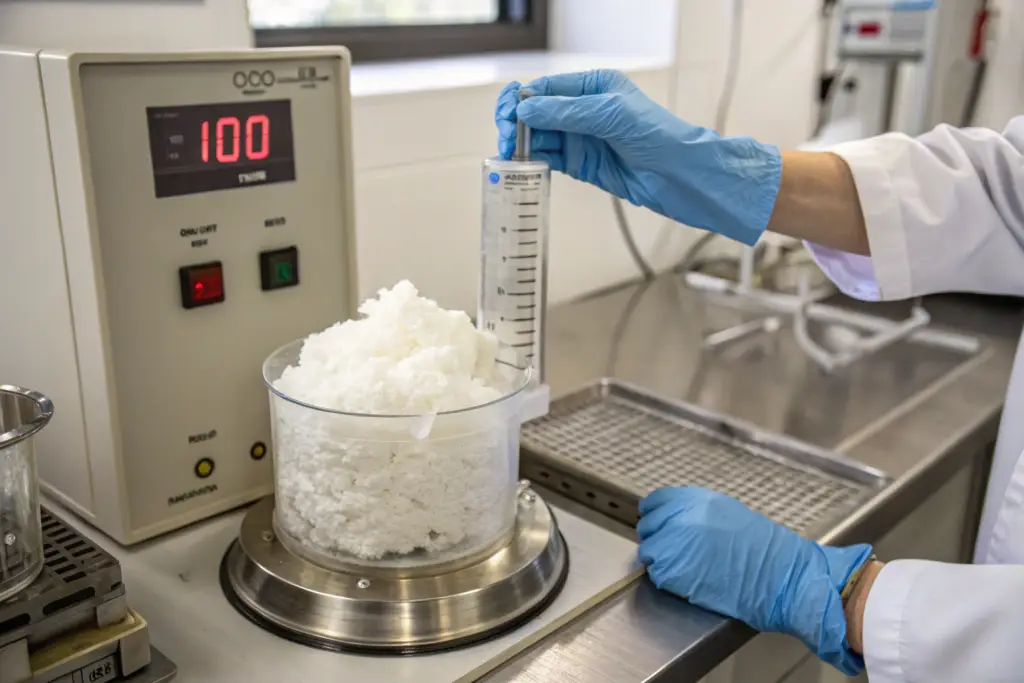
The IDFB fill power test is a five-step procedure that must be performed in a conditioned laboratory maintained at 20 degrees Celsius and 65% relative humidity. The down sample must be conditioned in this environment for at least 72 hours before testing. This is critical, because down is hygroscopic; it absorbs atmospheric moisture, and a damp down cluster will not loft fully. A test performed on an unconditioned sample can underestimate the true fill power by 50 points or more. Our testing lab maintains a 24-hour environmental monitoring log to prove the conditioning protocol is followed.
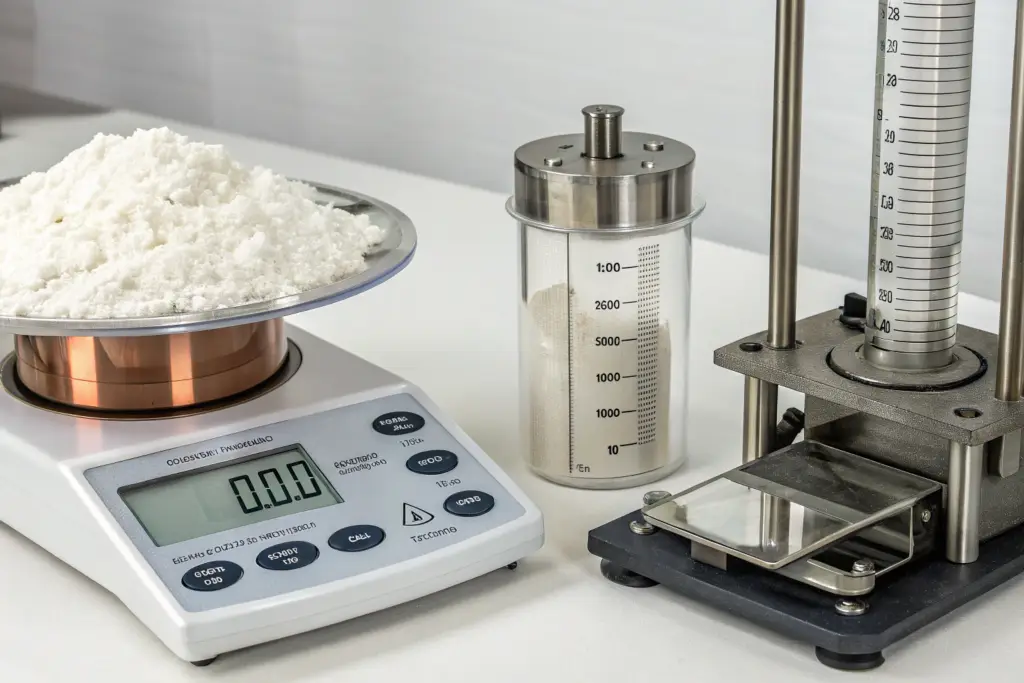
The conditioned sample is weighed to exactly one ounce, or 28.35 grams, on a calibrated analytical balance. The weighed sample is then gently placed into a transparent, calibrated, graduated cylinder with a precisely known internal diameter. A mechanical conditioning plunger is inserted, and the down is gently fluffed and preconditioned for a specified number of cycles. This breaks up any static clumping and ensures the down clusters are fully separated and lofted to their maximum natural volume. After preconditioning, a precisely weighted compression piston, applying a standardized pressure of 0.0625 pounds per square inch, is gently lowered onto the down. The down compresses under this load, and the piston stabilizes. After exactly 60 seconds, the volume of the compressed down column is read directly from the graduated scale on the cylinder, to the nearest 5 cubic inches. This number is the fill power. The entire procedure is video-recorded by our lab technician, and the video file is archived along with the numerical data. The result is not a single measurement; it is the mean of three separate sub-samples from the same batch, each tested independently. The batch’s certified fill power is the mean of these three measurements, and the coefficient of variation between the three must be less than 2%. If the variation is higher, the down is not sufficiently homogenized, and the test is invalidated and repeated on a new, re-homogenized sample.
How Does Cluster Content Percentage Relate to Fill Power?
A fill power number in isolation is incomplete. A down cluster is the three-dimensional, plumule structure from the breast of a mature goose or duck. A feather is the flat, two-dimensional, quill-based structure from the wing. A down cluster traps air; a feather does not. A jacket filled with 90% down clusters and 10% feathers will have a higher fill power, a higher warmth-to-weight ratio, and a longer loft life than a jacket filled with 70% down and 30% feathers, even if the down component itself has the same raw fill power. The feathers are heavier, flatter, and less resilient. They add weight without adding warmth. They reduce the fill power of the blend.
The true thermal quality of the down fill is defined by two numbers, not one: the fill power and the down cluster content percentage. A jacket labeled “800 fill power, 90/10 down/feather ratio” is a premium, high-performance product. A jacket labeled “800 fill power” with no cluster content stated could legally contain a 70/30 blend. The raw fill power of the down component might be 800, but the blended fill power of the actual fill inside the jacket is significantly lower, because the feathers are dragging the average down. Our batch-specific certificate always states both the fill power and the down cluster content, measured to the IDFB or EN standard. We do not allow a fill power claim without a cluster content claim. The two numbers are a thermally inseparable pair. A brand that advertises fill power without cluster content is telling a deliberately incomplete story.
How Does Fumao Certify Every Down Batch Independently?
A supplier’s internal test report is a conflict of interest. The supplier who sold the down also tested the down. The financial incentive to overstate the fill power, even slightly, is significant. A 50-point exaggeration on a fill power number can add $15 to the wholesale price of a jacket. The temptation is constant, and the customer has no way to detect the fraud without cutting open the jacket and sending the fill to a lab.
Our certification process eliminates this conflict of interest entirely. We do not test our own down. We physically extract a random, blinded sample from every single bulk down batch, seal it in a tamper-proof evidence bag with a unique, traceable batch code, and ship it directly to an independent, ISO 17025-accredited laboratory. The laboratory does not know the supplier’s name or the claimed fill power. They receive a coded sample bag. They perform the IDFB or EN fill power test, the species identification test, and the down cluster content analysis. They issue their own, official test report on their own letterhead, with their own accreditation number and their own signature. This report is the only basis for the fill power claim on our puffer jackets.
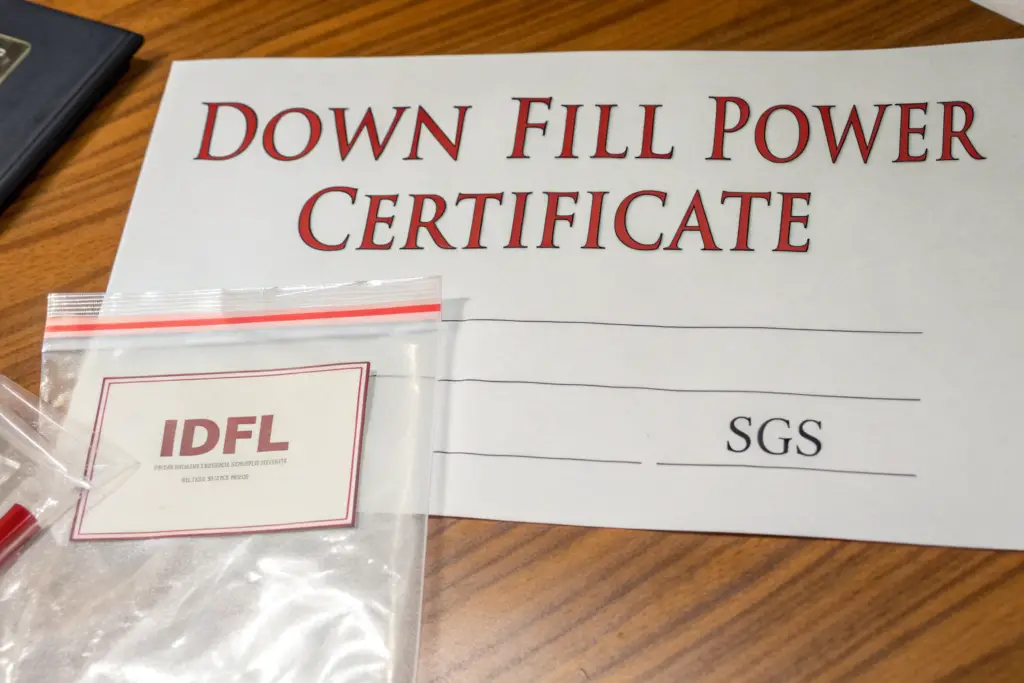
What Is an IDFL or SGS Down Test Report?
IDFL, the International Down and Feather Laboratory, and SGS, the global testing, inspection, and certification company, are the two most recognized and trusted independent down testing laboratories in the world. An IDFL or SGS down test report is the gold standard of down certification. It is a document that is accepted by the U.S. Federal Trade Commission, the European Commission, and every major outdoor and luxury outerwear brand’s compliance department.
The report contains ten specific, critical data points. First, the tested fill power, expressed in cubic inches per 30 grams or per ounce, and the standard used. Second, the down cluster content, expressed as a percentage of the total weight. Third, the species identification, determined by microscopic analysis of the down and feather fibers, stating whether the fill is pure goose down, pure duck down, or a blend. Fourth, the country of origin. Fifth, the turbidity test result, measuring the cleanliness of the down. Sixth, the oxygen number, a chemical measure of the down’s protein degradation. Seventh, the fat and oil content. Eighth, the residual moisture content. Ninth, a clear pass/fail statement against the applicable standard. And tenth, the unique, traceable batch number that links the report to the specific physical bag of down in our warehouse. This report is not a summary. It is a complete, standardized, auditable data file. It is the legal proof of the down’s quality, and we provide a copy of this exact report, unedited and in full, to every brand partner for every bulk production batch.
How Does a “Blind Sample” Chain of Custody Prevent Fraud?
A blind sample chain of custody is a forensic protocol that ensures the down sample that arrives at the independent laboratory is the exact down that we poured into the jacket baffles. It prevents the most common fraud in the down industry: a supplier sending a “golden sample” of high-grade down to the lab for testing, while shipping a lower-grade bulk down to the factory for production. The test report is beautiful; the jacket is fraudulently filled.
Our chain of custody protocol has five steps, each documented and witnessed. Step one: our incoming QC inspector physically cuts open a random bale from the bulk down shipment. Step two: the inspector, wearing clean gloves, extracts three sub-samples from the center of the bale, not the surface, using a long, hollow, stainless steel sampling probe. Step three: the sub-samples are placed into a single, pre-labeled, tamper-evident evidence bag. The bag is sealed, and the unique, pre-printed serial number on the bag’s tear strip is recorded in our batch log. Step four: the sealed bag is placed into a courier envelope, and the airway bill is generated. The courier envelope is handed directly to the FedEx or DHL driver, who signs for it. The chain of custody log records every person who has handled the sample, from the inspector to the driver. Step five: the independent laboratory receives the sealed bag, verifies that the tear strip serial number matches the chain of custody log, breaks the seal, and performs the test. If the seal is broken or the serial number does not match, the sample is rejected, and a new sample is requested. This forensic protocol makes it physically impossible for anyone in our factory, or anyone at the down supplier, to swap a high-grade sample for a low-grade bulk fill. The sample the lab tests is the down your jacket receives. The chain of custody is the guarantee.
Why Is a Fill Power Certificate a Defensible Marketing Claim?
A fill power number printed on a hangtag is a public, legally actionable claim. Under U.S. law, specifically the Federal Trade Commission’s Textile Fiber Products Identification Act and the FTC’s broader authority to regulate deceptive advertising, a false or unsubstantiated fill power claim is a deceptive trade practice. A consumer, a competitor, or the FTC itself can challenge the claim. If the brand cannot produce a valid, independent test report for the specific batch of down in that specific jacket, the brand faces fines, a forced recall, and reputational damage that can destroy a premium outerwear brand’s positioning.
A defensible marketing claim is a claim that is backed by pre-existing, independent, batch-specific evidence. Our certification package is that evidence. When a brand partner attaches our down certificate to their product, they are not just adding a marketing tag. They are attaching a legal defense. If a consumer or a regulator challenges the fill power claim, the brand does not need to hire a lawyer to write a letter. They simply produce the IDFL or SGS test report, with its batch number and its unbroken chain of custody, and the challenge is resolved with data, not argument. This pre-positioned evidence transforms a marketing risk into a marketing asset.
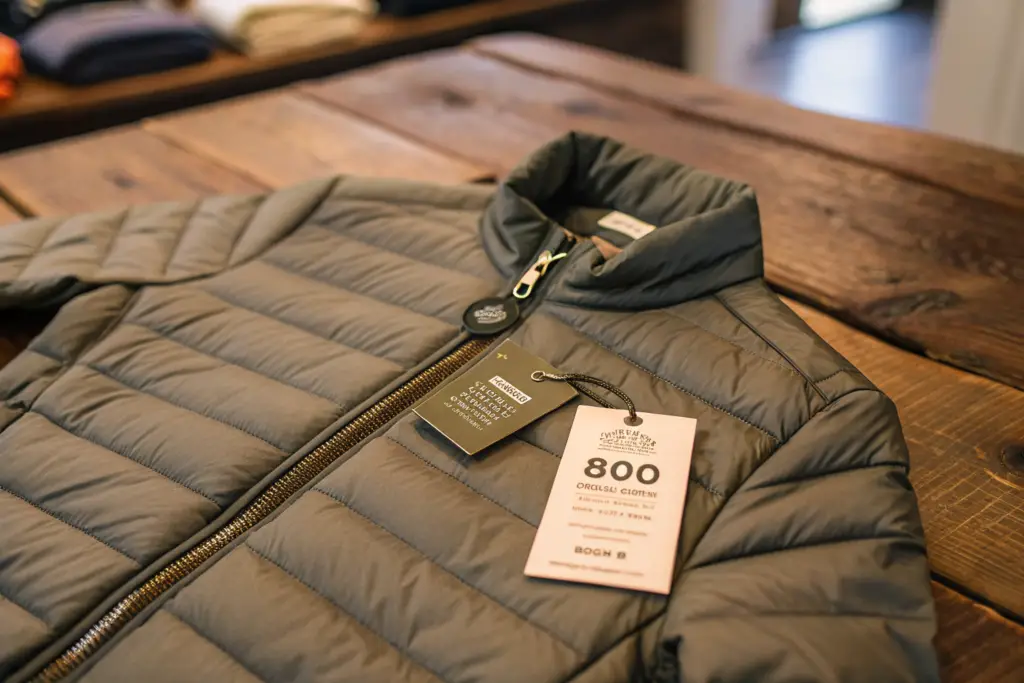
How Can a Brand Publish a “Fill Power Certificate” on Its Product Page?
We encourage our brand partners to publish the actual, redacted test report directly on their e-commerce product page. This is the ultimate expression of radical transparency. A customer buying an $800 puffer jacket is making a considered, high-involvement purchase. They are comparing technical specifications across brands. A product description that states “800 Fill Power” is a claim. A product page that shows a downloadable PDF of the actual IDFL test report is a proof.
The report can be redacted to remove the supplier’s internal pricing codes and the exact shipping date, while leaving all the technical data, the laboratory’s name, the accreditation number, and the batch code fully visible. This published certificate immediately differentiates the brand from competitors who are making identical, unsubstantiated fill power claims. The customer sees the document, checks the IDFL accreditation on the IDFL website, and their skepticism is replaced with trust. This trust translates directly into a higher conversion rate and a lower return rate on a high-ticket item. We provide our brand partners with a pre-approved, redacted PDF of the certificate, along with a brief, legally reviewed explanatory text they can post alongside it. This is not a marketing gimmick. It is a genuine, verifiable data point that the customer can independently audit.
How Does Species and Origin Traceability Build a Premium Brand Story?
A “pure goose down” claim is not verifiable without a microscope. Duck down is visually very similar to goose down to the naked eye. It is slightly smaller, has a slightly lower fill power potential, and has a slightly more pronounced natural odor. Passing duck down off as goose down is a common fraud in the industry. The IDFL or SGS test report includes a definitive, microscopic species identification. The analyst examines the barbules of the down fibers under a microscope, identifies the species-specific node structures, and certifies the fill as “100% White Goose Down” or “90% Grey Duck Down,” as the case may be. This certificate is the only proof of the species claim.
Furthermore, the country of origin, as determined by the down supplier’s audited supply chain records, is stated on the certificate. A brand that sources down from a specific, responsibly managed region can use this traceable origin data to build a powerful brand story. “The down in this jacket is 100% White Goose Down, sourced from an audited, RDS-certified farm in the Pyrenees region of France, independently verified by IDFL certificate number X.” This is a complete, traceable, defensible narrative. It connects the customer to the origin of the material, justifies the premium price, and builds an emotional bond between the customer and the product. This level of traceability is only possible with an independent, third-party certification system. The certificate is not just a compliance document; it is a ready-made marketing asset that tells an authentic, verifiable story about quality and provenance.
Conclusion
A fill power number on a puffer jacket is a promise of thermal performance. A false fill power number is a promise broken, leaving a customer cold and a brand’s reputation damaged. At Shanghai Fumao, that promise is backed by a forensic, independent, and batch-specific certification process that makes fraud impossible. We do not test our own down. We send a blind, tamper-evident sample from every bulk batch to an ISO 17025-accredited, independent laboratory like IDFL or SGS. The laboratory measures the fill power to the IDFB or EN 12130 standard, determines the exact down cluster content, identifies the species, and traces the country of origin. We receive their unedited, signed test report, and we deliver a copy of that exact report to you, our brand partner, along with your shipment. The number on your hangtag is not a marketing claim; it is a published, third-party-verified, legally defensible physical measurement.
Your customer is buying an $800 puffer jacket because they need it to perform in real cold. Give them the proof that it will. Put the IDFL certificate on your product page. Let your customer download it, check the accreditation, and know, with forensic certainty, that the down in their jacket is exactly what you claim it to be. That trust is the foundation of a premium outerwear brand.
If you are a U.S. outerwear brand owner ready to build a puffer jacket line with certified, traceable, and defensible down, let’s talk. We can send you a sample jacket, a full down certification package with a batch-specific IDFL report, and a hangtag prototype. Contact our Business Director, Elaine, at elaine@fumaoclothing.com. Tell her you want the down certification sample kit. Let’s build a puffer jacket where the fill power claim is not a hope, but a certified, published, and independently verifiable fact.