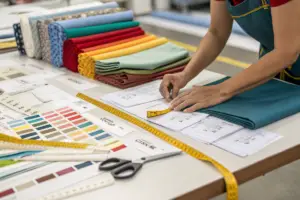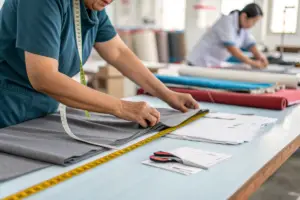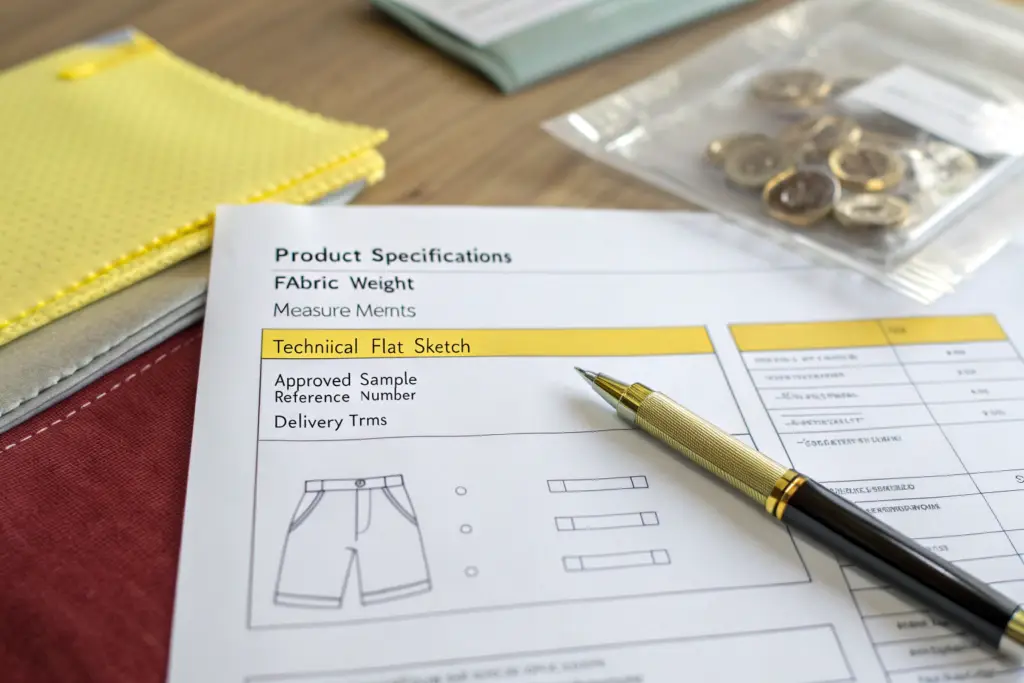
About eight years ago, a brand owner sent me a purchase order for 2,000 pairs of classic shorts that consisted of exactly two lines. The first line said "Classic Chino Shorts – Sand Color – 2,000 pcs." The second line said "Delivery: ASAP." I stared at the email for a full minute, then called him. I asked about the fabric weight, the zipper specification, the pocket bag material, and the labeling requirements. His answer to every question was, "Whatever your standard is." I told him, respectfully, that I could not accept this purchase order. Not because I did not want his business, but because an order this vague was guaranteed to end in a dispute. He was frustrated at the time, but six months later, after we had worked together to develop a proper specification sheet, he told me that conversation had saved his business from the disaster he had experienced with his previous factory, where "standard" had meant the cheapest possible interpretation of every detail.
A winning purchase order for custom classic shorts from Asia is a legally enforceable technical document that leaves zero room for subjective interpretation, combining a complete bill of materials with precise measurement tolerances, a clear reference to a mutually approved sealed sample, defined quality inspection standards including the AQL level and inspection point, and explicit Incoterms with a delivery schedule that includes a grace period and a penalty or cancellation clause for late shipment.
At Shanghai Fumao, I process purchase orders every week from brands ranging from startups to established multi-million-dollar labels. The difference between a PO that results in a smooth production run and a PO that results in frustration is entirely in the level of specificity. The factory wants to make you happy, but the factory cannot read your mind. The PO is the document that translates the vision in your head into the language of the cutting room floor. Let me show you exactly how to write one that protects your interests and sets up your manufacturing partner for success.
What Essential Product Specifications Must a Classic Shorts PO Include?
The product specification section of a purchase order is the heart of the document. It is the section that will be pinned to the wall of the cutting room, referenced by the QC inspector, and, if a dispute arises, examined in detail by both parties. A vague specification invites creative interpretation by the factory, and creative interpretation, in manufacturing, is synonymous with cost-cutting. A precise specification closes off those avenues and forces the factory to build exactly what you designed.
A complete product specification for custom classic shorts must define the garment across five immutable dimensions: the fabric specification including fiber composition, weight in GSM, weave type, and any finishing treatments; the trim and hardware specification identifying the exact brand and model of zipper, button, and any other fasteners; a detailed measurement chart with tolerances for every size; a color specification using Pantone references; and the labeling and packaging requirements including the exact placement of brand labels, care labels, hangtags, and folding method.
Why Do Fabric and Trim Specifications Need Exact Reference Codes?
Writing "100% cotton twill" on a purchase order is like writing "four-door sedan" on a car purchase contract. It describes a category, not a specific product. Within the category of 100% cotton twill, there are hundreds of variations. A lightweight 180 GSM twill with a soft finish. A heavyweight 280 GSM twill with a crisp finish. A peached twill. A brushed twill. Each behaves completely differently when cut and sewn into shorts.
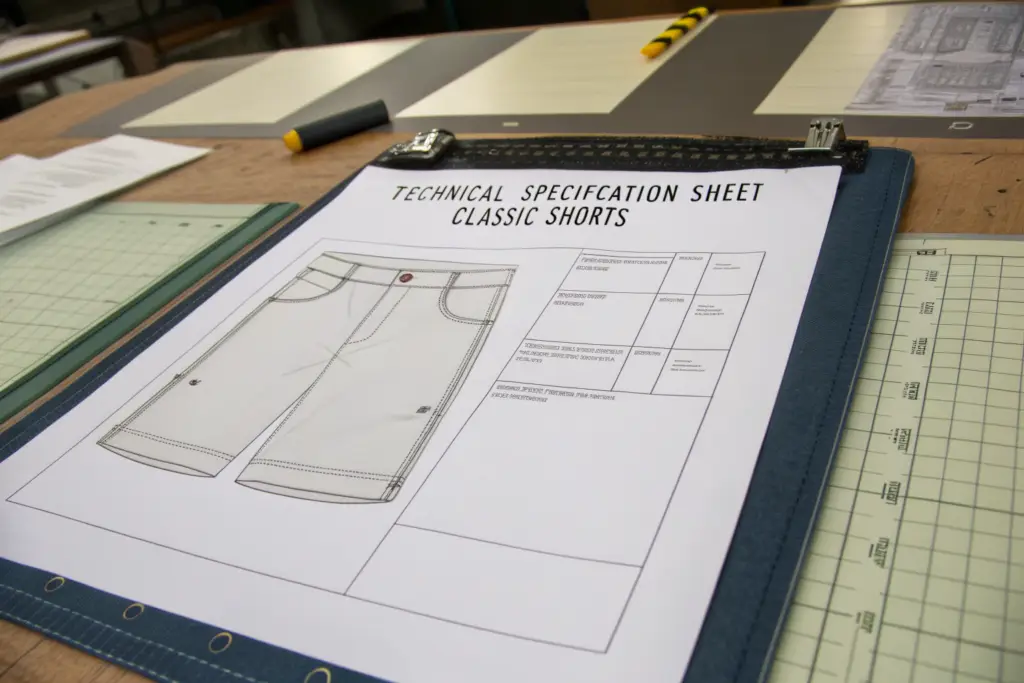
The fabric specification must include the exact fiber composition, the weight in grams per square meter, the weave construction, and the finishing treatment. If you have approved a specific fabric reference from the mill, include the mill name and the fabric article number. "100% Cotton Twill, 240 GSM, 3/1 Z-twill, enzyme washed, fabric ref: MillName-Art-4521" is a specification. The trim specification requires equal precision. "YKK zipper" is not specific enough. YKK makes dozens of zipper types. Specify the exact product code. "YKK #5 Metal Zipper, antique brass finish, auto-lock slider, closed-end, tape color to match body fabric." The button specification should include the material, the size in ligne, the color reference, and the attachment method. This garment specification sheet level of detail eliminates the factory's ability to substitute a cheaper component. If the PO says "YKK #5," and a generic #5 coil zipper arrives, the discrepancy is objective and indisputable. At Shanghai Fumao, we prefer this level of detail. It means we know exactly what to order and exactly what to inspect against.
How Do You Create a Measurement Chart That Prevents Fit Disputes?
The measurement chart is the most litigated section of any apparel purchase order. A brand claims the shorts are too small. The factory claims they are within tolerance. The argument happens because the PO did not define how the measurements are taken and what variation is acceptable.
A professional measurement chart includes three elements. First, a diagram showing exactly where each measurement point is located. Where does the waist measurement start and end? Is it measured with the waistband relaxed or stretched? Where is the inseam measured from and to? Second, a table with the target measurement for each size in inches or centimeters. Third, and most critically, a tolerance column specifying the acceptable plus or minus variation. A common tolerance for a waist measurement on woven shorts is +/- 0.5 inches. For the inseam, it might be +/- 0.25 inches. Without this tolerance column, the factory's internal standard applies, and that standard may not match your expectations. This size specification sheet should also specify the measurement method. "All measurements taken with garment laid flat, waistband fastened, and fabric smoothed but not stretched." These words on a PO have prevented more disputes than any amount of post-delivery negotiation. At Shanghai Fumao, we insist on a signed measurement chart before any bulk cutting begins. It is the physical reference that our QC team uses for every inline and final inspection.
How Do You Define Quality Standards and Inspection Protocols?
I have had a buyer reject an entire shipment because of a single loose thread on one pair of shorts. I have had another buyer accept a shipment with a 3% major defect rate without complaint. The difference between these two outcomes was not the quality of the shorts. It was the quality standards defined in the purchase order. Without a pre-agreed definition of what constitutes a defect and what defect rate is acceptable, quality assessment becomes a subjective argument rather than an objective process.
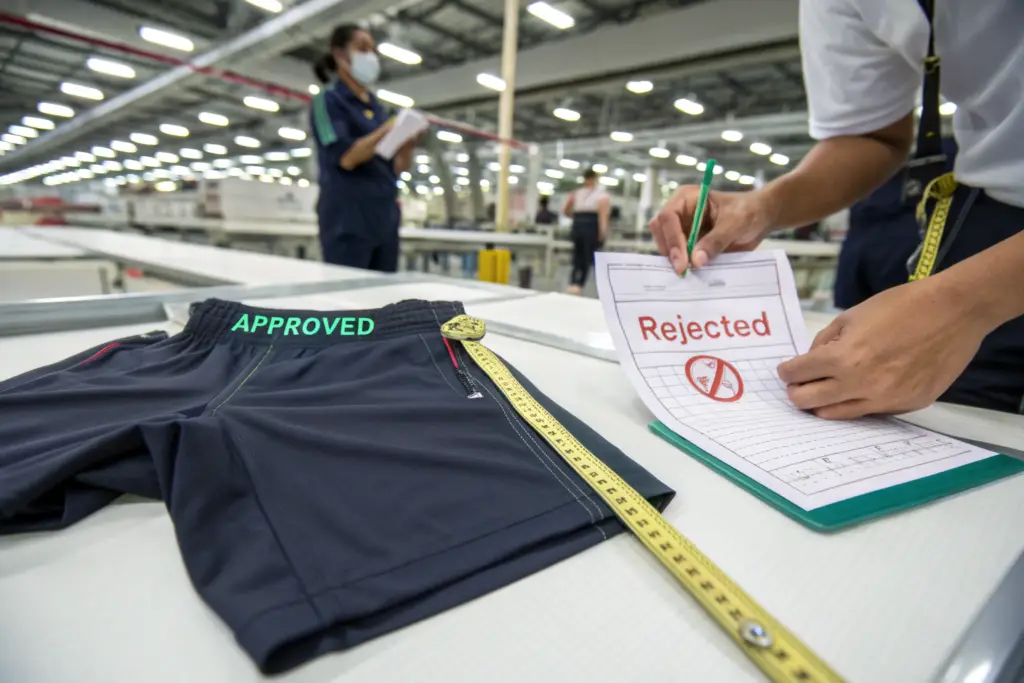
Defining quality standards in a classic shorts purchase order requires specifying the acceptable quality limit using the AQL statistical sampling methodology, categorizing potential defects into critical, major, and minor with clear definitions for each category, naming the specific inspection point where quality will be verified, and identifying the party who will perform the inspection, whether it is the factory's internal QC, a named third-party agency, or the buyer's own representative.
What AQL Level Should You Specify for Classic Shorts?
The AQL table is the universal language of quality assurance in global apparel manufacturing. It defines the maximum number of defective units allowed in a random sample drawn from the shipment. Using AQL eliminates the unproductive conversation where the buyer says "too many defects" and the factory says "no, just a few." The numbers answer the question.
For classic shorts, I recommend specifying an AQL of 2.5 for major defects and 4.0 for minor defects, with a zero-tolerance policy for critical defects. This is the standard that most mid-to-premium apparel brands use. A major defect is something that would cause a customer to return the shorts: a broken zipper, a seam that is coming apart, a waist measurement that is outside the agreed tolerance. A minor defect is something the customer would notice but probably not return the shorts for: a slightly crooked label, a loose thread that needs trimming, a slight color variation within the same pair. A critical defect is something that makes the shorts unsafe or legally non-compliant: a needle fragment left in the garment, a hazardous chemical residue. The PO should state the AQL level, the inspection level, and the sampling plan. "Final random inspection per ISO 2859-1, Level II, AQL 2.5 Major, 4.0 Minor, 0 Critical." This AQL inspection standards sentence, dropped into a purchase order, signals to the factory that the buyer is a professional who understands quality control. It also gives the buyer a legally enforceable quality benchmark.
Who Should Conduct the Inspection and When?
The timing and the authority of the inspection determine whether quality problems are caught before they ship or discovered after they arrive. There are three common inspection points, and the PO should specify which one applies. The inline inspection happens when approximately 20% to 30% of the order is produced. Defects found here can be corrected before the rest of the order is manufactured. The final random inspection happens when the order is 100% produced and at least 80% packed. This is the last checkpoint before shipping. The loading supervision happens at the container stuffing, ensuring that the goods that passed inspection are the goods that are actually loaded.
For a new factory relationship, I always advise buyers to specify a third-party final random inspection by an agency such as SGS, Bureau Veritas, or Intertek. The cost is several hundred dollars and is typically paid by the buyer. The value is an independent, professional quality report that the factory cannot influence. The PO should state: "Third-party final random inspection to be conducted by SGS at seller's factory after 100% production completion and before shipment. Inspection to be arranged and paid for by buyer. Shipment release contingent on passed inspection report." This third-party inspection process clause gives the buyer the ultimate quality gate. If the shorts do not pass, they do not ship. At Shanghai Fumao, we welcome third-party inspections. We see them as a validation of our quality systems, not as an accusation of failure.
What Payment and Delivery Terms Protect Both Buyer and Factory?
Money and time are the two resources that sourcing disputes are ultimately fought over. A purchase order that is vague about payment milestones or delivery deadlines is a purchase order that invites exploitation. The factory wants security that they will be paid for the work they do. The buyer wants security that the factory will deliver on time and as specified. A well-structured PO balances these interests with payment terms that release funds in stages tied to verifiable production milestones, and delivery terms that define exactly when the goods must be ready and what happens if they are not.
A protective payment structure for a custom classic shorts order splits the total into two or three milestones linked to objective events rather than calendar dates, typically a deposit against order confirmation, a progress payment against a passed inspection report, and a balance payment before or after shipment depending on the relationship, while the delivery terms specify the exact Incoterm, the required shipping date with a defined grace period, and a remedy for late delivery that is commercially meaningful but not punitively destructive to the relationship.
Why Should Payments Be Tied to Milestones, Not Dates?
A payment schedule that says "50% on April 1st, 50% on May 15th" is disconnected from production reality. If the factory is delayed for reasons outside their control, the payment is still due, and the buyer has lost leverage. A payment schedule tied to milestones aligns the factory's financial incentive with the buyer's quality and timeline interests.
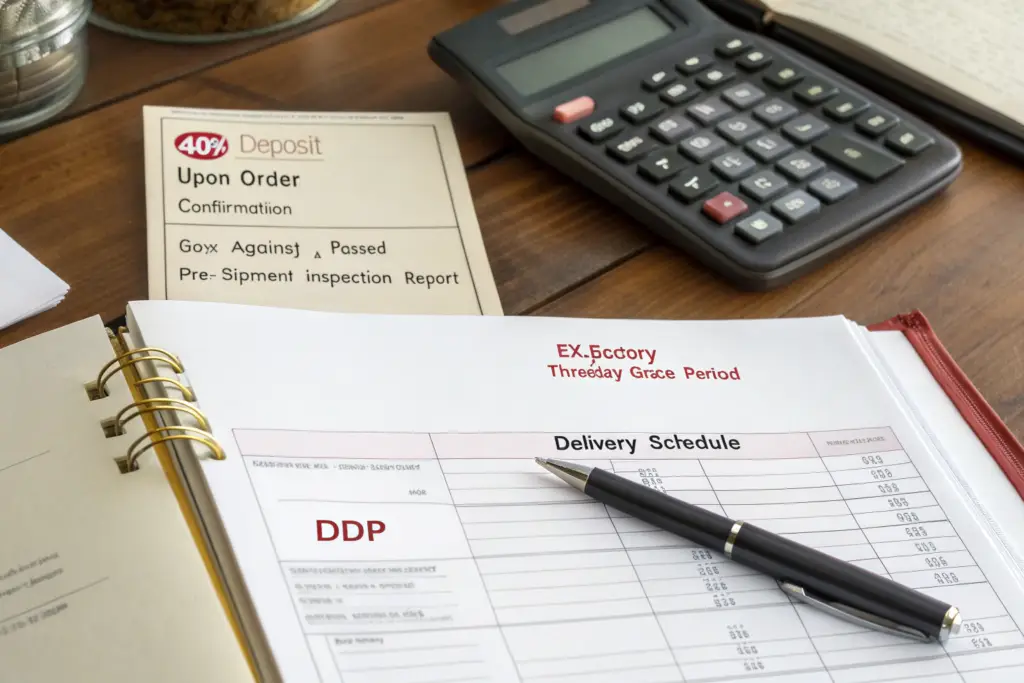
The most common structure for a first order with a new factory is a 30% to 40% deposit to confirm the order and fund the raw material purchase, with the remaining 60% to 70% due against a passed third-party pre-shipment inspection report. This structure means the factory gets working capital to buy fabric and trims, but does not receive the bulk of their payment until they have produced conforming goods. An alternative for ongoing relationships is a 30% deposit, a 40% progress payment against photographic evidence of completed production, and a 30% balance against the bill of lading. The key principle is that the buyer's payment obligation is triggered by a documented, verifiable event, not by a date on a calendar. This payment terms negotiation strategy protects both parties. The factory knows that if they produce good shorts, they will be paid. The buyer knows that if the shorts are defective, they have financial recourse.
How Do You Structure a Delivery Schedule with Real Consequences?
A delivery date without a consequence is a suggestion, not a commitment. Every factory intends to deliver on time. The ones that actually do are the ones that know there is a cost to not doing so. The delivery clause in a PO must define what "on time" means, what a reasonable grace period is, and what remedy the buyer has if the deadline is missed.
"Delivery: End of May" is not a delivery schedule. "Ex-factory date: May 28th, 2026, with a three-day grace period to May 31st, 2026. For each calendar day of delay beyond the grace period, the seller agrees to a discount of 1% of the total order value, capped at 10%, after which the buyer may cancel the order and receive a full refund of the deposit." This is a delivery schedule with teeth. The grace period acknowledges the reality of production variability. The daily discount is commercially meaningful enough to focus the factory's scheduling attention without being so punitive that it destroys the relationship. The cancellation right at 10% protects the buyer from infinite delay. This delivery schedule clause should also specify the Incoterm, because the ex-factory date under FOB is the date the goods are loaded onto the vessel, while the delivery date under DDP is the date the goods arrive at the buyer's warehouse. These are completely different dates with completely different risk profiles.
How Do You Structure the Legal and Communication Framework?
The final section of a purchase order is often treated as boilerplate, skimmed and ignored. This is a mistake. The legal and communication clauses are the safety net that catches the relationship when something goes wrong. They answer the questions that become suddenly urgent during a dispute: which country's laws govern this contract? Where will disputes be resolved? What constitutes an official communication? A few well-chosen clauses in this section can prevent a solvable quality issue from escalating into an international legal nightmare.
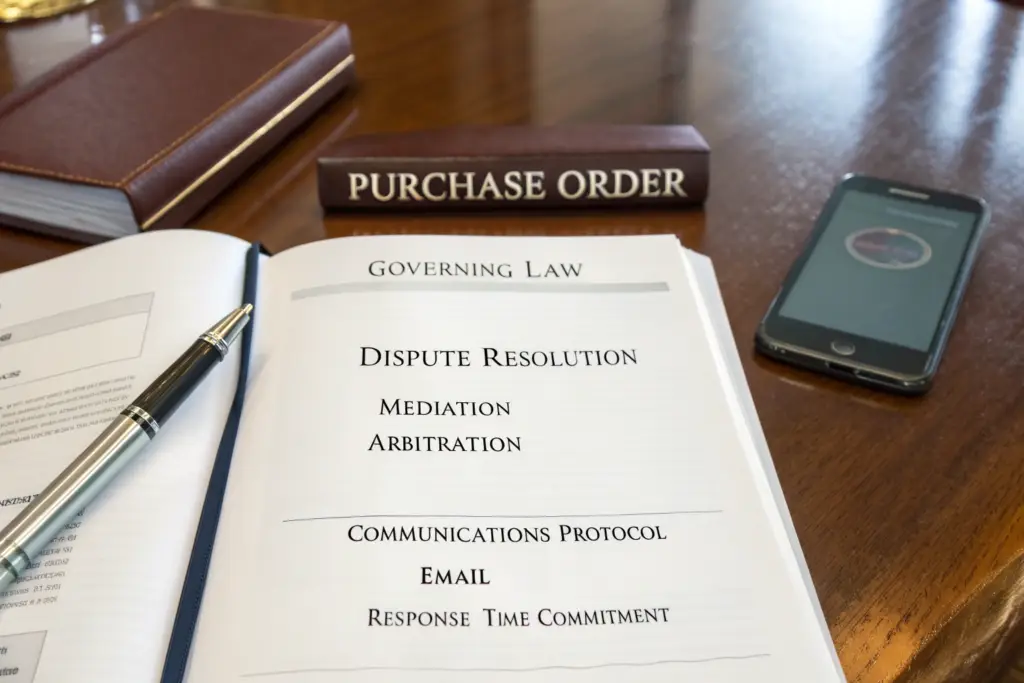
A complete legal framework for an Asian apparel purchase order includes a governing law clause that specifies which jurisdiction's laws apply, a dispute resolution clause that provides a tiered process starting with negotiation and escalating to mediation or arbitration before litigation, a force majeure clause that defines excusable delays, and a communications clause that designates email as the official channel and specifies a maximum response time for order-related communications.
Why Should You Specify Governing Law and Dispute Resolution?
When a dispute between a buyer in Texas and a factory in China reaches an impasse, the first question a lawyer will ask is: "Which court has jurisdiction?" If the purchase order is silent on this question, the answer is complicated, expensive, and likely to favor the party with deeper pockets and local legal representation.
A governing law clause provides certainty. "This Purchase Order shall be governed by and construed in accordance with the laws of the State of New York, without regard to its conflict of laws principles." This is a common choice for international apparel contracts because New York has a well-developed body of commercial law. However, winning a court judgment in New York is one thing. Enforcing it against a factory in China is another entirely. This is why the dispute resolution clause should specify arbitration. Arbitration awards are enforceable across borders under the New York Convention, to which both the United States and China are signatories. A tiered dispute resolution clause reads: "The parties shall first attempt to resolve any dispute through good-faith negotiation for a period of 30 days. If negotiation fails, the dispute shall be submitted to binding arbitration administered by the Singapore International Arbitration Centre in accordance with its rules." This international dispute resolution clause provides a practical path to enforcement that a simple "jurisdiction in New York" clause does not.
What Communication Protocols Prevent Misunderstandings During Production?
Production problems are solvable if they are communicated quickly. A problem that sits in an unread WeChat message for five days becomes a missed deadline and a dispute. The PO should establish clear communication expectations that prevent issues from festering.
Specify the official communication channel. "All communications relating to this Purchase Order, including production updates, quality issues, and schedule changes, shall be conducted via email to the addresses listed below. Both parties shall acknowledge receipt of any order-related communication within 24 hours during business days." This prevents the fragmentation of communication across WeChat, WhatsApp, Alibaba messenger, and phone calls, where information gets lost and undocumented. Also, specify the production update frequency. "The Seller shall provide a written production status update every Friday including the percentage of order completed, any issues encountered, and the current estimated ex-factory date." These supplier communication protocols transform the production black hole into a transparent process. At Shanghai Fumao, we provide this level of communication as a standard practice, not because purchase orders require it, but because we know it prevents the anxiety and uncertainty that poison buyer-supplier relationships.
Conclusion
A winning purchase order for custom classic shorts is not a simple order form. It is a technical blueprint, a quality contract, a financial agreement, and a legal framework, all contained in a single document that leaves nothing to assumption. The product specification section freezes the design with fabric reference codes, trim model numbers, and a measurement chart with defined tolerances. The quality section replaces subjective opinion with objective AQL statistics and independent third-party verification. The payment and delivery section aligns financial incentives with production milestones and attaches real consequences to missed deadlines. The legal section provides a clear path to resolution if every other section fails.
The time you invest in writing this level of purchase order is repaid many times over in the disputes that never happen, the production errors that are caught before they ship, and the factory respect you earn by demonstrating that you are a professional buyer who understands how manufacturing works. A factory will always take a detailed PO more seriously than a vague one, because a detailed PO comes from a buyer who will also inspect seriously.
If you are preparing your first purchase order for custom classic shorts, or if you want to upgrade your current PO template to the level of specificity that protects your business, we can help. At Shanghai Fumao, we work with our brand partners to ensure every purchase order is complete, clear, and mutually protective before any deposit changes hands. Contact our Business Director, Elaine, at elaine@fumaoclothing.com. Let's build a PO that starts your production run on a foundation of clarity.