Two years ago, a resort wear brand owner from Miami sat in my office and told me she was thinking about dropping white shorts from her collection. She had data showing that online returns for white shorts were running at almost double the rate of her khaki and navy styles. Customers complained about sheerness, about visible pocket bags, about stains that appeared after a single wear. She was ready to walk away from the category entirely. I asked her to hold off for one season. We re-engineered her white short from the fabric up, changing the weave density, the pocket bag material, and the lining specification. The following year, white shorts became her number one selling SKU, with a return rate below the category average. She had not been facing a demand problem. She had been facing a manufacturing problem that made the demand look weak.
Classic white shorts for women remain a top-tier seller for resort wear brands because they occupy a unique and irreplaceable position in the vacation wardrobe, serving as the universal high-contrast anchor piece that photographs beautifully, pairs effortlessly with every colorful top and accessory in a traveler’s suitcase, and signals a level of relaxed luxury that no colored bottom can replicate, but their commercial success depends entirely on the brand solving the technical manufacturing challenges of opacity, stain resistance, and fit that have historically driven high return rates.
At Shanghai Fumao, we manufacture white shorts for several resort wear labels, and I have watched the category closely for over a decade. The narrative that white shorts are "too difficult" or "not worth the returns" is a narrative created by brands that have not invested in the right fabric and construction solutions. The consumer demand is there. It has always been there. The brands that capture it are the ones that stop treating white shorts like a color variation of their khaki program and start treating them as a distinct engineering challenge. Let me show you why this category still dominates, and how to manufacture it profitably.
Why Do White Shorts Remain a Resort Wear Staple?
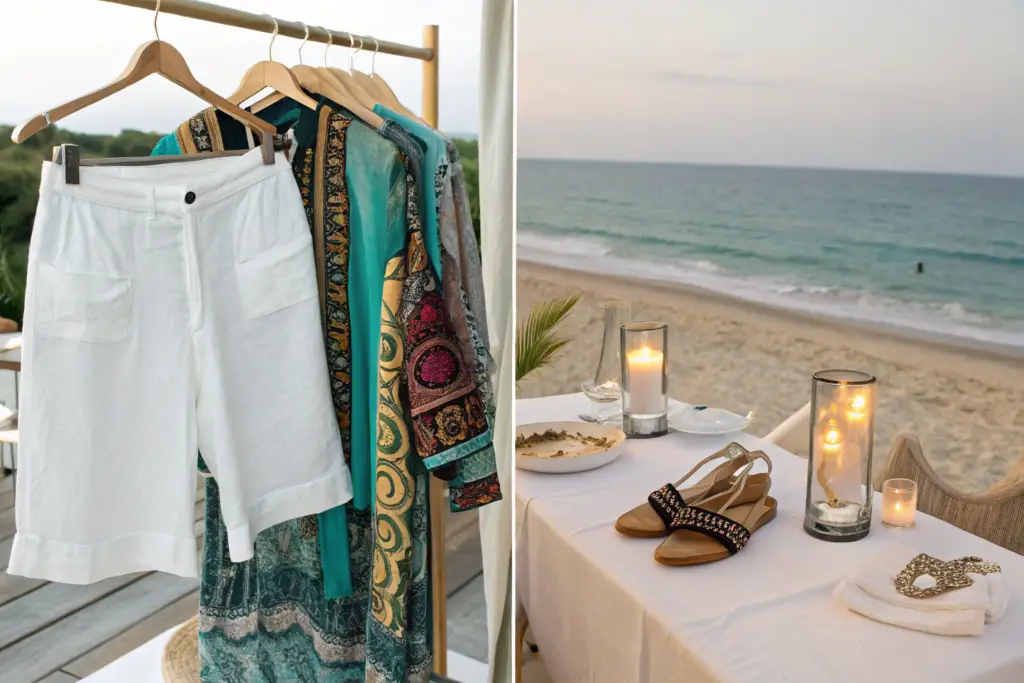
I have asked dozens of women why they pack white shorts for a vacation. The answers are remarkably consistent. They do not say "because they are trendy." They say "because they go with everything I packed." This versatility is not a minor convenience. It is the core economic value proposition of the white short in a resort wardrobe. A traveler has limited suitcase space. Every item must earn its place by coordinating with multiple other items. A pair of white shorts pairs with a floral blouse for lunch, a linen button-down for sightseeing, and a silk camisole for dinner. It is the most efficient packing decision a woman can make.
White shorts endure as the foundational resort wear category because they function as a visual neutral that maximizes outfit combinations from minimal luggage, they create a high-contrast, photographically striking silhouette that performs exceptionally well on social media, and they carry a psychological association with leisure, exclusivity, and the impractical luxury of wearing pristine white in a relaxed setting.
How Does the “Wardrobe Multiplier” Effect Drive White Short Sales?
The mathematics of packing for a week-long vacation are unforgiving. Seven days, limited suitcase weight, and a desire to look different in photos each day. The solution is a modular wardrobe where a small number of bottoms pair with a larger number of tops. A colored short—say, a coral pink or a tropical print—pairs with perhaps two or three tops that do not clash. A white short pairs with everything. Every top in the suitcase works.
This wardrobe multiplier effect is the silent sales driver behind the resort white short category. When a customer is shopping for a vacation, she is not buying a pair of shorts in isolation. She is mentally constructing an entire trip wardrobe. The white short is the first item she adds to the cart because it solves the coordination problem before it even arises. Resort wear retailers understand this psychology intimately. Many of them build their entire summer collection around a core of white bottoms—shorts, skirts, and trousers—and then layer on the colorful tops, kaftans, and accessories that generate higher margins. The white short is the anchor that sells the rest of the line. This resort wear merchandising strategy has been employed by brands from Tommy Bahama to Zimmerman. The customer may come to the website for the printed blouse she saw on Instagram, but she adds the white shorts because the product page shows them styled together, and she instinctively understands that she needs a neutral bottom to make the printed top work. The vacation outfit planning process almost always starts with a white bottom.
What Psychological Signals Do White Shorts Send in a Resort Setting?
Clothing in a vacation context is not just about covering the body. It is about signaling a state of mind. The white short communicates several things simultaneously. It says, "I am on holiday, not working." It says, "I am relaxed enough to wear something that requires a certain level of care." It says, "I am participating in the ritual of resort dressing."
There is an aspirational quality to white clothing that has persisted for over a century. In the early 20th century, white linen suits and dresses were the uniform of the leisure class, people who could afford to wear clothes that showed dirt easily because they did not perform manual labor and could afford frequent laundering. This association with privilege and ease has never entirely disappeared. A woman wearing white shorts at a resort is participating in this visual tradition. The high contrast of white against sun-kissed skin also has a specifically photographic appeal. White shorts make the wearer look more tanned by contrast, a beauty standard that, whatever its problematic aspects, remains commercially powerful in the resort context. The fashion psychology of white clothing in vacation settings is deeply embedded in decades of advertising imagery, from Slim Aarons’ poolside photography to modern influencer content. The white short is not just a garment. It is a prop in the performance of a successful, enviable vacation. This aspirational pull is what drives full-price purchasing. Customers do not buy white shorts on deep discount at the end of the season. They buy them at full price in the weeks before their trip, when they are emotionally invested in constructing their vacation identity.
What Are the Manufacturing Challenges Unique to White Shorts?
The manufacturing challenges of white shorts are real, and they are the reason many brands produce white poorly or avoid the category entirely. But these challenges are solvable with the right technical specifications. The problems that drive high return rates—sheerness, visible pocket bags, staining during try-on, and fit inconsistency due to fabric shrinkage—are not inherent to white shorts. They are inherent to white shorts that are manufactured like colored shorts. The solutions are known, documented, and repeatable.
White shorts present three specific manufacturing challenges that colored shorts do not: opacity control, which requires a higher fabric density and strategic lining to prevent the silhouette of pocket bags and undergarments from showing through; stain management, which demands that every person handling the garment from cutting to packing wears clean gloves and that the factory environment is rigorously dust-free; and color consistency across production lots, because even microscopic variations in white dye lots are visible to the customer in a way that variations in navy or olive are not.
How Do You Solve the Sheerness and Shadowing Problem?
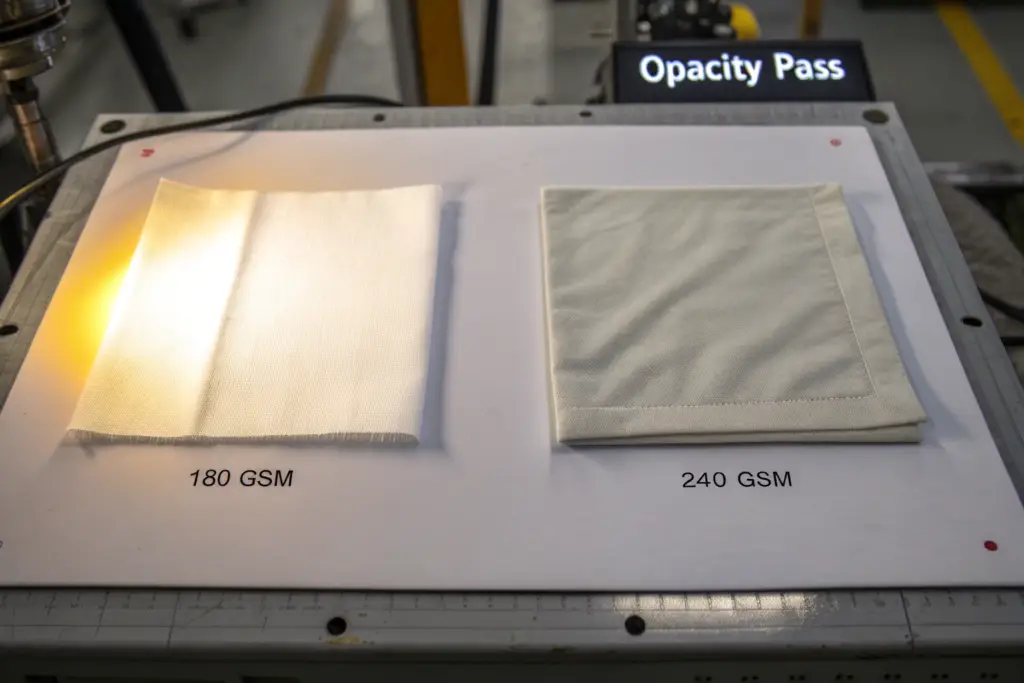
The number one reason white shorts are returned is that the customer tries them on, looks in the mirror, and sees the outline of the pocket bags or, worse, her underwear through the fabric. This is not a design flaw. It is a fabric specification flaw. The standard 180 GSM cotton twill that works perfectly for a khaki short in terms of opacity is frequently inadequate for white. White fabric reflects light, and it reflects light through the weave, making the interior of the garment more visible.
The solution begins with fabric weight and weave density. For white shorts, we recommend a minimum fabric weight of 220 GSM, and ideally 240 to 260 GSM for a twill. The higher weight compresses the weave, reducing the gaps between yarns that allow light and shadow to pass through. The fabric construction also matters. A tight, high-twist yarn in a dense plain weave or a fine twill weave will provide significantly better opacity than a looser, low-twist yarn. Beyond the shell fabric, the interior components must be addressed. Standard white pocket bags are visible through white shell fabric. We use a nude or pale grey pocketing fabric instead. The color is closer to the skin tone of the wearer and blends visually, eliminating the stark white pocket outline. For the waistband interlining, we use a white or natural-colored fusible rather than a standard grey or black. This fabric opacity testing and component selection process is the single most important quality intervention for white shorts. At Shanghai Fumao, every white fabric we source passes a light-box opacity test before we accept it into inventory. We hold the fabric up to a calibrated light source with a dark object behind it. If the object is visible, the fabric fails.
Why Is Production Environment Control Critical for White Garments?
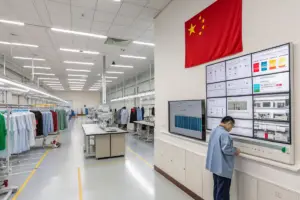
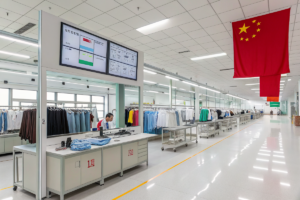
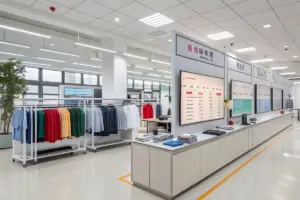
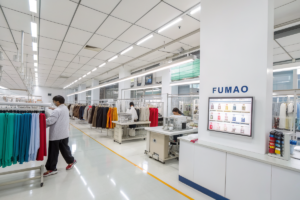
A microscopic speck of dust on a navy short is invisible. A microscopic speck of dust on a white short looks like a flaw. The entire factory environment must be controlled when white garments are in production, and this is a cost that brands often do not see reflected in their FOB price because responsible factories build it into their overhead, while irresponsible ones skip it and ship stained goods.
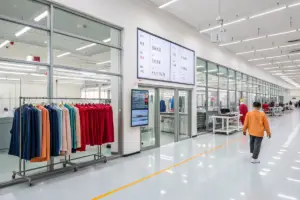
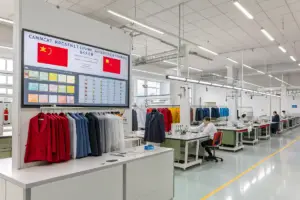
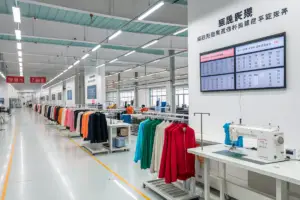
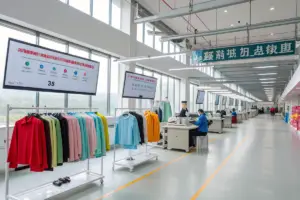
We have a specific protocol for white production runs. The cutting tables are cleaned and disinfected before the white fabric is spread. All workers on the white sewing line wear clean, light-colored uniforms and lint-free gloves. The sewing machines are fitted with white or natural-colored thread only, and the machine beds are wiped down between shifts to prevent oil stains. The finished shorts are immediately placed in protective polybags, not left exposed on open racks where airborne dust can settle. These measures sound obsessive, but they are standard practice in any factory that takes white garment production seriously. The alternative is a return rate that destroys the margin on the entire program. This garment production quality control for white and light-colored products is a specialized discipline. I have seen a factory lose a white shorts contract because a single sewing machine leaked a drop of oil onto a unit that made it through to the customer. The brand received a one-star review with a photo of the oil stain, and that review deterred hundreds of potential buyers. The factory’s cost-saving shortcut on line hygiene cost the brand far more in lost sales than the factory ever saved.
How Should Brands Merchandise White Shorts to Minimize Returns?
Returns are the silent margin killer of the white shorts category. But the majority of returns for white shorts are not caused by the customer not liking the product. They are caused by a gap between what the customer expected and what she received. The sheerness issue is the most common culprit, followed by fit issues. Both of these can be dramatically reduced through better online merchandising that sets accurate expectations and provides the information the customer needs to make an informed purchase decision.
Effective merchandising of white shorts to reduce returns requires radical transparency about the product’s opacity and fit, including close-up fabric photography that honestly shows the weave density, explicit verbal confirmation that the shorts are fully lined or made from an opaque fabric weight, styling photography that shows the shorts on a range of body types in natural light, and care instructions that address the customer’s anxiety about staining before she even receives the product.

What Product Page Information Reduces Sheerness-Related Returns?
The customer’s core fear when buying white shorts online is "will these be see-through?" If the product page does not answer this question definitively, she will either not buy, or she will buy and return. The answer must be visual and textual.
The product photography must include a close-up, high-resolution shot of the fabric pulled taut, with a dark object or hand placed behind it, to demonstrate opacity. This is not a glamour shot. It is a technical evidence shot. It tells the customer, "We are confident enough in this fabric to show you exactly what it looks like under stress." The product description must explicitly state the fabric weight and the lining specification. Write "Crafted from a substantial 240 GSM cotton twill with a full nude lining for complete opacity" rather than "high-quality white shorts." The specificity is the marketing. Additionally, show the shorts on a model in natural sunlight. Studio lighting can wash out the very shadowing that the customer is worried about. Sunlight is honest. If the shorts are truly opaque, sunlight will prove it. This e-commerce product photography approach to transparency has been validated by brands with low return rates. One of our resort wear partners implemented these specific photography and description changes and saw their white short return rate drop from 14% to 6% in a single season, without any change to the physical product.
How Do You Address Customer Anxiety About Staining and Care?
The customer who buys a white short is making a purchase she is slightly anxious about. She knows that white is impractical. She is mentally calculating how many wears she will get before the first stain appears. If the brand does not acknowledge and address this anxiety, it sits in the back of her mind and makes her more likely to return the shorts after trying them on, before she has even had a chance to stain them.
Address the anxiety head-on. Include a care card in the packaging that provides specific, reassuring instructions for stain removal. Pre-treat the fabric with a stain-resistant finish if possible, and call this out on the product page. Offer a fabric protection spray as an add-on purchase at checkout. These signals tell the customer that the brand understands her concern and has engineered a solution. This proactive product return reduction strategies approach transforms a potential objection into a brand trust moment. The customer feels taken care of before she even wears the shorts. At Shanghai Fumao, we can apply a C0 fluorocarbon-free water-repellent and stain-release finish to white fabrics. This finish is invisible, does not affect the hand feel, and makes the shorts resistant to water-based stains like spilled rosé or pool water splashes. It is not a magic shield, but it gives the customer a fighting chance to blot a spill before it sets, and the peace of mind that comes with that feature is a powerful conversion and retention tool.
Which Fabrics and Blends Perform Best for Resort White Shorts?
The choice of fabric for a resort white short is not simply a matter of picking the whitest white. The fabric must perform in specific environmental conditions. The customer is wearing these shorts in tropical heat, often in high humidity, sometimes near saltwater and chlorinated pools. She is sitting on sandy beach chairs and hot pool decks. She is wearing them for extended periods in direct sunlight. The fabric must breathe, resist wrinkling to a reasonable degree, maintain its color under UV exposure, and survive contact with sunscreen and insect repellent.
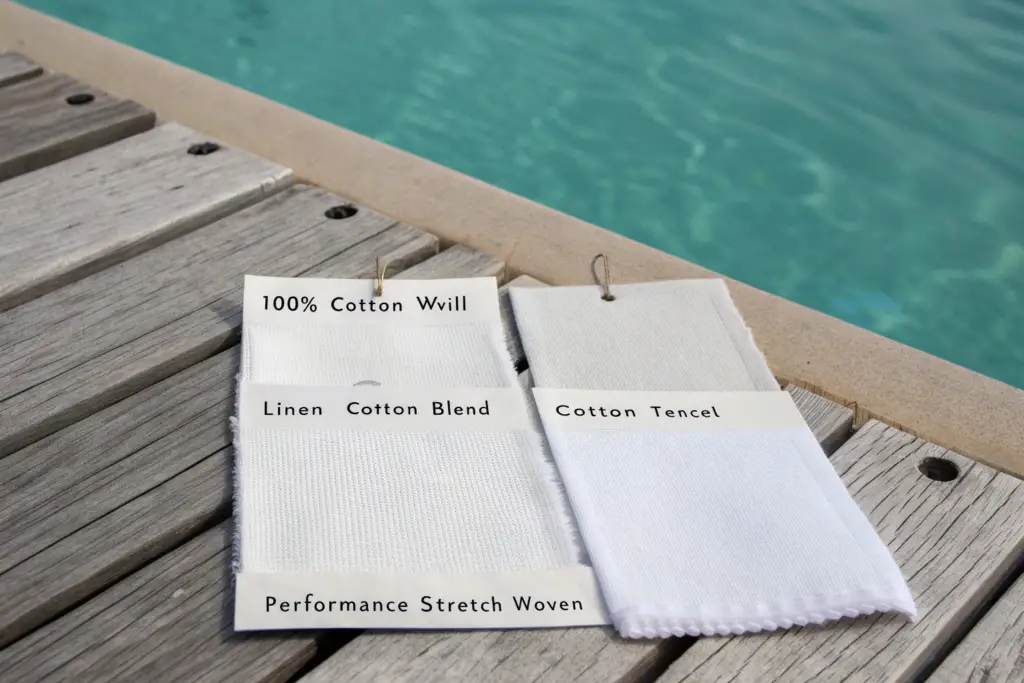
The best fabrics for resort white shorts balance four performance criteria: breathability for tropical heat, wrinkle resistance for all-day wear, UV stability to prevent yellowing under intense sunlight, and sufficient density for opacity, with cotton-Tencel blends and high-twist cotton twills currently representing the optimal intersection of these requirements, while 100% linen offers the most authentic resort aesthetic but requires the most diligent quality control on density and lining.
Why Are Cotton-Tencel Blends Gaining Popularity for Resort Whites?
A 100% cotton twill in a heavy weight is the traditional, reliable choice for white shorts. It is opaque, durable, and takes a crisp press beautifully. However, it has two weaknesses in a resort context. It wrinkles significantly, and it absorbs moisture, which can lead to visible sweat marks in a humid climate. This is where cotton-Tencel blends have emerged as a superior alternative.
Tencel lyocell, when blended with cotton at a 30% to 50% ratio, improves the fabric in several measurable ways. Tencel’s fiber structure is more absorbent than cotton, but it wicks moisture away from the surface more efficiently, meaning sweat is less likely to show as a visible wet patch. Tencel has a natural drape and fluidity that reduces the sharp creasing associated with 100% cotton. It also has a subtle, cool-to-the-touch hand feel that is genuinely pleasant on hot skin. Critically for white shorts, Tencel takes white dye beautifully, achieving a bright, luminous white that is difficult to achieve on 100% cotton without optical brighteners. This Tencel fabric properties guide explains the moisture management benefits. At Shanghai Fumao, our resort wear clients are increasingly requesting a 70% cotton, 30% Tencel blend for their white shorts. The cost is slightly higher than 100% cotton, but the reduction in returns from wrinkling complaints and the improvement in customer satisfaction with the hand feel justify the premium.
Does 100% Linen Still Have a Place in the Resort White Category?
Linen is the original resort fabric, and it retains a powerful aesthetic hold on the category. A well-made pair of white linen shorts, slightly rumpled, paired with a loose silk top, is the Platonic ideal of vacation dressing. However, linen presents amplified versions of all the manufacturing challenges discussed earlier. Linen is more transparent than cotton at equivalent weights. It wrinkles more. It shrinks more. It is more expensive.
The brands that succeed with white linen shorts are those that lean into the fabric’s character rather than fighting it. They use a heavy, 220 GSM or higher linen that has been pre-washed and softened. They line the shorts fully with a lightweight cotton voile for opacity. They photograph the shorts on a model after four hours of wear, showing the natural rumpling as a feature, not a defect. The marketing message is "this is how linen is supposed to look." This approach requires a customer who understands and values linen’s natural properties, which is a smaller but often higher-spending segment of the resort market. The linen resort wear aesthetic has a dedicated following among luxury travelers who prioritize natural fibers and artisanal quality over wrinkle-free performance. For these brands, a 100% linen white short is a hero product that defines their brand identity, and the higher manufacturing cost and complexity are a barrier to entry that protects their market position. At Shanghai Fumao, we have developed a specialized linen program for white shorts that includes pre-washing, full lining, and a soft enzyme finish that elevates the hand feel to a level that competes with the best European resort brands.
Conclusion
Classic white shorts for women are not just still a top seller for resort wear brands. They are the structural pillar around which the entire resort category is built. Their commercial power comes from a combination of practical wardrobe efficiency—one pair of shorts that matches every top in the suitcase—and a deep psychological association with leisure, luxury, and photographic beauty that no other color can replicate. The demand is durable. It does not wax and wane with seasonal trend cycles the way a printed short or a neon color does. White shorts are a replenishment purchase, not a trend purchase.
The brands that lose money on white shorts are the brands that manufacture them identically to their colored shorts. The brands that win are the ones that treat white as a specialized engineering challenge, investing in higher fabric densities, strategic nude linings, factory hygiene protocols, and radically transparent online merchandising that directly addresses the customer’s opacity and staining anxieties. The solutions are known and repeatable. The margin opportunity is substantial.
If your resort wear brand is struggling with the white shorts category, or if you are ready to launch a white short that stays sold and stays out of the returns pile, we have the technical expertise to help. At Shanghai Fumao, we have solved the opacity, staining, and quality consistency problems for multiple resort wear labels. For a direct conversation about developing your white short program with the right fabric and construction from day one, contact our Business Director, Elaine, at elaine@fumaoclothing.com. Let’s make white work for your bottom line.