Picture this: You have spent months perfecting your latest collection of classic shorts. The fabric is premium, the stitching is flawless, and the fit is impeccable. You upload the photos to your wholesale catalog, expecting a flood of inquiries from American brand buyers. Instead, you hear crickets. The harsh reality is that in the B2B apparel world, your product photography is not just a minor detail; it is the deciding factor between a buyer scrolling past or requesting a sample. If your images look amateurish, buyers instantly assume your manufacturing quality is equally subpar. They never get the chance to touch the fabric or inspect the seams, so the visual communication must do all the heavy lifting for you.
A high-converting wholesale catalog image must move beyond simple flat lays to communicate structural integrity, accurate color, and scalability through standardized studio lighting and ghost mannequin photography, because these specific visual triggers directly address a professional buyer's need to assess construction quality and brand alignment before committing to a bulk order.
Most factory owners and small workshop managers I speak with are excellent at sewing garments but often lack the aesthetic eye required for modern digital marketing. They think a smartphone snapshot against a wrinkled bedsheet is enough. It is not. Your wholesale buyer—a 44-year-old owner like many of my clients—has a high sensitivity to quality but a low tolerance for visual clutter. He wants to see exactly what he is paying for without guessing. I want to share exactly how we at Shanghai Fumao solve this problem, transforming standard products into catalog stars that consistently win purchase orders.
How to Achieve Consistent Lighting for Accurate Color
Bad lighting is a silent deal-breaker. I learned this the hard way back in 2019, while helping a Miami-based resort wear brand develop a linen short. We sent them a physical sample that looked like a vibrant aqua blue in our Chinese office lighting. When they received it and shot it under Florida sunlight for their website, the color clashed horribly with their existing collection. They nearly canceled the whole 5,000-piece order because the catalog representation did not match the physical product. That experience taught me that color accuracy is not subjective; it requires rigid consistency.
Consistent lighting directly impacts the buyer's trust because color mismatch is the number one reason for B2B order returns in the apparel industry. To achieve this, you must remove the variables of ambient light. I always tell my team that photographing a classic pair of shorts is a scientific process, not just a creative one.
Why Are Color Calibration Tools Essential for Clothing Photography?
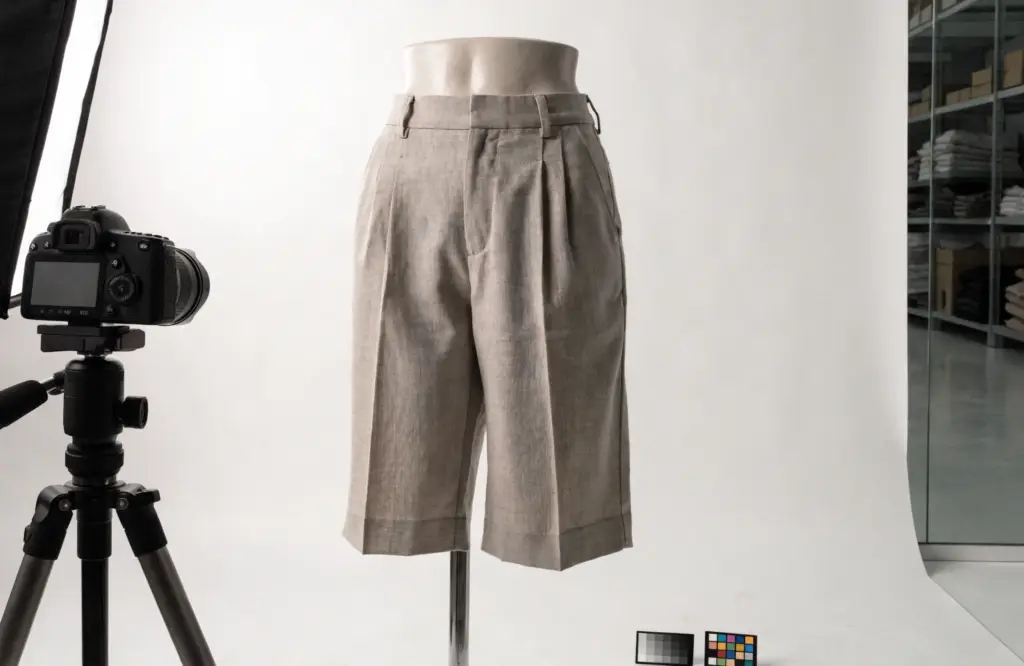
Shooting without a color checker passport is like cutting fabric without a pattern; you are just guessing. In the context of wholesale apparel photography, the camera sensor can be easily tricked by the white balance in your studio.
We once worked with a Chicago distributor who rejected a batch of khaki shorts because they looked "too green" on his calibrated screen. I realized our workflow was broken. We invested in a standard X-Rite ColorChecker and a gray card system. Now, before every shoot, we take a reference photo with the card placed exactly where the shorts will be. In post-production, we use that reference shot to neutralize the colors. This is a critical step in the product photography workflow for B2B brands. This small step ensures that the fabric's true pigment—whether it's a dusty rose or a deep burgundy—is faithfully reproduced, which significantly reduces sampling frictions and chargebacks.
What Is the Best Lighting Setup for Shooting Classic Shorts?
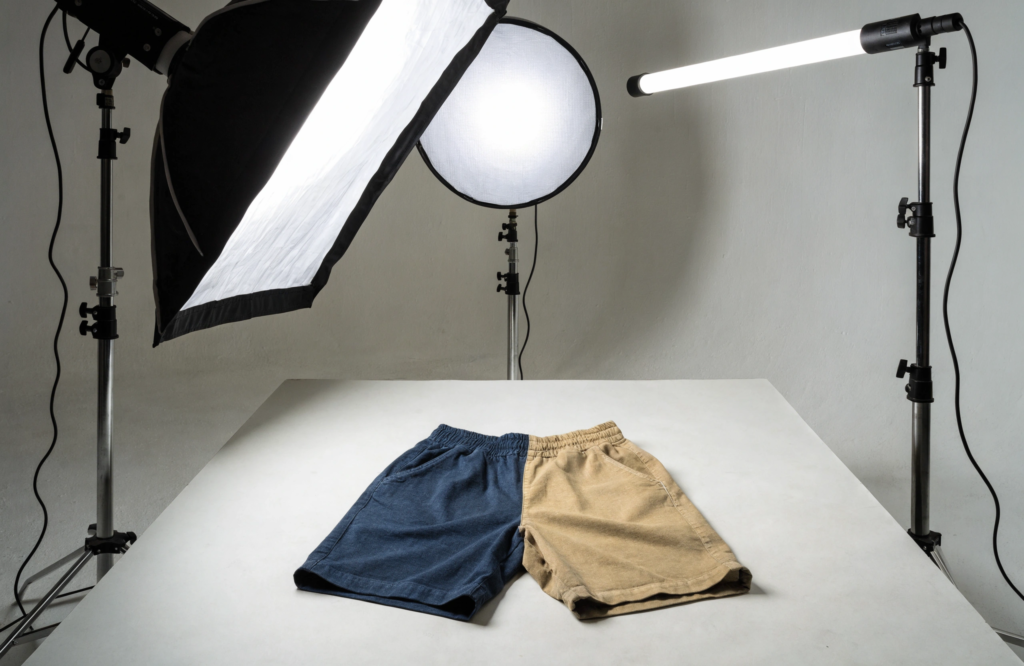
The goal is to eliminate shadows that distort the shape of the shorts. Ghost mannequin photography requires completely flat, even lighting. I recommend a classic three-point studio lighting configuration, but with a twist.
For a recent project with a Los Angeles athleisure client, we shot their jersey cotton shorts using two softboxes placed at 45-degree angles to diffuse the light. We placed a white bounce card at the bottom to fill in the shadows near the hemline. The most crucial detail is setting your camera’s Kelvin scale manually to match the flash strobes—usually 5500K. When you look through the viewfinder or the live view screen, the fabric texture should appear crisp without the highlights being "blown out." This setup prevents the cotton from looking shiny or the seams from disappearing in the dark, giving the buyer a true sense of the garment's density.
How to Style and Prep Shorts to Show True Construction
A wrinkled pair of shorts communicates laziness. It hides the darting, the curve of the waistband, and the sharpness of the side seam. Early on, when I started taking photos for our Shanghai Fumao catalog, I would just pull a sample out of the polybag, snap a picture, and call it a day. A veteran buyer from a Texas department store once called me out saying, "If you can't take the time to steam the shorts, how can I trust your factory to properly set the sleeves on a blazer?" I never made that mistake again.
Styling for wholesale catalogs is not about artistic flair; it is about revealing the garment's blueprint and structural integrity to a buyer who understands sewing terms like single-needle stitching and bar tacks.
How Do You Prepare Shorts to Highlight Structural Details?
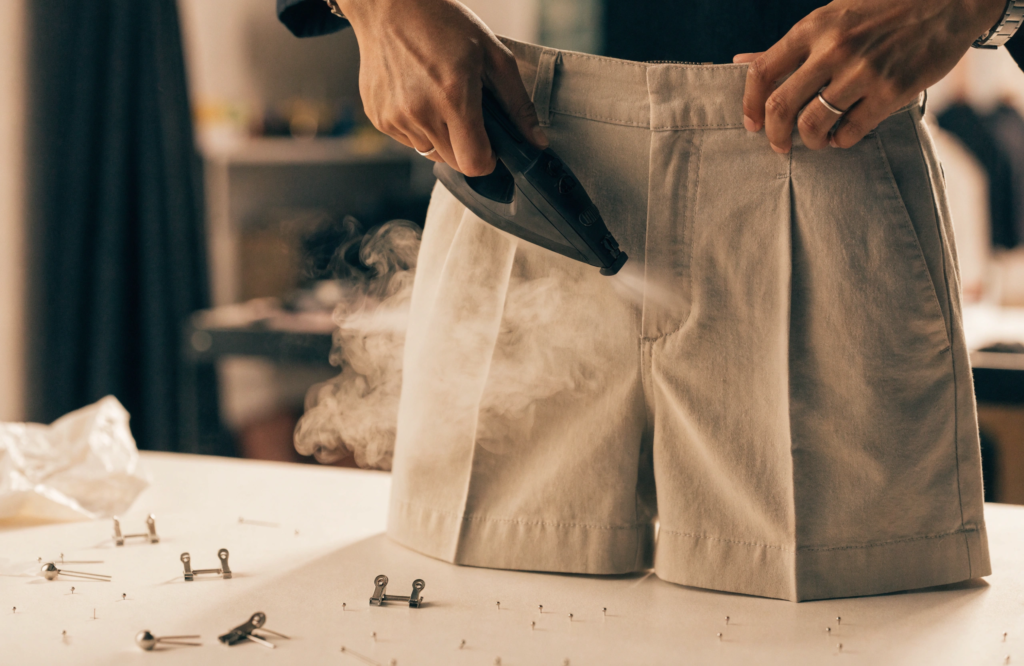
The preparation begins not with the camera, but with a steamer and a set of fine sewing pins. You must remove the "factory flatness" and inject shape.
I learned a specific technique from a client who specialized in premium men's tailoring. For chino shorts, you never just lay them flat like a dead fish. You need to "finger press" the center crease gently, using a bit of steam to set a faint line down the front leg. The pockets must be empty, and often, we stuff them with acid-free tissue paper to give them a subtle, natural 3D volume. This is a crucial distinction in garment styling for photography. This stops the pocket bags from bunching up and creating ugly bulges on the hip. We also use small butterfly clips on the backside of the shorts to cinch the waist just slightly, showing the curve of the waistband without the need for a belt. This helps the brand buyer visualize the fit on a standard end-consumer.
Should You Use a Mannequin or Flat Lay for Wholesale Shorts?
If you are selling directly to consumers, creative flat lays with flowers and sunglasses are fine. In B2B, distractions are your enemy. I always advise my clients to use a ghost mannequin. It creates an invisible 3D form that shows the rise of the shorts—how they sit on the hip—without the buyer being distracted by a model's look or skin tone.
We did a split test for our own catalog last spring. We shot the same linen-blend shorts in two ways: a complex flat lay versus a ghost mannequin. The ghost mannequin image received three times more clicking inquiries on our Alibaba storefront. Why? Because it showed the tension on the fabric, the slight curve of the back yoke, and the clean fall of the hem. Many large distributors prefer this invisible mannequin method because the final image is clean, consistent, and easy to drop into a white-background catalog. It also makes it easier for buyers to change the background or add their own logo placement mockups later.
What Background and Angles Convert B2B Buyers Best?
I used to think the more angles I showed, the more professional I looked. I would stuff my emails with 15 different shots of the same pair of shorts, including extreme close-ups of the crotch and pocket corners. A buyer from a fast-growing e-commerce brand in New York finally told me that my image overload was actually slowing down his decision. He couldn't quickly scan and compare specs. That feedback was gold for me.
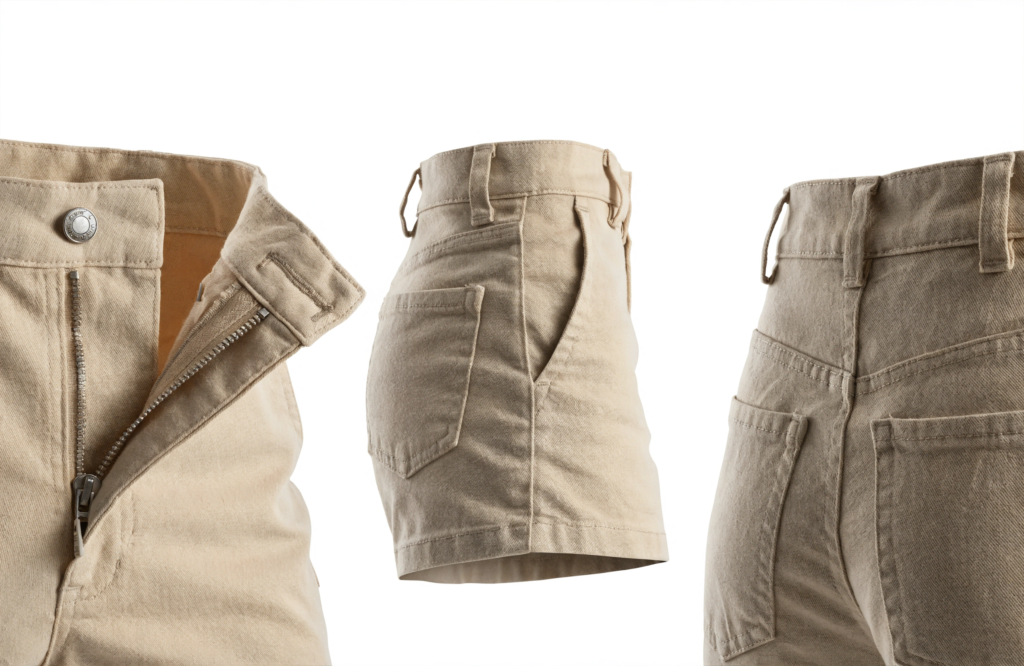
The most effective catalogs balance macro detail shots with standardized front, side, and back views, letting buyers scan the style line quickly before zooming into the essential hardware or fabric weave. In wholesale B2B, you are catering to a visual quick-check and a deep technical dive, both in the same image set.
Why Are White Background Standard Views Non-Negotiable?
Pure white backgrounds are not just a trend; they are a technical requirement for most multi-brand e-commerce platforms and department store line sheets.
When we started supplying to larger distribution centers in the US, we quickly realized our creative grey-background shots were being rejected by their automated systems. The white background requirement is critical for seamless e-commerce catalog integration. We now shoot strictly on a #ffffff seamless paper sweep, ensuring there is no vignetting. We provide a straight front view, a straight back view, and a pure profile. This consistency tells the buyer, "We are a professional Shanghai Fumao factory that understands your distribution requirements." Additionally, we always include a shot of the shorts folded symmetrically. This helps the buyer see the alignment of the side seams and the hem; if an outseam is wavy, a discerning buyer will spot it immediately in this view.
How to Capture Detail Shots That Build Buyer Confidence?
While the full views get you through the door, the macro details seal the deal. You need to get up close with the hardware. A blurry photo of a zipper tells the buyer nothing.
I always shoot with a macro lens, specifically at an aperture around f/8 to f/11 to ensure the entire fly length is in sharp focus. We focus on three specific zones: the zipper fly and waistband button, the side pocket construction, and a close-up of the fabric texture. For the fabric, we use a "scrunch and shoot" technique. We don't just shoot a flat swatch; we scrunch the fabric slightly to show the fabric drape and weight. This tells the buyer if the material is stiff or fluid. Once, by showing a macro shot of a herringbone weave on a pair of shorts, we helped a Florida brand identify it as a premium quality fabric that they could market as "Italian-style textured short," increasing their perceived retail value by 25%.
How to Optimize Your Catalog Images for Online Platforms
You can have the most beautiful images in the world, but if the file size is 50MB, no wholesale buyer in America will ever see them because their email firewall will block your message. I have lost count of how many times my sales team complained that clients "didn't receive the lookbook," only for us to discover the heavy PDF drowned in their spam folder. Image optimization in B2B is a balancing act between high-resolution clarity and lightning-fast loading speeds.
Technical SEO for images, including schema markup and descriptive alt text, is just as critical as the photo shoot itself because Google Image search is one of the leading discovery tools for American buyers sourcing overseas. You need to give the algorithms exactly what they want while preserving the visual fidelity that your client needs to zoom in and inspect a stitch.
How Do You Balance Image Quality and Loading Speed for B2B?
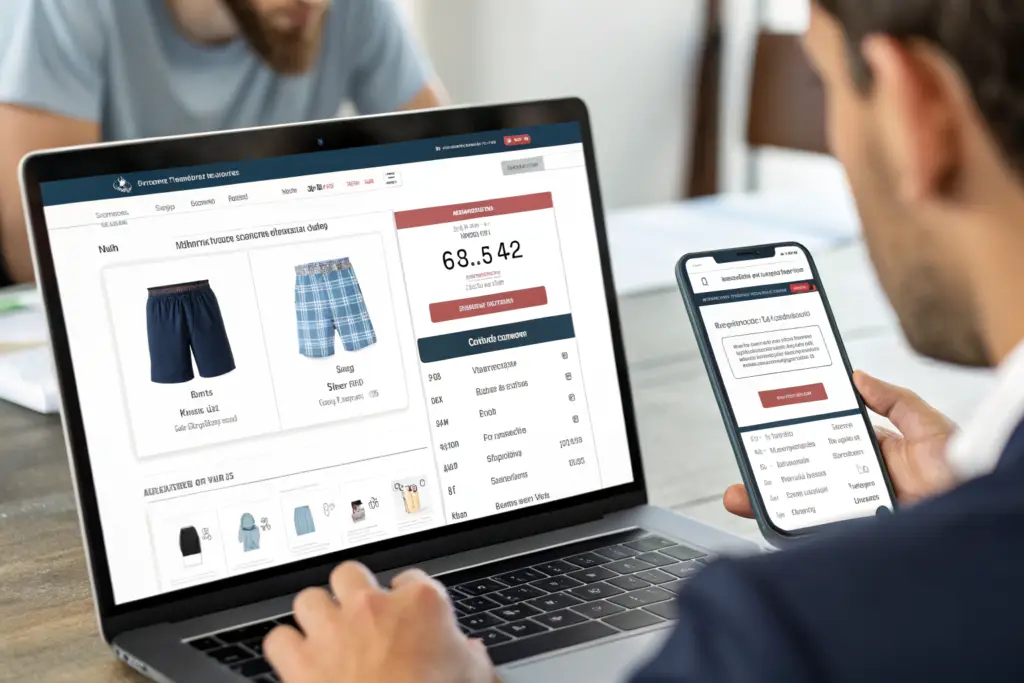
This is a constant battle. B2B buyers need to zoom in to 200% to check the seam finishing. This requires high-resolution source files. However, if your online B2B portal takes more than 3 seconds to load, the bounce rate skyrockets.
Our standard workflow for image optimization involves shooting in RAW format for the master archive. For the web catalog, we convert to sRGB color space and save as JPEG at 60-70% quality. This usually keeps the file size under 200KB without visible pixelation. We also use the WebP format for our main Shanghai Fumao website because it maintains the crispness of the chino texture while being significantly lighter than PNG. Tools like TinyPNG are a staple in our design department. This ensures that when a busy CEO in New York scrolls through our latest collection on his iPhone during a trade show, the images pop up instantly, allowing him to make a split-second decision to click for more details or move to a competitor.
Why Should You Use Schema Markup for Clothing Catalogs?
A standard image is just a decoration to a search engine, but an image with structured data is a direct sales invitation. This is something many traditional factories completely ignore.
I insisted we add Product schema to all our catalog pages. When Google crawls our site, it doesn't just see a picture of "men's cotton shorts." It sees the product name, the available colors, the fabric composition, and even the price range if we expose it. This allows our photos to appear in rich results with badges like "Wholesale" or "Customization Available" right in the image search results. This filters out the casual browsers and attracts hardcore buyers looking specifically for a B2B supplier. We also ensure every image file name is descriptive—using "wholesale-chino-shorts-front-view.jpg" instead of "IMG_5543.jpg"—and fill out the alt text accurately. These technical tweaks often bring more qualified traffic than our paid Google Ads do.
Conclusion
Mastering the catalog photography for classic shorts is a non-negotiable discipline for any factory serious about the US wholesale market. We have walked through the precise steps, from achieving consistent lighting with color calibration tools to the subtle art of prepping and steaming the garment to highlight its construction integrity. You now also understand that B2B success demands standardized white-background angles and macro detail shots that build buyer confidence, not just artistic flair. Finally, and this is what truly separates the amateurs from the pros, we delved into the technical backend of image optimization—ensuring your beautiful photos actually get seen by leveraging fast loading speeds and structured data markup.
The journey from a wrinkled sample in a polybag to a high-converting digital catalog asset is a journey from being just another supplier to becoming a trusted manufacturing partner. I have seen our own order conversion rate jump significantly by treating our photography process with the same respect we give our cutting and sewing lines. It is about eliminating the guesswork for the buyer, especially for those experienced owners who value quality assurance but have no time for inefficient visual clutter.
If you are looking to develop a line of classic shorts and need a manufacturing partner who understands how to present them to the tough American market, we are here to help. At Shanghai Fumao, we don't just stitch garments; we help package your vision. For a direct conversation about starting your next project, feel free to contact our Business Director, Elaine, at elaine@fumaoclothing.com. Let’s build a catalog that sells.