Your brand just landed a major wholesale account. The initial order is 500 units across three styles. The buyer warns you that if the products sell through, the reorder could be 5,000 units with a four-week delivery window. You call your current factory. They can handle the 500 units, but scaling to 5,000 on short notice is impossible. Their lines are booked. Your growth is capped by their capacity. You either turn down the wholesale opportunity or scramble to qualify a second factory while managing production at the first. Both options are stressful, risky, and drain the momentum from your brand's biggest moment.
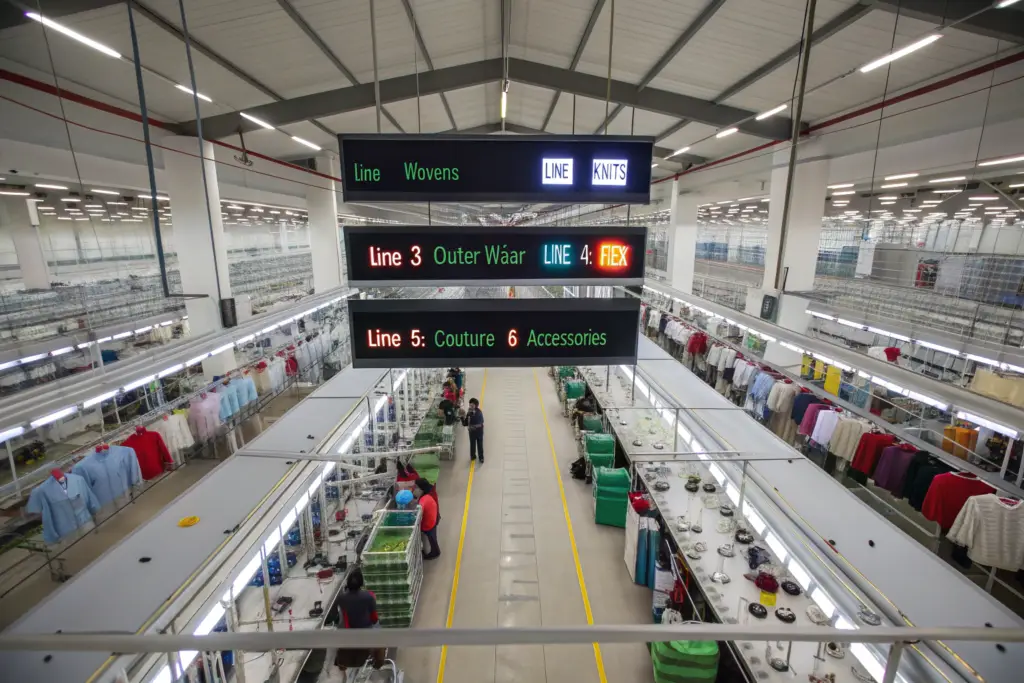
Shanghai Fumao's 5 production lines provide the structural capacity to scale orders from 100-unit test runs to 10,000-unit wholesale programs without changing factories. The lines are configured for both specialization and flexibility: dedicated lines for woven garments, knitwear, and outerwear ensure category-specific expertise, while a flexible line handles small-batch and rapid-turnaround orders, and a fifth line is reserved for high-fashion and accessories. This architecture means your brand can grow within a single manufacturing partnership, scaling volume without sacrificing quality or switching suppliers.
Scalability is not just about having more sewing machines. It is about how those machines are organized, how the workforce is trained, how production is scheduled, and how the physical factory layout supports both high-volume efficiency and small-batch agility. At Shanghai Fumao, our 5-line configuration is the result of deliberate design decisions made to serve brands at every stage of growth. Let me walk you through exactly how each line functions, how they work together, and how this structure protects your brand's ability to scale.
What Is the Production Capacity of 5 Dedicated Apparel Manufacturing Lines?
When a factory claims to have capacity, the brand needs to know what that means in measurable terms. "We can handle your order" is not a capacity statement. It is a sales promise. Measurable capacity is expressed in units per month, per line, by product category, with current utilization rates. This transparency allows a brand to assess whether the factory can absorb their current volume and their projected growth without creating bottlenecks that delay deliveries.
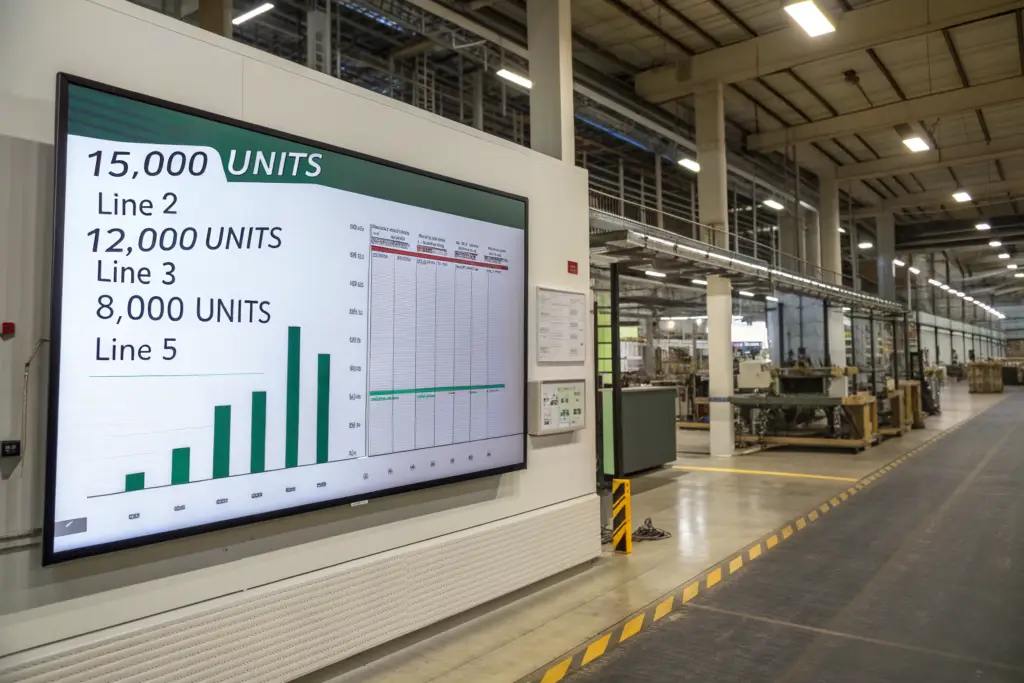
Shanghai Fumao's 5 production lines deliver a combined monthly output capacity of approximately 45,000 to 60,000 units, depending on product complexity. Line 1 handles woven garments at 12,000-15,000 units per month. Line 2 handles knitwear at 10,000-12,000 units per month. Line 3 handles outerwear and complex structured garments at 5,000-8,000 units per month. Line 4 is a flexible capacity line that shifts between categories based on demand, adding 8,000-12,000 units of surge capacity. Line 5 handles high-fashion, couture, and accessories at 2,000-4,000 units per month. Current utilization typically runs at 70-80%, leaving deliberate capacity reserves for partner growth and emergency orders.
How Does Line Specialization Improve Quality at Scale?
A factory that runs all product types on undifferentiated lines forces operators to switch between woven shirts, knit polos, and padded jackets. Each product category requires different machine settings, different handling techniques, and different quality checkpoints. Constant switching degrades efficiency and increases the defect rate. Line specialization eliminates this problem.
Line 1 is configured specifically for woven garments. The machines are lockstitch and chainstitch models optimized for non-stretch fabrics. The pressing stations are set up for collar pressing, cuff pressing, and flat garment pressing. The operators are specialists in woven construction techniques: flat-felled seams, french seams, collar setting, and buttonholing. They produce woven shirts day after day. Their speed and precision reflect this specialization. Line 2 is configured for knitwear. The machines are overlock and coverstitch models designed for stretch fabrics. The operators understand stretch recovery, seam elasticity, and how to handle delicate knits without distortion. A knit polo produced on Line 2 has consistently correct seam tension because the operators work exclusively with knit construction. This production line specialization approach means that as volume scales, quality remains consistent. The brand does not experience the quality degradation that often accompanies rapid growth at factories with undifferentiated lines.
What Is the Relationship Between Capacity Utilization and Delivery Reliability?
A factory running at 95% capacity utilization has no buffer. Any disruption—a fabric delay, a machine breakdown, a flu outbreak among workers—immediately pushes orders past their delivery dates. The factory is constantly in firefighting mode, and delivery reliability suffers. A factory running at 70-80% utilization has deliberate capacity reserves. Disruptions are absorbed within the buffer. Delivery dates are met.
We maintain our utilization below 80% across the five lines specifically to protect delivery reliability for our brand partners. This reserved capacity is not idle capacity. It is strategic capacity that provides flexibility. When a partner needs to accelerate a reorder of a winning style, the reserved capacity allows us to add a second shift or dedicate additional machines to that order without displacing other partners' production. When an unexpected fabric delay pushes a production start back by three days, the reserved capacity allows us to compress the production timeline and still meet the original ship date. This production capacity management philosophy prioritizes reliability over maximum asset utilization. It is a deliberate choice that costs us some theoretical efficiency but protects our partners' delivery commitments.
How Does the Flexible Line Support Small-Batch and Rapid-Scale Production?
The gap between a 100-unit test order and a 5,000-unit production order is where many factory partnerships break. The small order runs on a sample line or a fragmented schedule, producing acceptable quality but at a high per-unit cost. The large order requires a dedicated production line, but the factory's dedicated lines are committed to other clients. The brand's growth stalls in this gap, not because demand is lacking, but because the factory cannot transition the product from small-batch to scaled production.
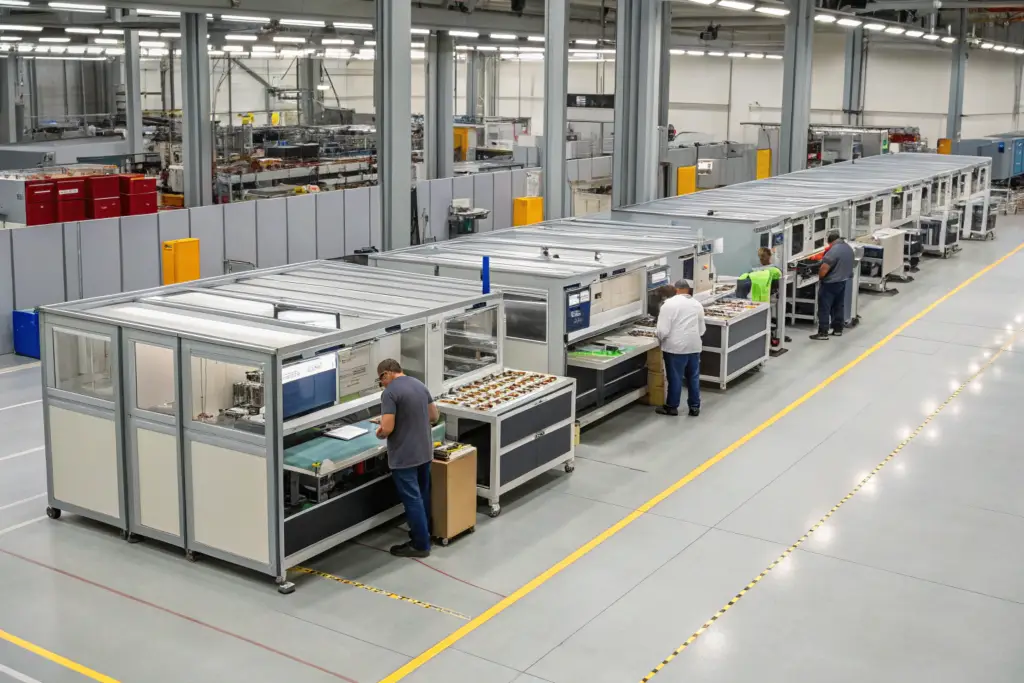
Line 4, our Flexible Production Line, is specifically designed to bridge the gap between test and scale. It operates on a modular configuration: workstations that can be grouped into small clusters for simultaneous small-batch runs, or aligned into a full linear line for a single high-volume order. This architecture allows a brand to test a new style at 100 units, prove the market, and then scale to 2,000 or 5,000 units on the same line with the same supervisory team and quality standards. The transition from test to scale is a reconfiguration, not a relocation.
How Does Modular Workstation Configuration Enable Multi-Style Small Batches?
A traditional linear production line processes one style at a time. If the line is set up for men's dress shirts, every station is balanced for that specific garment. Running a different style requires rebalancing the entire line, which can take hours or a full shift. This setup time makes small-batch production economically unviable on a traditional line.
Line 4 uses cluster-based workstations. Instead of a 30-station linear line, the line can be configured as six clusters of five stations each. Each cluster operates as an independent mini-line, capable of producing a different style. One cluster can produce 150 units of a women's blouse while an adjacent cluster produces 200 units of a men's short. The clusters share centralized cutting and finishing services but operate independently for sewing. Changeover between styles within a cluster takes minutes rather than hours. This modular configuration allows us to run three or four small-batch styles simultaneously on Line 4, each with dedicated operator teams who understand the specific construction requirements. A brand testing multiple new styles can receive production-quality samples and small-batch inventory from the same line that will eventually scale their winning designs. The transition from cluster to full line configuration happens without changing the supervisory team or the quality standards. This modular manufacturing lines capability is what makes small-batch production economically viable and scalable.
What Happens When a Test Order Proves Successful and Needs to Scale Rapidly?
The test order of 100 units sold out in three days. Customer feedback is glowing. The wholesale buyer who placed the contingent order confirms: they want 3,000 units delivered in six weeks. In a factory without flexible capacity, this is a crisis. The line that produced the test samples is booked. The order must be moved to a different line, with different operators and a different supervisor. The quality achieved on the test batch must be reproduced on an unfamiliar line. The risk of quality drift is high.
When a test order on Line 4 proves successful, the scaling process is seamless because the product stays on Line 4. The line configuration shifts from cluster mode to linear mode. Additional operators are added from our cross-trained workforce pool. The cluster supervisor who oversaw the test run becomes the line supervisor for the scaled run. The quality standards, the machine settings, and the construction techniques are identical because the product never left the line. A men's casual shirt brand tested a new linen style with a 150-unit order on a Line 4 cluster. Sell-through was exceptional. The brand confirmed a 3,000-unit reorder. We reconfigured Line 4 from multi-style cluster mode to single-style linear mode. The scaled production began four days after the reorder was confirmed. The quality on the 3,000-unit run matched the quality on the 150-unit test run because the same supervisor, the same core operator team, and the same quality inspector managed the production. This scalable garment production continuity is only possible when the factory has invested in a flexible line architecture that is designed for exactly this transition.
How Are the 5 Lines Coordinated for Large, Multi-Category Orders?
A brand that orders men's woven shirts, knit polos, and branded caps from a single factory needs these products to arrive together. A shipment of shirts without the matching caps is an incomplete collection. A shipment of caps that arrives weeks before the shirts incurs unnecessary warehousing costs. Coordinating multiple product categories across multiple production lines so that everything finishes together requires centralized production planning, not siloed line management.
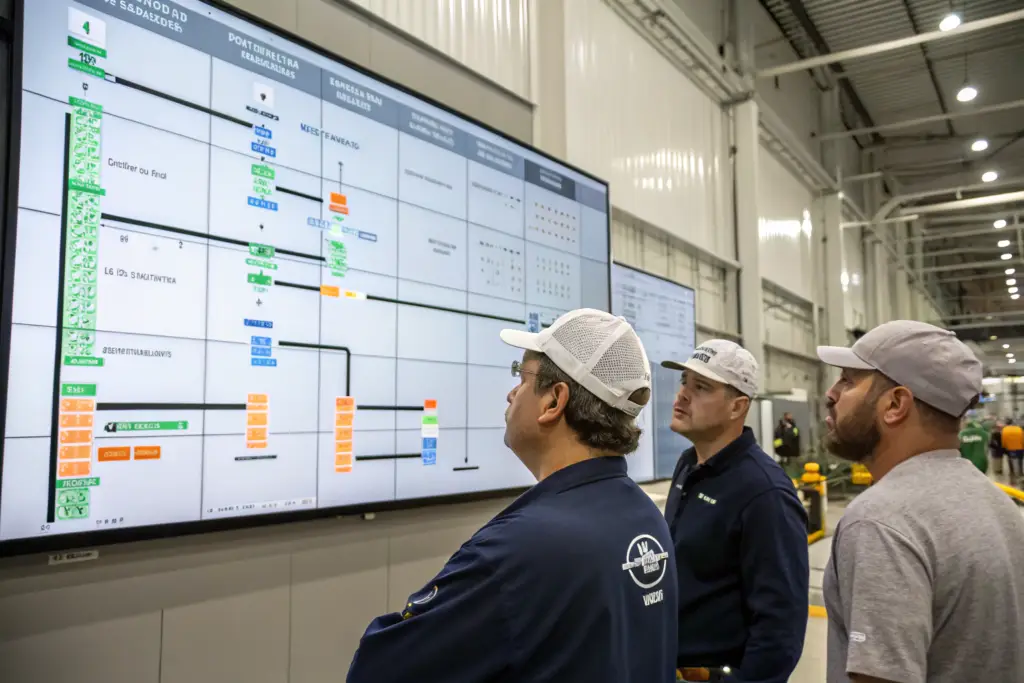
Our centralized production planning system schedules orders across all 5 lines with a unified view of the brand's complete order. When a brand places an order for woven garments, knitwear, and accessories, the planner creates a master schedule that assigns each product to its specialized line with completion dates synchronized to enable consolidated packing and shipping. A brand coordinator serves as the single point of contact, providing the brand with a unified status across all lines rather than requiring them to track each product category separately.
How Does Cross-Line Scheduling Ensure Synchronized Delivery?
Each product category has a different production lead time. A woven dress shirt on Line 1 might require 3 weeks from cut to pack. A knit polo on Line 2 might require 2 weeks. A canvas tote bag on Line 5 might require 1 week. If each line schedules independently, the products finish at different times. The finished goods sit in the warehouse waiting for the rest of the order, or multiple partial shipments are sent, increasing freight costs.
Our master scheduler calculates the required start date for each product based on its lead time, working backward from the target ship date. The knit polo starts later than the woven shirt because its production lead time is shorter. The tote bag starts later still. All three products complete in the same week. The order is packed into a single container and shipped together. The brand receives their complete collection in one delivery. This multi-line production scheduling discipline requires a centralized planning function that has visibility into all lines and the authority to coordinate across them. It is a capability that only exists in a factory that manages its own production lines as an integrated system rather than as independent fiefdoms.
What Role Does the Brand Coordinator Play in Multi-Line Order Management?
A brand with products on three different lines does not want to communicate with three different production supervisors. They want one person who knows the status of their entire order and can answer questions without transferring the inquiry. The brand coordinator is that single point of contact.
Each brand partner is assigned a dedicated brand coordinator. This person is not a sales representative. They are a production management professional who sits in the planning office with visibility into the master schedule. When the brand emails with a question—"What is the status of our polo order, and will it ship with the shirts?"—the coordinator checks the master schedule, confirms the status of both lines, and replies with a single, accurate answer. The coordinator also proactively communicates. If a fabric delay on Line 1 threatens to push the shirt completion date past the scheduled ship window, the coordinator informs the brand before the brand needs to ask. They present options: delay the entire shipment by three days so the shirts and polos ship together, or ship the polos on schedule and the shirts three days later in a separate air freight shipment. The brand makes an informed decision. This brand production coordination role is the human interface that makes multi-line production manageable for the brand.
How Does the 5-Line Structure Future-Proof a Brand's Growth?
A brand that expects to grow needs a manufacturing partner whose capacity and capabilities can grow with them. A factory with two lines might be adequate for the brand's current volume. What happens in three years when the brand has added new product categories, increased order volumes, and requires faster turnaround times? Either the factory invests in expansion, which takes time and capital, or the brand outgrows the partnership and must switch suppliers at the worst possible moment—when they are succeeding.
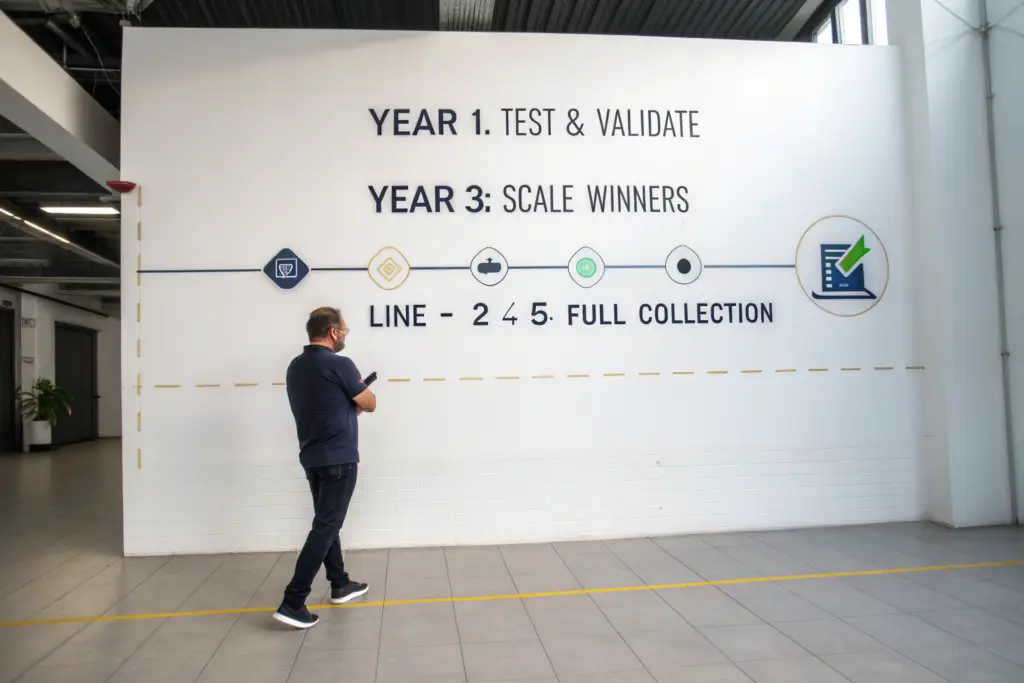
Shanghai Fumao's 5-line structure future-proofs a brand's growth by providing capacity headroom, category expansion capability, and speed-to-market advantages that a smaller factory cannot offer. The brand can start on Line 4 with small-batch test orders, scale winning styles onto dedicated Lines 1, 2, or 3 as volume grows, add accessories on Line 5 as the product line expands, and utilize Line 4's surge capacity for rapid reorders. The manufacturing partnership deepens as the brand grows, rather than breaking under the strain of growth.
How Does Capacity Headroom Support Unplanned Growth Opportunities?
A brand's growth is rarely linear. A celebrity endorsement, a viral social media post, or a favorable press mention can spike demand overnight. A factory running at full capacity cannot absorb this spike. The brand leaves revenue on the table because they cannot restock fast enough. A factory with deliberate capacity reserves can absorb the spike and help the brand capture the demand while it exists.
Our 20-30% capacity reserve across the 5 lines exists for exactly this scenario. When a brand partner experiences an unexpected demand surge, we can allocate reserve capacity to accelerate their reorder. A women's dress brand we work with was featured by a major influencer, causing their best-selling dress to sell out in 48 hours. They called us with an urgent reorder request: 2,000 units in four weeks. We allocated reserve capacity on Line 1 and Line 4, ran a second shift, and delivered the reorder in three and a half weeks. The brand captured revenue that would have been lost with a factory running at full capacity. This manufacturing capacity for brand growth is not luck. It is structural. The capacity reserve is built into our operating model specifically to support partner growth.
How Does the Factory Evolve Its Own Capabilities as Partner Brands Mature?
A brand that started with basic cotton T-shirts may evolve into complex outerwear, tailored garments, and accessories. A factory that cannot evolve its capabilities alongside the brand's product development will eventually lose the partnership. The brand will outgrow the factory's technical ceiling.
Our investment in the 5-line structure was driven by the recognition that brands evolve, and their manufacturing partner must evolve with them. Line 3 was added specifically to serve brands that graduated from basic woven and knit products into structured outerwear. Line 5 was added to serve brands that expanded into premium, high-fashion, and accessories. The flexible Line 4 was reconfigured to support the test-and-scale model that modern DTC brands depend on. This evolution was not reactive. We did not wait for brands to ask for capabilities we did not have and then scramble to build them. We built the capabilities in anticipation of partner growth. A brand partner that started with us five years ago producing 500 units per month of basic knit tops on Line 2 now produces 8,000 units per month across Lines 1, 2, and 5, including woven dresses, structured jackets, and branded accessories. Their growth was never constrained by our capabilities because we had invested in the capacity and the category expertise they would need before they needed it. This long-term manufacturing partnership model is only possible when the factory has the financial strength and strategic vision to invest in capabilities ahead of demand.
Conclusion
Five production lines are not just five times the capacity of one line. They are a structural capability that enables specialization, flexibility, coordinated multi-category production, and scalable growth within a single manufacturing partnership. The lines are configured to serve a brand at every stage: testing new ideas on the flexible line, scaling winners on dedicated category lines, adding accessories and premium products, and absorbing demand surges with reserved capacity. The brand never needs to switch factories as it grows because the factory's structure is designed to grow with it.
At Shanghai Fumao, the 5-line configuration is the physical expression of our partnership philosophy. We do not want to be a brand's factory for one season or one product category. We want to be the manufacturing backbone that supports a brand's growth from startup to established market force. The capacity headroom, the category specialization, the flexible architecture, and the centralized coordination are all investments in that long-term vision.
If your brand is approaching a growth inflection point—a wholesale expansion, a category launch, a demand surge—and your current factory's capacity is becoming a constraint, let us show you how our 5-line structure can support your next phase. Contact our Business Director, Elaine, at elaine@fumaoclothing.com. Share your current volume and your growth projections. We will provide a capacity analysis showing exactly how your production would flow across our lines, with room to grow.