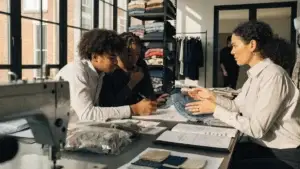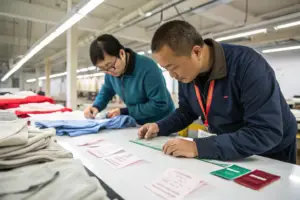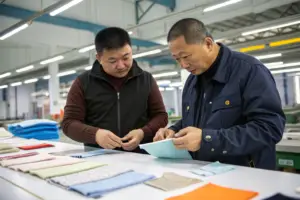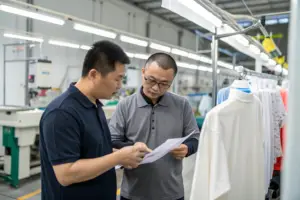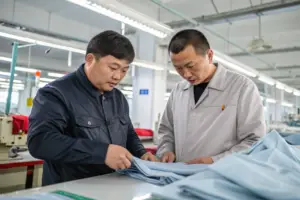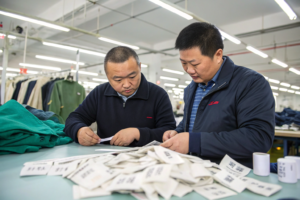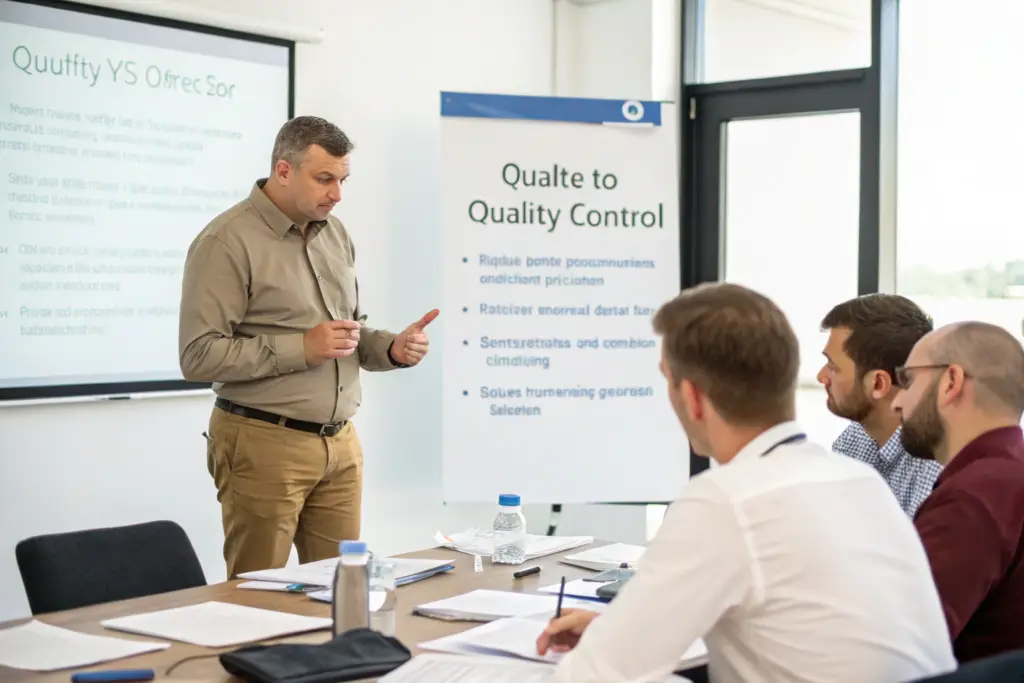
A quality director from a major US retail chain once spent an entire day auditing our factory. At the end of the day, he sat down in our conference room and said something I will never forget. He said, "Most factories I audit have one quality system. It depends on one person, usually the owner or a senior QC manager, who walks the floor and yells at people when they see a defect. It works okay when the factory is small, one line, one product. But when that factory grows to three lines, or five, the one-person system collapses. The owner cannot be everywhere. Quality becomes inconsistent. Lines drift. I knew your system was different when I saw that the QC inspectors on Line 2 and Line 4 were using the same checklist, checking the same points, at the same interval, and entering data into the same system. That is not a person. That is a process."
Shanghai Fumao manages quality across five production lines through a centralized, technology-enabled quality management system that enforces identical standards on every line, every operator, and every unit. The system has three core components: a centralized QC department, independent of any production line, that deploys rotating inspectors and uses a unified digital inspection platform, standardized operating procedures and physical reference samples, including sealed golden samples and placement jigs, at every workstation, and a multi-stage inspection protocol with in-process, pre-final, and final AQL gates that catch defects early and prevent quality drift across high-volume production.
Quality at scale is a systems engineering problem. The challenge is not making one beautiful garment. The challenge is making 10,000 identical beautiful garments, across five different teams, working on five different lines, possibly on five different days. The solution is a quality management system that makes the desired outcome inevitable, regardless of which line, which operator, or which day. I want to walk you through the three core components of our system, and explain how they work together to deliver consistent quality at scale.
How Is Our Quality Control Department Structured for Multi-Line Oversight?
The most common quality failure in multi-line factories is line-specific quality drift. Line 3 gradually drifts from the standard because the Line 3 supervisor has a slightly different interpretation, or the Line 3 inspector has become too familiar with the Line 3 operators and has stopped reporting minor defects. Over time, garments from Line 3 become subtly different from garments from Line 1. The customer opens a box and notices the inconsistency. The brand is damaged.
We prevent line-specific drift by making our QC department structurally independent from any production line. The QC team does not report to the line supervisor. The line supervisor is responsible for output and efficiency. The QC team reports to the centralized QC Manager, who is responsible only for quality, regardless of output.
Why Is the QC Team Independent from Production Line Management?
Independence creates an inherent conflict of interest that protects quality. The line supervisor is measured on daily output, on meeting the production schedule. Their instinct, when a minor defect is found, might be to let it pass to avoid slowing down the line and missing the daily target.
The QC inspector is not measured on output. They are measured on defect detection and reporting accuracy. They have no incentive to let a defect pass. In fact, their professional performance is evaluated on their ability to find and report defects. This structural tension between production speed and quality inspection is deliberate. It ensures that quality decisions are not compromised by production pressure. If the QC inspector flags a defect trend, the line is stopped, the issue is corrected, and the line restarts. The line supervisor's output target is adjusted to account for the stoppage, because the QC stoppage is recognized as a valid, necessary quality intervention, not a production failure. This independent quality assurance structure is a foundational principle of our quality system.
How Do Rotating Inspectors and a Unified Digital Platform Prevent Drift?
Even an independent QC inspector can become complacent if they inspect the same line, with the same operators, making the same product, day after day. They can stop noticing a gradually developing defect. They can develop informal relationships with the operators that make it harder to flag issues.
We counter this with an inspector rotation system. Our line inspectors rotate between different production lines on a weekly schedule. The inspector on Line 2 this week will be on Line 4 next week. This rotation has two effects. First, a fresh pair of eyes is more likely to detect a gradual drift that the previous inspector had become accustomed to. Second, the rotation prevents any single inspector from developing a proprietary or inconsistent interpretation of the quality standard. Every inspector must apply the standard in the same way, because the standard is documented in the digital platform, and their work can be compared to the work of other inspectors on the same line. This digital platform is the second key element. Every inspection, whether in-process, pre-final, or final, is recorded on a tablet using our centralized QC software. The inspector selects the defect type from a standardized, pre-defined dropdown menu. The data is uploaded in real-time to the central database. The QC Manager can see the defect data from all five lines, compared side-by-side, on a single dashboard. If a defect trend emerges on Line 3, it is immediately visible, and corrective action is targeted precisely at Line 3. The digital quality management system for manufacturing combined with inspector rotation is a powerful mechanism for maintaining uniform standards.
What Standardized Work Instructions Ensure Uniform Quality on Every Line?
A production manager who joined us from another factory once told me about the difference he observed. At his previous factory, work instructions were verbal. The line supervisor told the operators what to do. If an operator forgot a detail, or a new operator joined the line, the instruction was repeated, possibly with slight variations. Quality depended on memory and consistency of verbal communication.
At Shanghai Fumao, we operate on a principle of visual, physical, and unambiguous work instructions. The quality standard for any operation is not a memo in the supervisor's office. It is physically present at the workstation, in a form that cannot be misinterpreted.
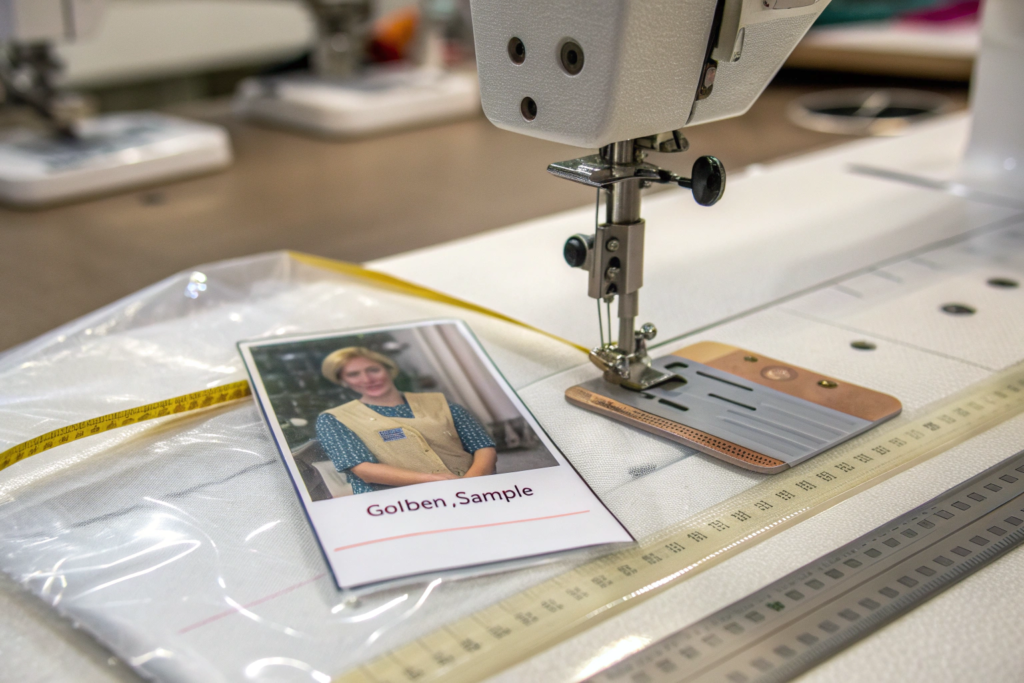
How Do We Use 'Golden Samples' and Physical Jigs at Workstations?
For every critical operation on a production order, we create two physical reference tools that are deployed to every workstation on every line running that order.
The first is the Golden Sample, a fully approved pre-production garment, or a section of a garment, sealed in a transparent, tamper-proof bag. The Golden Sample is hung at the entrance to the production line and at each critical workstation. It represents the exact quality standard that must be replicated. The sewer can look at the Golden Sample, see the correct stitch density, the correct seam allowance, the correct hem width, and the correct label placement, and compare their work against it in real-time. There is no ambiguity. The standard is visually present. The second is the placement jig, a custom-made acrylic or metal template that clips onto the sewing machine bed. The jig physically guides the fabric, ensuring that a pocket is placed in the exact same position, or a label is sewn at the exact same distance from the seam, on every single unit. The jig removes the need for the operator to measure and mark each piece. The placement is mechanically determined by the jig. These visual work instructions in manufacturing and physical jigs ensure that the quality standard is applied identically, regardless of which line, which operator, or which day.
How Do We Train Operators to the Same Standard Across All Lines?
Training is standardized and centralized. All new operators, regardless of which line they will eventually join, go through a centralized training program led by our senior master sewers in a dedicated training area, away from the pressure of the production floor.
The training curriculum is based on a library of standardized operating procedures for each operation type. The operator is trained on the specific machine, the specific attachment, and the specific quality checklist for that operation. They practice on sample fabric until they can produce the operation consistently to the quality standard. Only after they pass a skills assessment, conducted by the QC Manager, not the line supervisor, are they certified and assigned to a production line. When a new order with a new construction detail is launched, a pre-production briefing is held for all operators on all lines assigned to the order. The Golden Sample is presented, the critical quality points are explained, and the QC checkpoints are reviewed. This standardized operator training program ensures that every operator, on every line, has been trained to the same standard.
What Is Our Multi-Stage Inspection Process for Large Orders?
A brand owner who had experienced quality collapses with previous suppliers once asked me, "When do you find your defects?" I told him, "Ideally, at 20% complete. Sometimes at 80%. Almost never after the goods are packed." He said that answer told him more about our quality system than any certification.
The timing of defect detection is the single most important variable in a quality system. A defect found after the entire order is packed and ready to ship is a crisis. It requires unpacking, reworking, re-pressing, re-packing, and it threatens the delivery date. A defect found at 20% completion is a minor operational adjustment. The same defect, detected at different points, has completely different consequences. Our multi-stage inspection process is designed to find defects as early as possible.
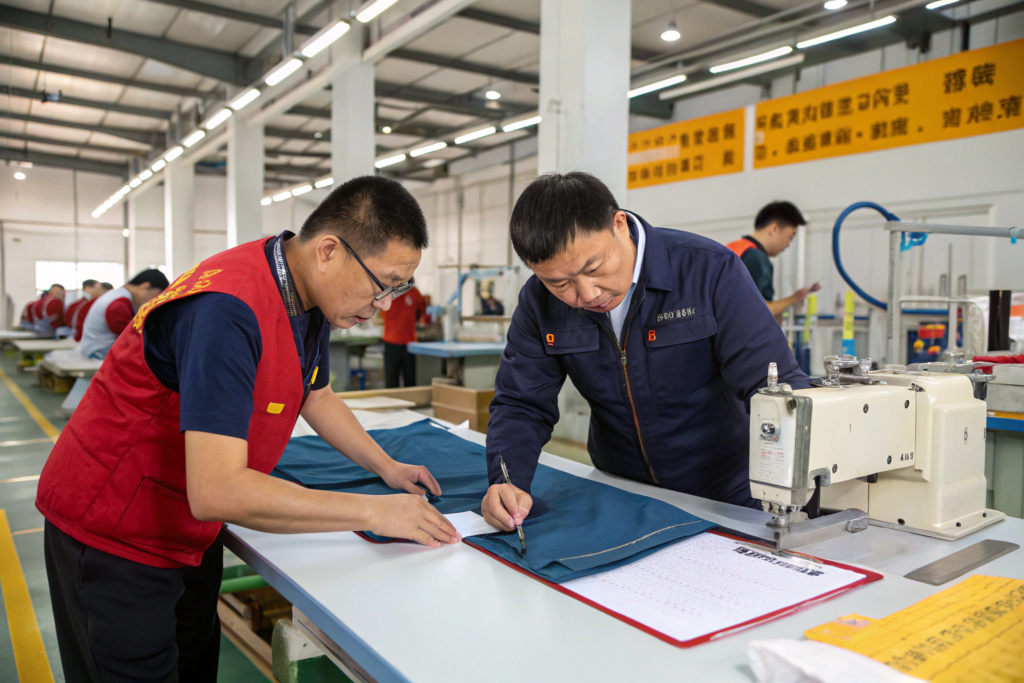
How Do In-Process Inspections Catch Defects Before They Multiply?
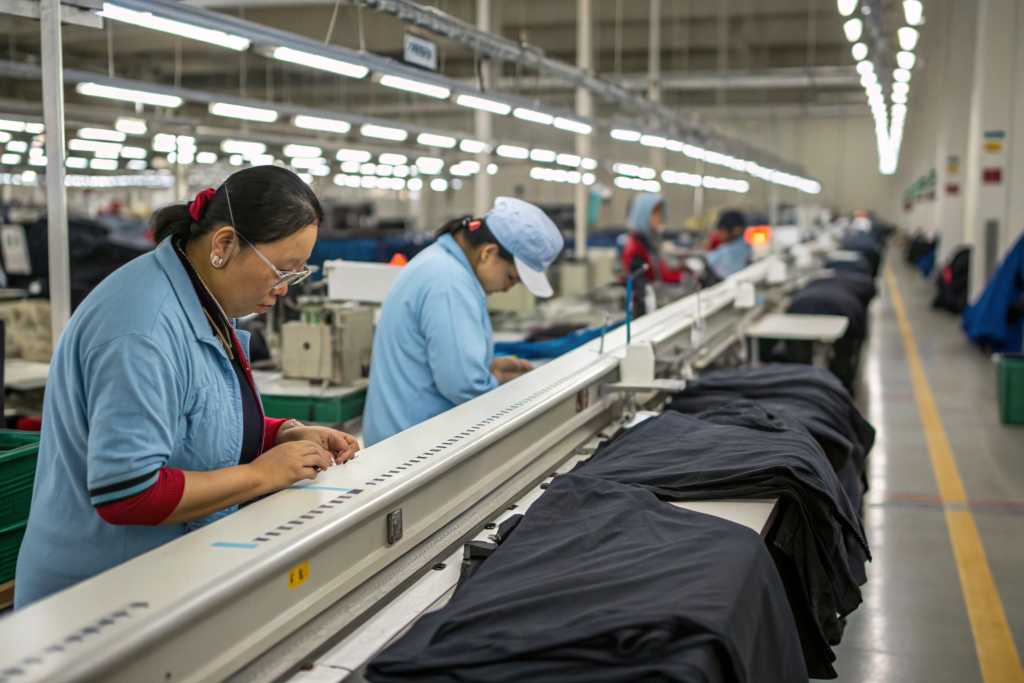
In-process inspection is the first line of defense. Our roving QC inspectors patrol the production lines continuously. They pull garments at regular intervals, typically every 25 to 50 units depending on order size and product complexity, and inspect the operations that have just been completed.
If a defect is detected, the inspector immediately alerts the line supervisor and the specific operator or machine causing the issue. The issue is corrected on the spot. The small number of defective units, typically the 25 units produced since the last inspection, are flagged for rework. The other 1,975 units that have not yet been produced will be sewn correctly, because the root cause has already been fixed. This is fundamentally different from end-of-line inspection. End-of-line inspection finds that 2,000 units have the same defect. In-process inspection finds the defect after 25 units and prevents it from affecting the other 1,975. The in-process quality inspection is the most cost-effective quality intervention in our system.
What Happens at the Pre-Final and Final AQL Inspection Stages?
Pre-final inspection occurs when approximately 80% of the order is complete. We conduct a formal AQL statistical sample inspection on the finished, pressed garments. The purpose of this inspection is to verify that the in-process corrections have been effective, and that no new, systemic defect pattern has emerged.
If the pre-final inspection reveals a defect pattern, the remaining 20% of the order is held, the root cause is corrected, and the affected goods are reworked, before the final 20% is produced. This prevents the situation where a defect is discovered only after 100% of the order is complete, requiring a massive unpack-and-rework operation. The final AQL inspection is the last quality gate. It is conducted after the goods are 100% complete, pressed, and packed into cartons. A statistically valid random sample of cartons is opened, and the garments are inspected against the full quality checklist. This is the final pass/fail decision. Only lots that pass the final AQL inspection are released for shipping. The AQL inspection report is provided to the client with the shipping documents. This AQL-based garment inspection process is the global standard for objective quality verification in apparel manufacturing.
Conclusion
Managing quality across five production lines is not a superhuman feat of attention. It is the predictable output of a well-designed quality management system. The three core components of our system, a centralized, independent QC department with rotating inspectors and a unified digital platform, standardized visual work instructions with Golden Samples and physical jigs at every workstation, and a multi-stage inspection process that catches defects at 20% completion rather than 100%, work together to make consistent quality the default outcome, not a heroic achievement. The system ensures that the garment produced on Line 4 on Friday afternoon is indistinguishable from the garment produced on Line 1 on Monday morning. The distributor, the retailer, and the end consumer experience a consistent, reliable product, regardless of the internal complexity of the production process.
If you are placing orders that require multi-line production capacity, and consistent quality across that volume is a critical requirement for your brand, I invite you to audit our quality system yourself. Contact our Business Director, Elaine, at elaine@fumaoclothing.com. Request a live video walkthrough of our QC department, our digital quality dashboard, and our in-process inspection procedures. Ask to see a sample AQL report from a recent order. We will show you the specific systems, the data, and the documented processes that produce consistent quality at scale. Let the evidence of the system build your confidence in the output.