I once lost a $60,000 order because of a two-word email. A brand buyer from Chicago sent me a technical question about seam sealing on a waterproof jacket. My sales rep replied with "No problem." That was it. Two words. The buyer went silent for a week, then told me she was moving to another factory. Why? Because "No problem" told her nothing. It did not answer the technical question. It did not give her confidence that we understood her request. It was just a verbal reflex. That day, I learned that communication efficiency is not about speed. It is about precision. A fast "yes" that is wrong is worse than a slow "no" that is honest.
Brand buyers can test a factory's communication efficiency before placing bulk orders by conducting a structured "communication audit." This involves sending a multi-part technical inquiry and measuring the response against three criteria: speed of first acknowledgment, clarity of technical answers, and the proactive use of visual confirmation like photos or videos. An efficient factory responds within 24 hours with specific data, not just polite reassurances.
You are not just buying garments. You are buying a relationship that will last six to nine months per collection. During that time, you will face fabric delays, fitting issues, and shipping crises. If the factory communicates poorly when you are asking for a quote, they will communicate disastrously when you have a container stuck in customs. At Shanghai Fumao, we treat communication as a measurable production metric, just like stitch count or fabric weight. Let me show you how to audit us, or any factory, before you commit a single dollar.
What Pre-Order Tests Reveal a Factory's True Responsiveness?
The quote phase is the honeymoon. Every factory is fast when they want your order. The sales rep is glued to their phone. Answers come in minutes. But this artificial urgency fades the moment you pay the deposit. You need a test that reveals the factory's true operational communication, not just their sales desperation. You need to simulate a mid-production problem and see how they handle it before any money changes hands.
Three specific pre-order tests reveal a factory's genuine responsiveness: the Technical Clarification Drill, the Weekend Pressure Test, and the Visual Verification Request. These tests send a controlled inquiry that mimics real development challenges. A factory that passes these tests provides detailed, timely, and visually-supported answers. One that fails gives vague promises, delayed responses, and text-only replies that signal future communication breakdowns.
I want you to be suspicious. I am a factory owner, and I am telling you to test us. Test us hard. A good factory welcomes the scrutiny because it proves our professionalism. A bad factory will get defensive or go silent. That reaction alone tells you everything you need to know. Let me walk you through these drills so you can deploy them immediately with any prospective partner.

How Does a "Technical Clarification Drill" Expose Superficial Sales Talk?
A bad sales rep answers a technical question with marketing words. You ask about the shrinkage rate of a cotton jersey. A bad rep says, "Very good quality fabric, no shrinkage." A good rep says, "Our standard compact cotton jersey shrinks 3-4% in length and 2-3% in width after the first home wash, tested per AATCC 135. We recommend adding 5% to the cutting pattern to compensate."
The drill is simple. Send an email with three specific technical questions in a single message. Make one question about fabric, one about a construction detail, and one about a compliance standard. Do not number them. Just bury them in a normal paragraph. See if all three are answered. A lazy reader will answer the first one and ignore the rest.
I remember a brand buyer from Seattle who tested us this way. She asked about the pilling resistance of a merino blend, the SPI on a flatlock seam, and our Oeko-Tex certification status. All in one block of text. Our team replied with a table. The table had her three questions in the left column and the specific answers in the right column. She told me later that the table format was what won her trust. It showed we read carefully and organized our thoughts. It showed we respected her time enough to structure the information. This approach builds trust, similar to how structured content is valued in platforms like LinkedIn for professional credibility.
Why Should You Send a "Weekend Pressure Test" Message Before Ordering?
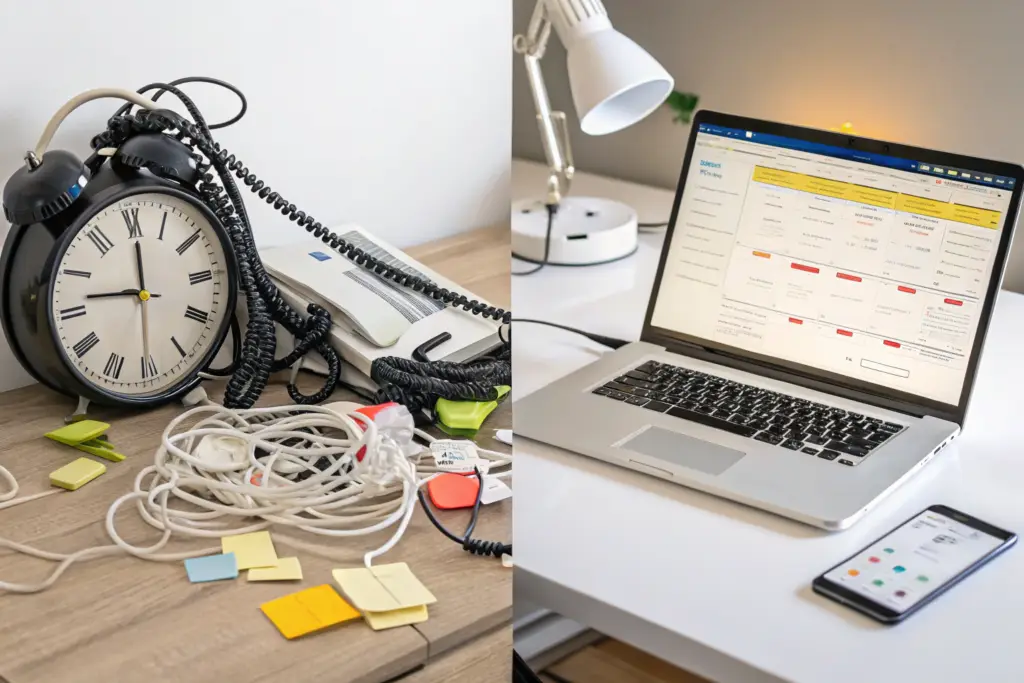
Production problems do not respect office hours. A zipper breaks on a Saturday morning. A dye lot is rejected on a Sunday night. If your factory contact goes completely dark from Friday 6 PM to Monday 9 AM, you will be left staring at your phone in panic for an entire weekend. That is a lot of stress for a brand owner.
The Weekend Pressure Test is simple. Send a non-urgent but legitimate question on a Friday evening, your time. Maybe ask for a specific measurement from a previous sample they shipped. Do not mark it urgent. Just send a normal inquiry. Then watch. Do you get an auto-reply? Do you get a brief acknowledgment on Saturday morning saying, "Got your note, I will check the sample room on Monday and send photos"? Or do you get total silence until Tuesday?
A factory that has zero weekend coverage is a risk. I am not saying you should expect a full technical reply at midnight. But a brief "Received, will action Monday" is a mark of a professional operation. It shows there is a protocol. At Shanghai Fumao, our merchandisers have rotating on-call schedules. You will never be completely alone. Someone is monitoring the inbox for exactly these situations. It is not about disrupting work-life balance. It is about providing peace of mind. When a shipment is on the water, you need to know there is a human on the other side, ready to help if customs flags your container.
How Can a Single Sample Request Evaluate a Supplier's Project Management?
A sample is not just a piece of clothing. It is a project deliverable. The way a factory handles a sample request reveals their entire internal management system. Do they just cut and sew and hope for the best? Or do they treat the sample as a micro-project with a defined start, middle, and end? The difference determines whether your bulk order will be predictable or chaotic.
You can evaluate a supplier's project management by observing how they respond to a sample request with multiple components. A strong factory sends back a confirmation document summarizing the specifications, provides an estimated ship date for the sample, and proactively flags any material or technique conflicts before cutting the fabric. This behavior demonstrates a system-driven approach, not a memory-driven one.
When a brand buyer sends me a tech pack, my team immediately fills out a "Sample Development Brief." This internal document mirrors what we send back to the client. It is a sign of good project hygiene. If a factory just replies with "OK, we start," that is a red flag. They have not processed your instructions. They are hoping they can figure it out as they go. Figuring it out as you go is how you get a shirt with a collar that is two centimeters too wide.
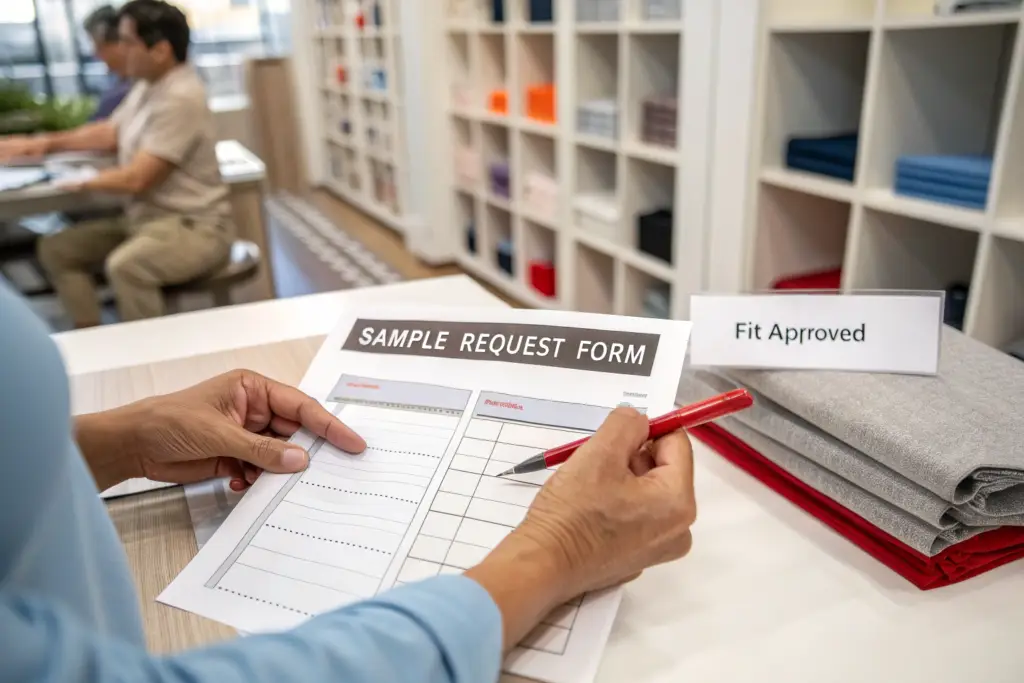
What Does a Professional "Sample Acknowledgment" Email Look Like?
A professional sample acknowledgment is a mirror. It reflects your request back to you in organized detail. It proves the factory read every line of your tech pack. It catches errors before they become physical samples.
Here is what you should look for. The email must restate the style name and your reference number. It must list the base fabric, the secondary fabric, and all trims. It must confirm the sizing standard (ASTM, EN, or your proprietary spec). It must state the planned ex-factory date for the sample. If any material is out of stock or requires a minimum order that conflicts with your sample yardage request, this is the moment to flag it. Not three weeks later when you are chasing for an update.
I had a client who sent us a tech pack for a women's bomber jacket. The spec called for a specific YKK zipper with a custom puller. Our acknowledgment email flagged that the custom puller had a 15-day lead time for the mold. We offered two options: wait for the custom puller or use a similar stock puller for the fit sample. The client chose the stock puller for speed and saved 15 days on her development timeline. That is proactive project management. That level of detail is what separates a partner from a vendor. This kind of structured communication aligns with best practices recommended by Project Management Institute.
How Do Proactive "Conflict Flags" Save Weeks on Development?
A tech pack is a wish list. Sometimes, the wishes conflict. You might spec a very rigid denim and also request a full-circle skirt silhouette. A rigid denim cannot drape well for a full circle. The pattern will look stiff and awkward. A lazy factory ignores this. They make the sample exactly as specified, even though they know it will fail. They waste two weeks. The sample arrives. You look at it and say, "This looks terrible." Then they say, "Yes, the fabric is too heavy for this design." You want to scream, "Why didn't you tell me?"
A good factory raises the conflict flag at the start. They send a note alongside the sample acknowledgment. It says, "Fabric Alert: The specified 12oz denim has limited drape. The full-circle skirt will appear rigid. We recommend a 9oz fabric with Tencel blend for similar look and better drape. Please advise if you want to proceed with 12oz or test the alternative."
This single email saves three weeks. It stops the bad sample from being made. It starts a solution-oriented conversation. It proves the factory cares about the end product, not just about ticking a box. I train my team to always look for these "conflict points." It is the single highest-value communication we provide. It demonstrates that we are thinking alongside the brand, not just taking orders.
What Are the Signs of an Organized Pre-Production Workflow?
The period between sample approval and bulk cutting is the "zone of silence" in a bad factory. You approved the sample. You sent the deposit. Then you hear nothing for weeks. You start to worry. You send an email: "How is production going?" The reply comes back: "Everything going well." That is not an update. That is a pacifier. An organized factory does not have a zone of silence. They have a zone of structured, proactive communication.
The signs of an organized pre-production workflow include a shared milestone tracker, a formal pre-production meeting report, and proactive material status updates. A factory that sends you a production timeline with specific dates for cutting, sewing, and finishing is managing your order. A factory that just says "on track" is managing your emotions, not your inventory.
At Shanghai Fumao, we believe the pre-production phase is the most critical part of the entire order. It is where the foundation is laid. If the foundation is crooked, the house falls. We share our foundation work openly with our clients because we want them to see the rigor. Their calm is worth more than the few minutes it takes to send an update.
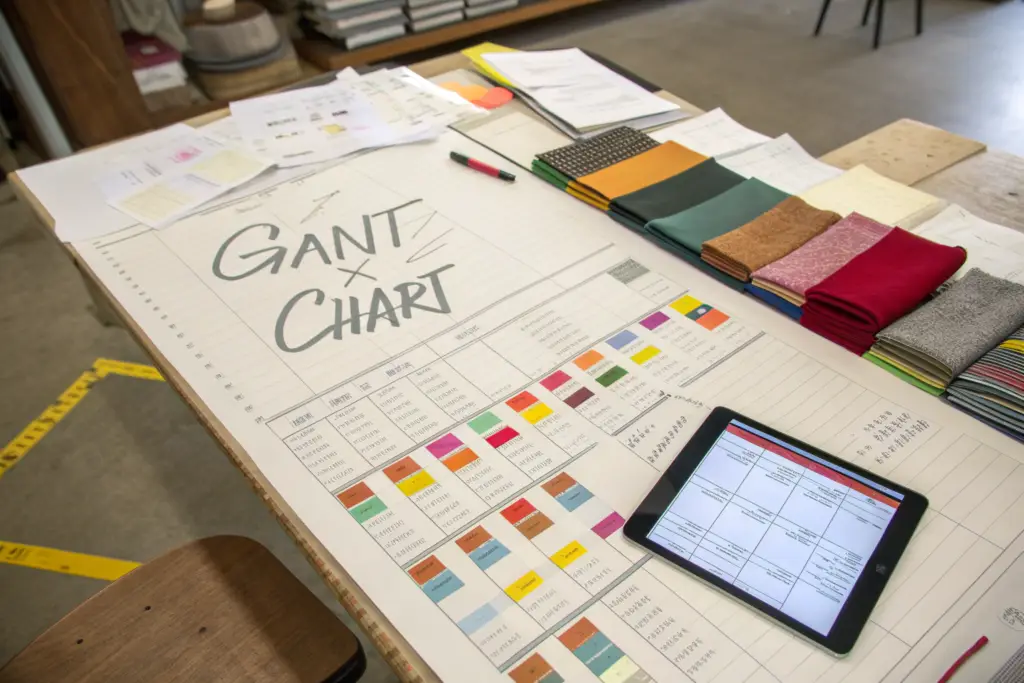
A shared timeline is a contract for time. It takes the verbal promise of "30 days" and breaks it into checkable pieces. It turns an abstract deadline into a series of concrete mini-deadlines. This is not just for the client. It is for internal discipline.
We use a simple Google Sheet that we share with the client. It lists the key milestones. Fabric in-house date. Cutting start date. Sewing line allocation date. Washing finish date. Final QC date. Packing and loading date. We update the actual completion date next to the planned date. If something slips, we change the cell color to red and add a comment explaining why and what we are doing to catch up.
This level of transparency is rare. But it eliminates 80% of client anxiety. The client can see the progress without sending an email. They can see that the cutting started on time. They can see that the sewing is 50% complete. This self-service information access respects the client's intelligence. We found that our clients who use the tracker send fewer "status check" emails. They trust the system. This practice is also applied in the software industry, as seen with tools developed by Atlassian for project tracking, demonstrating how cross-industry methods can improve manufacturing communication.
How Does a "Pre-Production Meeting" Report Prevent Bulk Errors?
The pre-production meeting is the last line of defense before hundreds of meters of fabric are cut. It is a focused one-hour meeting with the cutting master, the sewing line supervisor, the QC head, and the merchandiser. They review the approved sample, the tech pack, and any special instructions. They ask the hard questions. Is the thread color matching under different light? Did we receive the correct zipper slider? Are the labels heat transfer or woven?
The output of this meeting is a one-page report. This report is gold for a brand buyer. It shows that the factory did not just rush to the cutting table. It shows they paused and reviewed.
I remember a pre-production meeting for a line of women's silk blouses. The sewing supervisor noticed that the approved sample had a slightly different needle hole than the bulk fabric swatch. The sample was made with a finer needle for a lighter silk. The bulk fabric was a slightly heavier crepe de chine. She flagged it. We tested a different needle size on a scrap. The original needle caused puckering. We switched needles before cutting a single bulk piece. That meeting report, which we shared with the client, documented this decision. It proved our quality system was working.
What Communication Red Flags Should You Never Ignore?
Your gut feeling is a valid data point. If something feels off about the communication, it probably is. Too many brand buyers override their instincts because the price is attractive. They think, "The price is so good, I can put up with bad communication." This is a trap. The price will not matter when the bad communication leads to a bad shipment. Here are the patterns that should make you walk away immediately.
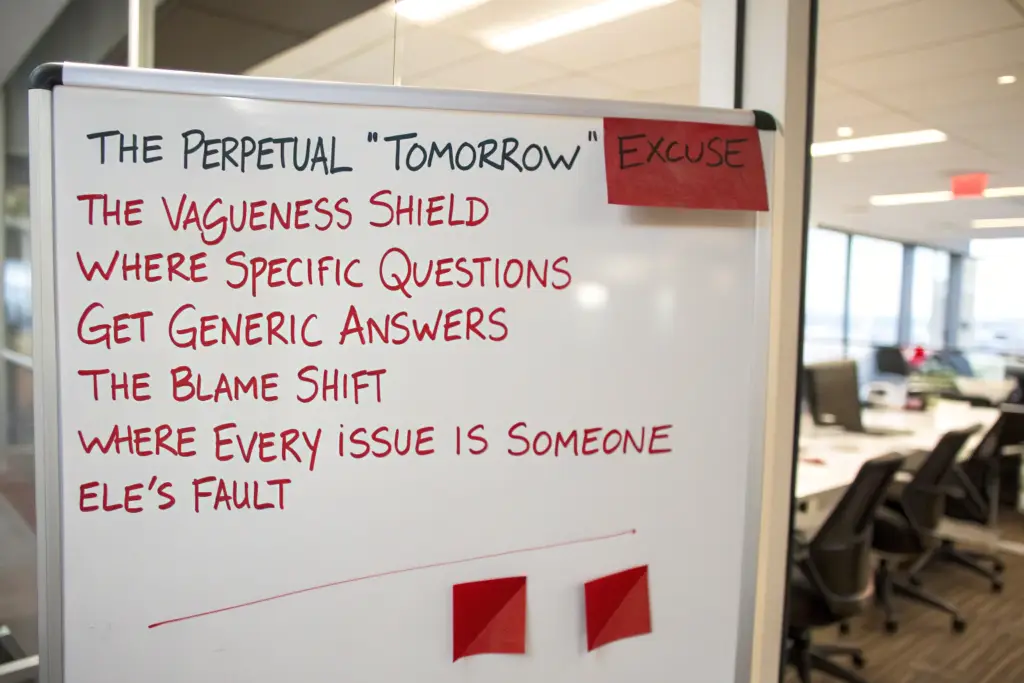
Three communication red flags you must never ignore are: the perpetual "tomorrow" excuse, the vagueness shield where specific questions get generic answers, and the blame shift where every issue is someone else's fault. These patterns reveal a factory that lacks internal control and customer respect. Continuing to work with them guarantees escalating problems.
I have seen these red flags play out again and again across hundreds of client interactions. They are remarkably consistent across different factories and different price points. The red flags are not cultural. They are indicators of a broken management system. A well-managed Chinese factory communicates clearly and directly. A poorly managed one hides behind vague language and broken promises.
When Does "Tomorrow" Become a Broken Promise Cycle?
The word "tomorrow" is the most abused word in garment sourcing. You ask for a photo of the cut pieces. "Tomorrow." You ask for the tracking number. "Tomorrow." Tomorrow arrives, and you get silence. You follow up, and you get a new "Tomorrow." This cycle is a clear signal that the factory is disorganized. They do not have the information you need, so they tell you what you want to hear to get you off their back for 24 hours.
I had a client who was stuck in this cycle with a previous supplier. She was promised a shipping update "tomorrow" for 12 consecutive days. Each day, a new excuse. The truck was delayed. The port was closed. The document had a typo. When the goods finally arrived, they were three weeks late and had a major quality defect. The "tomorrow" cycle was not just a delay. It was a cover-up for a factory that had lost control of its production schedule.
A reliable factory gives you a specific date and time, not a vague "tomorrow." We say, "The packing photos will be sent by Wednesday, 3 PM Shanghai time." If we miss that, we have broken a promise. Specificity is a form of respect. Vagueness is a form of avoidance.
Why Is a "Blame Shift" Response the Ultimate Deal-Breaker?
When a problem occurs, the factory's first reaction tells you everything. Do they own the problem and propose a solution? Or do they immediately point the finger elsewhere? The blame shift is the ultimate red flag because it reveals a lack of accountability. If the factory blames the fabric mill, the shipping line, or even you, the client, they are telling you they cannot control their own supply chain.
A classic blame shift sounds like this: "The fabric mill sent us the wrong lot, so we had to wait. It's not our fault." But it is their fault. They chose the mill. They should have inspected the fabric when it arrived. A good factory owns the entire chain. We had a situation where a yarn supplier delivered a batch that was slightly off-color. We did not tell our client, "Oh, the yarn guy messed up." We told them, "We caught a shading issue in our incoming inspection. We have rejected the yarn. This will push the cut date by three days. We are air-freighting replacement yarn. We will absorb the air freight cost." That is ownership.
If a factory blames everyone else during the sampling phase, imagine what they will do when a $100,000 bulk order has a major problem. They will leave you holding the bag. This kind of communication failure is a deal-breaker. It suggests a fundamental absence of quality management principles, which are well-documented in standards like ISO 9001. This specific clause of the standard deals with corrective action, requiring organizations to take action to eliminate the cause of nonconformities.
Conclusion
Communication is the invisible thread that holds a garment order together. It is more important than the stitching, because if the communication fails, the stitching never gets finished. We have explored how you can test a factory's communication efficiency before you commit to a bulk order. The Technical Clarification Drill reveals whether they read your spec sheet or just skim it for keywords. The Weekend Pressure Test reveals whether you will be alone in a crisis. The Sample Acknowledgment process reveals whether they have project management discipline or just a sewing machine.
These tests cost you nothing but a few minutes of email writing. But they can save you months of frustration and thousands of dollars in dead stock. The factories that pass these tests are the ones that operate with systems, not just with hands. They are the ones that treat a question as a request for information, not as a nuisance.
At Shanghai Fumao, we have built our customer service protocols around these exact standards. We structure our answers. We share our timelines. We flag our concerns early. We do this not because we want to impress you during the sales pitch. We do it because this is how we run our factory every single day. It is the only way we know how to work.
If you are looking for a manufacturing partner who measures response quality as carefully as garment quality, I invite you to test us. Send our Business Director, Elaine, a Technical Clarification Drill email right now. Ask her three specific questions about your next product idea. See how she structures the reply. Time it. Judge it. I believe you will find the level of detail and precision you are looking for. Reach out to Elaine at elaine@fumaoclothing.com. Let's start a conversation built on clarity, not on guesswork.