You have found the dresses. The A-line silhouette is perfect. The floral prints are exactly what your customers want. The quality, when you inspected the sample, exceeded your expectations. Now you face the final, critical question before you commit to an order: can you put your own label on these dresses? Can you sell them under your brand name, with your hangtags, your care labels, and your brand story? Or will the factory's identity remain attached to the product, limiting your pricing power and your customer's brand loyalty? The answer to this question determines whether you are building a brand or simply reselling someone else's product.
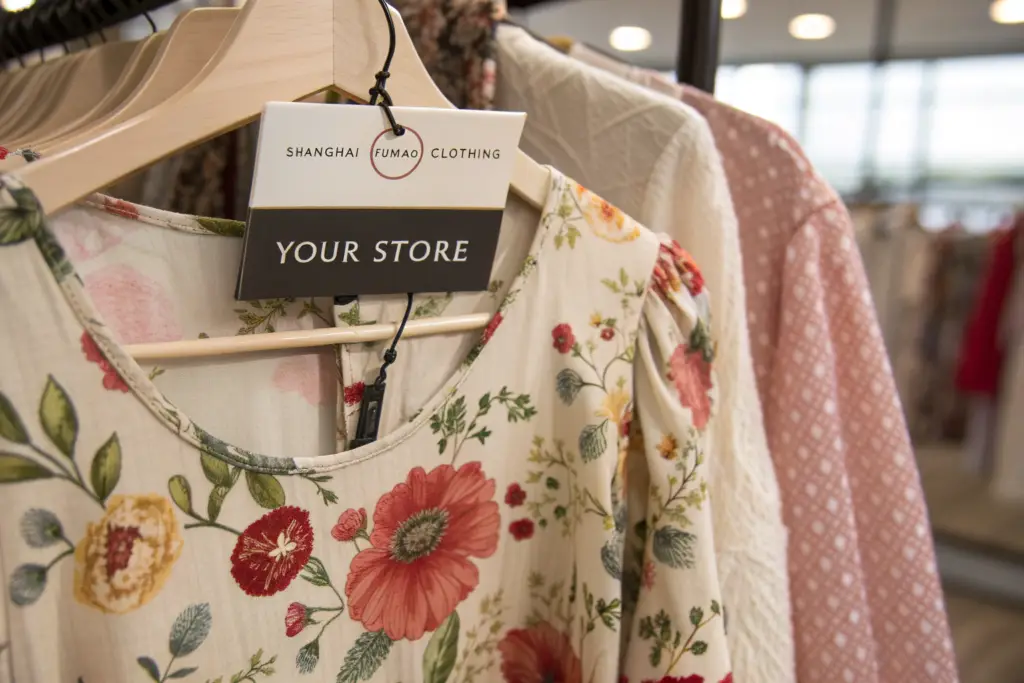
Yes, you can fully rebrand Shanghai Fumao Clothing's floral dresses for your store. We are a custom manufacturer, not a branded wholesaler. Every dress we produce can carry your brand's labels, your hangtags, your packaging, and your brand identity. The customer who buys the dress from your store or your website will see only your brand. She will not know the factory that produced it. We provide this as a standard service, not a special request. The rebranding process includes custom woven labels, custom care labels with your brand name and contact information, custom hangtags produced to your design, and custom packaging options including branded polybags, tissue paper, and stickers. Your brand is the hero. We are the invisible infrastructure behind it.
My name is Elaine. I am the co-owner of Shanghai Fumao. I understand the importance of brand ownership because I have spent fifteen years helping brands build their identity on our production quality. The brands that succeed are not the ones with the cheapest product. They are the ones whose customers feel a connection to the brand's story, aesthetic, and values. That connection cannot form if the brand is visibly just a reseller of another company's product. In this article, I will walk you through exactly how our rebranding process works, what customization options are available, how the logistics of label and packaging production are handled, and what legal and quality considerations you need to understand. By the end, you will have a complete picture of how to transform our dresses into your dresses.
What Does "White Label" Versus "Full Custom Manufacturing" Mean for Rebranding?
The terms "white label" and "private label" are sometimes used interchangeably in the apparel industry, but they represent different levels of brand integration and product ownership. Understanding the distinction helps you choose the right approach for your brand's current stage and communicate your requirements clearly to your manufacturer.
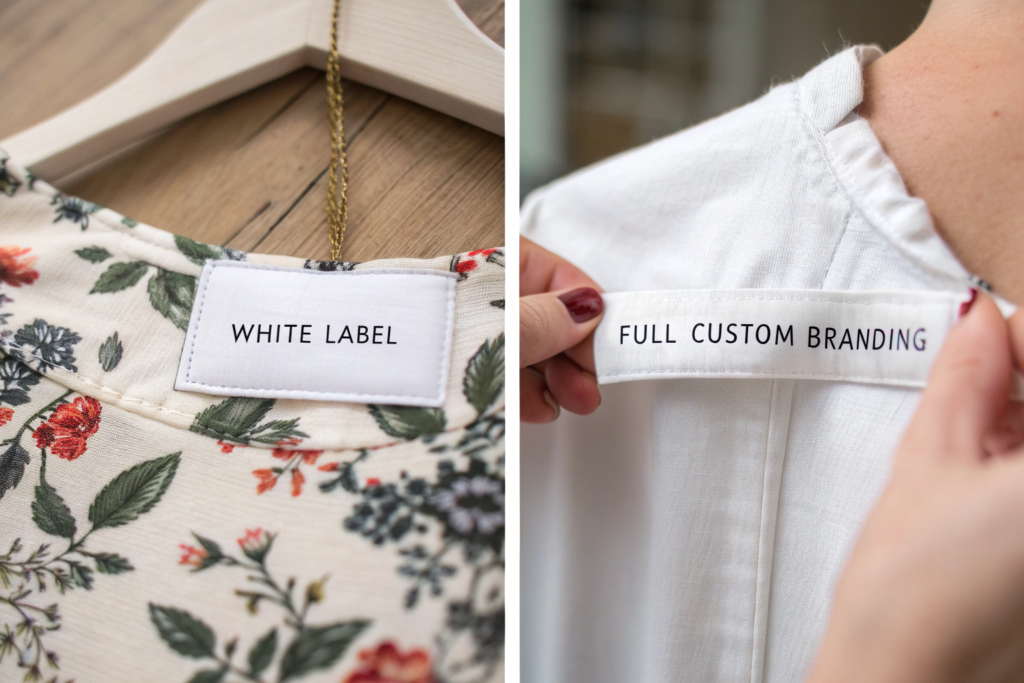
White label manufacturing means the factory produces a pre-existing product design, and you apply your brand label to it. The silhouette, the fit, and often the fabric and print options are determined by the factory. You select from available options. Your brand name goes on the label, but the product design is not exclusively yours. Other brands may be selling the same dress with different labels. Full custom manufacturing, which is what Shanghai Fumao provides, means the product is developed specifically for your brand. The silhouette can be adapted from our pattern library or developed from your design sketch. The print is developed exclusively for you. The fabric is selected to meet your specifications. Your brand is not just on the label. Your brand is in the product's DNA. Full custom manufacturing with rebranding gives you complete brand ownership of the product.
Can You Rebrand a Stock Silhouette From Our Pattern Library?
Yes. Our pattern library, which contains several proven A-line dress silhouettes, is a starting point for custom development, not a finished product that carries our brand. When you select a silhouette from our library, we adapt it to your specifications—your size chart, your preferred length, your sleeve modifications, your neckline adjustments—and produce it exclusively for your brand with your labels, your hangtags, and your packaging.
The dress that ships to your store has your brand identity on every visible surface. The fact that the underlying pattern block originated in our library is invisible to your customer and irrelevant to your brand ownership. Many of our most successful boutique clients started with a library silhouette, branded it fully, and built their customer base on it. As their brand grew, they transitioned to fully custom silhouette development. The white label versus private label versus custom manufacturing for fashion brands guide explains the spectrum of manufacturing relationships and their implications for brand ownership.
Do You Require a Minimum Order for Custom Labels and Packaging?
Custom labels and packaging involve their own production processes and their own supplier relationships. Woven labels are produced by specialized label mills. Hangtags are printed by printing companies. Custom packaging, such as branded polybags or tissue paper, is produced by packaging suppliers. Each of these suppliers has minimum order quantities, and those minimums often exceed the quantity needed for a single dress order.
We manage this complexity for you. We have established relationships with label, hangtag, and packaging suppliers who accept the smaller quantities that align with our clients' dress order volumes. For custom woven labels, the minimum order is typically 1,000 to 2,000 pieces. This covers several dress orders, and we hold the excess label inventory for your future production runs. For custom hangtags, the minimum is typically 500 to 1,000 pieces. For custom packaging like branded polybags, minimums vary by specification. We can also produce a smaller quantity of labels and hangtags at a higher per-unit cost for brands that are placing their first order and do not want to invest in a large label inventory upfront. The custom apparel label and packaging minimum order quantities article explains the cost-volume trade-offs. We will present you with options at different volume tiers so you can choose the approach that fits your budget and your growth plan.
What Custom Labeling and Branding Options Do You Offer?
Your brand is communicated to the customer through every physical touchpoint. The label at the back neck. The care label inside the side seam. The hangtag she reads while standing in the boutique. The tissue paper she unfolds when she opens the package. Each touchpoint is an opportunity to reinforce your brand identity and build an emotional connection with your customer. A generic, unbranded touchpoint is a missed opportunity. A cohesive, beautifully designed set of touchpoints is a silent salesperson that communicates quality, care, and brand value.
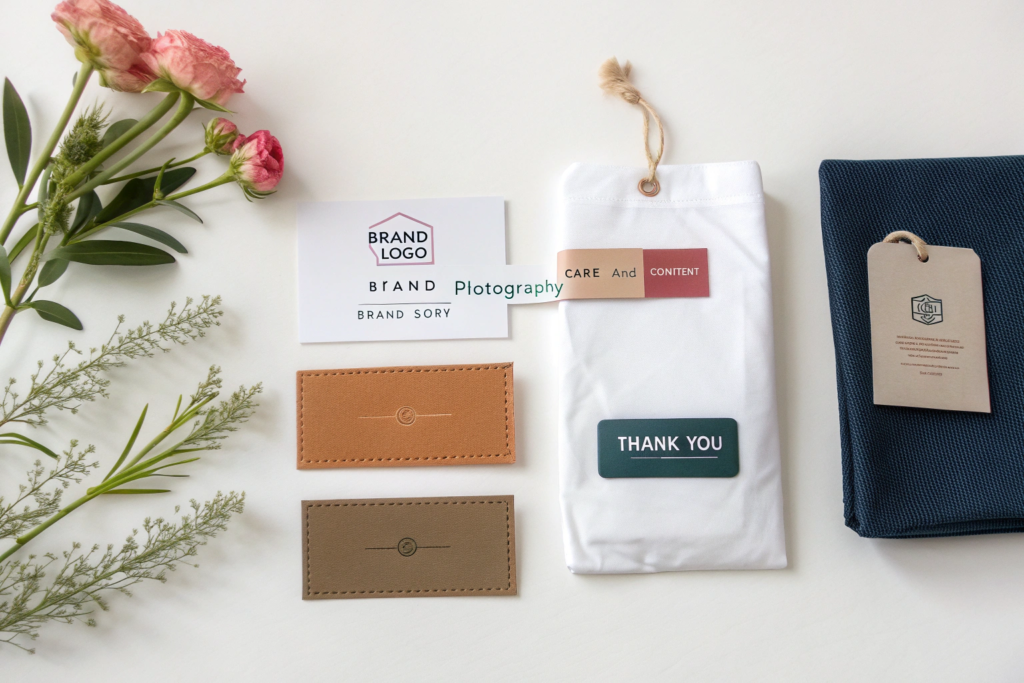
We offer a complete range of custom branding options, all managed through our production process so you have a single point of contact. Custom woven labels, produced in your choice of size, colors, and material, with your logo, brand name, or any design you provide. Custom care and content labels, printed with your brand name, contact information, fiber content, care instructions, and country of origin in the format required by your target market's regulations. Custom hangtags, printed on your choice of paper stock, in your choice of shape and size, with your brand photography, brand story, and any marketing message you want to communicate. Custom packaging, including branded polybags with your logo, branded tissue paper, branded stickers, and thank-you cards. Each element is produced to your specifications and applied to your dresses during our finishing and packing process.
What Information Do You Need From Me to Produce Custom Labels?
The label production process runs parallel to the dress sampling process so that both are ready at the same time. To begin label production, we need specific information and artwork from you.
For woven labels, we need your logo or brand name in a high-resolution vector file, preferably an AI or EPS file. We need your preferred label dimensions, typically the standard back-neck label size or a custom size. We need your color specifications, either Pantone references or a physical color standard. We need your preferred material: damask woven for a classic, high-end look; satin woven for a smooth, shiny finish; or taffeta woven for a crisp, matte finish. For care and content labels, we need your brand name exactly as you want it to appear. We need your contact information if you choose to include it, such as a website or a customer service email. We need the fiber content of the dress, which we provide based on the fabric specification. We need the care instructions, which we can recommend based on the fabric's tested performance. For hangtags, we need your complete hangtag design in a print-ready file, or a design brief if you want our design partner to create the hangtag for you. We need your brand photography if you want lifestyle or product images on the hangtag. The custom apparel label design and production guide provides detailed specifications for artwork preparation and material selection.
Can You Help Design My Branding Elements If I Don't Have Finished Artwork?
Many emerging brands do not have a professional graphic designer on retainer. They have a clear vision for their brand identity but not the technical files required for label and hangtag production. This should not be a barrier to professional branding.
We have a design partner who specializes in apparel branding and can create your label and hangtag artwork from your brand concept. The process is collaborative. You share your brand name, your logo if you have one, your brand colors, your brand aesthetic references, and the message you want your hangtag to communicate. Our design partner creates initial concepts. You review, provide feedback, and approve the final designs. The design files are then transferred to the label and hangtag suppliers for production. The design service is an additional cost, typically $150 to $300 for a basic label and hangtag package, depending on the complexity. This investment pays for itself in the professional brand image it creates. A dress with a beautiful, cohesive branding package sells at a higher perceived value than the same dress with a generic label and a blank hangtag. The branding design for emerging fashion labels guide provides advice on developing a brand identity that resonates with your target customer.
How Does the Rebranding Process Work Logistically?
The rebranding process runs on a parallel track to the dress production process. The two tracks converge at the finishing and packing stage. Managing these parallel tracks requires clear timelines, clear specifications, and a manufacturer who integrates the branding supply chain into the garment supply chain. A failure in the branding track—labels that arrive late, hangtags that are printed with an error—can delay the entire order just as effectively as a failure in the garment track.
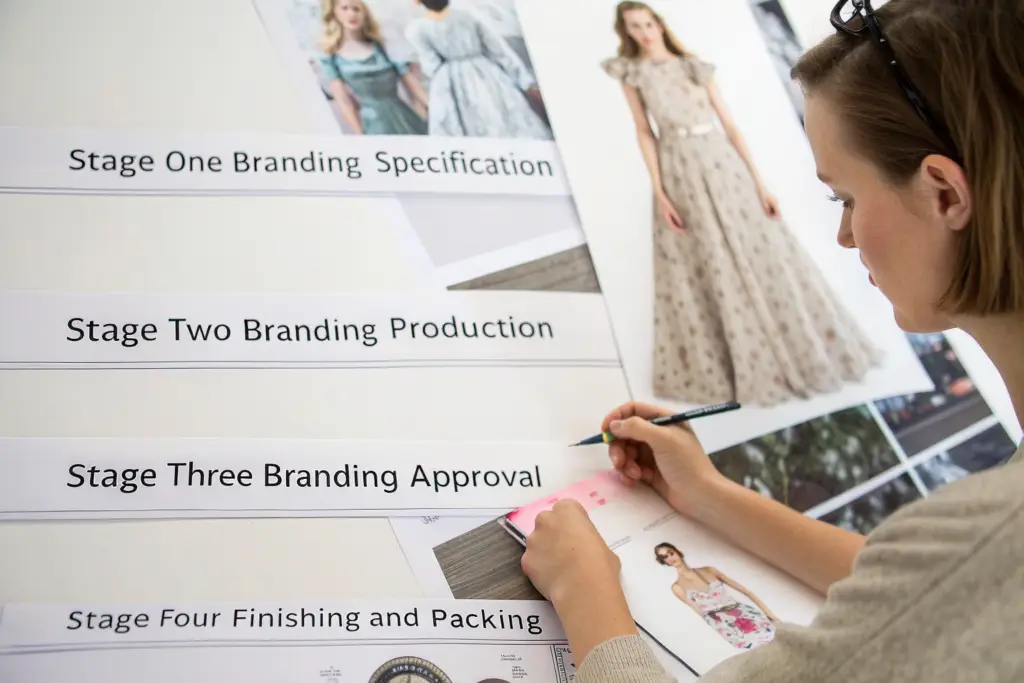
The rebranding process follows a four-stage timeline that runs parallel to dress production. Stage one, branding specification, occurs at the same time as the dress design brief. You provide your label, hangtag, and packaging specifications, or you engage our design partner to develop them. Stage two, branding production, occurs while the dress sampling process is underway. Our label and hangtag suppliers produce your custom items. This typically takes two to three weeks. Stage three, branding approval, occurs before the branding items are shipped to our factory. We send you photos or physical samples of the produced labels and hangtags for your approval. Stage four, finishing and packing, occurs when both the finished dresses and the approved branding items are in our factory. Our finishing team sews in the labels, attaches the hangtags, and packages each dress according to your specifications. The complete, branded product is then packed into cartons for shipment.
A branding error—a misspelled word, an incorrect fiber content, a color that doesn't match—is a serious problem. The labels and hangtags are the customer's primary source of legally required information and brand impression. A dress with an incorrect care label, for example, is a regulatory liability in many markets.
Our process includes two checkpoints to prevent branding errors. The first checkpoint is the branding proof review. Before any labels or hangtags are produced, we send you a digital proof of each item. You review the text, the colors, the layout, and the dimensions. You approve the proof in writing. This is your opportunity to catch any errors before production begins. The second checkpoint is the branding sample review. After production but before bulk shipping to our factory, we send you photos of the actual produced labels and hangtags. You verify that the finished items match the approved proofs. If an error is discovered at either checkpoint, the items are corrected and reproduced at our cost if the error was ours, or at your cost if the error was in your approved proof. This is why careful proof review is essential. The garment label compliance and error prevention guide explains the legal requirements and quality control processes for apparel labeling.
Yes. If you have an existing relationship with a label supplier, or if you have already produced labels and hangtags that you want to use, you can ship them to our factory and we will apply them to your dresses. This is common for established brands that have standardized branding across multiple manufacturers.
If you supply your own labels and hangtags, we need you to ship them to our factory at least one week before the finishing and packing stage begins. We need a packing list detailing the quantities and types of each item. We need written confirmation of which label goes into which dress style if you are producing multiple styles. We will verify the received quantities against the order quantity and alert you immediately if there is a shortage. There is no additional charge for applying client-supplied labels and hangtags. It is part of our standard finishing service. The shipping labels and trims to overseas manufacturers guide provides logistics advice for this process.
What Are the Legal and Quality Implications of Rebranding?
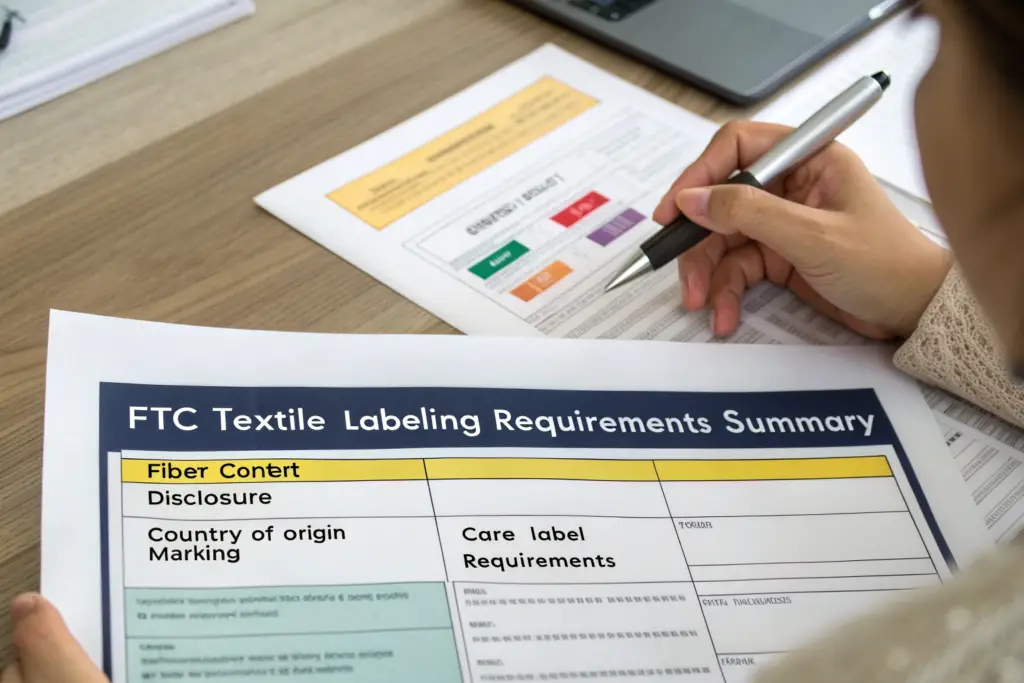
Rebranding a product is not simply a matter of sewing in a different label. It carries legal obligations. In the United States, the Federal Trade Commission enforces the Textile Fiber Products Identification Act, which requires that garments sold to consumers carry labels disclosing the fiber content, the country of origin, and the identity of the manufacturer, importer, or other responsible party. In the European Union, similar regulations apply under the EU Textile Regulation. When you rebrand a dress with your label, you become the responsible party for the accuracy of these disclosures. You need to understand what this means and how we support you in meeting these obligations.
When you rebrand our dresses, you assume the legal responsibility for the accuracy of the product labeling in your target market. We support this by providing you with the verified technical information you need to create compliant labels: the exact fiber composition, supported by an independent lab test report; the correct country of origin, which is China for dresses manufactured in our facility; and recommended care instructions based on the fabric's tested washing, drying, and ironing performance. Your care label and content label must reflect this information accurately. We also recommend that your label include your brand's RN (Registered Identification Number) if you sell in the United States, or your relevant business registration information for other markets. The FTC provides detailed guidance on textile labeling requirements that you should review or discuss with a compliance specialist.
Who Is Responsible If a Customer Complains About the Garment?
When a customer buys a dress from your store with your label, her relationship is with your brand, not with the factory that produced the dress. Your brand is responsible for handling the complaint, processing the return, and maintaining the customer relationship. This is true regardless of whether the defect was caused by a manufacturing error or a design flaw.
Our role is to support you in resolving manufacturing-related complaints. If a customer returns a dress because of a defect that our QC system should have caught—a seam that split, a zipper that failed, a print that faded—we investigate the root cause. If the defect is determined to be a manufacturing error, we compensate you according to the terms of our manufacturing agreement, typically through a credit on a future order or a discount on the affected portion of the order. This is why our sealed pre-production sample, our in-line QC, and our final inspection protocols are so important. They minimize the probability that a manufacturing defect reaches your customer. And when one does, our documented quality standards provide the objective basis for determining responsibility and resolution. The garment defect responsibility and resolution between brands and manufacturers guide explains the framework for handling quality complaints in a manufacturing partnership.
Can You Provide the Technical Documentation I Need for My Labels?
Yes. As part of our standard production package, we provide the technical documentation you need to create accurate, compliant care and content labels. This documentation is based on independent laboratory testing of the fabric lot used for your order.
The documentation package includes: a fiber composition test report from an accredited laboratory such as SGS or Intertek, confirming the exact fiber content of your dress fabric. A fabric shrinkage test report, showing the residual shrinkage percentage after home laundering, which informs the care instructions. A colorfastness test report, showing the fabric's resistance to rubbing, washing, and light exposure. Based on these test results, we provide recommended care label instructions in the standard care symbol format or in written text, depending on your market's conventions. This documentation gives you the evidence you need to create legally compliant labels and to defend your labeling if it is ever challenged by a regulatory authority or a consumer.
Conclusion
Rebranding Shanghai Fumao Clothing's floral dresses for your store is not only possible. It is the standard way we work. We are a custom manufacturer that exists to help brands build their identity on a foundation of quality production, not a branded wholesaler that sells its own label alongside yours. Every dress we produce can carry your brand name, your labels, your hangtags, and your packaging. The customer who buys the dress experiences only your brand. We provide the invisible manufacturing infrastructure that makes that brand experience possible.
The rebranding process is structured and supported. You provide your branding specifications or work with our design partner to develop them. We manage the parallel production of your dresses and your branding elements. We apply the branding during finishing and packing, and we ship you a complete, retail-ready product. We provide the technical documentation you need to create compliant care and content labels. And we stand behind our manufacturing quality with documented QC protocols and a clear defect responsibility framework.
If you are ready to turn our dresses into your dresses, I invite you to begin the conversation. Send me your brand name, your logo, and your vision for how you want your product to be presented. I will provide a branding timeline, a cost estimate for labels and hangtags, and a clear plan for integrating your brand identity into your first order. My name is Elaine. My email is elaine@fumaoclothing.com. Your brand deserves to be the only name your customer sees.