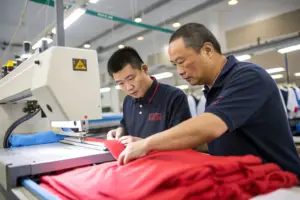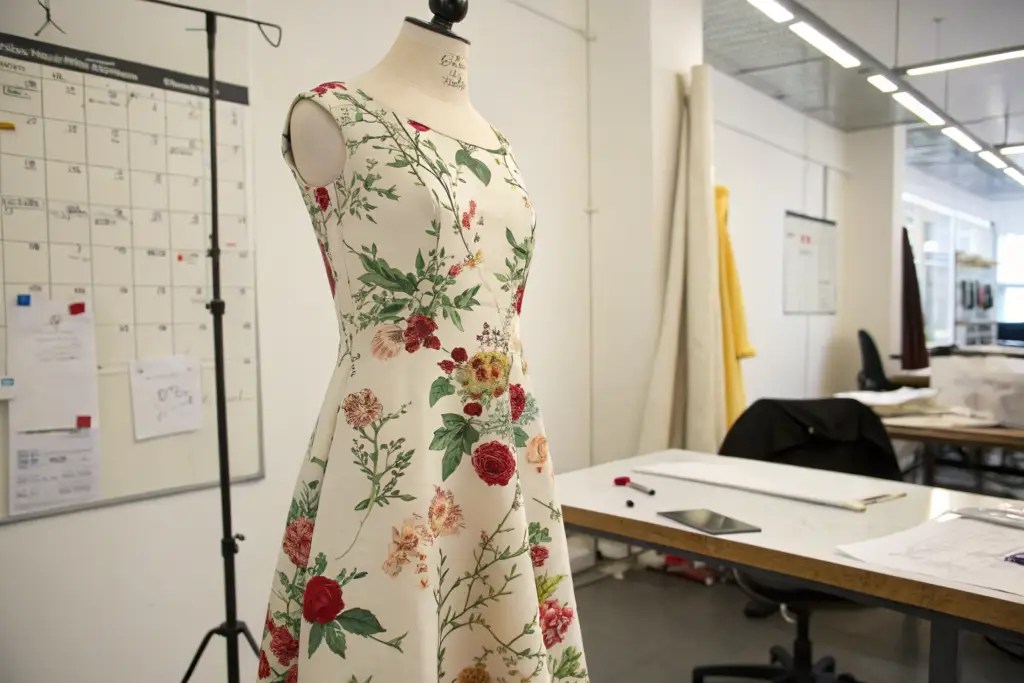
You have found the perfect A-line floral dress design. The fabric is beautiful. The print is exclusive. The wholesale price fits your margin model. You are ready to place an order for your boutique in Berlin, your shop in Amsterdam, or your online store shipping to Paris and Milan. Then the sizing question hits you. You have heard the stories. Dresses ordered from Asia run small. A size Medium fits like an Extra Small. The proportions are wrong for European bodies. The shoulders are too narrow, the bust is too short, the waist hits in the wrong place. You cannot afford a 30% return rate because the sizing is off. Your European customer expects a size 38 to fit like a size 38, not like a size 34 with a different number on the label.
Yes, Shanghai Fumao Clothing's floral dresses are true to size for the European market. We achieve this through three specific practices. First, we develop our patterns on Alvanon European-standard dress forms, not Asian-standard forms, so the fundamental body shape assumptions are European from the start. Second, we grade our sizes according to the EN 13402 European sizing standard, which defines the specific body measurements and the increments between sizes that European consumers expect. Third, we provide a detailed measurement chart with every sample and every bulk order, showing the finished garment measurements for each size, so you can verify the fit against your own size standards before production begins. A size 38 dress from us measures as a European 38. A size 40 measures as a European 40. The sizing is not an approximation. It is engineered.
My name is Elaine. I am the co-owner of Shanghai Fumao. I started my career as a pattern maker, cutting and draping muslin on dress forms. I learned my craft on European dress forms because my first clients were French and German brands. The European fit standard is baked into our pattern room's DNA, not added as an afterthought. In this article, I will explain exactly how we engineer European sizing, how our sizing compares to standard European size charts, what to expect if your brand has its own specific fit block, and how we handle the sizing transition from sample to bulk production.
What Does "True to Size for Europe" Actually Mean in Garment Manufacturing?
"True to size" is a phrase that gets thrown around casually in fashion e-commerce, often without any technical definition. To a pattern maker, true to size has a specific meaning. It means that the finished garment measurements correspond to a defined body measurement standard, with appropriate ease allowances for the fabric type and the silhouette. A size 38 dress with a bust measurement of 88 centimeters on the body should have a finished garment bust circumference that accommodates an 88-centimeter bust with the intended ease—neither pulling tight nor swimming in excess fabric.
The concept of "true to size" rests on three technical foundations. First, the dress form on which the pattern is developed must represent the target market's body proportions. A pattern developed on an Asian dress form will have a shorter torso length, a different bust point position, narrower shoulders, and a different hip-to-waist ratio than a pattern developed on a European dress form. Second, the grading rules that scale the pattern from the base size to the full size range must follow the target market's size increment standards. European grading typically increases the bust circumference by 4 to 6 centimeters per size, while other markets may use different increments. Third, the ease allowances built into the pattern must be appropriate for the fabric and the silhouette. A woven linen A-line dress requires more ease than a stretch knit dress. The ease must be consistent across sizes so the fit intention—relaxed, semi-fitted, fitted—is maintained from size 34 to size 48.
How Do European and Asian Body Proportion Standards Differ?
The differences between European and Asian body proportion standards are not minor. They are structural, and they affect how a dress fits in ways that a customer notices immediately. A pattern developed for the Asian market and simply relabeled with European size tags will not fit a European body correctly.
The average European female torso is longer from shoulder to waist than the average Asian female torso. A dress pattern developed for a shorter torso will have the waist seam hitting too high on a European body, creating an unflattering proportion and discomfort. The average European shoulder width is broader than the average Asian shoulder width. A dress pattern with narrower shoulders will feel tight across the upper back and restrict arm movement. The average European bust point position is different from the average Asian bust point position. A dart placed for an Asian bust point will fall in the wrong position on a European body, creating puckering and poor shaping. These are not stereotypes. They are anthropometric data points that professional pattern makers use to develop fit standards for different markets. The anthropometric differences across global body measurement standards provide the technical data behind these differences. At Shanghai Fumao, our patterns are developed on European-standard dress forms. The torso length, shoulder width, bust point, and hip-to-waist ratio are European from the first pattern draft. We do not adapt an Asian pattern. We start European.
What Role Does the EN 13402 Standard Play in Our Sizing?
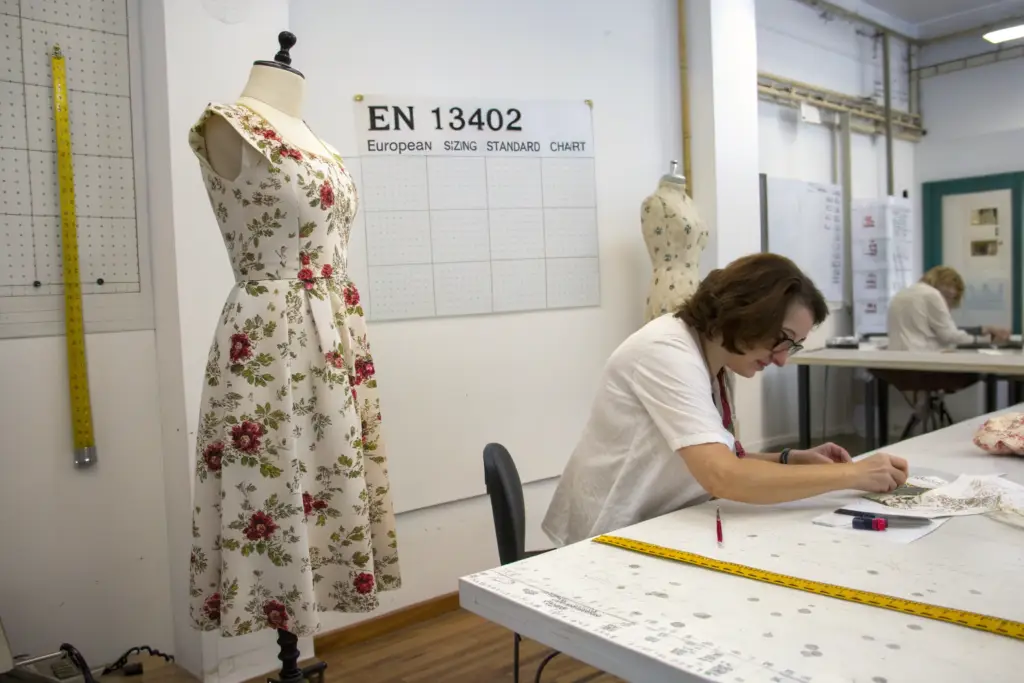
The EN 13402 is the European standard for size designation of clothes. It defines the body measurements that correspond to each size label, the measurement intervals between sizes, and the pictogram that communicates the key measurements to the consumer. It is not a legal requirement, but it is the industry reference standard that European consumers implicitly expect their clothing to follow.
Our base size is a European 38, which under EN 13402 corresponds to a bust circumference of 86 to 90 centimeters, a waist circumference of 68 to 72 centimeters, and a hip circumference of 94 to 98 centimeters. Our grading rules scale from this base size following the standard European increments: approximately 4 centimeters in bust circumference per size, approximately 4 centimeters in waist circumference per size, and approximately 4 centimeters in hip circumference per size. These increments are not arbitrary. They reflect the actual body measurement differences across the European female population. A size 40 dress is not just a size 38 dress scaled up by a random percentage. It is a size 38 dress scaled to fit the body measurements of a woman who measures 4 centimeters larger in bust, waist, and hip. The EN 13402 European size designation standard provides the full technical specification. When we say our dresses are true to European size, we mean they are engineered to this standard.
What If Your Brand Has Its Own Size Specifications?
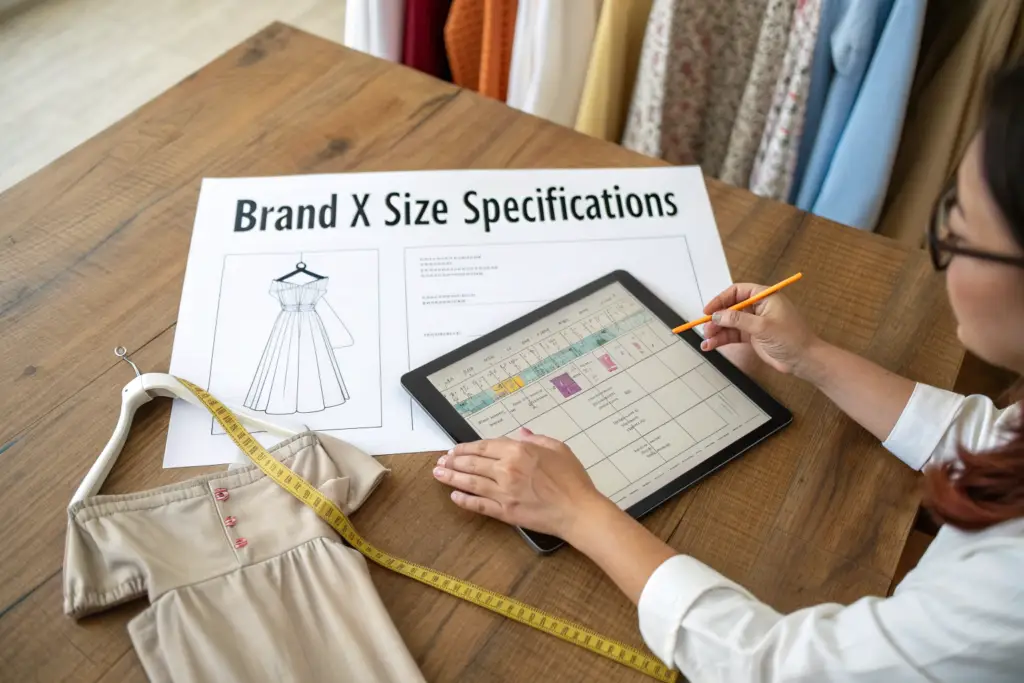
Many established European brands have their own size specifications that differ from the EN 13402 standard. A brand that has spent years cultivating a loyal customer base has trained those customers to expect a specific fit. A size 38 from Brand A might have a slightly more generous bust ease than a standard 38 because the brand's customer prefers a relaxed fit through the bodice. When a brand with its own size specifications comes to us, we do not impose our standard sizing. We adapt to theirs.
If your brand has its own established size specifications, we develop your patterns to your exact measurements, not ours. You provide your graded size chart with the finished garment measurements you require for each size. Our pattern engineer drafts the pattern to match your chart. The first sample is measured against your chart before it ships. Any deviation from your specified measurements is corrected in the revision round. Your size specifications become our production standard. The dresses we produce for your brand will measure to your chart, not to a generic European standard. This is the definition of custom manufacturing.
How Do We Handle a Brand's Existing Fit Block?
A fit block, or a base pattern, is a brand's proprietary foundation pattern that encapsulates their specific fit preferences. It reflects the brand's decisions about torso length, shoulder slope, bust dart placement, ease distribution, and a dozen other micro-adjustments that collectively define "how our brand fits." A brand that has invested in developing a fit block with a pattern maker or a technical designer has a valuable asset that should not be discarded when changing manufacturers.
When a brand comes to us with an existing fit block, we digitize it if it is a physical pattern, or we import the digital file if it is a CAD pattern. Our pattern engineer studies the block, understands its fit characteristics, and uses it as the foundation for developing new A-line dress styles. The brand's fit DNA is preserved. The new dress silhouette is built on the brand's proven shoulder, bodice, and torso foundation. This eliminates the multi-round fit sampling process that typically accompanies a manufacturer transition. The transferring fit blocks between apparel manufacturers guide explains the technical process and the common pitfalls. We have successfully integrated fit blocks from dozens of European brands into our pattern library.
Can We Grade to Non-Standard Size Ranges, Such as Petite or Tall?
The standard European size range assumes an average height of approximately 168 centimeters. Customers who fall significantly outside this height range—petite women under 160 centimeters, tall women over 175 centimeters—are poorly served by standard sizing. A brand that offers petite or tall sizing as part of its value proposition needs a manufacturing partner who can engineer these specialized grades.
We offer petite and tall grading as a standard capability, not a special request. For petite grading, we reduce the torso length, the shoulder-to-bust point, the sleeve length, and the skirt length proportionally, while maintaining the standard bust, waist, and hip circumferences. A petite size 38 fits a woman with standard circumference measurements and a shorter bone structure. For tall grading, we increase the same length measurements proportionally. The grading rules for petite and tall are not a simple percentage reduction or increase of the standard pattern. They are specific adjustments derived from anthropometric data for these body types. Our pattern engineer has developed dedicated grading rule sets for petite and tall ranges. The petite and tall grading rules for woven dresses article explains the technical adjustments required. If your European customer base includes a significant petite or tall segment, we can help you serve them with a properly engineered fit.
How Do We Verify and Maintain Size Consistency Across Production Runs?
A sample that fits perfectly is a promise. Bulk production that maintains that fit across every size and every unit is the fulfillment of that promise. The gap between sample fit and bulk fit is where many manufacturer relationships fail. The sample was sewn by the most skilled sewer in the factory, working slowly and carefully. The bulk units were sewn by production sewers working at production speed. Without a systematic process to ensure consistency, the bulk dresses will not fit like the sample. Size drift will occur. The size 38 that fit beautifully in the sample will fit slightly differently in the bulk order. The customer will notice. She will return the dress.
We maintain size consistency across production runs through three interlocking practices. First, the sealed pre-production sample protocol. Before bulk cutting begins, we produce a PP sample in each size from the actual bulk fabric. These samples are measured against the approved size chart. They are sealed, signed, and dated by both us and the client. They become the physical reference standard for the bulk order. Second, in-line measurement audits. During production, our QC inspector pulls garments from the sewing line every two hours and measures them against the PP sample measurements. If a measurement drifts outside the tolerance of plus or minus 1 centimeter for circumferences and plus or minus 0.5 centimeters for lengths, the line is stopped and the pattern or the sewing process is corrected. Third, final inspection measurement sampling. When the order is complete, the third-party or internal final inspector randomly selects a statistically significant sample from the packed cartons and measures each garment against the spec. Any size that fails the AQL sampling is re-inspected at 100%.
What Happens If a Size Measurement Drifts During Production?
Size drift is not a moral failing. It is a physical reality of garment production. Fabric stretches. Cutting knives can deviate slightly from the marker line. Sewing operators can sew a seam allowance 2 millimeters wider or narrower than specified. A 2-millimeter difference on a single seam is negligible. A 2-millimeter difference accumulated across eight seams is a 1.6-centimeter difference in the finished garment circumference. That is the difference between a dress that fits and a dress that is returned.
Our in-line measurement audit system catches drift early. When the QC inspector measures a garment and finds a measurement outside tolerance, she does not just flag the garment. She traces the deviation to its source. Is the cutting marker incorrectly printed? Is the fabric spreading tension too high? Is a specific sewing operator consistently sewing a seam allowance too wide? She identifies the root cause within the hour. The production manager corrects the cause. The affected garments are reworked or rejected. The line resumes with the correct measurements. This is statistical process control applied to garment sizing. The size consistency and measurement drift control in garment manufacturing guide explains the methodology. We invest in this system because a consistent size 38 across 500 dresses is more valuable to our clients than the fastest possible production time with inconsistent sizing.
How Do We Ensure the Size Label Matches the Actual Garment Measurements?
A size label that says 38 on a dress that measures as a 36 is a customer trust disaster. The customer orders her usual size. It does not fit. She feels frustrated, body-conscious, and deceived. She returns the dress. She may not order from the brand again. The brand did nothing wrong. The factory sewed the wrong label into the dress, or the dress was cut to the wrong size specifications but labeled as the correct size.
We have a specific QC checkpoint for size label verification. At the final inspection stage, before the garments are packed, the inspector verifies that the size label sewn into each sampled garment matches the actual measurements of the garment. If a dress labeled size 38 measures within the tolerance of our size 38 specification, the label is correct. If it measures as a size 36, the label is incorrect, and the entire batch of that size is re-inspected. This checkpoint also verifies that the correct care label, fiber content label, and country of origin label are sewn into the correct garments. Labeling errors are simple to prevent with a systematic checkpoint and devastating to a brand's customer trust when they occur. The garment labeling accuracy in quality control article explains the common labeling errors and their prevention.
How Can You Verify Our Sizing Claims Before Placing a Bulk Order?
You have read about our sizing standards and our quality control systems. You should not take our word for any of it. You should verify it yourself, with physical evidence, before you commit to a bulk order. A manufacturer who is confident in their sizing will welcome your verification. A manufacturer who is insecure about their sizing will resist it, deflect, or make excuses. Your verification process is both your right as a buyer and a test of the manufacturer's honesty.
Verify our sizing claims through a three-step process. Step one: order a stock sample in your target size. This is a sample of an existing dress from our pattern library, made to our standard European size specifications. Try it on a fit model who knows her European size. Assess the fit. Measure the dress against the EN 13402 standard or your own size chart. Step two: if you proceed to custom development, we will produce a fit sample in your base size, made to your specifications if you provided them or to our European standard if you did not. This sample arrives with a measurement report showing the actual measurements against the spec. Fit it on your model. Provide feedback. Step three: before bulk production begins, we produce a pre-production sample in your base size from the actual bulk fabric. This sample is the final fit verification. Approve it, and it becomes the sealed quality standard for your order. Each step provides objective, measurable evidence of our sizing accuracy.

What Should You Look for When Fit-Testing a Sample on a Model?
Fit-testing a sample is a skill. It is not simply a matter of putting the dress on a model and asking, "How does it feel?" Feel is subjective. Fit is measurable. A structured fit assessment combines the model's subjective feedback with objective observation of specific fit points.
Dress the model in the sample. Have her stand in a relaxed posture with her arms at her sides. Walk around her slowly. Observe these specific fit points, in order. The shoulder seam should sit at the edge of the shoulder, not pulling toward the neck or sliding down the arm. The bust darts should point toward the bust apex, not above it or below it. The bodice should lie smooth across the bust without horizontal pulling lines that indicate insufficient bust ease, or vertical folds that indicate excess bust ease. The waist seam should sit at the model's natural waist, which you can find by having her bend sideways. The skirt should flare evenly from the waist without twisting. The hem should be parallel to the floor. Ask the model to move: raise her arms, sit down, bend forward. The dress should not restrict movement, and the armhole should not gape. The professional fit evaluation for woven dresses guide provides a detailed, illustrated methodology. A dress that passes all these fit points on a model who matches the target size measurements is a dress that is true to size.
What Measurements Should You Check on the Sample Against the Spec?
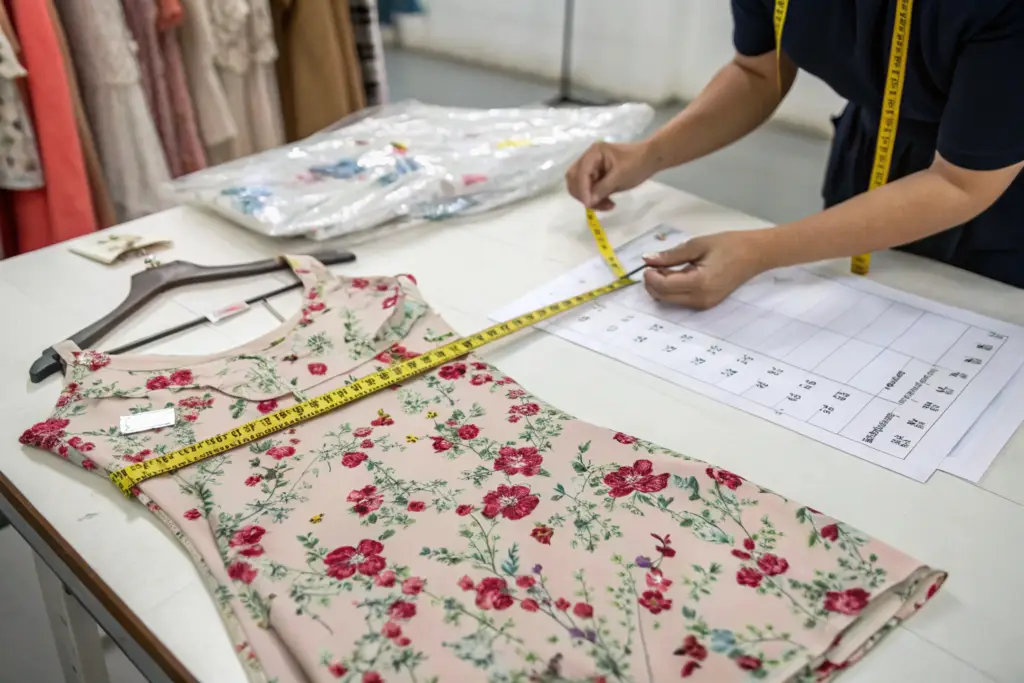
The measurement chart we provide with every sample lists the key measurements and their tolerances. You should verify these measurements yourself with a measuring tape. Lay the dress flat on a table, smooth out any wrinkles, and measure each point exactly as described in the measurement guide we provide.
The critical measurements to verify are: the bust circumference, measured across the front and back at the armhole level and doubled. The waist circumference at the waist seam. The hip circumference, measured at the intended hip level, typically 20 to 22 centimeters below the waist seam for a standard A-line dress. The dress length from the center back neck point to the hem. The shoulder width across the back. The armhole depth. The hem circumference at the skirt opening. Compare each measurement to the spec. A deviation of plus or minus 1 centimeter on circumferences and plus or minus 0.5 centimeters on lengths is within standard tolerance for woven garments. A deviation larger than this should be flagged and corrected in the next sample round. The garment measurement guide for fit verification provides illustrated measurement instructions. Consistent measurement technique is important. Measure the same way each time, from the same points, to ensure your measurements are comparable to ours.
Conclusion
Shanghai Fumao Clothing's floral dresses are true to size for the European market because our sizing is engineered, not improvised. We develop patterns on European-standard Alvanon dress forms, so the fundamental body shape assumptions are European. We grade our sizes according to the EN 13402 European sizing standard, so the size increments match European consumer expectations. We maintain size consistency across production runs through sealed pre-production samples, in-line measurement audits, and final inspection measurement sampling. And we welcome your independent verification of our sizing claims through stock samples, fit samples, and pre-production samples, each provided with a measurement report.
If your brand has its own size specifications, an existing fit block, or a need for specialized petite or tall grading, we adapt to your standards, not the other way around. Custom manufacturing means your sizes, your fit, your consistency.
If you would like to test our sizing with a stock sample, or if you have questions about how we would handle your brand's specific size requirements, I am ready to help. Contact me, Elaine, at elaine@fumaoclothing.com. Send me your size chart if you have one. I will provide an honest assessment of how our sizing aligns with your needs. Your European customers trust your sizing. We protect that trust.