The industry says no. The conventional wisdom is that you can have two of three things: low price, high quality, or fast delivery. Pick two. You cannot have all three. This is the iron triangle of manufacturing. It is taught in business schools. It is repeated by sourcing agents. It is accepted as an unchangeable law of the apparel industry. I am here to tell you that the conventional wisdom is wrong. Not entirely wrong. The trade-offs are real. But they can be shifted. A well-structured factory can offer competitive pricing and high fabric quality, not by cutting corners on materials, but by eliminating the inefficiencies that drive up costs without adding value for the customer.
Shanghai Fumao offers competitive pricing without sacrificing fabric quality by attacking costs in three areas that most factories ignore. First, we reduce fabric waste. Our CAD pattern making and automated cutting systems achieve fabric utilization rates above 85%, meaning less fabric is wasted per garment, lowering the effective fabric cost without using cheaper material. Second, we compress the supply chain. By purchasing greige fabric directly from mills and finishing it ourselves, we eliminate intermediary markups that add cost without adding value. Third, we operate with lean manufacturing discipline. Our hourly in-line audits catch defects early, when rework costs pennies instead of dollars. Our production tracking system reduces idle time. Our dedicated lines for long-term clients reduce setup waste. These operational savings offset the higher cost of quality materials.
I run Shanghai Fumao. I have spent fifteen years figuring out how to use premium materials, ring-spun denim, YKK zippers, OEKO-TEX certified fabrics, and still offer prices that are competitive with factories that use cheaper inputs. The answer is not a secret. It is operational efficiency. In this article, I will break down the real cost structure of a denim short, show where most factories waste money, and explain how our systems deliver premium quality at a competitive price.
What Are the Real Cost Drivers in Denim Shorts Manufacturing?
A denim short is not a single cost. It is a bundle of costs. Fabric. Hardware. Labor. Wash. Overhead. Logistics. Each of these costs has a quality floor and a quality ceiling. The quality floor is the cheapest material you can use without the product failing. The quality ceiling is the most expensive material that the market will pay for. A factory that competes purely on price pushes every cost toward the floor. Cheapest fabric. Cheapest zipper. Cheapest wash. The product is cheap to make and feels cheap to wear. A factory that competes on quality pushes toward the ceiling. Premium fabric. YKK zipper. Complex wash. The product is expensive to make and feels premium. The conventional wisdom says you must choose.
The flaw in this thinking is that it ignores the costs that are not visible on the bill of materials. Fabric waste. Rework. Idle time. Logistics inefficiencies. These are the silent costs. They add to the price of the short without adding to its quality. A factory that reduces these silent costs can afford to spend more on visible quality, fabric, hardware, wash, and still offer a competitive total price. The cost savings from operational efficiency subsidize the material quality. The buyer gets a premium product at a price that competes with a standard product from a less efficient factory.
Let me break down the cost structure and show where the savings come from.
How Much Does Fabric Waste Inflate the Effective Cost per Garment?
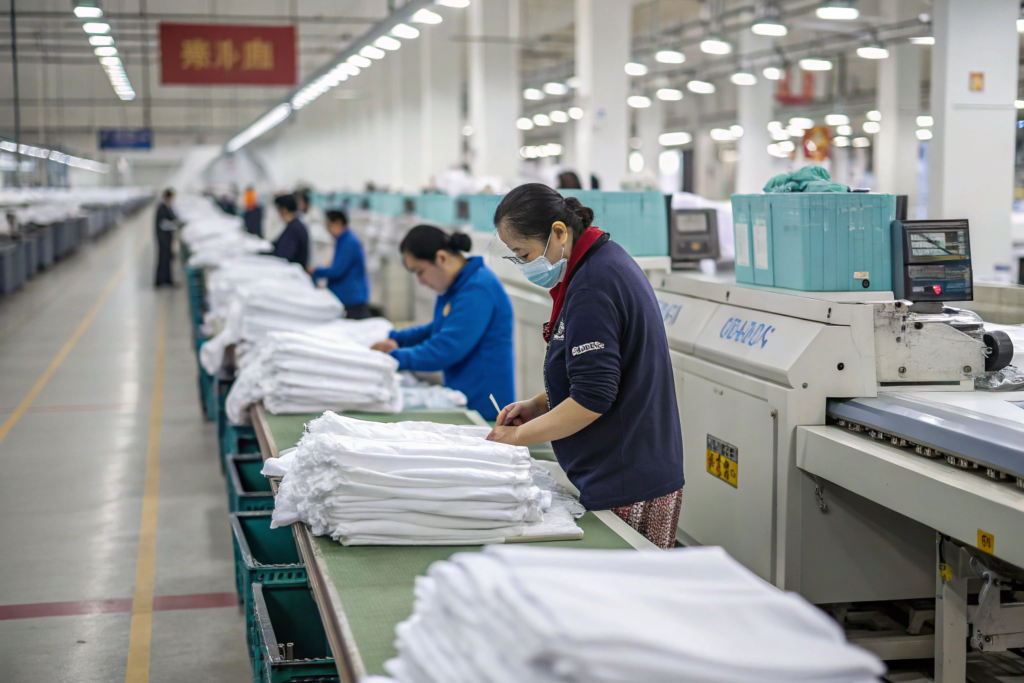
Fabric is the largest single cost in a denim short. It typically represents 35% to 45% of the ex-factory cost. A factory that pays $2.50 per yard for denim and uses 1.5 yards per short spends $3.75 on fabric. A factory that pays $2.00 per yard and uses the same 1.5 yards spends $3.00. The $0.50 per yard difference looks like a significant saving. But fabric utilization, the percentage of the purchased fabric that actually ends up in the garment, is often overlooked.
A factory with poor pattern engineering and manual cutting might achieve 80% fabric utilization. To get 1.2 yards of fabric into a short, they must purchase 1.5 yards. 0.3 yards is wasted. At $2.00 per yard, the waste costs $0.60 per short. A factory with good pattern engineering and automated cutting might achieve 88% utilization. To get the same 1.2 yards into a short, they purchase 1.36 yards. The waste is 0.16 yards. At $2.50 per yard for higher-quality fabric, the waste costs $0.40 per short. The effective fabric cost for the lower-quality short is $3.00 purchase plus $0.60 waste, $3.60 total. The effective fabric cost for the higher-quality short is $3.40 purchase plus $0.40 waste, $3.80 total. The higher-quality fabric costs only $0.20 more per short after accounting for waste. The fabric utilization in garment manufacturing is a critical efficiency metric. Our CAD pattern making and automated Gerber spreading machines achieve utilization rates that offset much of the cost premium of better fabric.
Why Are Rework and Defect Costs Higher Than Most Factories Admit?
A defect caught at the end of the production line is expensive. The garment has already consumed the fabric, the labor, the hardware, and the wash cost. If the defect can be reworked, the rework labor adds cost. If the defect cannot be reworked, the garment is sold as a second or discarded. The entire cost of the garment is lost.
A factory with a 5% internal defect rate on a $5.00 ex-factory cost product loses $0.25 per unit produced to defects, assuming the defective units cannot be sold at full price. A factory with a 1.5% defect rate loses $0.075 per unit. The difference is $0.175 per unit. This is pure cost. It adds nothing to the product's quality. It is the cost of poor quality.
Our quality systems, hourly in-line audits, AQL 1.5 final inspection, centralized lab testing, are designed to minimize this cost. We catch defects early, when the cost to fix them is a fraction of the finished garment cost. A skipped stitch caught at the in-line audit costs $0.05 in rework labor. The same skipped stitch caught at final inspection costs $0.50 in rework labor and handling. The same skipped stitch caught by the customer costs $10 in return processing and a lost customer. The savings from early defect detection subsidize the cost of better materials. The cost of quality in garment manufacturing is a well-established concept. Prevention is cheaper than inspection. Inspection is cheaper than failure. Our systems invest in prevention.
How Do We Reduce Inefficiencies to Subsidize Premium Materials?
The savings from reduced waste and reduced defects are significant, but they are not the whole story. A factory also incurs costs from idle time, setup time, logistics inefficiencies, and intermediary markups. These costs are hidden in the overhead. They are not visible on a bill of materials, but they are baked into the price the factory must charge to be profitable. A factory that reduces these overhead costs can charge a lower price for the same quality, or a competitive price for higher quality.
We attack overhead costs through four strategies. Direct mill relationships that eliminate intermediary markups on fabric. Lean production scheduling that reduces idle time and setup waste. In-house testing and wash development that eliminate the cost and delay of outsourcing. A DDP logistics model that consolidates shipping and reduces the hidden costs of fragmented logistics. These strategies are not about cutting corners. They are about cutting waste. The savings they generate subsidize the use of premium materials, ring-spun denim instead of open-end, YKK zippers instead of generics, OEKO-TEX certified fabrics instead of untested materials.
Let me explain the specific overhead reduction strategies and their impact on pricing.

How Does Direct Mill Sourcing Cut Costs Without Cutting Quality?
Many garment factories do not buy fabric directly from mills. They buy from fabric wholesalers or agents. The wholesaler buys from the mill, marks up the price, and sells to the factory. This markup is typically 5% to 15%. It adds cost to the fabric without adding any value. The fabric is the same fabric the mill produced. The wholesaler simply added a margin.
We buy directly from mills. We have long-term relationships with three denim mills. We commit to annual purchase volumes. In exchange, we receive competitive pricing and priority access to their production capacity. There is no intermediary taking a cut. The savings from direct sourcing are passed on to our clients in the form of competitive pricing for premium fabric specifications.
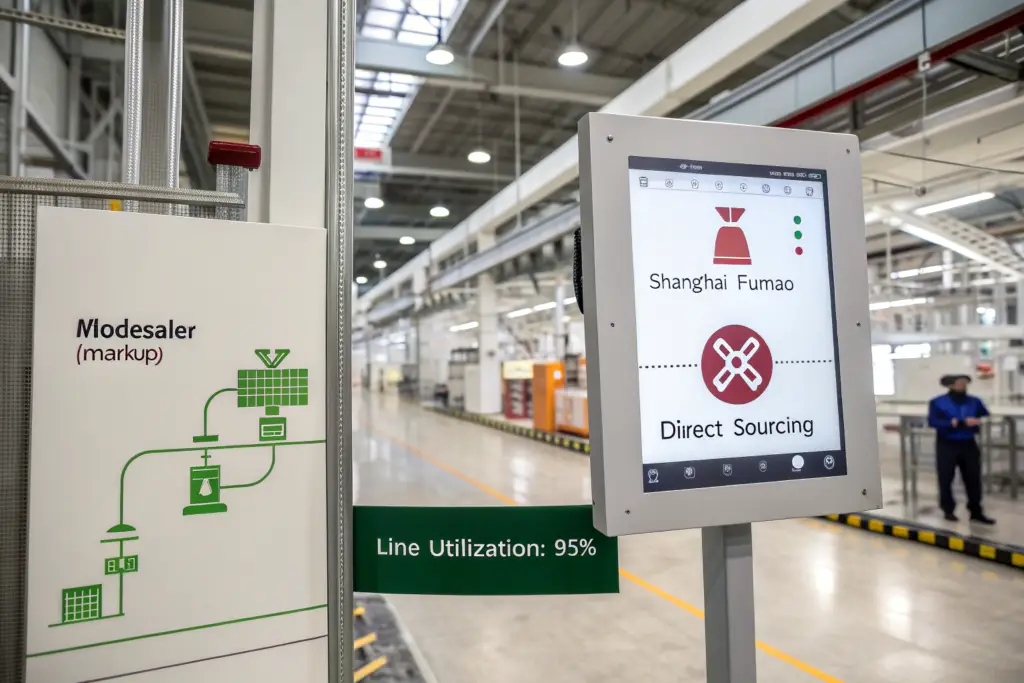
We also buy greige fabric, undyed, unfinished denim, directly from mills. We then manage the finishing process, dyeing, sanforization, skew control, through our partner finishing houses. Buying greige is cheaper than buying finished fabric because the mill does not bear the finishing cost and risk. By managing finishing ourselves, we capture that cost saving without sacrificing quality. The finished fabric meets the same specifications as if we bought it finished from the mill. The direct fabric sourcing vs wholesale cost comparison shows that eliminating intermediaries reduces material cost without changing material quality. This is a structural cost advantage.
Why Does Lean Production Scheduling Reduce the Cost of Every Unit?
A production line that is not running is still costing money. The workers are being paid. The factory overhead, electricity, rent, management salaries, continues. The cost of idle time is spread across the units that are produced. The more idle time, the higher the overhead cost per unit.
Lean production scheduling minimizes idle time. Our capacity booking system ensures that production lines are booked at near-full capacity during peak seasons. Our dedicated lines for long-term clients reduce the setup time required when switching between styles. A line that runs one client's styles for a month has less downtime than a line that switches styles every week. Our cross-trained workforce allows us to shift operators between lines as demand fluctuates, keeping all lines running at high utilization. The result is a lower overhead cost per unit. This saving contributes to our ability to price competitively while using premium materials. The lean manufacturing in apparel principles are well-established. Reducing waste in all its forms, idle time, setup time, defects, overproduction, reduces cost without reducing quality.
What Does "Competitive Pricing" Actually Mean for a Premium Product?
Competitive pricing does not mean the lowest price. It means a price that is fair relative to the value delivered. A premium denim short made with ring-spun, rope-dyed indigo denim, a YKK zipper, a complex enzyme-ozone wash, and OEKO-TEX certified trims cannot be priced at the same level as a basic short made with open-end, pigment-dyed denim, a generic zipper, and a simple rinse wash. The materials cost more. The wash costs more. The testing costs more. The product is objectively worth more.
The question is whether the premium product is priced competitively relative to other premium products of similar specification, and whether the price premium over a basic product is justified by the value delivered. Our pricing is competitive on both counts. Compared to other factories producing at our quality level, our prices are in the middle of the range, not at the high end. Compared to basic products, our price premium is smaller than the cost of the quality failures, returns, and brand damage that the basic product is likely to generate. The value-based pricing in apparel manufacturing concept recognizes that price must reflect the total cost of ownership for the brand, not just the ex-factory cost of the garment.
Let me provide specific price comparisons and explain the value proposition.
How Do Our Prices Compare to Factories Using Cheaper Materials?
Let me use a specific example. A standard women's denim short, 10.5 oz, medium enzyme wash, YKK zipper. A typical mid-tier Chinese factory using open-end denim and a basic wash might quote $4.80 FOB. Our quote for a comparable short using ring-spun denim and the same wash specification is approximately $5.50 FOB. The difference is $0.70 per unit. The buyer who chooses the cheaper option saves $0.70 on the purchase order.
However, that $0.70 saving must be weighed against the quality differences. The open-end denim is weaker and less comfortable. It will fade less attractively. The customer may return the shorts because they feel cheap. The return cost is $7 to $10 per return. If the return rate is just 2% higher on the cheaper short, the cost of returns wipes out the $0.70 saving. The ring-spun denim is also more durable. It will last longer. The customer will be more satisfied. They will be more likely to buy from the brand again. The lifetime value of that customer far exceeds the $0.70 upfront saving.
Our price is competitive not because we match the lowest price, but because the total cost of ownership, the purchase price plus the cost of quality failures, is lower for our product than for the cheaper alternative. The total cost of ownership in apparel sourcing calculation reveals that the cheapest FOB price is rarely the cheapest total cost.
Why Is the Total Value Equation More Important Than the Unit Price?
A buyer who focuses only on the unit price is optimizing the wrong variable. The goal is not to minimize the purchase price. The goal is to maximize the profit generated by the product. Profit is a function of the retail price, the unit cost, the return rate, the markdown rate, and the repeat purchase rate. A product with a higher unit cost but a higher retail price, lower return rate, lower markdown rate, and higher repeat purchase rate will generate more profit than a product with a lower unit cost but worse performance on all other variables.
Our products command a higher retail price because the quality is visible and tangible. The fabric feels better. The wash looks better. The hardware operates more smoothly. The customer is willing to pay more. Our products have a lower return rate because the quality is consistent and durable. The zipper does not fail. The color does not bleed. The fabric does not tear. The customer keeps the product. Our products drive repeat purchases because the customer is satisfied with their first purchase and trusts the brand to deliver quality again. The lifetime value of that customer is higher.
The unit price is one line item on the profit and loss statement. The return rate, the markdown rate, and the repeat purchase rate are larger line items. A factory that enables a brand to improve those larger line items by investing in product quality is delivering value that far exceeds the difference in unit price. The profitability impact of product quality is a strategic consideration, not just a procurement metric. Our pricing reflects the value we deliver to the brand's bottom line, not just the cost of the goods we ship.
Conclusion
A top clothing manufacturer can offer competitive pricing without sacrificing fabric quality. The key is to attack the costs that add no value to the customer. Fabric waste. Rework. Idle time. Intermediary markups. Logistics inefficiencies. These costs inflate the price of the garment without improving its quality. A factory that reduces these costs through operational efficiency, CAD pattern making, automated cutting, lean production scheduling, direct mill sourcing, in-house testing, DDP logistics, can afford to spend more on the materials and processes that the customer actually cares about. The premium ring-spun denim. The YKK zipper. The complex enzyme wash. The OEKO-TEX certification.
The result is a product with a higher ex-factory cost than a basic commodity short, but a lower total cost of ownership for the brand. The higher retail price, lower return rate, lower markdown rate, and higher repeat purchase rate that the premium product enables more than offset the difference in unit cost. The brand makes more profit per unit sold and sells more units over the customer's lifetime. The conventional wisdom that you must choose between price and quality is based on a narrow view of cost that ignores operational efficiency and total value. A well-structured factory shifts the trade-off. It delivers premium quality at a competitive price, not by cutting corners, but by cutting waste.
If you want to see the numbers for your specific product specification, contact our Business Director, Elaine. She can provide a detailed cost breakdown that shows our fabric sourcing, our efficiency metrics, and our DDP landed cost. She can also send you a sample so you can feel the quality for yourself. Her email is elaine@fumaoclothing.com. At Shanghai Fumao, we do not compete on being the cheapest. We compete on being the best value. The difference is measured in your profit, not our price.