You are a European brand. You are looking at Chinese manufacturers for your denim shorts. You have heard the horror stories. A shipment seized at Rotterdam because the nickel content in the buttons exceeded REACH limits. A container held at German customs because the factory could not provide proof that the cotton did not come from Xinjiang. A batch of shorts pulled from a Berlin boutique because the azo dye test came back positive for carcinogenic amines. The compliance risks feel overwhelming. The regulatory framework seems designed to exclude Chinese manufacturers. You wonder if it is even possible for a Chinese factory to guarantee EU compliance, or if sourcing from China is just too risky for a European brand in 2026.
Yes, a top Chinese clothing manufacturer like Shanghai Fumao can guarantee EU compliance in 2026. Compliance is not a matter of geography. It is a matter of systems, testing, and documentation. We guarantee EU compliance through five concrete mechanisms. First, we maintain REACH-compliant chemical management, with every component tested for restricted substances and documented through our OEKO-TEX Class I certification and ZDHC Gateway wastewater reporting. Second, we operate a fully documented and auditable cotton supply chain, with GOTS and BCI transaction certificates that verify the origin of our cotton fiber. Third, we comply with the EU's upcoming Digital Product Passport requirements by maintaining a digital chain of custody from fabric mill to finished garment. Fourth, our social compliance is verified by unannounced SMETA audits, which meet the due diligence expectations of the EU's proposed Corporate Sustainability Due Diligence Directive. Fifth, we ship DDP to the EU, which means we act as the Importer of Record and assume legal responsibility for customs compliance, removing the administrative burden from the brand.
I run Shanghai Fumao. I have spent the last three years building our EU compliance infrastructure. I did this because I saw the regulatory wave coming. The brands that were sourcing from Turkey and Bangladesh for the European market were starting to look at China again, not because China was cheaper, but because Chinese factories that invested in compliance were becoming the safest choice. In this article, I will walk you through the specific EU regulations that affect denim shorts, the systems we have built to comply with them, and the documentation we provide so that you, the brand, can sleep at night knowing your shipment will clear customs and your product will not generate a recall.
What EU Regulations Apply to Denim Shorts in 2026?
The European Union has built the most comprehensive regulatory framework for textiles in the world. A denim short sold in the EU is subject to chemical safety regulations, product safety regulations, labeling regulations, and increasingly, supply chain due diligence regulations. The framework is not static. It is evolving rapidly, with new requirements phasing in between now and 2030. A brand that wants to sell denim shorts in the EU must ensure their products comply with all applicable regulations. The factory that manufactures the shorts must provide the data and the documentation to prove compliance.
The four regulatory areas that most directly affect denim shorts are REACH for chemical safety, the General Product Safety Regulation for overall product safety, the Textile Labeling Regulation for fiber content disclosure, and the proposed Ecodesign for Sustainable Products Regulation, which will mandate the Digital Product Passport. Additionally, the Corporate Sustainability Due Diligence Directive will require brands to conduct human rights and environmental due diligence on their supply chains. Each of these regulations imposes obligations on the brand, which flow down to the factory as requirements for testing, documentation, and transparency.
Let me break down the two chemical safety regulations that are most critical for denim shorts and explain how our factory ensures compliance.
How Do REACH and the General Product Safety Regulation Affect Denim Shorts?
REACH stands for Registration, Evaluation, Authorisation, and Restriction of Chemicals. It is the EU's primary chemical safety regulation. For denim shorts, REACH restricts the use of several categories of substances. Azo dyes that can release carcinogenic aromatic amines, which are commonly found in low-quality indigo dyes and colored trims. Formaldehyde, which is used in fabric finishing to reduce wrinkling and shrinkage. Heavy metals like lead, cadmium, and nickel, which can be present in metal buttons, rivets, and zippers. Phthalates, which can be present in plastic components like synthetic leather patches, printed labels, and elastic waistbands. Organotin compounds, which can be present in printed designs and polyurethane coatings.
The General Product Safety Regulation, which replaced the General Product Safety Directive in December 2024, requires that all consumer products placed on the EU market are safe. For denim shorts, this means the shorts must not present any risk to the consumer under normal or reasonably foreseeable conditions of use. This includes physical risks, such as sharp edges on metal hardware or drawstrings on children's garments that pose a strangulation hazard, as well as chemical risks.
We address REACH compliance at the material sourcing stage. We require all fabric mills and trim suppliers to provide REACH compliance declarations for their products. We test incoming materials in our in-house lab using our XRF analyzer for heavy metals. We send production samples to independent, ISO 17025 accredited laboratories, such as SGS or Bureau Veritas, for full REACH Annex XVII testing. The test reports are provided to the brand as part of the compliance documentation package. The REACH regulation for textiles guidance from the European Chemicals Agency explains the full scope of the regulation. Our compliance process is designed to ensure that no restricted substance is present in our products above the legal limits.
What Documentation Proves Compliance for European Customs and Retailers?
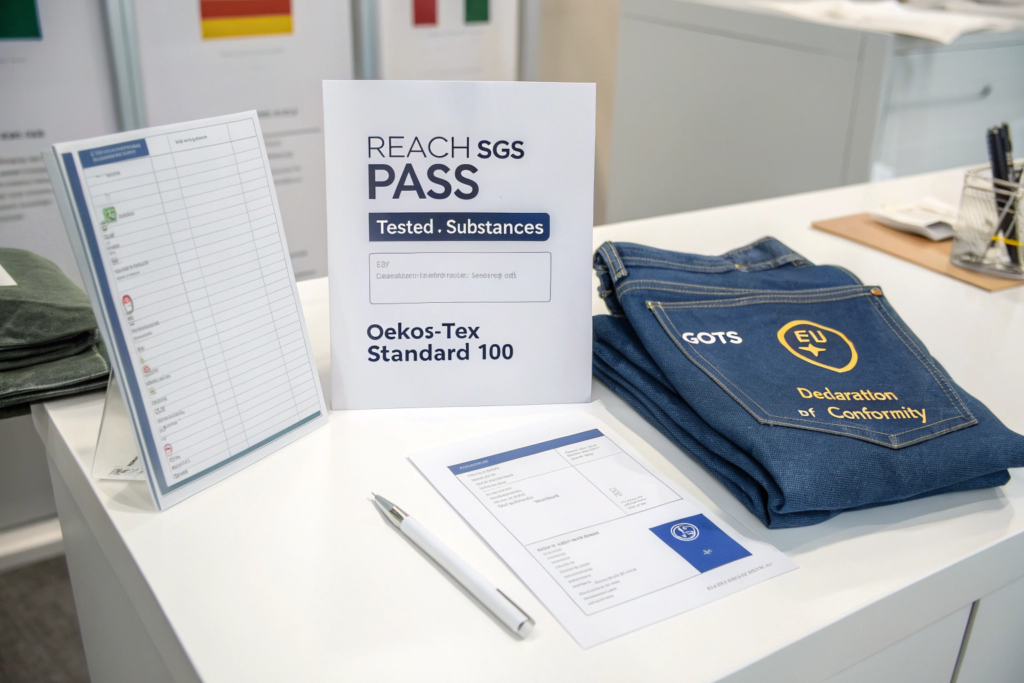
Documentation is the proof. A factory that says "we are REACH compliant" but cannot produce a test report is not compliant. The documentation package we provide for EU-bound denim shorts includes the REACH test report from an ISO 17025 accredited laboratory, testing for the full Annex XVII substance list applicable to textiles and metal components. The OEKO-TEX Standard 100 Class I certificate, which is a product safety certification that aligns with and in some categories exceeds REACH requirements. The certificate number is verifiable on the OEKO-TEX public database. The GOTS transaction certificate, if the order is for organic cotton shorts, which verifies the organic content and the chemical inputs used in processing. A Declaration of Conformity, which is a legal document in which we, as the manufacturer, declare that the product meets all applicable EU safety regulations. The fiber composition test report, which verifies the fabric content stated on the care label, as required by the EU Textile Labeling Regulation. The care label itself, which includes the fiber composition in the EU-mandated format, and the care instructions using the ISO care symbols.
This documentation package is provided to the brand before the goods ship. The brand can submit it to their EU customs broker to facilitate smooth clearance. The brand can also provide it to their retail partners, who increasingly require compliance documentation as a condition of purchase. The EU product compliance documentation guide explains the required documents for different product categories. Our package covers the requirements for textile apparel.
How Do Our Supply Chain Traceability Systems Meet EU Due Diligence Requirements?
The era of "trust me" sourcing is over in the European Union. The Corporate Sustainability Due Diligence Directive, or CSDDD, which was adopted in 2024 and is being transposed into national laws, requires large companies to conduct human rights and environmental due diligence throughout their supply chains. Even if your brand is not directly in scope, the brands you sell to may be, and they will push due diligence requirements down to you. The EU's Forced Labor Regulation, which is expected to be finalized in 2025 or 2026, will ban products made with forced labor from the EU market, regardless of where the forced labor occurred. For a denim short, the highest-risk area is the origin of the cotton. The U.S. has already enacted the Uyghur Forced Labor Prevention Act, which restricts imports containing Xinjiang cotton. The EU is moving in a similar direction with its own forced labor regulation.
To comply with these requirements, a brand must be able to trace its cotton back to the country of origin and, increasingly, to the specific gin. The factory must be able to document that the workers who made the shorts were treated fairly, with safe working conditions and freely chosen employment. A factory that cannot provide this documentation is a liability for any brand selling into the EU.
Let me explain the specific traceability systems we have implemented to meet these requirements.
How Do We Document the Cotton Supply Chain from Gin to Garment?
Cotton traceability is the most challenging aspect of supply chain due diligence. The cotton supply chain is long and fragmented. Cotton is grown on farms, ginned, traded by commodities merchants, spun into yarn, woven into fabric, and then finally cut and sewn into a garment. At each stage, the physical product is mixed and combined. Tracing a pair of shorts back to a specific farm is difficult. Tracing it back to a specific country of origin is achievable and is the current standard.
We use two mechanisms to document the cotton supply chain. For organic cotton orders, we use the GOTS certification system. The GOTS transaction certificate flows from the certified gin to the certified spinner to the certified weaver to our certified sewing and finishing operation. Each transaction certificate lists the country of origin of the cotton and the quantity. The certificates are audited by independent certification bodies. The brand receives the final transaction certificate, which provides documented proof of the organic content and the cotton origin. The GOTS certification traceability system is one of the most robust supply chain documentation frameworks in the textile industry.
For conventional cotton orders, we use the Better Cotton Initiative chain of custody model. Our partner mills source BCI cotton, and the BCI transaction certificates flow through the supply chain. BCI is a mass balance system, not a physical traceability system, which means the cotton is not physically segregated. However, it provides documented evidence that the mill is sourcing cotton in accordance with BCI principles, which include prohibitions on forced labor and requirements for improved farming practices. For brands that require physical traceability for conventional cotton, we can source cotton from specific origins, such as Australian or Brazilian cotton, through mills that offer physically traceable supply chains. This requires higher minimum order quantities and longer lead times, but it is achievable. The cotton supply chain traceability landscape is evolving rapidly, with new technologies like isotopic testing and blockchain-based traceability platforms entering the market.
Can We Provide the Documentation Required for the Digital Product Passport?
The Digital Product Passport is a centerpiece of the EU's Ecodesign for Sustainable Products Regulation. While the specific requirements for textiles are still being finalized, the general framework is clear. A DPP is a digital record that accompanies a product through its lifecycle. It contains information about the product's materials, manufacturing processes, supply chain, environmental impact, and circularity. The DPP is expected to become mandatory for textiles sold in the EU by 2027 or 2028.
Our digital production tracking system already captures much of the data that a DPP will require. Every production order has a digital record that includes the fabric mill, the fabric specification, the dye lot, the wash recipe, the trim suppliers, the production line, the inspection results, and the shipping details. We are currently working with a software partner to structure this data into a DPP-compatible format. When the EU publishes the final technical standards for the textile DPP, we will be ready to output the required data fields.
For our brand clients, this means they will not need to scramble to collect supply chain data when the DPP requirements come into force. The data will already be digitized and structured. They will be able to populate their product's DPP directly from our system. The EU Digital Product Passport initiative is a fundamental change in how textile products are documented. Factories that digitize their supply chain data now will be the preferred partners for European brands when the regulation takes effect.
What Social Compliance Audits Prove Our Factory Meets EU Labor Standards?
European consumers and regulators care deeply about the conditions under which their clothing is made. A brand that is exposed for selling products made in a factory with unsafe working conditions, excessive overtime, or suppressed wages will face consumer boycotts, regulatory fines, and retail delistings. The reputational risk is existential. Social compliance audits are the mechanism by which brands verify that their factories meet acceptable labor standards.
We hold two of the most widely recognized social compliance certifications, BSCI and SMETA. Both are accepted by major European retailers and brands. The BSCI audit, conducted by an independent auditing firm, covers twelve performance areas including fair remuneration, decent working hours, occupational health and safety, and no forced or child labor. Our current BSCI rating is B, which is a good rating indicating minor non-conformities that have been addressed with a corrective action plan. The SMETA audit is conducted under the Sedex platform and is available in an unannounced format, meaning the auditor arrives without prior notice. We have opted for unannounced SMETA audits because we believe they provide the highest level of assurance to our clients.
Let me explain what these audits verify and why they matter for EU market access.

What Is the Difference Between BSCI and SMETA, and Why Do We Hold Both?
BSCI and SMETA are both social compliance audit frameworks, but they have different origins and slightly different emphases. BSCI was developed by Amfori, a European trade association. It is widely used by European brands and retailers. The BSCI audit covers twelve performance areas and rates the factory on a scale from A to E. Our B rating indicates good performance.
SMETA, which stands for Sedex Members Ethical Trade Audit, was developed by Sedex, a global membership organization. The SMETA audit uses a similar methodology to BSCI but includes an optional environmental assessment module. We have chosen to include this module in our SMETA audits, which means the auditor also checks our environmental management systems, our chemical storage, and our waste handling.
Holding both certifications demonstrates to European brands that our social compliance has been verified by two independent frameworks. It provides redundancy. If a particular brand's compliance team is more familiar with one framework than the other, we have both available. The audit reports are shared with clients under non-disclosure agreements. The BSCI and SMETA social compliance audits comparison is well understood by European sourcing professionals. A factory that holds both is signaling a serious commitment to social compliance.
How Does Our Corrective Action Process Work When an Audit Finding Is Identified?
No factory is perfect. An audit that finds zero non-conformities is suspicious. It suggests the audit was not rigorous or the factory was hiding problems. A credible audit will identify findings, and a credible factory will address them transparently.
When an audit finding is identified, we log it in our Corrective Action Plan. The CAP includes a description of the finding, the root cause, the corrective action, the responsible person, and the target completion date. For example, our last BSCI audit identified that the lighting level at one inspection station was below the recommended standard. The finding was logged. The corrective action was to install an additional LED task light above that station. The responsible person was our facilities manager. The target completion date was 14 days. The action was completed in 10 days. We took a photo of the installed light and submitted it to the auditor as evidence of closure.
This CAP process is documented and available for client review. It demonstrates that we do not just pass audits. We use audits as a tool for continuous improvement. The supplier corrective action process is a core component of the BSCI system. A factory that embraces the CAP process rather than resisting it is a factory that is genuinely committed to improving working conditions.
How Does Our DDP Shipping Model Simplify EU Import Compliance?
Importing goods into the European Union involves customs clearance, VAT payment, and compliance with product safety regulations. For a brand without an established EU entity, this process is complex and risky. A mistake in the customs declaration can result in delays, fines, and seizure of goods. A brand that is not established in the EU needs an Importer of Record who is legally responsible for the goods at the point of entry. Under our DDP model, we act as the Importer of Record. We assume legal responsibility for customs clearance, duty payment, and VAT.
This simplifies EU market access significantly for non-EU brands, particularly those from the U.S. or the UK selling into the EU. It also simplifies the process for EU-based brands who want to outsource the logistics complexity. The brand receives a single invoice with a single price per unit, delivered to their warehouse or fulfillment center in the EU. We handle the rest.
Let me explain how DDP to the EU works in practice and what it means for your compliance obligations.

How Does DDP to the EU Differ from FOB in Terms of Legal Responsibility?
Under FOB terms, the brand is the Importer of Record. The brand is legally responsible for ensuring the goods comply with EU regulations at the point of entry. The brand must have an EU EORI number, an Economic Operators Registration and Identification number. The brand must arrange customs clearance, pay duties and VAT, and maintain the compliance documentation. If the goods are found to be non-compliant, the brand is liable.
Under DDP terms, we are the Importer of Record. We clear the goods through EU customs under our EORI number. We pay the duties and VAT. We are legally responsible for the compliance of the goods at the point of entry. If the goods are found to be non-compliant, we are liable. This is a significant risk transfer. It places the compliance responsibility on the entity best equipped to manage it, the factory that designed and manufactured the product.
The DDP model for the EU is more complex than for the U.S. because the EU has 27 member states with different VAT rates and different customs procedures. We have established partnerships with customs brokers in the Netherlands and Germany, the two primary entry points for our EU shipments. These brokers handle the customs clearance and the VAT payment on our behalf. The DDP Incoterms for European imports information explains the seller's obligations. For a brand that wants the simplest possible import process, DDP to the EU is the solution.
What Happens If Customs Challenges the Classification or Compliance of a Shipment?
If customs challenges the classification, value, or compliance of a shipment imported under DDP, our customs broker responds on our behalf. We provide the documentation required to resolve the challenge. The product test reports, the certificate of origin, the commercial invoice, the packing list, the technical specifications. Because we manufactured the product, we have immediate access to all of this documentation. A brand importing under FOB would need to request this documentation from us, adding time and communication layers.
If customs determines that additional duties are owed, we pay them. If customs determines that the goods are non-compliant and must be re-exported or destroyed, we bear the cost. This is the risk we assume as the Importer of Record. It is a risk we manage by ensuring our products are compliant before they leave our factory. The EU customs compliance for importers guide explains the importer's obligations. Our DDP model puts those obligations on us, where they belong.
Conclusion
A top Chinese clothing manufacturer can guarantee EU compliance in 2026. The guarantee is not a verbal promise. It is a documented system. Our REACH and OEKO-TEX certifications ensure chemical safety. Our GOTS and BCI transaction certificates document the cotton supply chain. Our digital production records are being structured for the Digital Product Passport. Our BSCI and SMETA audits verify social compliance, with a transparent corrective action process. Our DDP shipping model makes us the Importer of Record, assuming legal responsibility for customs compliance and product safety at the EU border.
This infrastructure was built deliberately, over years, in anticipation of the regulatory direction. We saw that the EU was raising the bar for textile imports. We decided to meet that bar, not duck under it. The result is that a European brand sourcing denim shorts from Shanghai Fumao faces no more compliance risk, and in many cases less, than sourcing from a factory in Turkey or Bangladesh that lacks this documentation infrastructure. Compliance is not a function of geography. It is a function of systems, testing, and transparency. We have invested in all three.
If your brand is selling denim shorts in the European market, or planning to enter it, contact our Business Director, Elaine. She can provide our EU compliance documentation package, including our REACH test reports, OEKO-TEX certificate, GOTS scope certificate, BSCI audit report, and a sample DDP shipping timeline to your specific EU destination. Her email is elaine@fumaoclothing.com. At Shanghai Fumao, we do not just claim to be EU compliant. We document it. That documentation is your guarantee.