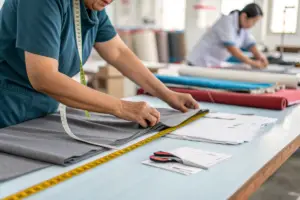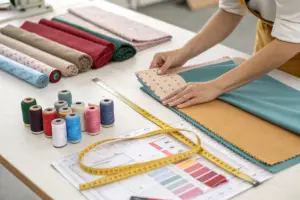
A brand owner from Florida once sent me a WhatsApp message that made my stomach turn. She had wired a 50% deposit, $38,000, to a factory she had found on a B2B platform. The factory had a professional-looking website, a responsive sales representative, and a sample that looked perfect. The price was 18% below the next best quote. The sales rep had pushed for a quick decision, saying the production slots were filling up for the summer season. She paid the deposit. For two weeks, communication was normal. Then the emails started bouncing. The WhatsApp messages showed a single grey check mark, never a double blue. The phone number was disconnected. The factory had vanished. The $38,000 was gone. She later discovered, through a sourcing agent she hired to investigate, that the factory's address belonged to a residential apartment building. The sample she had received was purchased from a legitimate factory and relabeled. She had been targeted by a fraudulent supplier, and she had missed every red flag because she wanted to believe the price.
The red flags of a dishonest summer coat supplier fall into five categories. First, pricing that is significantly below the market range. A summer coat with a market FOB price of $14 to $18 that is quoted at $9 is not a bargain. It is a bait. Second, communication behavior that evades specific questions. An honest supplier answers your questions directly. A dishonest supplier deflects, delays, or changes the subject. Third, unwillingness to provide verifiable business credentials, a physical factory address, a business license, a third-party audit report. Fourth, pressure tactics that demand an immediate deposit or claim that a production slot is about to be taken by another client. Fifth, sample quality that does not match the quoted production capability. A sample that is suspiciously perfect or, conversely, significantly worse than the factory's claimed standards is a red flag. At Shanghai Fumao, we encourage every potential client to verify our credentials, visit our factory in person or via live video walkthrough, and speak with our existing clients before placing an order. An honest factory welcomes scrutiny. A dishonest factory avoids it.
The dishonest supplier problem is not a reason to avoid sourcing from China. It is a reason to approach sourcing with the same due diligence you would apply to any significant business investment. The red flags are visible if you know what to look for. Let me walk through each category in detail so you can protect your brand and your capital.
How Can You Spot A Factory That Is Misrepresenting Its Capabilities?
A factory that misrepresents its capabilities is not necessarily a criminal enterprise. It may be a small workshop pretending to be a mid-sized factory, or a trading company pretending to own a production facility, or a factory that genuinely believes it can produce your order but lacks the actual experience with your product category. The result is the same: the order is delayed, the quality is substandard, or the order is subcontracted to an unknown third party without your knowledge or consent. The capability misrepresentation is the most common form of supplier dishonesty, and it is the hardest to detect without physical verification.
You spot a factory that is misrepresenting its capabilities by triangulating three sources of evidence: the factory's claimed production capacity versus the physical evidence of that capacity, the factory's claimed product specialization versus the diversity of products in its showroom or catalog, and the factory's claimed client list versus the verifiable references you can contact. A factory that claims 300 workers but cannot show you a live video of the production floor with those workers is misrepresenting. A factory that claims to specialize in woven outerwear but shows you a catalog of knits, denim, and home textiles is a generalist trading company, not a specialist factory. A factory that claims major brand clients but cannot provide a single verifiable reference from those brands is lying. At Shanghai Fumao, we address capability concerns by providing a live video walkthrough of our five production lines, by sharing our business license and our third-party audit reports, and by offering references from our long-term clients who have agreed to serve as references.
The capability verification is the most important due diligence step in supplier selection. It should be completed before the first sample is requested, and certainly before any deposit is paid.
The business license is the fundamental identity document of a Chinese company. It is issued by the State Administration for Market Regulation and it contains the company's registered legal name, its unified social credit code, its legal representative, its registered address, its business scope, and its registration date. Every legitimate factory has a business license. The license is a matter of public record. There is no legitimate reason for a factory to withhold it from a potential client.
A factory that refuses to share its business license is hiding its legal identity. The reasons for hiding are never benign. The factory may not have a license at all, which means it is operating illegally and you have no legal recourse if something goes wrong. The factory's license may show a different company name than the one it is using in its marketing materials, which is a sign of a shell company structure designed to evade liability. The factory's license may show a business scope that does not include garment manufacturing, which means the company is not legally permitted to produce your order. The factory may be operating under a license that has been revoked or expired. When a potential client asks us for our business license, we provide it immediately. It is a completely normal request. The verification of Chinese business licenses for international trade is a standard due diligence practice. A factory that refuses is telling you everything you need to know.
How Can A Video Walkthrough Expose A Fake Factory Operation?
The video walkthrough is the most powerful remote verification tool available to an international buyer. It is a live video call, conducted on the buyer's schedule, where the factory representative walks through the production facility showing the buyer exactly what the buyer wants to see. A fake factory cannot stage a convincing video walkthrough for more than a few minutes. The inconsistencies will reveal themselves.
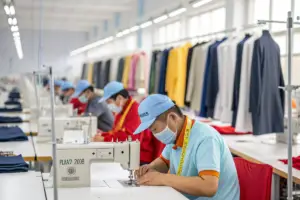
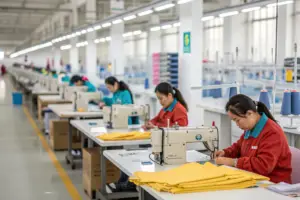
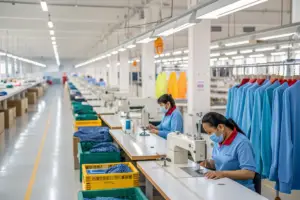
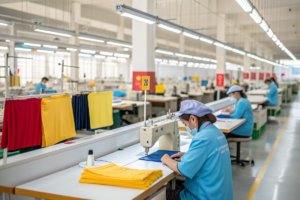
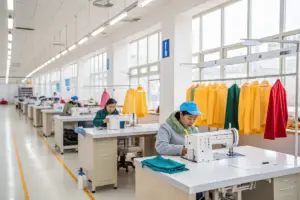
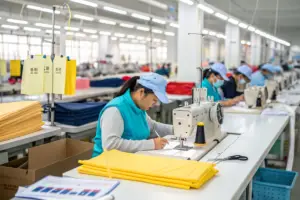
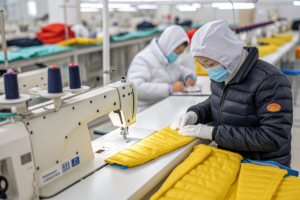
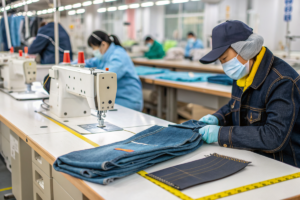
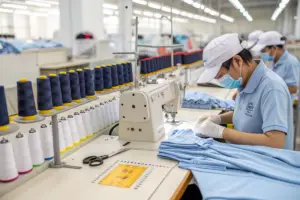
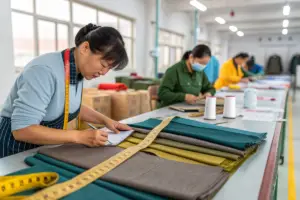
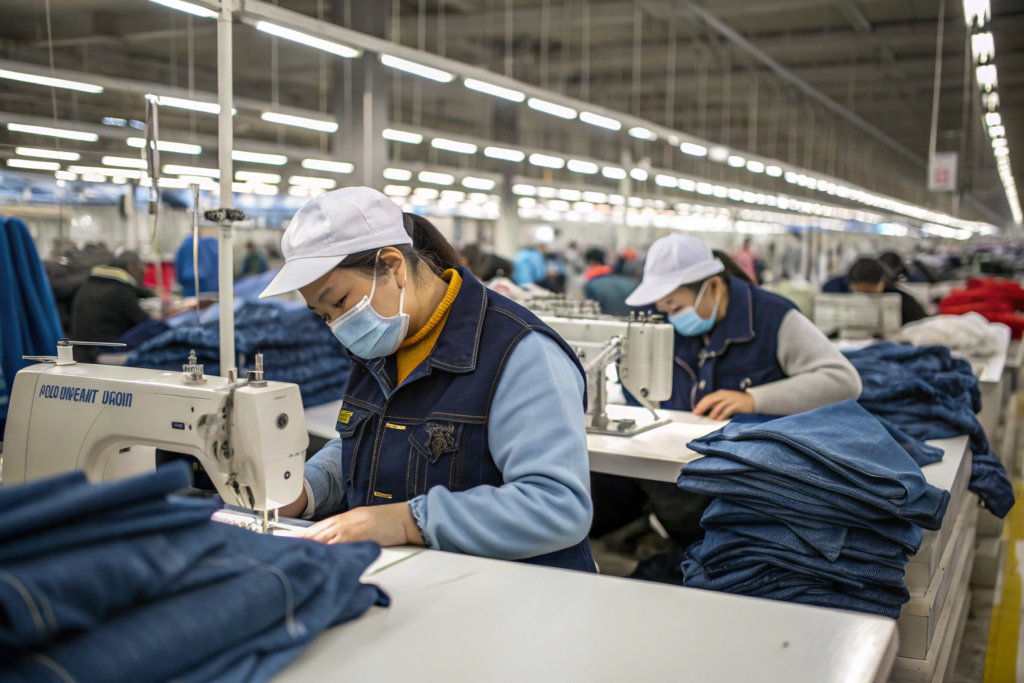
The video walkthrough should be conducted unannounced, or with minimal notice, to prevent the factory from staging the scene. The buyer should control the camera direction. Ask the representative to walk to the back of the production floor. Ask to see the cutting table. Ask to see a specific machine in operation. Ask to pick up a work-in-progress piece and hold it to the camera so you can see the brand labels and the construction quality. A real factory has fabric rolls on the racks, cut pieces in bundles, operators at machines, finished goods on the packing line, and cartons on the loading dock. A fake factory has an empty floor, a few machines that are not running, and a representative who tries to keep the camera pointed away from the empty areas. The virtual factory audit for international sourcing is now a standard practice. The brand that does not conduct a video walkthrough before paying a deposit is relying on trust in a situation that demands verification.
What Pricing Irregularities Signal A Potential Scam Or Bait-And-Switch?
Pricing is the most common entry point for a dishonest supplier. The price is the bait. The brand is searching for a competitive landed cost, and the dishonest supplier offers a price that seems too good to be true. It is. The bait-and-switch works by quoting an unrealistically low price to secure the deposit, then revealing the real price after the brand is financially committed. Or the supplier takes the deposit at the low price and then disappears entirely. Or the supplier produces the order at the low price by substituting cheap fabric, cheap trim, and cheap labor, delivering a product that bears no resemblance to the approved sample.
Pricing irregularities that signal a potential scam include a unit price that is more than 20% below the average of other quotes for the same specification, a price that does not change when you adjust the order quantity, a supplier that refuses to break down the price into its components such as fabric, labor, trim, and overhead, a supplier that demands an unusually high deposit, 70% or more, and a supplier that offers a price that is significantly below the known cost of the raw materials alone. At Shanghai Fumao, we provide our clients with transparent pricing that includes a breakdown of the major cost components. Our prices are competitive but not unrealistic. We are happy to explain our pricing to any client who wants to understand it. A supplier who cannot or will not explain their pricing is a supplier whose pricing cannot be trusted.
The price is the foundation of the commercial relationship. If the price is dishonest, everything else in the relationship will be dishonest. The brand that chases the lowest possible price without questioning its realism is the brand that becomes a victim.

What Is The True Cost Floor For A Quality Summer Coat From China?
The true cost floor is the minimum price at which a summer coat of acceptable quality can be produced by a legitimate factory that pays legal wages, complies with environmental regulations, and uses genuine, specified materials. Any price below this floor is mathematically impossible without some form of dishonesty, labor exploitation, material substitution, tax evasion, or outright fraud.
For a mid-complexity women's summer blazer in a linen-viscose blend at 160 GSM, with standard polyester lining, standard resin buttons, and a standard woven label, produced in a compliant factory in the Yangtze River Delta region, the true cost floor in 2025 is approximately $10.50 to $12.00 FOB for an order of 1,000 to 3,000 units. This floor is composed of approximately $5.50 to $6.50 for the fabric, $3.00 to $4.00 for the labor and overhead, $1.00 to $1.50 for the trims, and $1.00 for the factory's margin. A quote below $10.00 for this specification should be questioned. A quote below $8.00 is almost certainly fraudulent or involves material substitution. These numbers shift with fabric choice, order volume, and factory location, but the floor is real. The garment cost breakdown and pricing analysis is a discipline that every professional buyer should develop. The brand that understands the cost structure of its product can identify an unrealistic price before it becomes a financial loss.
Why Should You Be Suspicious Of A Quote That Doesn't Change With Order Quantity?
Garment manufacturing has significant economies of scale. The cost per unit decreases as the order quantity increases because the fixed costs, the pattern making, the cutting setup, the line setup, the fabric minimum order quantity, are amortized over more units. A factory that quotes the same unit price for 300 units and 3,000 units is either not a real factory, because a real factory's costs change with volume, or is planning to produce your order at the same cost regardless of the quantity you order, which means it is planning to cut corners on the small order or it never intended to produce the small order at all.
A legitimate factory's pricing will show a clear volume discount curve. The unit price at 300 units might be 15% to 20% higher than the unit price at 1,000 units, which is 5% to 10% higher than the unit price at 3,000 units. The discount reflects the spreading of the fixed setup costs, the fabric volume discount from the mill, and the production line efficiency gains from a longer run. A factory that does not offer a volume discount is signaling that it is not actually producing the goods in a factory setting. It may be a trading company that is buying the goods from a factory at a fixed price and reselling them to you, or it may be a fraudulent operator that has no intention of producing anything. The economies of scale in garment manufacturing are a fundamental characteristic of the industry. The brand that encounters a flat pricing curve should ask probing questions and walk away if the answers are not satisfactory.
How Do Communication Patterns Reveal A Supplier's Honesty?
Communication is the window into the supplier's business character. An honest supplier communicates clearly, directly, and consistently. Questions are answered. Problems are disclosed. Timelines are realistic. A dishonest supplier communicates evasively, inconsistently, and defensively. Questions are deflected. Problems are hidden. Timelines are whatever the client wants to hear. The communication pattern over the first few weeks of the relationship is highly predictive of the communication pattern that will prevail during production, when the stakes are higher and the pressure is greater.
Communication patterns that reveal a supplier's honesty include response time consistency, an honest supplier responds within one business day to most inquiries, and if a delay is necessary, the delay is communicated proactively. Answer specificity, an honest supplier provides specific answers to specific questions, while a dishonest supplier provides vague, general answers that avoid committing to a concrete detail. Problem disclosure, an honest supplier informs the client immediately when a problem arises, while a dishonest supplier hides the problem and hopes it resolves itself. Bad news delivery, an honest supplier delivers bad news, a delay, a quality issue, a cost increase, directly and with a proposed solution, while a dishonest supplier avoids delivering bad news until it is unavoidable. At Shanghai Fumao, our client communication is a core part of our service quality. We respond within one business day. We answer questions specifically. We disclose problems immediately. We deliver bad news with a solution already in progress.
The communication test is simple and free. In your first few interactions with a potential supplier, ask specific questions and observe the responses. The supplier's communication behavior is a sample of what you will experience throughout the relationship.

What Specific Questions Should You Ask To Test A Supplier's Transparency?
The transparency test is a set of specific questions designed to probe the supplier's willingness to share information, admit limitations, and provide verifiable details. An honest supplier answers these questions willingly. A dishonest supplier deflects, delays, or becomes defensive.
The ten transparency test questions are as follows. One: "Can you provide your business license and your most recent third-party audit report?" Two: "Can you give me a live video walkthrough of your production floor right now, or at a time of my choosing within the next 24 hours?" Three: "What specific brands have you produced summer coats for in the last twelve months, and can I contact one of them as a reference?" Four: "What is the exact fiber composition and weight of the fabric you are proposing, and can you provide the mill's test report?" Five: "What is your current production capacity utilization? How many lines are running and how many are available for new orders?" Six: "Can you break down the FOB price into fabric, labor, trim, and overhead components?" Seven: "What is your standard defect rate for summer coat production, and what is your process for handling quality complaints?" Eight: "What happens if the shipment is delayed beyond the agreed delivery date? What compensation do you offer?" Nine: "Can I visit the factory in person? If not now, can we schedule a visit for the near future?" Ten: "Is there any reason, any reason at all, why you would not be able to produce this order exactly as specified and deliver it on time?" A supplier that answers all ten questions directly and satisfactorily has passed the transparency test. The supplier qualification questions for international sourcing should include these probing questions.
How Should You Interpret A Supplier Who Is Always "Too Busy" To Provide References?
References are the single most valuable piece of evidence about a supplier's performance. A reference is a real brand that has paid real money to the supplier and received real product. The reference can tell you whether the supplier delivered on time, whether the quality matched the sample, whether the communication was professional, and whether there were any hidden costs. A supplier that is always "too busy" to provide references is hiding something.
The legitimate reasons a supplier might not provide references are narrow. The supplier may be new and may not have completed any orders yet. The supplier may have confidentiality agreements with its clients that prevent sharing their names. Both of these reasons are disclosed honestly and accompanied by alternative forms of verification. The new supplier offers to provide references from its previous employment or from its partner factories. The supplier with confidentiality agreements offers to provide anonymized case studies or to arrange a call with a client who has agreed to serve as a reference confidentially. A supplier that simply says it is too busy, or that references are not necessary, or that its reputation speaks for itself, is a supplier that does not want you to talk to its previous clients. The supplier reference checking for procurement is a non-negotiable step in the sourcing process. A supplier that resists reference checks is disqualified.
What Contract And Deposit Red Flags Should You Never Ignore?
The contract and the deposit are the legal and financial commitments that bind the brand and the supplier. A dishonest supplier uses the contract to create ambiguity that can be exploited later, or avoids a formal contract entirely. The deposit is the brand's leverage. A dishonest supplier structures the deposit to maximize the brand's financial exposure while minimizing its own accountability. The contract and deposit terms are the last red flags before the brand commits its capital. Ignoring them is gambling with the brand's financial survival.
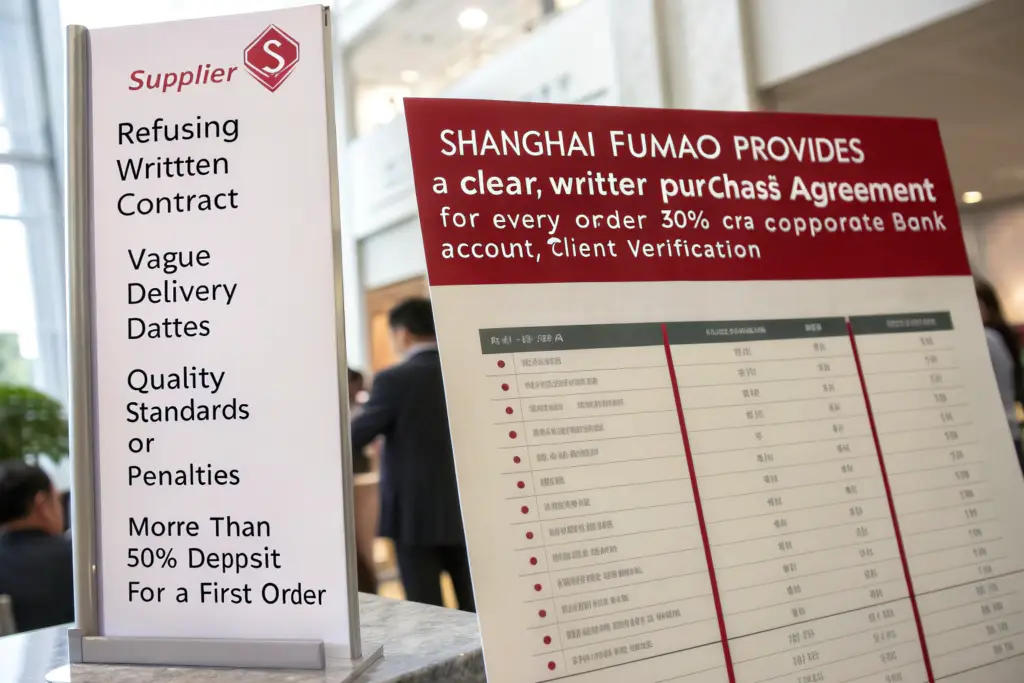
Contract and deposit red flags you should never ignore include a supplier that refuses to provide a written contract or purchase agreement, a contract that is vague about the delivery date, the quality standards, or the penalty for non-performance, a supplier that demands a deposit of more than 50% for a first order, a supplier that requires payment to a personal bank account or to a company with a different name than the supplier's business name, a supplier that refuses to accept a payment method that provides buyer protection, such as a letter of credit or Alibaba Trade Assurance, and a supplier that pressures you to sign the contract or pay the deposit immediately, without giving you time to review and verify. At Shanghai Fumao, we provide a clear, written purchase agreement for every order. Our standard deposit for new clients is 30% to 50%, and the balance is due against the shipping documents. We accept payment to our corporate bank account. We encourage our clients to take the time they need to review the agreement and complete their due diligence.
The contract and deposit stage is the point of maximum risk for the brand. The brand is about to transfer a significant amount of money to a supplier in a different country with a different legal system. The protections in the contract and the payment method are the brand's only defenses if something goes wrong.
Why Is A Vague Delivery Date Clause A Major Warning Sign?
The delivery date is the supplier's primary performance obligation. A supplier that delivers a perfect coat six weeks late has failed to perform. The summer selling window does not extend for late deliveries. A vague delivery date clause, one that says "approximately June" or "within 8 to 12 weeks" or "subject to production schedule," is not a commitment. It is an escape hatch.
A professional supply agreement specifies the delivery date precisely. The date is defined as the date the goods are delivered to the named place, which under DDP is the brand's warehouse, or the ex-factory date under FOB. The date is a calendar date, not a range. The agreement includes a liquidated damages clause that specifies the daily penalty for late delivery. The penalty aligns the supplier's incentives with the brand's need for on-time delivery. A supplier that resists a specific delivery date and a liquidated damages clause is signaling that it does not have confidence in its own ability to deliver on time, or that it does not intend to be held accountable for late delivery. Either interpretation disqualifies the supplier. The delivery date clauses in international supply contracts should be reviewed by the brand's legal counsel or by a sourcing professional with contract experience. The delivery date is not a detail. It is the foundation of the seasonal business model.
How Can Unusual Payment Methods Indicate A Fraudulent Supplier?
The payment method is the trail of the money. An honest supplier wants the money to flow through formal, traceable channels that provide a record of the transaction and protection for both parties. A dishonest supplier wants the money to flow through informal, untraceable channels that make recovery impossible if the supplier disappears.
Payment methods that indicate a fraudulent supplier include requests to wire money to a personal bank account rather than a corporate account. Requests to use Western Union, MoneyGram, or other untraceable money transfer services. Requests to pay into a bank account in a different country than the supplier's location, which makes legal recourse nearly impossible. Requests to split the payment across multiple accounts. Refusal to accept payment methods that provide buyer protection, such as a letter of credit, which guarantees payment only upon presentation of compliant shipping documents, or Alibaba Trade Assurance, which holds the payment in escrow until the goods are delivered. An honest supplier may have a preference for a specific payment method, but it will not refuse all methods that protect the buyer. The safe payment methods for international sourcing are well established. The brand should never agree to a payment method that eliminates its ability to recover the funds if the supplier does not perform.
Conclusion
The red flags of a dishonest summer coat supplier are visible to the brand that is looking for them. The price that is too low, the communication that is too vague, the credentials that cannot be verified, the contract that is too loose, and the deposit that is too large and payable through an untraceable channel. Each red flag individually is a warning. Multiple red flags together are a clear instruction to walk away, regardless of how attractive the price or how urgent the production timeline.
The honest supplier, by contrast, is transparent, specific, and patient. The honest supplier shares its business license and its audit reports. It welcomes a video walkthrough and a factory visit. It provides references from real clients. It quotes a realistic price and explains the cost breakdown. It signs a clear contract with specific delivery dates and fair payment terms. It does not pressure the brand to make a quick decision. It wants the brand to do its due diligence because an informed, confident client is a better long-term partner than a rushed, suspicious one.
At Shanghai Fumao, we hold ourselves to the standard of the honest supplier. We provide our credentials. We welcome scrutiny. We communicate specifically and respond promptly. We sign clear agreements. We accept standard payment methods. We do this not because we are exceptionally virtuous, but because it is the only way to build a sustainable business in the garment industry. The brand that sources from honest suppliers sleeps better at night and builds a more resilient business.
If you are evaluating potential suppliers for your summer coat production and you want to work with a factory that welcomes your due diligence rather than resisting it, contact our Business Director, Elaine, at elaine@fumaoclothing.com. Ask her for our business license, our audit reports, and a live video walkthrough of our production floor. Ask her the ten transparency questions. She will answer every one of them. Because a supplier that has nothing to hide hides nothing.