A brand owner I worked with a few years ago had a pricing problem that nearly killed her business. She was sourcing a beautiful crinkle-nylon anorak from us at Shanghai Fumao. Her landed cost was $17.20 per unit. She looked at the coat, compared it to similar styles in department stores priced at $89 to $109, and decided to price hers at $79 to "undercut the competition and drive volume." She sold 2,800 units in her first season. Her revenue was $221,200. Her gross profit, after the landed cost, was $173,040. But after the selling costs, the marketing spend, the returns, the chargebacks, and her own salary, her net profit was $8,400. She had built a $220,000 business that paid her less than minimum wage. The problem was not the product. The problem was not the market. The problem was the markup. She had left $30 to $40 per unit on the table because she was afraid to charge what the coat was worth.
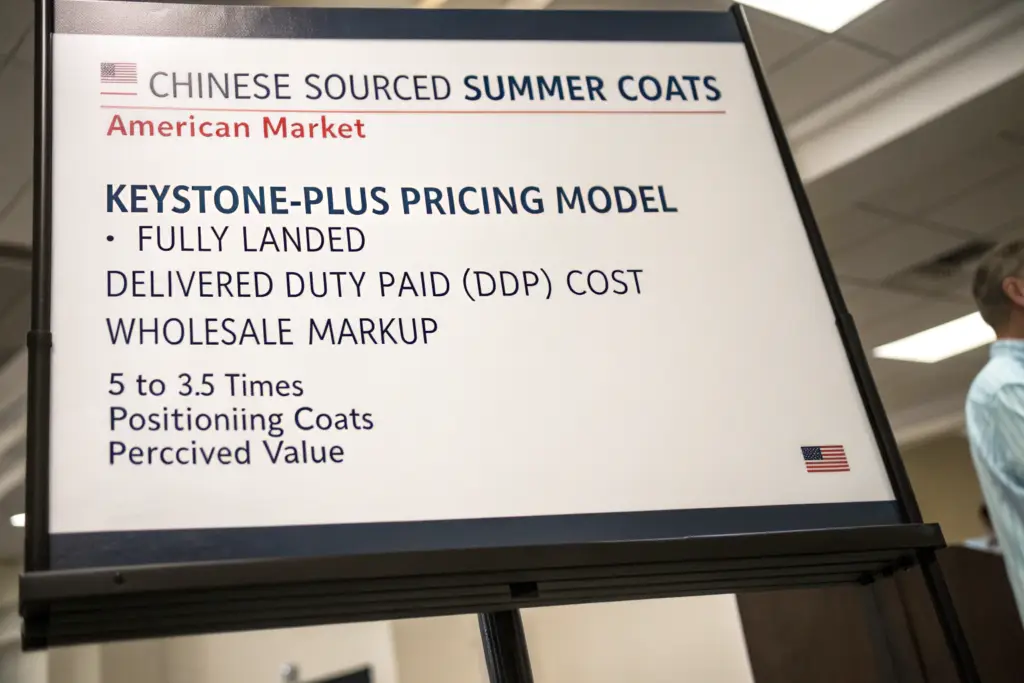
You mark up Chinese-sourced summer coats for the American market using a keystone-plus pricing model that starts with the fully landed DDP cost and applies a wholesale markup of 2.5 to 3.5 times and a direct-to-consumer markup of 5 to 7 times, depending on the brand's positioning, the coat's perceived value, and the competitive landscape. A coat with a landed cost of $18 should wholesale at $45 to $63 and retail at $90 to $126. The markup is not an arbitrary number. It is calculated to cover the selling costs, the marketing costs, the overhead, and the profit margin, while positioning the coat at a price that communicates quality to the American consumer. At Shanghai Fumao, we help our clients determine the right markup by providing a transparent landed cost and by sharing market intelligence on the retail pricing of comparable coats in the US market.
The markup is the most important financial decision a brand owner makes. It determines the revenue, the margin, the brand positioning, and the long-term viability of the business. A coat priced too low generates volume but no profit. A coat priced too high generates margin but no sales. The optimal price is the highest price the target customer will pay with conviction, not hesitation. Let me walk through the exact markup formulas, the competitive pricing analysis, the brand positioning that justifies the price, and the psychological pricing tactics that turn a browser into a buyer.
What Is The Standard Markup Formula For Wholesale And Retail Pricing?
The markup formula is the mathematical bridge between the landed cost and the selling price. The formula is not a secret. It is a standard practice in the apparel industry, used by every brand from luxury houses to mass-market retailers. The specific multiplier varies by market segment, but the structure is consistent. The landed cost is multiplied by the wholesale markup factor to determine the wholesale price. The wholesale price is multiplied by the retail markup factor, or the landed cost is multiplied by the direct-to-consumer markup factor, to determine the retail price.
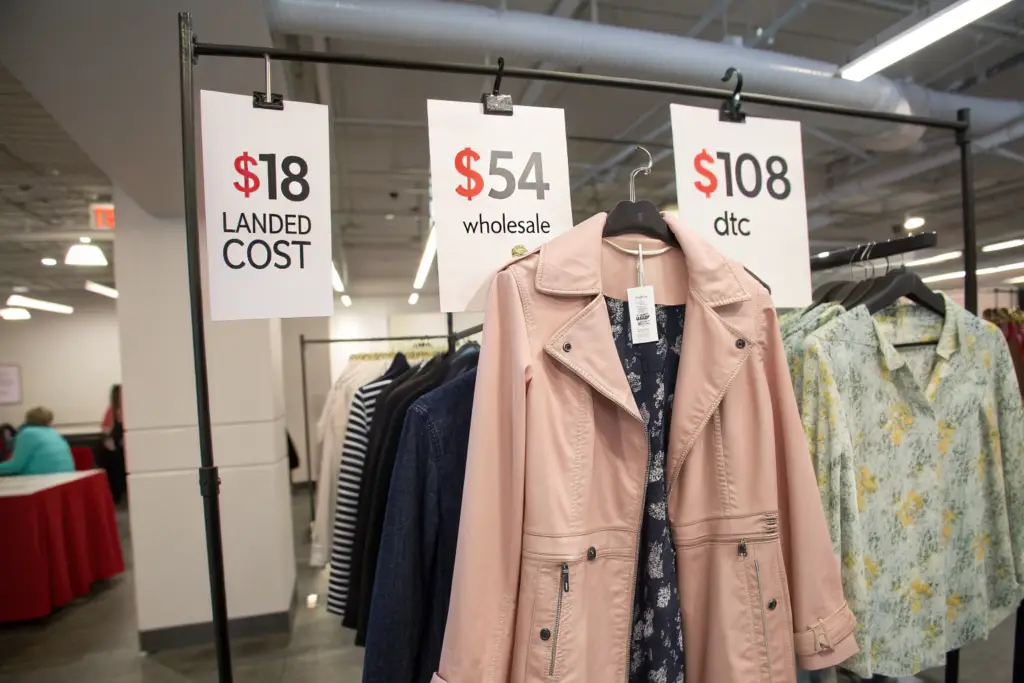
The standard markup formula for women's summer outerwear in the US market is as follows. The wholesale price is calculated as the landed cost multiplied by a factor of 2.5 to 3.5. A coat with an $18 landed cost, at a 3.0 wholesale markup, has a wholesale price of $54. The wholesale markup covers the brand's operating costs, the sales rep commission, the marketing to wholesale accounts, the samples, the trade show expenses, and the brand's profit on the wholesale transaction. The direct-to-consumer retail price is calculated as the landed cost multiplied by a factor of 5 to 7, or as the wholesale price multiplied by 2.0 to 2.5. The same $18 coat, at a 6.0 DTC markup, has a retail price of $108. The DTC markup covers all the wholesale costs plus the e-commerce platform fees, the payment processing, the shipping to the customer, the packaging, the returns processing, the digital marketing cost to acquire the customer, and the brand's profit on the DTC transaction. The higher DTC markup reflects the higher selling costs of the direct channel.
The markup factor is not a fixed number. It is a range that the brand adjusts based on the competitive landscape, the brand's stage of growth, and the coat's unique value proposition. A coat with a proprietary fabric, a distinctive design, and a strong brand story commands a higher markup factor than a coat that is visually similar to generic alternatives.
How Do You Determine Whether To Use A 2.5x, 3.0x, Or 3.5x Wholesale Markup?
The wholesale markup factor is determined by three variables. The brand's positioning in the market, the brand's operating cost structure, and the competitive wholesale pricing for comparable coats. A brand that is positioned as a premium or contemporary label, with a strong brand identity and a clear point of differentiation, can use a 3.0 to 3.5 times markup. A brand that is positioned as an accessible or value-driven label, competing primarily on price, uses a 2.5 to 2.8 times markup. The difference is the brand equity premium.
The brand's operating cost structure also drives the markup factor. A brand that sells primarily through independent sales reps, paying a 10% to 15% commission, needs a higher markup to cover that cost than a brand that sells directly to boutiques through its own founder-led outreach. A brand that exhibits at trade shows, spending $5,000 to $15,000 per show, needs to amortize that cost across the wholesale volume, which requires a higher margin per unit. A brand that operates lean, selling through a digital wholesale platform and a tight network of repeat accounts, can afford a slightly lower markup. The competitive wholesale pricing establishes the ceiling. The brand must research the wholesale prices of coats with similar fabric, similar construction, and similar design complexity from brands with similar positioning. If the competitive wholesale price range is $48 to $58, the brand's $18 landed cost coat, at a 3.0 markup, is priced at $54, which is squarely in the competitive range. At a 2.5 markup, the price is $45, leaving money on the table. At a 3.5 markup, the price is $63, exceeding the competitive range and potentially reducing the wholesale account's willingness to buy. The wholesale pricing strategy for apparel brands is a balance between margin capture and competitive positioning.
What Is The Difference Between Keystone Markup And Cost-Plus Pricing?
Keystone markup is a pricing method where the retail price is exactly double the wholesale price or the landed cost. The term "keystone" comes from the historical practice of doubling the cost to arrive at the selling price. A coat with a $50 wholesale price, under keystone markup, retails for $100. A coat with a $20 landed cost, under a direct keystone, retails for $40. Keystone is simple and easy to calculate. It was the standard in brick-and-mortar retail for decades. It is also, for most modern apparel brands, insufficient to cover the selling costs of the direct-to-consumer channel.
Cost-plus pricing is a method where the brand calculates the total cost of producing and delivering the coat, including the landed cost and all the selling costs, and adds a fixed profit percentage on top. If the landed cost is $18 and the selling costs per unit, including marketing, platform fees, shipping, and returns, average $22, the total cost is $40. A 25% cost-plus margin adds $10, for a retail price of $50. The cost-plus method ensures the brand covers its costs and earns a specific profit, but it does not account for the perceived value of the coat in the market. The brand may be able to charge $90 for the same coat because the market perceives the value at $90. Cost-plus pricing leaves that value on the table. The most effective pricing strategy for private label summer coats combines cost-plus for the floor price, the minimum price the brand can charge and still be profitable, and value-based pricing for the ceiling, the maximum price the customer will pay based on the coat's perceived value. The keystone vs cost-plus pricing in retail is not a binary choice. The smart brand uses keystone as a benchmark and adjusts upward based on brand equity and perceived value.
How Should You Research The Competitive Pricing Landscape For Summer Coats?
Competitive pricing research is the process of identifying the retail prices of coats that compete with your product for the same customer. The research is not about copying a competitor's price. It is about understanding the price range that defines your market segment and positioning your coat within that range based on your specific value proposition. A coat priced below the market range signals low quality. A coat priced above the market range signals luxury, but only if the brand, the fabric, and the design support that positioning.
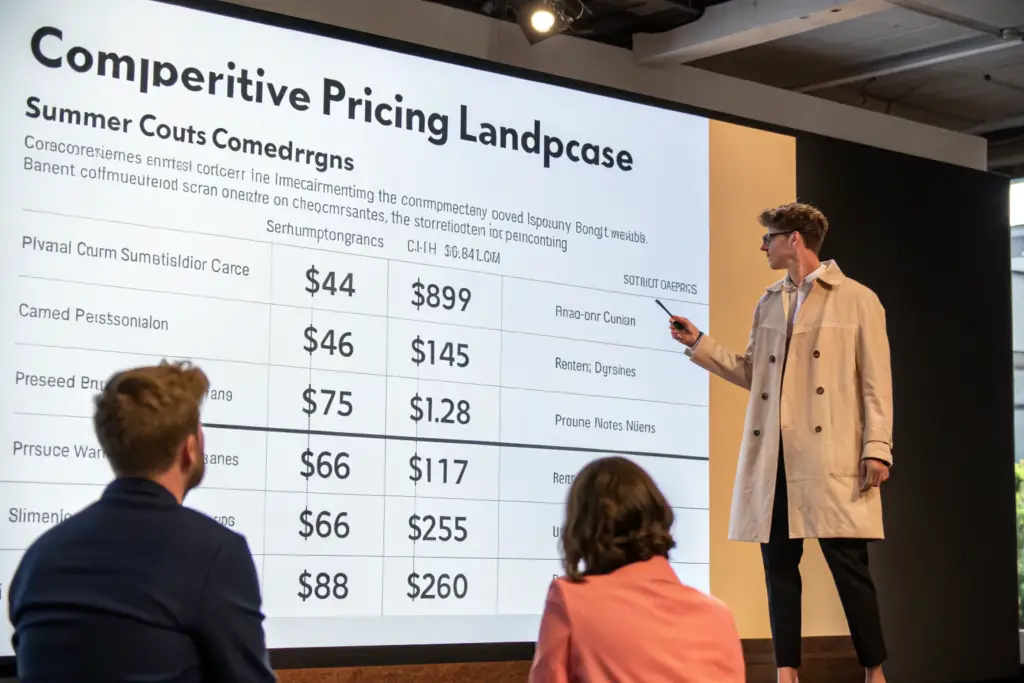
You research the competitive pricing landscape for summer coats by identifying five to ten direct competitors, brands that sell to the same target customer in the same distribution channels, and recording their retail prices for summer coats that are comparable to yours in fabric, construction, and design complexity. You then segment the competitors into three tiers: the value tier, the premium tier, and the luxury tier. The value tier for summer coats is $39 to $69. The premium tier is $78 to $148. The luxury tier is $168 and above. Your private label coat, with a landed cost of $15 to $22, has the product quality to compete in the premium tier, provided the branding, the photography, and the brand story support that positioning. At Shanghai Fumao, we provide our clients with competitive pricing intelligence based on our knowledge of the US market and the retail prices our other brand clients are achieving.
The competitive pricing research should be updated every season. The market shifts. New competitors enter. Established brands adjust their pricing. A brand that relies on a competitive analysis from two years ago is pricing against a market that no longer exists.
What Are The Typical Retail Price Tiers For Women's Summer Outerwear In The US?
The US women's summer outerwear market is segmented into clear price tiers that correspond to brand positioning, distribution channel, and customer expectation. A brand must decide which tier it is competing in and price consistently within that tier. A brand that prices one coat at $58 and another at $148 confuses the customer and dilutes the brand's identity.
The value tier, $39 to $69, is dominated by mass-market retailers, fast-fashion brands, and off-price channels. The coats in this tier are typically made from synthetic fabrics, with basic construction, minimal design detail, and generic branding. The customer in this tier is price-sensitive and shops primarily on price and convenience. The contemporary tier, $78 to $148, is where most private label brands compete. The coats in this tier use better fabrics, linen blends, Tencel, cotton-linen, have more considered design details, and carry a brand identity that resonates with the customer. The customer in this tier is value-conscious but willing to pay more for quality, fit, and brand alignment. The premium tier, $168 to $298, includes established contemporary brands and the entry-level of designer brands. The coats use premium fabrics, have distinctive design signatures, and the brand carries significant awareness and credibility. The luxury tier, $350 and above, is the domain of designer labels with global brand recognition. The apparel retail price segmentation strategy is a fundamental marketing decision. The brand that positions itself in the contemporary tier must deliver the product quality, the brand experience, and the marketing presence that the contemporary customer expects.
How Do You Position A Private Label Coat Against Established Brand Competitors?
The established brand has advantages that the private label brand does not. Brand awareness, retail distribution, customer reviews, and a track record of consistent quality. The private label brand cannot compete with the established brand on brand equity. It must compete on a different dimension: product specificity, founder story, or value proposition.
The private label coat can be positioned as a specialist alternative to the generalist established brand. The established brand sells a generic "linen blazer." The private label brand sells a "travel-tailored linen blazer with hidden zip pockets, designed by a former flight attendant who spent a decade searching for the perfect wrinkle-free layering piece." The specificity creates a perception of expertise and intentionality that the generalist brand cannot match. The private label coat can also be positioned on a value proposition that is tangible and specific. The established brand's coat is $148 and the fabric pills after five washes. The private label coat is $118 and the brand guarantees the fabric will not pill for one year, or the customer gets a free replacement. The guarantee is a credible signal of quality that the established brand, with its mass-market supply chain, cannot offer. The private label brand can also compete on the founder's story and the brand's values. The customer who buys a $128 coat from a founder-led brand that donates one percent of revenue to ocean conservation feels a different emotional connection than the customer who buys a $128 coat from a faceless corporation. The brand positioning strategies for emerging fashion labels leverage the private label's advantages of agility, specificity, and authenticity against the established brand's advantages of scale and awareness.
What Psychological Pricing Tactics Work Best For Summer Outerwear?
Psychological pricing is the practice of setting prices that influence the customer's perception of value and their willingness to purchase. The customer does not evaluate a price rationally. She evaluates it emotionally, comparing the price to a reference point in her mind, responding to the visual presentation of the number, and assessing whether the price feels "fair" given the product and the brand. The psychological pricing tactics that work for summer outerwear are the tactics that make the price feel like a good value without making the coat feel cheap.
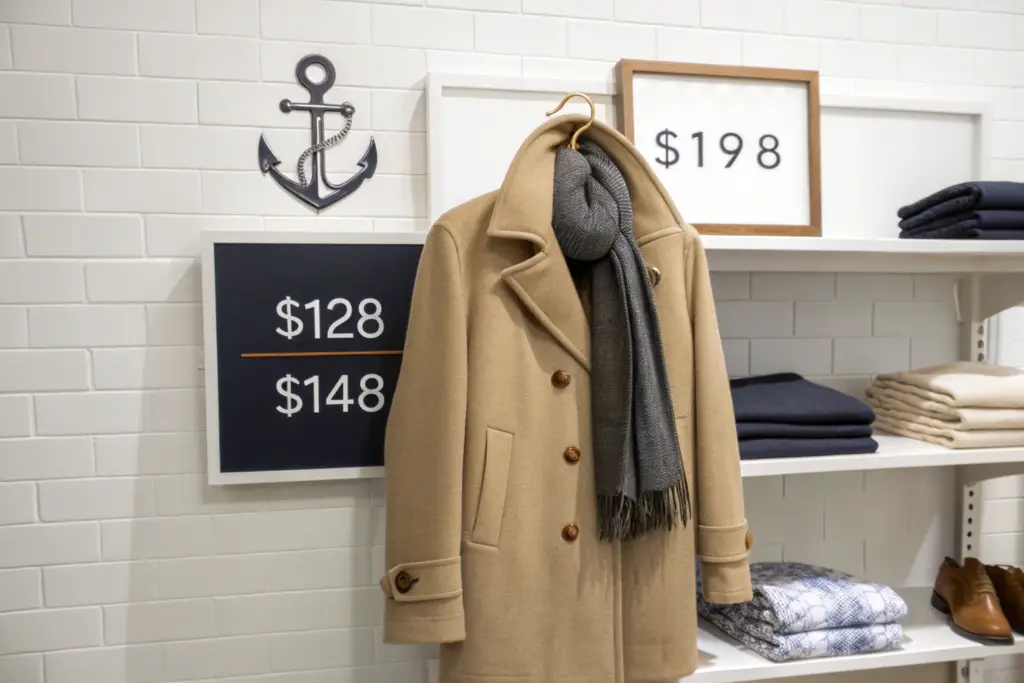
The psychological pricing tactics that work best for summer outerwear are charm pricing, where the price ends in a 5, 8, or 9, such as $98 or $128, rather than a round number. Anchor pricing, where the brand displays a higher "original" or "comparable value" price next to the actual selling price, creating a perception of savings. Tiered pricing, where the brand offers the coat in two fabric options, a standard at $98 and a premium at $148, making the $98 coat feel like a value. Bundle pricing, where the brand offers a discount for purchasing the coat with a matching piece, increasing the average order value. And free shipping thresholds, where the brand sets the free shipping minimum just above the coat's price, encouraging the customer to add a small accessory to qualify. At Shanghai Fumao, we produce the product quality that supports these pricing tactics. A coat that is priced at $128 must look and feel like a $128 coat when the customer opens the package.
The psychological pricing tactic must be supported by the product quality and the brand presentation. A coat priced at $98 with charm pricing will fail if the fabric feels like a $39 coat. The price sets the expectation. The product must deliver on the expectation.
Why Does "Charm Pricing" With A 5 Or 8 Ending Outperform Round Number Pricing?
Charm pricing, the practice of ending a price in a 5, 8, or 9 rather than a 0, is one of the most robust findings in consumer psychology. A coat priced at $98 sells more units than the same coat priced at $100, even though the difference is only $2. The reason is not that the customer is fooled into thinking $98 is significantly cheaper than $100. The reason is that the $98 price signals a different type of transaction. The $100 price is a round number that feels like a luxury or premium price, a price that was set arbitrarily. The $98 price is a specific number that feels calculated, as if the brand carefully determined the exact value of the coat and priced it accordingly.
The 8 ending has a specific effect in the US market that is different from the 9 ending. A price ending in 9, such as $99, has become associated with discounting and mass-market retail. The customer sees $99 and thinks "cheap." A price ending in 8, such as $98 or $128, is perceived as more premium and more considered. It is the price ending preferred by contemporary and premium brands. The 5 ending, such as $95 or $125, is perceived as straightforward and honest, a price that was not manipulated. The choice between 8 and 5 depends on the brand's personality. An 8 ending is slightly more premium. A 5 ending is slightly more approachable. The charm pricing in fashion retail research is extensive. The effect is real, it is measurable, and it costs the brand nothing to implement. A private label brand that prices its coats with a considered ending projects a more professional image than a brand that uses round numbers.
How Can You Use Tiered Pricing To Increase Your Average Order Value?
Tiered pricing offers the customer multiple versions of the same product at different price points. The classic example is the standard coat and the premium coat. The standard coat is the base model, made from a good-quality fabric with standard trims. The premium coat is made from a superior fabric, such as an organic linen or a Japanese cupro, with upgraded trims like a YKK Excella zipper or genuine horn buttons. The standard coat is priced at $98. The premium coat is priced at $148.
The tiered pricing structure serves two purposes. It captures the customers who are willing to pay more for a superior product, increasing the revenue and the margin on those units. The premium coat might have a landed cost that is only $6 higher than the standard coat, but it commands a $50 higher retail price. The incremental margin on the premium units is substantial. The tiered structure also makes the standard coat feel like a value. The customer who sees the $148 coat and then sees the $98 coat perceives the $98 coat as a bargain, even though $98 is the intended price point. The premium coat serves as an anchor that makes the standard coat more attractive. The tiered pricing can also be applied at the collection level, with a hero piece priced higher and a supporting piece priced lower. The $148 trench coat anchors the collection and makes the $78 matching shell top feel accessible. The tiered pricing strategies for e-commerce are a standard revenue optimization technique. The key is that the tier difference must be based on a real, perceivable difference in the product, not an arbitrary label.
How Do You Communicate The Value Of A Higher Markup To Wholesale Buyers?
The wholesale buyer is a professional evaluator of value. They see hundreds of coats every season. They know the market prices. They know the margins they need to achieve. When a private label brand presents a coat at a $54 wholesale price, the buyer's immediate question is, "Why should I pay $54 for your coat when I can buy a similar-looking coat from an established brand for $48?" The brand must have a clear, compelling answer to that question. The answer is the brand's value communication.
You communicate the value of a higher wholesale markup by quantifying the sell-through advantage that your coat offers the retailer. The buyer's metric is not the wholesale price. It is the gross margin dollars per square foot of floor space. A $54 coat that sells through at 85% generates more profit for the retailer than a $48 coat that sells through at 60%. The factors that drive higher sell-through are the product's differentiation, the fabric quality that the customer can feel, the fit that flatters a wider range of body types, the brand story that the sales associate can tell, and the marketing support that the brand provides to drive customers into the store. At Shanghai Fumao, we support our clients' wholesale value communication by providing the fabric quality, the construction detail, and the labeling compliance that allow the brand to confidently claim a premium position.
The wholesale value communication must be delivered in the line sheet, the sales meeting, and the follow-up email. The brand must show the buyer the coat, let them feel the fabric, explain the design features, and present the sell-through data from previous seasons or from test sales. A brand that can show a 90% sell-through rate on a similar style from last season has a much stronger negotiating position than a brand that is launching its first collection.
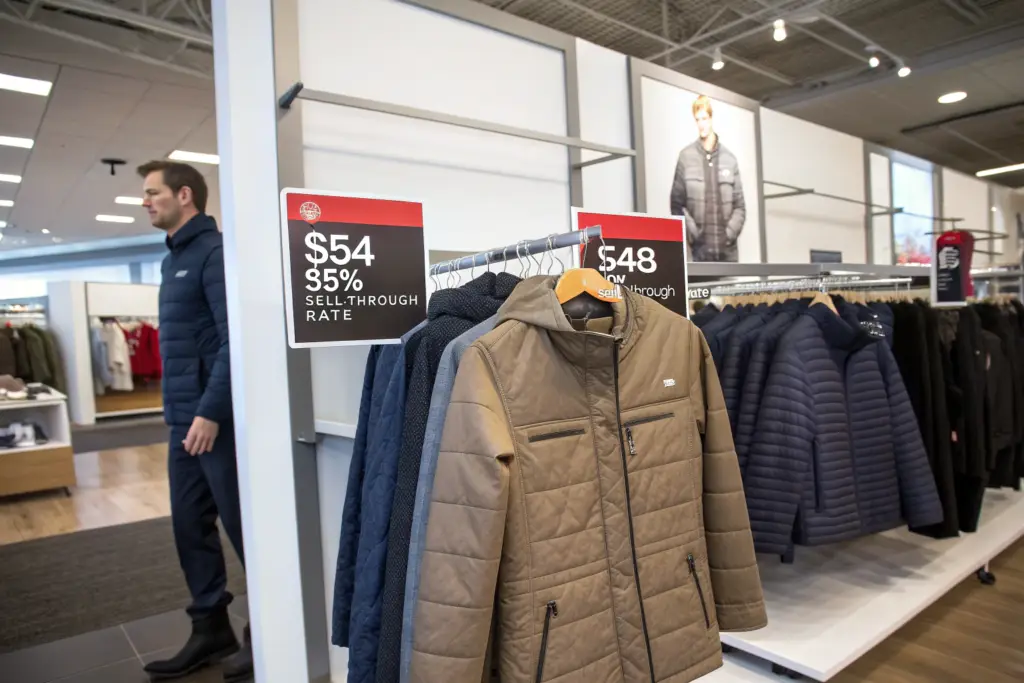
Sell-through is the percentage of the ordered units that the retailer sells at full price during the planned selling period. A coat that sells 80 out of 100 units at full price has an 80% sell-through. The sell-through is the single most important number for the wholesale buyer because it determines the buyer's return on investment. A buyer who buys 100 coats at $54 and sells 80 at $110 generates $8,800 in revenue and $4,480 in gross margin. A buyer who buys 100 coats at $48 and sells 50 at $100 generates $5,000 in revenue and $2,600 in gross margin. The higher-priced coat with the higher sell-through is the better financial decision for the retailer.
The brand should share its sell-through data from previous seasons, broken down by style, color, and size. The data should include the number of units sold to the retailer, the number of units sold through to the end customer, the sell-through percentage, and the average weeks to sell-through. If the brand is new and does not have wholesale sell-through data, it can share DTC sell-through data, which is a proxy, or it can share sell-through data from a test run at a friendly boutique. The brand can also share the return rate, which is the inverse of sell-through. A coat with a 3% return rate is a coat that customers are keeping, which is a strong signal of product satisfaction. The wholesale sell-through metrics for fashion brands are the language of the wholesale buyer. The brand that speaks this language fluently earns the buyer's trust and the buyer's order.
How Can A Professional Line Sheet Justify Your Wholesale Markup?
The line sheet is the brand's wholesale sales document. It is a multi-page PDF or a digital catalog that presents the collection to the wholesale buyer. A professional line sheet communicates the brand's positioning, the product's features, and the commercial terms in a format that the buyer can quickly evaluate. A sloppy line sheet, with low-resolution images, missing information, and pricing that does not add up, signals an amateur brand and justifies a low wholesale price. A professional line sheet signals a brand that understands the wholesale business and justifies a premium wholesale price.
A professional line sheet for a summer coat collection includes a cover page with the brand logo, the season, and a hero image of the collection. A brand story page that explains the brand's mission, its point of differentiation, and why the customer chooses this brand. A product detail page for each style with a high-resolution front and back image on a model, a flat lay image, a fabric close-up image, the style name, the style number, the available colors with swatch images, the size range, the fabric composition, the key design features in bullet points, the wholesale price, the suggested retail price, and the wholesale margin percentage for the retailer. An ordering information page with the order deadlines, the delivery windows, the payment terms, the minimum order quantity, and the contact information. The line sheet should be designed by a professional graphic designer. The investment in the line sheet design directly impacts the buyer's perception of the brand and the willingness to accept the wholesale markup. The wholesale line sheet creation for fashion brands is a critical sales tool. The brand that invests in a professional line sheet earns a return in higher wholesale prices and larger orders.
Conclusion
Marking up Chinese-sourced summer coats for the American market is a strategic pricing exercise, not a simple multiplication. The markup is the engine of the brand's profitability. It must be set high enough to cover the selling costs, the marketing costs, and the overhead, and to generate a profit that sustains and grows the business. It must be set low enough to be competitive within the brand's target market tier and to deliver value to the wholesale buyer and the end customer. The optimal markup balances these forces.
The markup formula is a tool, not a rule. The 2.5 to 3.5 times wholesale markup and the 5 to 7 times DTC markup are the starting point. The brand adjusts the multiplier based on the competitive landscape, the brand's positioning, the coat's unique value proposition, and the brand's operating cost structure. The brand that prices with confidence, backed by a product that delivers on the price's promise, earns a premium margin. The brand that prices with fear, underpricing the coat to avoid rejection, earns a commodity margin that cannot sustain a business.
At Shanghai Fumao, we produce the coats that support a premium markup. Our fabric quality, our construction standards, and our labeling compliance enable our clients to position their brands in the contemporary and premium tiers of the US market. Our DDP pricing provides the transparent landed cost that is the foundation of an accurate markup calculation. We are not just the factory. We are the cost partner that helps our clients build profitable pricing models.
If you are developing a summer coat collection and you want to establish a pricing strategy that captures the full value of your product, contact our Business Director, Elaine, at elaine@fumaoclothing.com. Send her your target retail price range and your target customer profile. She will provide a DDP costing for your styles and a markup analysis that shows you exactly how your pricing compares to the competitive landscape. Because the price you set today determines the profit you earn tomorrow, and the profit you earn determines the brand you build for the long term.