A brand owner I mentored called me last month, completely deflated. He had imported 3,000 pairs of classic chino shorts from a factory in Vietnam, rebranded them with his label, and sold through his Shopify store and two wholesale accounts. His revenue for the season was $142,000. He thought he had made a killing. Then his accountant sent him the final profit and loss statement. His net profit was $8,400. He had spent months designing, sourcing, importing, marketing, and shipping. He had taken on inventory risk, cash flow stress, and the anxiety of a container crossing the ocean. His reward was a net margin of 5.9%. He asked me where his money had gone. I asked him to send me every invoice from the season. We found his profit buried in a dozen small costs he had never budgeted for.
The true profit margin on imported, rebranded classic shorts typically ranges from 18% to 35% net after all costs, but only if the landed cost is accurately calculated, the duty and logistics line items are fully accounted for, and the rebranding and fulfillment costs are built into the pricing model from the start.
Importing and rebranding classic shorts is a legitimate, profitable business model. It is the backbone of hundreds of successful DTC and wholesale apparel brands. But the margin between "I sold the shorts" and "I made money" is filled with silent cost items that do not appear on the factory invoice. At Shanghai Fumao, we manufacture classic shorts for brands operating this exact model. I have seen the full financial picture from factory floor to customer doorstep. Let me pull back the curtain on the true economics so you can price for actual profit, not theoretical margin.
What Are the Real Cost Components Beyond the Factory FOB Price?
The factory FOB price is the number most new brand owners fixate on. The factory quotes $7.50 per pair of classic shorts. The brand owner multiplies by 3,000 units. She budgets $22,500. She thinks her cost is $7.50 per unit. She is wrong. The FOB price is the cost of the shorts sitting on the dock in Shanghai. It is not the cost of the shorts sitting in her warehouse in Los Angeles, rebranded, tagged, and ready to ship to a customer. The gap between those two numbers is where margins die.
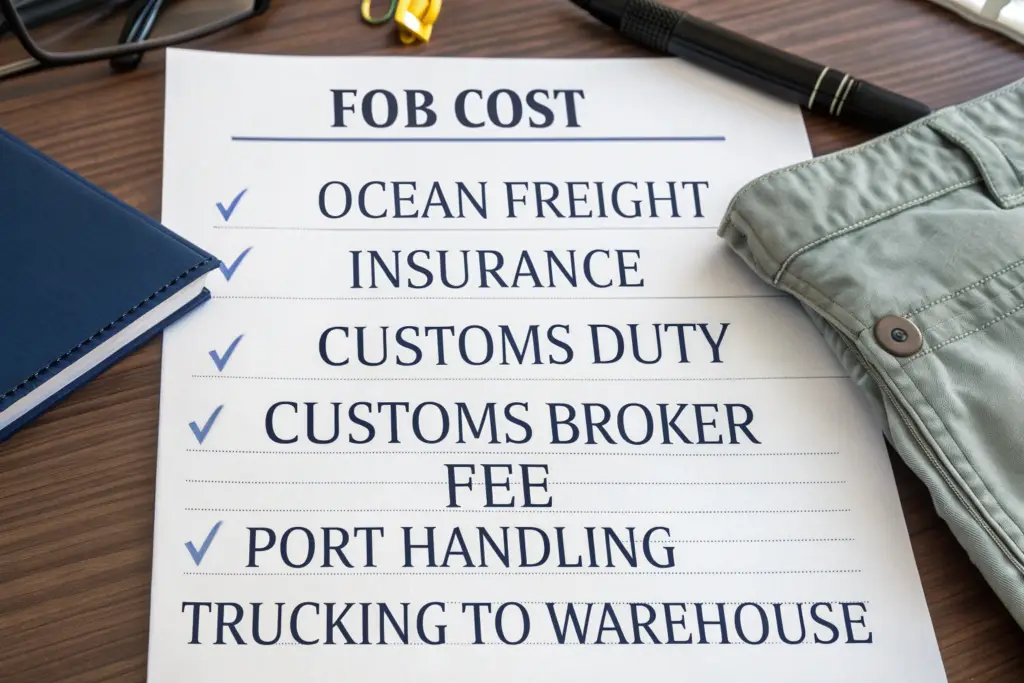
The true landed cost per unit includes ocean freight, marine insurance, US customs duty, customs brokerage fees, port handling charges, and inland trucking to the warehouse, which together typically add $1.80 to $3.50 per unit to the FOB price for a standard classic shorts order.
I worked with a brand that had budgeted $1.00 per unit for freight and logistics on top of their $8.00 FOB. Their actual logistics cost came in at $2.85 per unit. The difference was a series of charges they had never heard of: a Pier Pass fee at the port, a chassis rental fee for the truck, a customs exam fee because their container was randomly selected for inspection, and a fuel surcharge that had doubled since their forwarder's initial quote. The $1.85 per unit gap multiplied by 3,000 units was $5,550 in unplanned costs. Their budgeted margin was gone before a single short was sold. The fully-loaded landed cost calculation must be built line-by-line, with a contingency buffer, before the FOB price is even negotiated.
| Cost Component | Estimated Range Per Unit (Classic Shorts) | Notes |
|---|---|---|
| FOB Factory Price | $6.50 - $10.00 | Varies by fabric, order volume, trims |
| Ocean Freight | $0.60 - $1.20 | Depends on container utilization and route |
| Marine Insurance | $0.03 - $0.08 | Typically 0.3-0.5% of CIF value |
| US Customs Duty (6203.42) | 12% of CIF value | Paid on Cost + Insurance + Freight |
| Customs Brokerage Fee | $0.05 - $0.15 | Per-unit estimate on a 3,000-unit order |
| Port Handling & THC | $0.15 - $0.35 | Terminal handling, documentation fees |
| Inland Trucking to Warehouse | $0.30 - $0.80 | Varies by distance from port |
| Total Logistics Add-On | $1.80 - $3.50 | Added to FOB to reach Landed Cost |
How Does the Customs Duty Calculation Work and Why Is It Often Miscalculated?
The US customs duty on classic cotton shorts under HTS code 6203.42 is 12%. But this 12% is not applied to the FOB price. It is applied to the CIF value: Cost of goods plus Insurance plus Freight. A short with an FOB of $8.00, freight of $1.00, and insurance of $0.05 has a CIF value of $9.05. The duty is 12% of $9.05, which is $1.09. If the brand mistakenly calculated 12% of the $8.00 FOB, they budgeted $0.96. The $0.13 difference per unit, across 3,000 units, is a $390 budget error. Small math errors compound across an order. Additionally, if the fabric content is misclassified—if the shorts have a polyester pocket lining that changes the fiber composition—the duty rate could jump to a different HTS code with a higher rate. The correct HTS classification must be verified with a customs broker before the shipment leaves the factory. Official HTS resources are available from the U.S. International Trade Commission.
What Are the Hidden Destination Fees That Forwarders Do Not Include in Initial Quotes?
A freight forwarder's initial quote is often a base ocean freight rate plus a few standard surcharges. The final invoice includes many additional line items. Pier Pass is a fee for moving containers through the port terminal during peak hours. A chassis fee is the cost of renting the trailer chassis that carries the container on the truck. A customs exam fee, if the container is flagged for inspection, can range from $200 for an X-ray scan to $2,000 for a full physical examination. Demurrage is charged if the container sits at the port beyond the free time, typically three to five days. Detention is charged if the container is kept at the warehouse beyond the free time for returning the empty box. These fees are unpredictable per shipment but predictable over a year of importing. A budget that does not include a buffer for these fees is a budget that will be overspent. Industry guidance on logistics budgeting is available from freight platforms like Freightos.
What Is the Real Cost of Rebranding and Preparing Shorts for Sale?
The shorts arrive at your warehouse. They are in a generic polybag with the factory's size sticker. They have no brand identity. Turning them into your brand's product requires physical labor and materials. A new hangtag must be attached. A branded size label may need to be sewn or heat-sealed over the factory label. The shorts must be re-bagged in your branded polybag. A thank-you card or a brand story insert must be added. Each of these steps costs money in materials and warehouse labor time. The cost per unit seems small. It adds up.
Rebranding costs—including branded hangtags, woven labels, custom polybags, insert cards, and the warehouse labor to apply them—typically add $0.80 to $1.50 per unit for a classic shorts order, a cost entirely absent from the FOB price.
A brand I analyzed was spending $1.35 per unit on rebranding and did not know it. They used a premium hangtag with a string tie, a woven label that required a seamstress to sew over the factory label, a thick custom-printed polybag, and a folded cardstock insert. Each of these items had a per-unit cost and a labor cost to attach. When we tallied the total, the rebranding cost was eating 4.5% of their target margin. They switched to a heat-seal label that could be applied in seconds, a simpler hangtag, and a standard polybag with a sticker. The rebranding cost dropped to $0.60 per unit. The $0.75 savings across 5,000 units returned $3,750 to the bottom line.
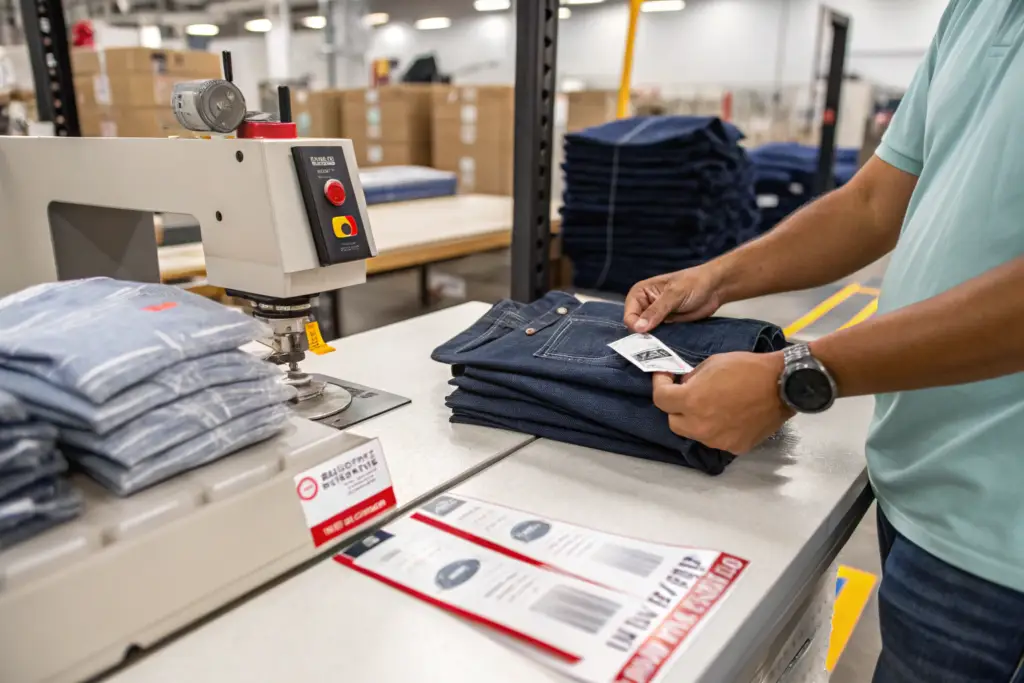
A custom-printed hangtag with a string tie costs $0.08 to $0.15 per unit at quantities of 3,000 to 5,000, depending on paper stock and print complexity. A woven label costs $0.06 to $0.12. A heat-seal or sticker label costs $0.03 to $0.05. A custom-printed polybag costs $0.10 to $0.25 depending on size and print. An insert card with brand messaging costs $0.04 to $0.10. These individual costs seem trivial. The brand owner looks at a $0.10 hangtag and thinks nothing of it. But add them together: hangtag $0.12, woven label $0.10, polybag $0.18, insert $0.08. Total materials: $0.48. Add warehouse labor to apply them: approximately $0.30 per unit at a standard picking and packing rate. Total rebranding cost: $0.78 per unit. Across a 5,000-unit order, that is $3,900. The cost is real and must be in the pricing model.
What Is the Most Efficient Way to Rebrand Without Excessive Labor Cost?
Design the rebranding process for speed. Use a hangtag that can be swiftly attached with a plastic swift-tack rather than a string that requires threading through a buttonhole. Use a heat-seal or sticker label that can be applied in two seconds rather than a sew-in label that requires a seamstress. Order the shorts from the factory with a plain, easily covered neck or waistband label so the rebranding label adheres cleanly. The factory can also be instructed to ship the shorts unbranded in bulk polybags, with the branded hangtags and labels shipped loose in the same container. This allows the rebranding to happen in your warehouse under your quality control. At Shanghai Fumao, we offer a "white label" production option specifically for brands that plan to rebrand domestically. We ship the shorts with a minimal internal care label only, and we pack the custom trim items separately for your warehouse team. This saves the cost of having the factory apply branding that you may later want to change.
How Do Selling Channel Costs and Customer Acquisition Eat Into Margin?
The shorts are landed. They are rebranded. They are sitting in your warehouse, ready to sell. Now you must get them into a customer's hands. That process costs money. If you sell wholesale to a boutique, the boutique takes a 50-60% margin, and you may pay a showroom commission. If you sell DTC on your Shopify store, you pay for the platform, the payment processing, the shipping to the customer, and the marketing that brought the customer to your site. If you sell on a marketplace like Amazon or Instagram Shops, the platform takes a referral fee. Each channel has a different cost structure, and each must be modeled separately.
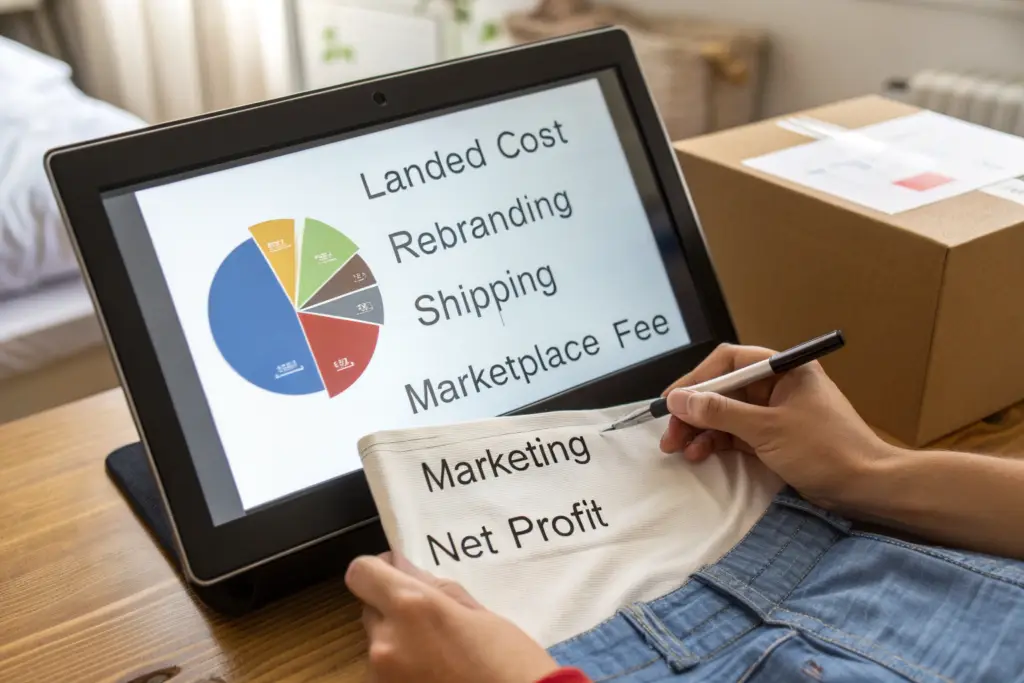
Selling channel costs—including marketplace referral fees of 15-20%, wholesale showroom commissions, and DTC shipping and payment processing—combined with customer acquisition costs averaging $12 to $25 per new customer for apparel, can consume 30-50% of the retail price, dramatically reducing the margin that remains after product costs.
A DTC brand I analyzed was selling their classic short for $68. Their landed and rebranded cost was $14.50. Their gross margin looked healthy at 78.7%. Then we deducted the costs. Free shipping to the customer: $7.80. Payment processing fee: $2.10. Their Shopify and app subscriptions divided by monthly units: $1.20. Customer acquisition cost via Facebook and Instagram ads averaged $18 per new customer. For a new customer buying one pair of shorts, the unit economics were catastrophic: $14.50 product cost plus $7.80 shipping plus $2.10 processing plus $1.20 platform plus $18 marketing. Total cost: $43.60. Net profit on a $68 sale: $24.40. Margin: 35.9%. That is still a healthy business, but it is a far cry from the 78.7% gross margin the brand thought it had. The math changes dramatically if the customer buys two pairs, because the acquisition cost is spread across more units. The brand that understands its channel costs can optimize for multi-unit orders and repeat purchases.
What Is the True Cost of "Free Shipping" to the Customer?
Free shipping is not free. It is a cost the brand absorbs to reduce cart abandonment. USPS Priority Mail or UPS Ground for a pair of shorts costs $6 to $9 depending on zone and package weight. This cost must be built into the retail price or into the margin calculation. A brand selling a $68 short with free shipping and a $14.50 product cost is effectively selling the short for $60.20 after deducting shipping. The gross margin drops from 78.7% to 75.9% just by accounting for the shipping cost. This is before marketing, processing, or platform fees. The shipping cost is a real deduction from revenue and must be treated as such in the profit model.
Why Does Wholesale Margin Look Big but Deliver Less Net Profit?
A wholesale order of 200 units to a boutique at $34 per unit generates $6,800 in revenue. The landed and rebranded cost at $14.50 per unit is $2,900. The gross margin is $3,900, or 57.4%. This looks better than the DTC math at first glance. But the wholesale model has its own hidden costs. A showroom or sales rep may take a 10-15% commission on the order. That is $680 to $1,020 off the gross margin. The brand may offer net-60 payment terms, meaning the cash is tied up for two months. Chargebacks for late delivery or minor packaging issues can claw back 2-5% of the invoice. The wholesale channel is less marketing-intensive than DTC, but the net margin after commissions and terms is often comparable to DTC, not superior to it. Wholesale is a volume play, not a margin play. Detailed wholesale profitability analysis is covered in retail business resources from The National Retail Federation.
How Do You Build a Pricing Model That Guarantees a Real Profit?
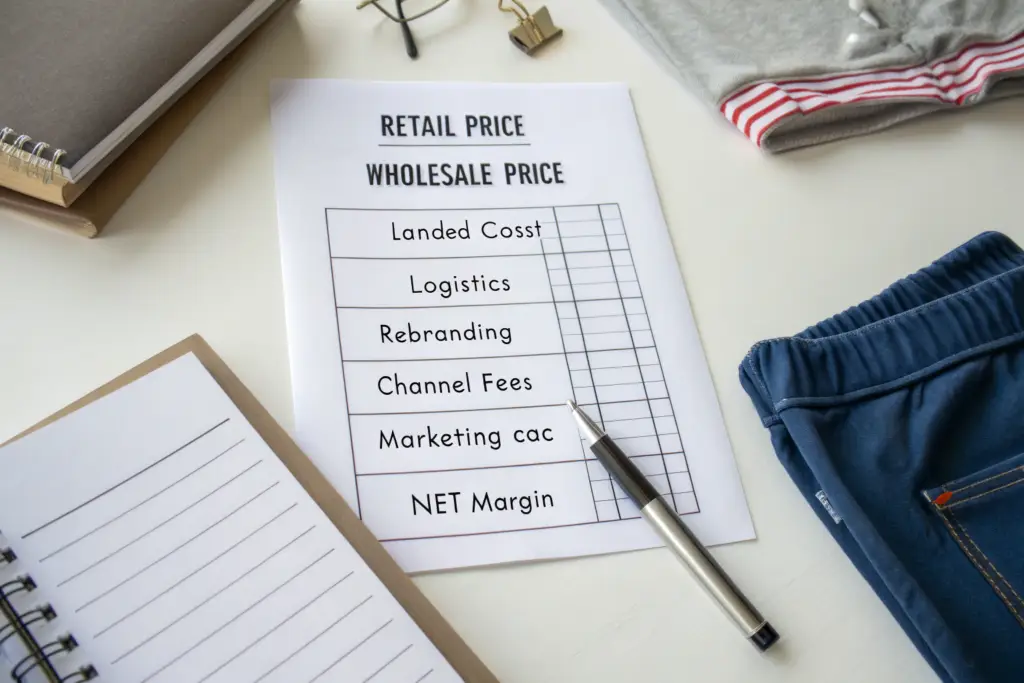
The solution to the margin erosion problem is not to avoid importing. It is to build a pricing model that accounts for every cost before the first purchase order is signed. The model starts with the target retail price or the target wholesale price. It subtracts every cost, line by line, backward to the maximum allowable FOB price. If the factory quotes an FOB above that maximum, the product is not viable at the target price. The brand either raises the price, reduces costs elsewhere, or walks away. The discipline of the backward-calculation model prevents the emotional decision to "just make it work" that leads to unprofitable orders.
A profitable import pricing model works backward from the target retail or wholesale price, deducting channel fees, shipping, marketing, rebranding, logistics, and duty to arrive at a maximum allowable landed cost, ensuring that every cost is accounted for before the factory order is confirmed.
I helped a brand build this model for their classic short line. They wanted to retail at $72 with a 35% net margin. We worked backward. $72 retail, minus $7.50 shipping, minus $2.20 payment processing, minus $1.00 platform costs, minus $15.00 average marketing cost per new customer, minus $1.00 rebranding and fulfillment labor. That left $45.30. We subtracted the desired 35% net margin on the $72 retail price, which was $25.20. The maximum total landed cost, including duty and logistics, was $20.10. The FOB price, after subtracting $2.50 for freight, duty, and logistics, could not exceed $17.60. The factory we used was able to produce the short at $8.50 FOB because of the volume commitment. The model worked. The brand hit its margin target. The discipline of the backward calculation made the business viable.
What Is the "Backward Calculation" Method for Determining Maximum Allowable FOB?
Start with the price the customer will pay. Subtract every cost between that payment and the factory. Do not guess. Get real quotes for shipping, for payment processing, for hangtags, for customs brokerage. Add a 5% contingency buffer for the unpredictable: the demurrage charge, the customs exam, the slight fabric price increase. The number that remains after all subtractions is the maximum the brand can pay for the product in its warehouse, fully landed and rebranded. Divide that number by 1.12 to account for the 12% customs duty if applicable, then subtract the estimated freight and logistics cost per unit. The result is the maximum allowable FOB. If the factory quotes above that number, the deal does not work. If the factory quotes below it, the extra margin is profit upside. This method removes hope from the pricing process and replaces it with math.
How Should the Pricing Model Differ for DTC Versus Wholesale Channels?
A DTC model is built around the retail price. A wholesale model is built around the wholesale price. The costs are different. DTC has high marketing costs but captures the full retail margin. Wholesale has low marketing costs but shares the margin with the retailer. The model must be channel-specific. A brand selling both DTC and wholesale should run two separate pricing models. The DTC model might show a healthy margin at a $68 retail price. The wholesale model, with a $34 wholesale price and a 12% sales rep commission, might show a thin margin at the same FOB cost. The brand must decide whether the wholesale volume justifies the thinner margin, or whether the FOB cost must be reduced through higher volume commitments or fabric engineering to make both channels work. Dual-channel profitability is a complex equation, and resources on multi-channel retail strategy are available from The Business of Fashion.
Conclusion
Importing and rebranding classic shorts can be a genuinely profitable business. The model works. Brands do it every season and build sustainable, growing companies. But the margin between the factory invoice and the bank deposit is populated with costs that the inexperienced importer overlooks. The customs duty calculated on CIF, not FOB. The Pier Pass fee at the port. The hangtag that costs $0.12 and the warehouse worker who costs $0.30 to attach it. The free shipping that costs $7.80. The Instagram ad that costs $18 to acquire a customer who only buys one pair. Each of these costs is small. Together, they decide whether the business makes money or breaks even.
The successful importer does not guess. She builds a pricing model that accounts for every cost, backward from the customer's payment to the factory FOB. She gets real quotes for every line item. She adds a contingency buffer. She negotiates the FOB price knowing exactly the number she must hit to protect her margin. She prices for profit, not for hope.
If you are ready to source classic shorts for your brand and want to work with a factory that understands the economics of the rebranding model, I invite you to talk with us. At Shanghai Fumao, we offer white-label production, competitive FOB pricing, and the documentation support you need to manage your logistics costs. Contact our Business Director, Elaine, at elaine@fumaoclothing.com with your target retail price point and order volume. We will help you build a realistic cost model that protects your margin from the factory floor to your customer's door.