A workwear brand owner from Detroit called me last summer with a recurring nightmare. His classic cargo shorts were selling well. The fabric was tough. The pockets were deep. But customer reviews kept mentioning the same failure point: the side seam was splitting along the hip after six months of wear. Not the fabric. The stitching. His previous factory was using a basic single-needle lockstitch with a standard polyester thread on a heavy 10oz canvas. The thread was snapping under the stress of bending and sitting. The shorts looked great out of the box. They fell apart under real-world load. He was losing repeat customers over a component that cost less than a penny per short.
The secret to long-lasting stitching in classic cargo shorts is a combination of a 301 lockstitch for visible seams paired with a 401 chainstitch for internal stress points, executed with bonded nylon or core-spun polyester thread at a stitch density of 8-10 stitches per inch, reinforced by precision-tuned machine tension.
Stitching failure is a silent brand killer. Customers do not write reviews about "excellent stitch density." They write reviews about shorts that "fell apart after three washes." The technical difference between a seam that lasts three years and a seam that fails in three months is invisible to the naked eye. It lives in the stitch type, the thread chemistry, the needle selection, and the machine calibration. At Shanghai Fumao, we have spent years engineering our stitching protocols for heavy-duty shorts. Let me open the technical manual and show you exactly what creates a seam that outlasts the fabric.
Why Does Stitch Type Selection Determine the Lifespan of Cargo Short Seams?
The stitch type is not a cosmetic choice. It is a mechanical decision that determines how force is distributed along a seam. When a man bends his knee in a pair of cargo shorts, the seat seam stretches by up to 15% of its resting length. If the stitch is rigid, it snaps. If the stitch is elastic, it stretches with the fabric and returns. Choosing the wrong stitch for the wrong seam is like putting a rigid concrete bridge over an earthquake fault. It will fail the moment the ground moves.
The 301 lockstitch provides a non-ravel, clean finish ideal for topstitching and visible areas, while the 401 chainstitch provides up to 30% seam elongation, making it the superior choice for the side seams and seat seams that bear the highest tension loads in cargo shorts.
I audited a failed shipment for a client two years ago. The seat seam of his cargo shorts had a neat, straight line of broken threads. The factory had used a 301 lockstitch with an 18 SPI density. The stitch looked premium. But 301 has zero elasticity. When the fabric stretched under load, the lockstitch had no give. It popped, stitch by stitch, like perforated paper. We switched the seat seam to a 401 chainstitch with a 10 SPI density. The 401 stitch loops under the fabric like a chain, and that loop structure can elongate without breaking. The next season's returns for seam failure dropped by over 70%.
What Is the Mechanical Difference Between a 301 Lockstitch and a 401 Chainstitch?
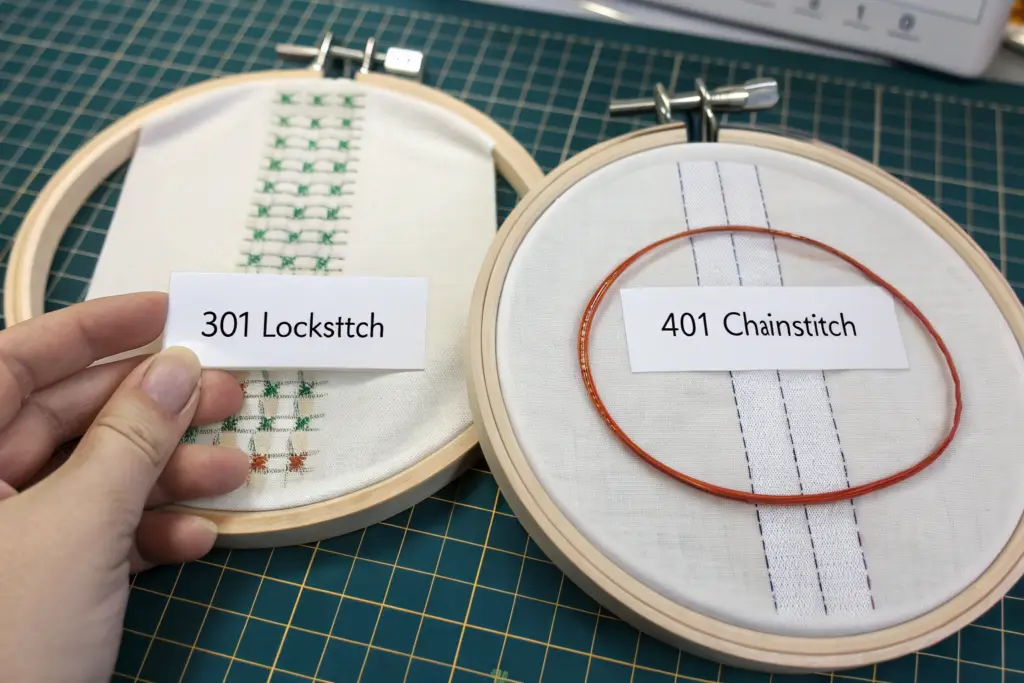
The 301 lockstitch uses two threads: one needle thread and one bobbin thread. They interlock inside the fabric layer. This creates a flat, identical appearance on both sides. It is the standard dress shirt stitch. It has near-zero stretch. If you pull the fabric apart with force, the thread breaks because the lock has no slack.
The 401 chainstitch uses one needle thread and one looper thread. They form a chain-like loop on the underside. This loop structure acts like a spring. When the fabric stretches, the chain extends slightly rather than snapping. The seam elongation of a 401 stitch can reach 30%, compared to less than 5% for 301. The trade-off is that a 401 stitch can unravel if the looper thread tail is not properly secured. A quality factory back-tacks the chainstitch ends to prevent raveling. The mechanical specifications of stitch types are standardized by ASTM International, which publishes the D6193 standard for stitch classification.
Why Should Bartack Reinforcement Be Mandatory on Pocket Corners?
Cargo shorts have pockets designed to hold weight. A phone, keys, a wallet, maybe a small tool. The pocket opening corners are stress concentration points. Every time the wearer reaches in, the corner of the pocket takes the full tension of the opening motion. A standard straight stitch at a pocket corner will tear out within months. A dense bartack—a zigzag stitch condensed into a tight, rectangular block of about 12-16 stitches across 1.5 centimeters—distributes that load across a much wider area. It effectively laminates the fabric at the stress point. At Shanghai Fumao, bartacking every pocket corner is a non-negotiable standard, not an optional upgrade. The International Organization for Standardization provides technical guidelines for stitch types and reinforcement methods through ISO.
What Thread Material and Thickness Guarantees Stitch Durability in Cargo Shorts?
Thread is the skeleton of the garment. The fabric panels are the flesh. If the skeleton is weak, the body collapses, no matter how strong the muscles are. Standard spun polyester thread, the kind used on lightweight dress shirts, has a tensile strength of around 0.8 to 1.0 kilogram. That is sufficient for a poplin shirt that never faces stress. It is dangerously inadequate for a cargo short made from 8oz to 10oz canvas. The thread must be stronger than the fabric it holds together. If the fabric outlasts the thread, the seam fails. If the thread outlasts the fabric, the garment is a success.
Core-spun polyester and bonded nylon threads in Tex 40 to Tex 60 weight offer the optimal balance of tensile strength, abrasion resistance, and UV stability for cargo short seams, with core-spun poly providing superior sewability and bonded nylon providing maximum seam strength.
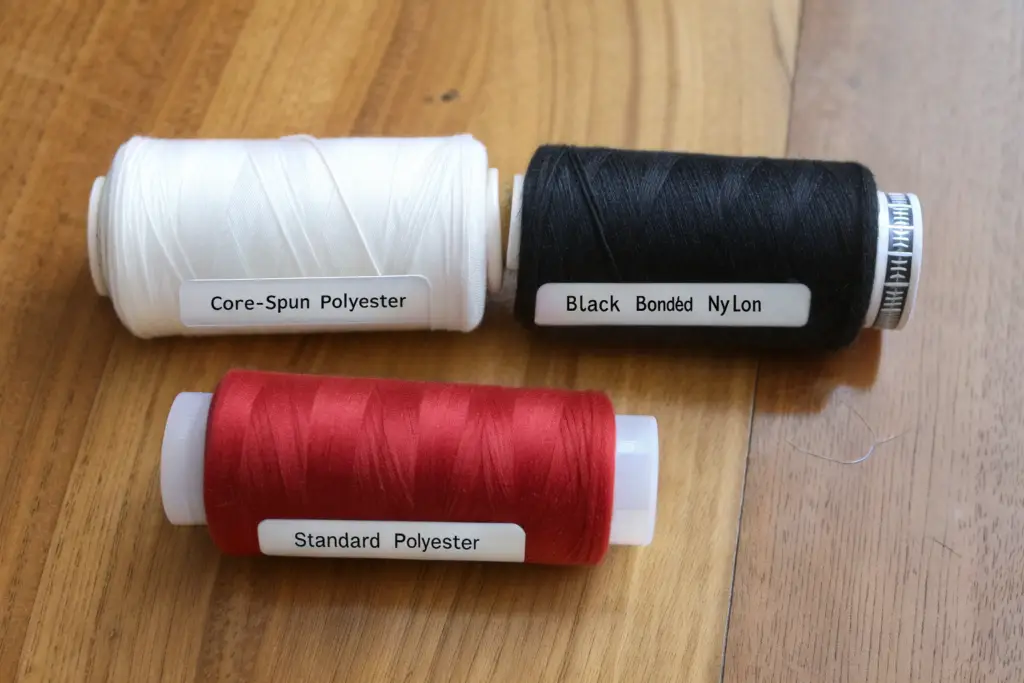
I tested three thread types head-to-head for a military-inspired brand last year. We sewed identical cargo short side seams with standard spun poly, core-spun poly, and bonded nylon. We ran them through a seam strength tester, pulling perpendicular to the seam until failure. The standard spun poly snapped at 12 kilograms of force. The core-spun poly held to 18 kilograms. The bonded nylon held to 22 kilograms. The cost difference between standard and core-spun was $0.03 per short. The brand upgraded. Their seam failure warranty claims dropped to near zero. The economics were obvious.
What Is Core-Spun Polyester Thread and Why Does It Outperform Standard Polyester?
Standard spun polyester thread is made from short staple fibers twisted together. Under magnification, it looks like a fuzzy rope. The surface fuzz creates friction against the needle, generating heat. At high sewing speeds, the heat can melt the thread and cause breaks. The short fibers also abrade against the fabric during wear, slowly thinning until the thread snaps.
Core-spun polyester has a continuous filament polyester core wrapped in a sheath of spun polyester fibers. The continuous core provides the tensile strength—like a steel cable inside a rope. The spun sheath provides the sewability and the natural fabric-like appearance. This hybrid structure gives core-spun thread roughly 50% higher breaking strength than the equivalent weight of spun polyester. It is the standard thread for denim and workwear for exactly this reason. The technical specifications for industrial sewing threads are published by major manufacturers like Coats Group, which provides detailed data sheets on tensile strength and abrasion resistance.
When Should You Specify Bonded Nylon Thread for Maximum Durability?
Bonded nylon is the heavyweight champion. It has the highest tensile strength per tex of any common sewing thread. It is coated with a bonding resin that reduces friction and adds abrasion resistance. The trade-off is that nylon has a slight sheen that looks technical, and it can feel stiff against the skin. For cargo shorts with a tactical or outdoor performance positioning, bonded nylon is ideal. For a softer, heritage workwear aesthetic, core-spun polyester is a better visual match. The decision should align with the brand's positioning. A fashion cargo short probably wants the invisible performance of core-spun poly. A rugged outdoor cargo short might lean into the technical sheen of bonded nylon as a visual feature. Either thread, when correctly specified, will outlast the fabric.
How Does Stitch Density and Tension Calibration Prevent Seam Failure?
A seam is a system, not a single component. The best thread in the world, paired with the ideal stitch type, will still fail if the machine tension is wrong or the stitch density is too low. Stitch density controls how many anchor points the seam has per inch of fabric. Too few, and the load on each stitch is too high. Too many, and the needle perforates the fabric so densely that it creates a perforation line, like a tear-off check, weakening the material. Tension controls the balance of thread between the needle and the bobbin. Unbalanced tension creates loose loops that catch and abrade or overly tight stitches that embed too deep and cut the fabric yarns.
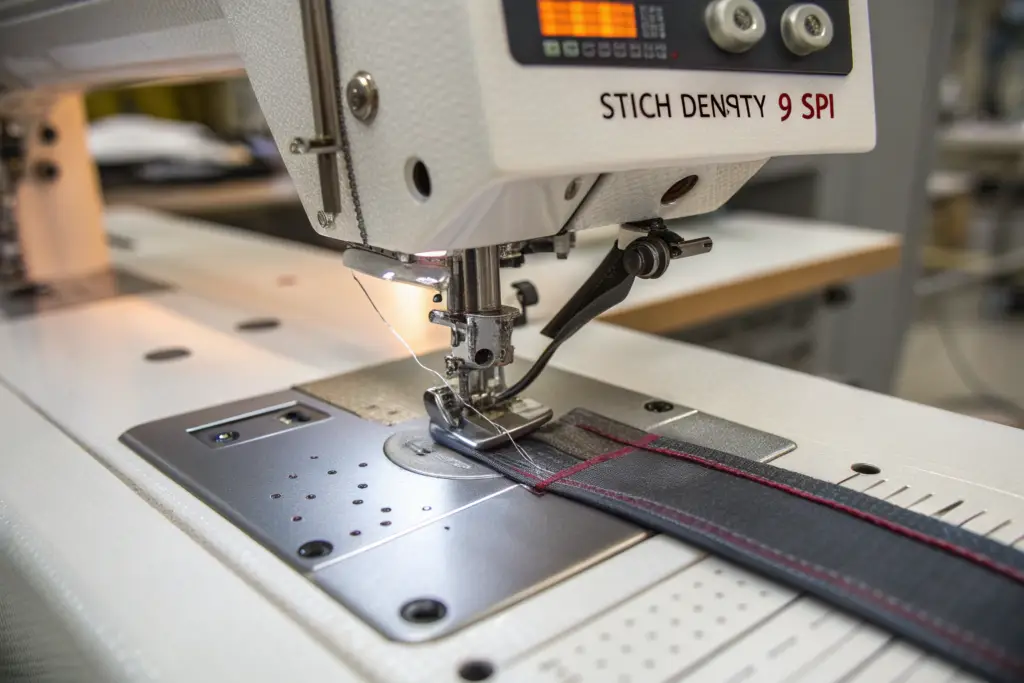
The ideal stitch density for cargo short main seams is 8 to 10 stitches per inch, with top thread tension calibrated between 120 and 150 grams of pull force and bobbin tension at 20 to 25 grams, verified daily on every production machine using a tension gauge.
I fired a subcontractor in 2021 after a routine quality audit. We pulled a random sample of shorts from their finished goods rack and cut open the side seam. The stitch density was 6 SPI. Our spec was 9 SPI. The seam was 33% weaker than specified. The subcontractor had reduced the density to sew faster and boost their daily output. The shorts would have failed in the field. We recalled the entire batch and re-stitched it in our facility. That subcontractor never touched another Shanghai Fumao order. Machine settings are auditable quality parameters, not artistic suggestions.
How Do You Measure and Set Correct Thread Tension on Industrial Sewing Machines?
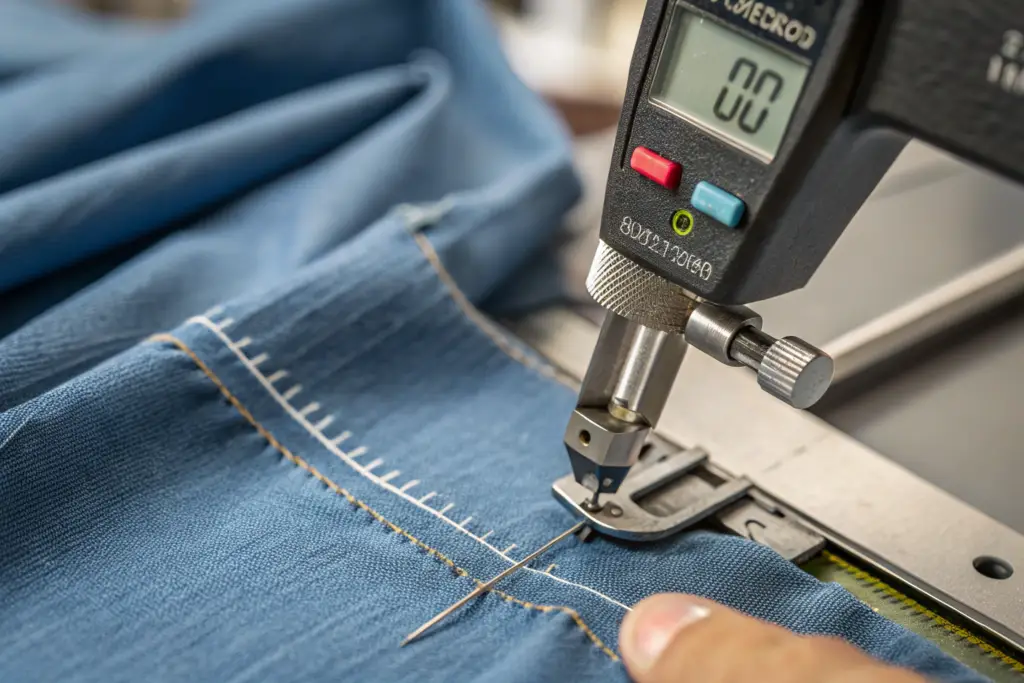
Thread tension is not set by feel. It is set by measurement. A thread tension gauge is a handheld device that clips onto the needle thread above the needle. It measures the pull force in grams required to draw the thread through the tension discs. For a standard Tex 40 core-spun polyester thread on a heavy cargo fabric, the top tension should be between 120 and 150 grams. The bobbin tension, measured by pulling the bobbin case thread out of its case on a tension meter, should be between 20 and 25 grams. If the top tension is too high, the bobbin thread is pulled to the surface, creating a weak seam that sits above the fabric where it is exposed to abrasion. If the tension is too low, the needle thread loops on the underside, creating snag points. Tension must be checked at the start of every shift and recorded in a machine log. This is tedious. It is also the difference between a seam that lasts and a seam that fails. Industry best practices for sewing machine maintenance are documented by Apparel Resources.
What Happens When Stitch Density Is Too High or Too Low?
Density too low—below 7 stitches per inch—and the individual stitches carry too much load. The seam looks sparse. The fabric shifts between stitches. The threads saw back and forth against the fabric holes, abrading themselves.
Density too high—above 12 stitches per inch on heavy fabric—and the needle creates a perforation line. Imagine a dotted cut line on a paper coupon. The fabric between the holes is weakened by needle damage. Under tension, the fabric tears along the stitch line, leaving perfectly intact stitches holding a strip of torn fabric. The seam did not fail. The fabric failed because the sewing destroyed it.
The sweet spot of 8-10 SPI provides enough anchor points to distribute load without creating a perforation weakness. This density range is specified in technical manuals from organizations like The Association of Sewing and Design Professionals.
What Quality Control Tests Prove Stitching Durability Before Shipment?
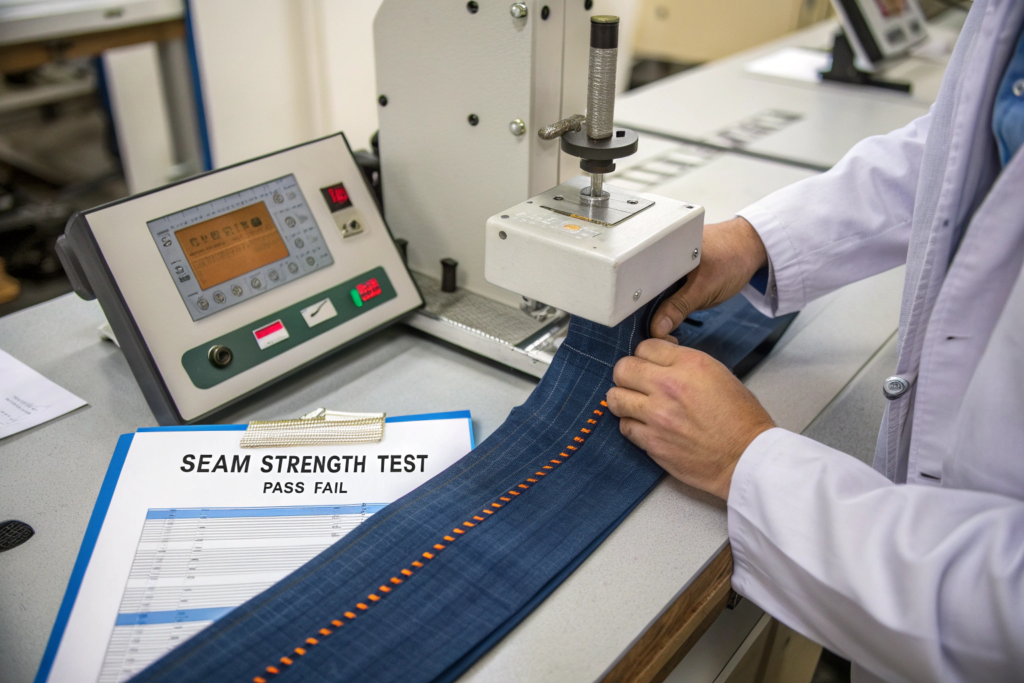
A factory can claim their stitching is durable. The claim means nothing without test data. Before a single carton of cargo shorts leaves our facility, the seams are tested to destruction. We do not test every pair. We test a statistically valid random sample pulled from the bulk production lot. The test machine pulls the fabric apart perpendicular to the seam at a controlled speed. It measures the force at which the seam fails, in pounds or kilograms. The result is a number on a report. If the number is below the minimum standard, the entire lot is held for rework. This is the final gate between production and shipment.
Seam strength testing using a tensile testing machine, cross-referenced with the AQL 2.5 inspection standard and a visual seam integrity check under a magnifying loupe, provides objective, verifiable proof that the stitching will survive real-world wear.
A client asked me once what our seam strength standard was for cargo shorts. I told him 15 kilograms minimum for the side seam, measured with a 2-inch wide fabric strip pulled at 300mm per minute. He asked why 15 kilograms. I told him that 15 kilograms is roughly the force a 200-pound man generates on his seat seam when he squats to pick something up. The standard is not arbitrary. It is reverse-engineered from the stresses of actual human movement. The testing standard we follow is based on the methodology published by ASTM International under ASTM D1683 for woven seam strength.
What Is the Correct Procedure for a Seam Strength Test?
The test is simple to describe but requires calibrated equipment to execute. Cut a fabric strip 2 inches wide and 6 inches long, with the seam running exactly down the center perpendicular to the 2-inch width. Clamp the strip in the tensile tester jaws, with the seam centered between the jaws and the jaws set 3 inches apart. Pull at 300 millimeters per minute until the seam breaks. Record the peak force. Also record the mode of failure: did the thread snap, did the fabric tear, or did the seam slip? The mode of failure tells you whether the thread or the fabric is the weak point. A seam that fails because the thread snaps suggests the thread is too weak. A seam that fails because the fabric tears suggests the thread is stronger than the fabric, which is the ideal outcome. Detailed test procedures are available from testing laboratories like SGS, which provides these services to apparel brands globally.
How Does AQL Sampling Ensure the Entire Shipment Meets Stitching Standards?
A seam strength test is a destructive test. You cannot test every pair of shorts because testing destroys the garment. The AQL sampling system tells you how many pairs to test to be statistically confident that the entire shipment meets the standard. For an order of 5,000 cargo shorts at AQL 2.5, the inspector pulls 200 pairs at random. From those 200 pairs, several are sacrificed for seam strength testing. If the number of failed pairs in the sample exceeds the AQL limit, the entire shipment is rejected for rework. This statistical method is the industry standard for balancing inspection cost with quality assurance. The sampling tables are standardized and published by the International Trade Centre, which offers guidance on quality control systems for apparel importers.
Conclusion
The secret to long-lasting stitching is not a single magic trick. It is a system. The correct stitch type for the specific seam—301 for topstitching, 401 for the seat and side seams. The correct thread material—core-spun polyester or bonded nylon, never standard spun poly on a cargo short. The correct stitch density—8 to 10 SPI, verified daily. The correct machine tension—120 grams on the top thread, 25 grams on the bobbin. And the objective verification of all of the above through seam strength testing before the shipment leaves the factory.
This system is not expensive. The thread upgrade costs pennies per unit. The tension calibration takes minutes per machine per day. The testing equipment costs a few thousand dollars, amortized across tens of thousands of shorts. The cost of not doing these things is customer returns, negative reviews, chargebacks from retailers, and a damaged brand reputation that takes years to rebuild. The math favors doing the engineering correctly the first time.
If your brand's cargo shorts have a seam failure problem, or if you are developing a new cargo short and want to ensure it is built right, I invite you to tap into our engineering knowledge. At Shanghai Fumao, stitching durability is not a marketing claim. It is a measurable manufacturing standard. Contact our Business Director, Elaine, at elaine@fumaoclothing.com to request our stitching specification sheet and a sample pair of shorts for your own seam strength test. Let us show you what properly engineered seams feel like.