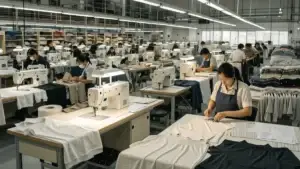
A boutique owner from Portland called me in tears of frustration three seasons ago. She had ordered 800 pairs of classic chino shorts from a factory she found on Alibaba. The pre-production sample fit her size medium mannequin perfectly. The bulk shipment arrived. She opened the first carton. The size small was too tight. The size large was somehow smaller than the size medium. The size XL was cut so generously it looked like a completely different product. Her retail customers were furious. Her return rate hit 40%. She had to liquidate the entire inventory at a loss. The sizing inconsistency did not just cost her that season's profit. It cost her a chunk of her loyal customer base who decided her brand was unreliable.
Consistent sizing across a wholesale shorts order is achieved through a combination of a sealed golden sample as the legal reference standard, factory-grade measurement tolerance sheets with a maximum deviation of +/- 0.5 cm on critical points, and a pre-shipment AQL inspection that randomly measures garments against the spec.
Sizing is the silent contract between your brand and your customer. When a woman buys a size 12 classic short from your website, she trusts that it will fit like the size 12 she bought last season. If it does not, she does not blame the factory. She blames your brand. She returns the short. She leaves a one-star review. She never buys from you again. At Shanghai Fumao, we treat sizing consistency as the most fundamental quality metric. Let me show you the system we use to ensure every pair of shorts in your wholesale order measures true to the spec.
Why Is a Sealed Golden Sample the Foundation of Size Consistency?
A verbal agreement on sizing is worth the air it travels through. An email thread discussing "the fit is a little snug, let's add half an inch" is a recipe for confusion. The factory's interpretation of "half an inch" might differ from yours. The pattern maker who received your email might be on vacation when production starts. The replacement pattern maker guesses. The shipment arrives wrong. The only thing that prevents this cascade of errors is a physical, sealed, signed reference standard that cannot be disputed.
The sealed golden sample serves as the physical legal standard that defines the exact measurements, construction, and fit for every size in the order, eliminating the interpretation drift that causes bulk production to deviate from the approved prototype.
I learned the hard power of the sealed sample early in my career. A buyer claimed our bulk shorts were a half-inch shorter in the inseam than approved. We pulled the sealed sample from the shelf. We cut the seal open in front of the buyer. We laid the bulk short and the sealed sample side by side on a cutting table. We measured both inseams with the same tape measure. They matched within 2 millimeters. The buyer's complaint evaporated. Without that sealed sample, it would have been his word against ours. With it, there was an objective standard. At Shanghai Fumao, we seal and archive a golden sample for every size of every style we produce. This is not optional. It is the foundation.
What Specific Measurements Must the Golden Sample Lock In?
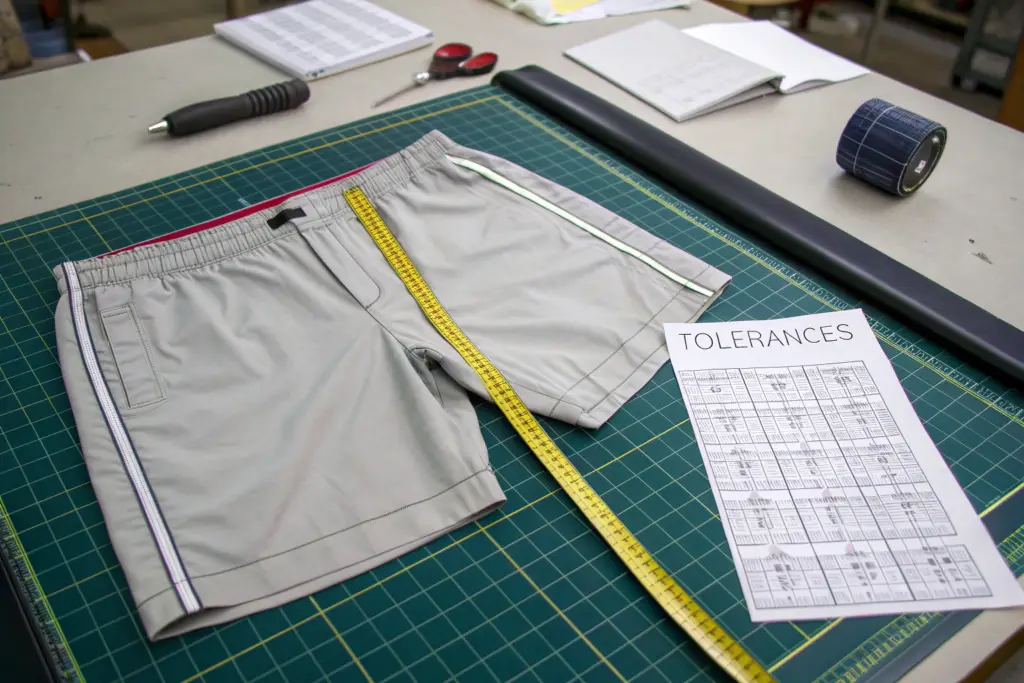
A golden sample for classic shorts must specify and physically demonstrate a minimum of ten Points of Measure. These include the waistband circumference relaxed and extended, the hip circumference at a specified distance below the waistband, the front rise, the back rise, the inseam length, the outseam length, the thigh circumference at a specified point, the leg opening circumference, and the pocket bag depth. Each measurement point must be marked on the sample with a small stitch or tag so the inspector can find the exact same location on every garment. The tolerances for each point are documented on a spec sheet attached to the sample. A complete list of standard POM for shorts is available from technical design resources like Techpacker, which provides templates for apparel measurement specifications.
How Does the Sample Sealing Process Create Legal Accountability?
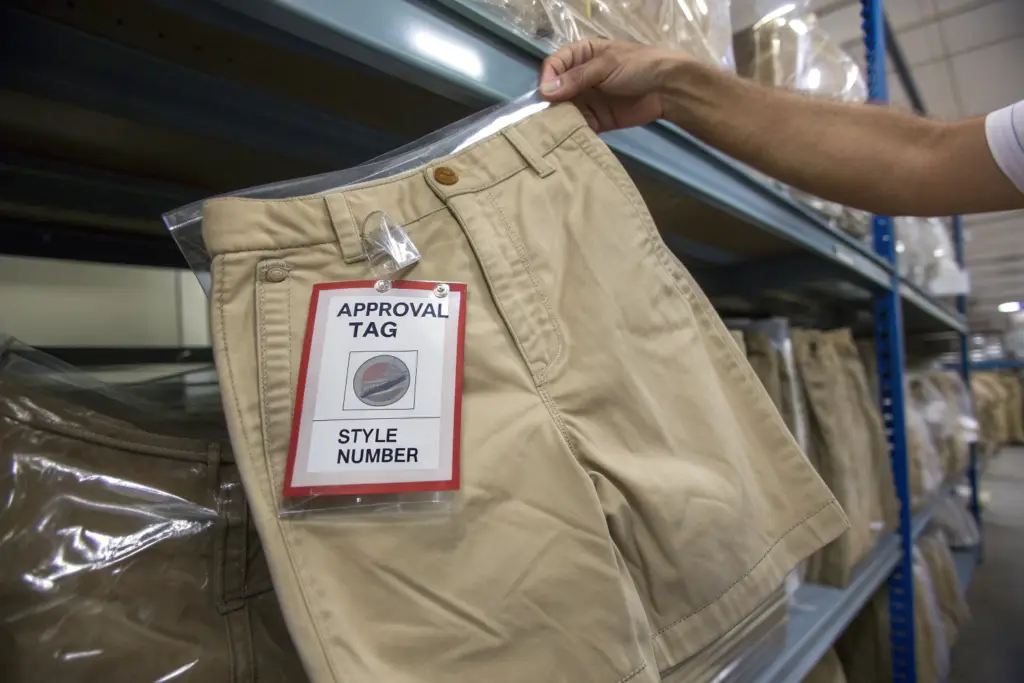
Both parties sign the sample. The brand representative or an authorized third-party inspector signs a tag attached to the sample. The factory quality manager countersigns. The tag includes the style number, the size, the date, and a unique serial number. The sample is then placed in a tamper-evident bag and sealed. The seal is photographed. The photograph is emailed to both parties. Any attempt to open the bag and alter the sample will destroy the seal. This creates a chain of custody. The sample becomes a legal exhibit in a purchase contract dispute. Most suppliers will not cut corners on a shipment when they know a sealed reference sample exists in the buyer's possession. The process aligns with the quality documentation standards recommended by ISO.
What Measurement Tolerances Are Acceptable for Wholesale Classic Shorts?
Perfection is a myth in bulk manufacturing. Fabric has natural variation. Cutting machines have micron-level drift. Sewing operators are human beings, not robots. A pair of shorts will never measure exactly 40.00 cm at the waist. The question is not whether variation exists. The question is how much variation is acceptable before the garment no longer fits the intended customer. The answer is defined by a tolerance range. The tolerance range is the boundary between a passing product and a defective product.
Acceptable sizing tolerances for classic shorts should be +/- 0.5 cm on critical fit points like waist, hip, and inseam, and +/- 1.0 cm on non-critical points like leg opening and pocket placement, with all tolerances written into the purchase agreement before production begins.
A brand I worked with had a tolerance dispute with a factory. The spec called for a 28 cm thigh circumference. The bulk shorts measured 27.2 cm. The factory argued the 0.8 cm difference was negligible. The brand argued it made the shorts too tight through the leg. The purchase agreement did not specify thigh tolerances. The dispute ended in a compromise that left both sides unhappy. Since then, I have insisted that every single point of measure on the spec sheet has a written tolerance. No blank cells. No assumptions.
| Measurement Point | Example Spec (Size M) | Critical Tolerance | Non-Critical Tolerance |
|---|---|---|---|
| Waistband (Relaxed) | 40.0 cm | +/- 0.5 cm | N/A |
| Hip Circumference | 52.0 cm | +/- 0.5 cm | N/A |
| Inseam Length | 20.0 cm | +/- 0.5 cm | N/A |
| Front Rise | 28.0 cm | +/- 0.5 cm | N/A |
| Leg Opening | 28.0 cm | N/A | +/- 1.0 cm |
| Pocket Position | 6.0 cm from side seam | N/A | +/- 1.0 cm |
Why Is a +/- 0.5 cm Tolerance the Industry Standard for Critical Fit Points?
A half-centimeter is a little less than a quarter of an inch. It is the smallest increment that can be reliably measured with a standard factory tape measure. At this tolerance, the difference between a size medium and a size large at the waist—typically a 4-5 cm grade—remains distinct. If you allow +/- 1.0 cm on the waist, a size medium could measure 41 cm and a size large could measure 42 cm. The gap between sizes collapses. The customer trying both sizes will perceive no meaningful difference and conclude the brand's sizing is random. The +/- 0.5 cm tolerance protects the grade rule that separates your sizes. Technical guidance on apparel tolerances is published by organizations like AATCC, which provides testing standards for garment dimensional stability.
How Should Tolerance Disputes Be Resolved During Inspection?
The sealed golden sample is the referee. If the bulk garment measures outside the agreed tolerance, the inspector records it as a defect. The defect count is tallied against the AQL limit. If the total defects exceed the AQL 2.5 limit for the sample size, the shipment is rejected for rework. There is no negotiation on the factory floor. The tape measure and the spec sheet are the final authority. This depersonalizes the process. The factory supervisor is not arguing with the buyer. He is arguing with a written standard and a measuring tool. The emotional heat is removed from the quality conversation. The International Trade Centre provides excellent resources on structuring objective quality inspection protocols.
How Can You Audit the Factory's Cutting and Grading Process for Accuracy?
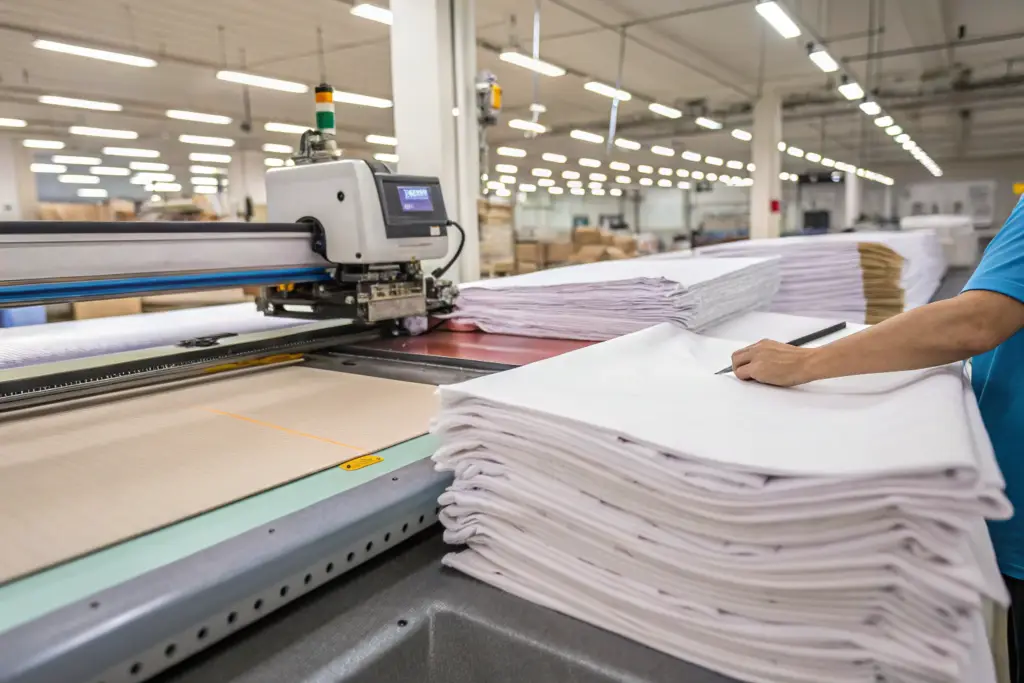
Sizing errors are born in the cutting room. If the cut pieces are inaccurate, no amount of sewing skill can fix them. The seamstress can stitch a straight line, but if the fabric panel is the wrong shape, the seam pulls, twists, and measures off-spec. Auditing the cutting process is far more efficient than inspecting finished garments. Catching a grading error at the cutting table prevents hundreds of defective units before they are sewn.
Auditing the cutting room involves verifying the printed marker dimensions against the approved pattern file, checking the automatic cutter's calibration with a daily test cut, and spot-measuring random cut panels from the ply stack against the spec sheet before they reach the sewing line.
During a routine audit of a subcontractor, I discovered that their automatic cutter was misaligned by 3 millimeters. The error had drifted over weeks because the daily calibration check had been pencil-whipped—signed off without actually being performed. Several thousand cut panels were off. We quarantined the entire cut work and demanded the cutter be recalibrated and the panels re-cut. The subcontractor absorbed the loss. The calibration log was reinstated with actual measured values recorded every morning. A 3-millimeter error on a waistband panel multiplies across the garment. It is the difference between a pass and a fail at inspection. The maintenance standards for cutting equipment are detailed by industry resources like Apparel Resources.
Why Must the Pattern Grading Rules Be Verified Across All Sizes?
Grading is the mathematical rule that scales a pattern from a base size up to larger sizes and down to smaller sizes. A poorly designed grade rule can make the size increments uneven. For example, if the waist grade is 4 cm but the hip grade is only 2 cm, the short becomes progressively tighter through the seat as sizes increase. The fit changes shape across the size range. The customer who wears a size small gets one product. The customer who wears a size large gets a fundamentally different product. Before bulk cutting, the factory must provide a full-size grading spec sheet showing every measurement for every size. A random sample of the graded pattern pieces should be overlaid on a light table against the base size pattern to verify the increments are accurate. The technical principles of pattern grading are taught through institutions like The Association of Sewing and Design Professionals.
How Does Fabric Shrinkage Testing Before Cutting Prevent Post-Production Sizing Drift?
Fabric shrinks. A cotton twill can shrink 2-3% in length on its first wash. If the cutting is done on unwashed fabric, the finished short will measure correctly when it leaves the factory. Then the customer washes it. It shrinks. The size medium becomes a size small. Your returns spike. To prevent this, the fabric must be tested for shrinkage before cutting. A marked square of fabric is washed, dried, and re-measured. The shrinkage percentage is calculated. If the shrinkage exceeds 2%, the fabric must be pre-shrunk in an industrial process, or the pattern must be adjusted to add the shrinkage allowance into the cut dimensions. At Shanghai Fumao, we run a shrinkage test on every incoming fabric lot. The lot number and shrinkage data are recorded and attached to the production order. No fabric moves to the cutting table without a passing shrinkage report. The testing methodology follows the standards established by Cotton Incorporated, which provides detailed protocols for fabric relaxation testing.
What Inline and Final Inspection Methods Catch Sizing Deviations Early?
Waiting until the entire order is packed to check sizing is a dangerous gamble. By that point, all the fabric is cut. All the stitching is done. The packing cartons are sealed. Reworking a finished, packed garment costs many times more than fixing a problem caught at the sewing line. Inline inspection places quality checkpoints inside the production process. It finds and fixes sizing drift in real time, not in a post-mortem.
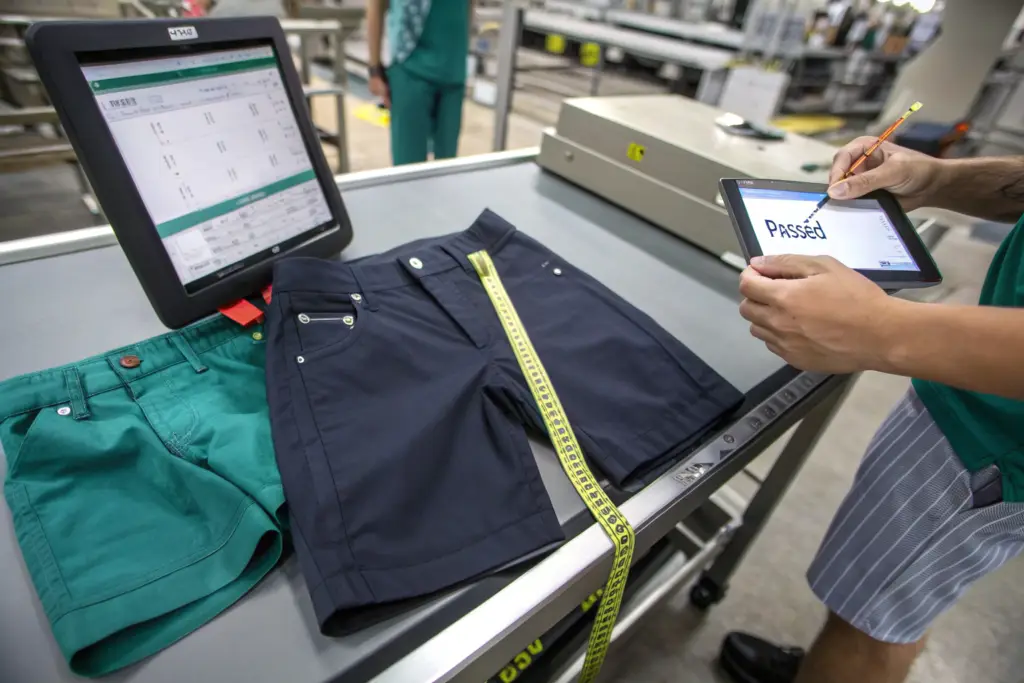
Inline inspection catches sizing deviations by measuring garments directly on the sewing line at hourly intervals, while the final AQL pre-shipment inspection provides a statistical validation that the entire shipment meets the size spec before payment is released.
A brand we manufacture for requested that we add an inline measurement checkpoint between the side-seam operation and the waistband attachment. The inspector measures the hip and thigh on every 50th pair before the waistband is sewn. If the hip measurement drifts beyond tolerance, the line stops immediately. The pattern is checked. The operator is retrained. The problem is fixed within minutes. This checkpoint caught a drift issue three times in the last production season. Each time, the fix prevented dozens of defective pairs from being completed. The brand's return rate for sizing issues dropped below 2%. The cost of the inline inspector was a fraction of the cost of the returns that were prevented.
How Often Should Inline Measurements Be Taken During a Production Run?
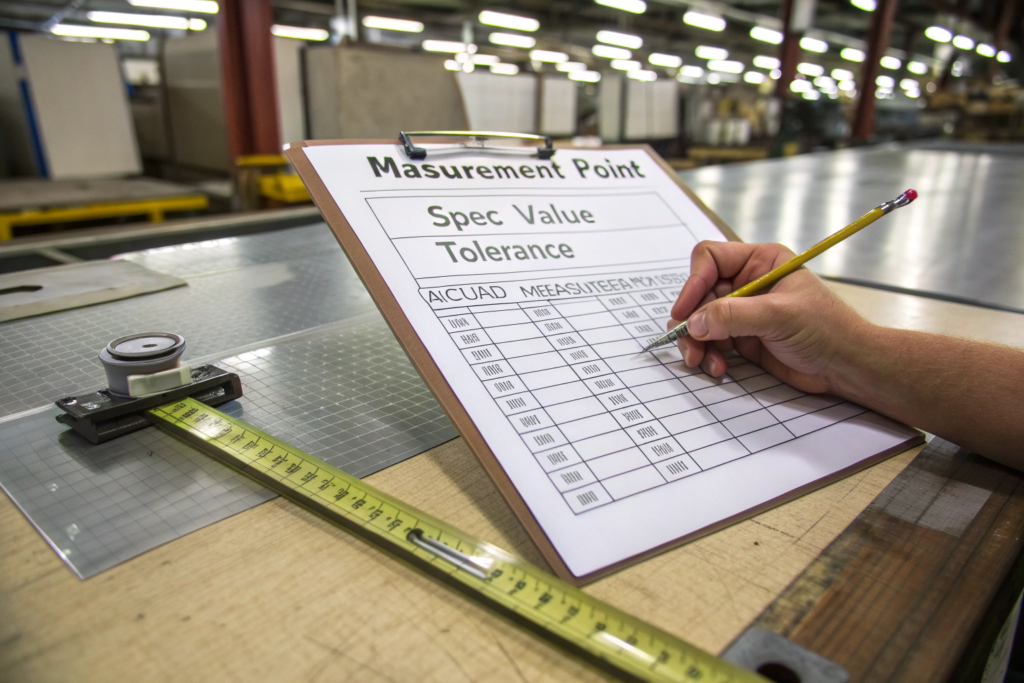
For a classic shorts order of 5,000 units, we pull three pairs per size per hour from each active production line. The inspector measures the critical points—waist, hip, inseam, and rise—and records the values on a control chart. The chart has upper and lower tolerance lines drawn horizontally. If three consecutive measurements trend toward the upper or lower line, even if they are still within tolerance, the line supervisor is alerted. This catches drift before it becomes a failure. The frequency of inline checks can be adjusted based on the order volume and the factory's historical performance with the style. A new style may require checks every 30 minutes. A repeat style with a known stable pattern may only need checks every two hours. The statistical principles of process control are widely applied in manufacturing and are detailed in resources from The Manufacturer.
What Is the Correct Sampling Protocol for Final Sizing Inspection?
The final inspection uses the AQL sampling tables. For a 5,000-unit order at AQL 2.5 Level II, the sample size is 200 pairs. These 200 pairs are pulled randomly from the packed cartons, not selected by the factory. The inspector measures every critical point on every pair in the sample. Each measurement outside the tolerance is counted as a sizing defect. The AQL 2.5 standard allows up to 10 sizing defects in the 200-pair sample. If 11 or more pairs have a sizing defect, the lot fails. The factory must sort and rework the entire order. This is a powerful financial incentive for the factory to maintain sizing control throughout production. Inspection protocols aligned with AQL standards are provided by testing and inspection companies like SGS, which offers pre-shipment inspection services globally.
Conclusion
Consistent sizing is not a mystery. It is not a matter of luck. It is a mechanical, measurable, auditable system. It starts with a sealed golden sample that defines the exact target for every size. It continues with a written tolerance sheet that specifies how much deviation is allowed. It is enforced by a cutting room audit that catches errors before the fabric reaches the sewing machine. It is monitored by inline inspections that catch drift in real time. And it is verified by a final AQL inspection that provides a statistical guarantee before the shipment leaves the dock.
Every one of these steps costs less than the returns, chargebacks, and lost customers that result from inconsistent sizing. The brand that invests in sizing discipline is the brand whose customers confidently order the same size season after season. That confidence is worth more than any marketing campaign.
If your brand has struggled with sizing inconsistency from previous suppliers, or if you are placing your first large wholesale order and want to get it right, we can help you build the spec package, the tolerance sheet, and the inspection protocol. At Shanghai Fumao, sizing consistency is our manufacturing identity. Contact our Business Director, Elaine, at elaine@fumaoclothing.com to discuss your size grade and receive a sample measurement tolerance template. Let's make sure your size medium fits like a size medium every single time.