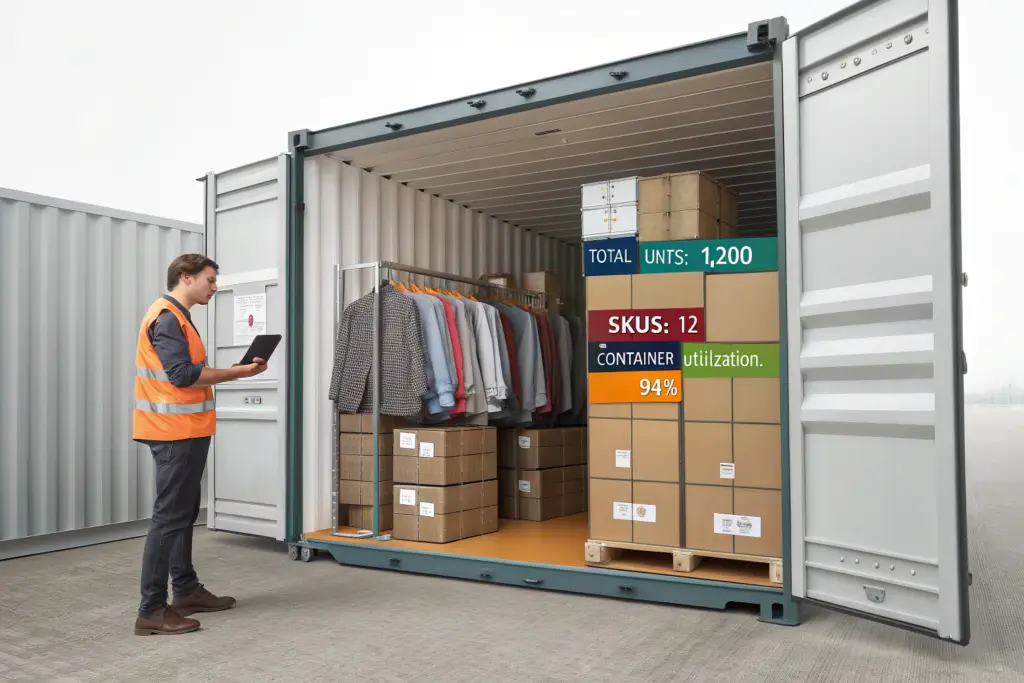
Two years ago, a distributor from Austin, Texas, was stuck in a painful cycle. She wanted to test six new women's dress styles for the spring season. Each style required a minimum order of 300 units per style to hit the factory's MOQ and fill a reasonable production run. That meant ordering 1,800 units total. Her boutique customers could maybe absorb 200 units of each style on a first test. She was staring down the barrel of 600 excess units that would likely end up on the clearance rack, destroying her margin. She was ready to abandon half the styles until she asked me, "Is there any way I can just order 150 of each and still get them made?"
Mixed container orders, often called consolidated or multi-SKU shipments, are becoming popular because they allow distributors to spread their risk across more styles while maintaining container efficiency. Instead of ordering 1,200 units of one style to fill a container, a distributor can order 150 units each of eight different styles. This dramatically reduces the financial risk of any single style failing. It enables faster market testing, more agile inventory management, and a more diverse product offering for boutique and online retail customers who crave novelty and variety.
The old model forced distributors to bet big on a few styles. The new model allows them to place many small bets and double down on the winners. The mixed container is the financial instrument that enables this agile, test-and-scale approach to apparel distribution. At Shanghai Fumao, we have seen mixed container orders increase from less than 10% of our US-bound shipments three years ago to over 40% today. The trend is accelerating, and it is reshaping how small and mid-sized distributors manage their inventory and their cash. Let me explain exactly how it works and why it might be the right model for your business.
How Do Mixed Containers Solve the "Test and Scale" Cash Flow Problem?
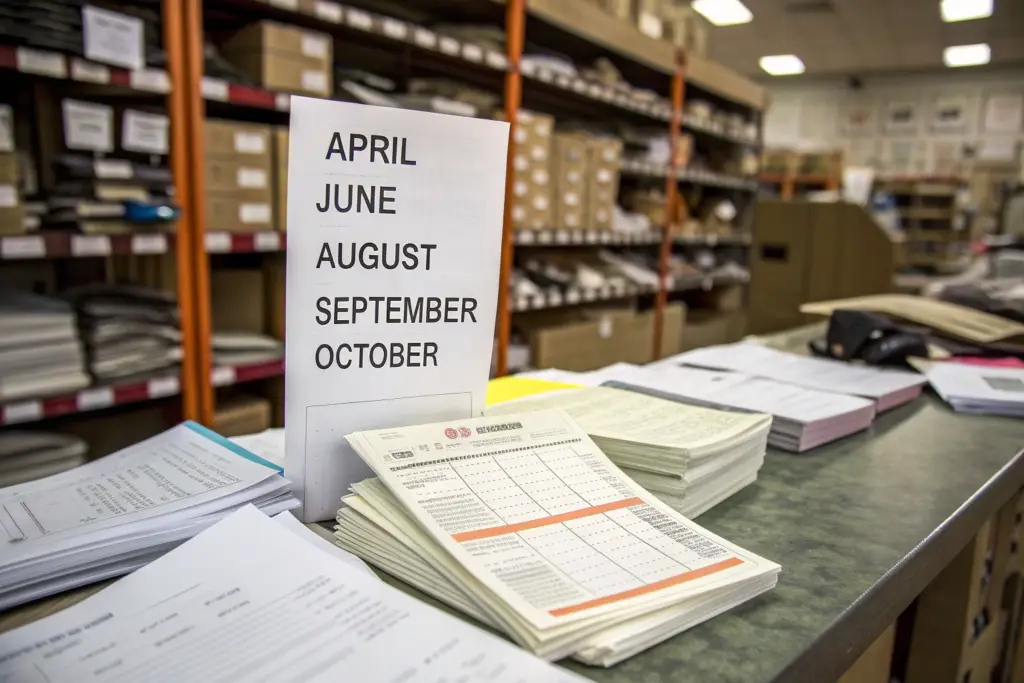
The cash flow problem for a distributor testing new styles is brutal. Cash goes out months before cash comes back. The deposit is paid in April. The balance is paid in June. The goods arrive in August. The boutiques pay in September or October, often on net-30 terms. The distributor's cash is tied up in inventory for four to six months. If that inventory is concentrated in two or three styles, and one of those styles flops, the cash is not just tied up. It is trapped in dead stock that must be liquidated at a loss.
Mixed containers solve the test-and-scale cash flow problem by reducing the "bet size" per style. A distributor who previously had to commit $15,000 to a single style can now commit $3,000 each to five styles. The total cash outlay is the same, but the risk is diversified. If one style fails, it represents a $3,000 loss, not a $15,000 loss. The other four styles, if successful, more than cover the loss. The diversified portfolio of styles generates a more predictable, less volatile cash return than the concentrated bet. The distributor's cash flow is smoothed and de-risked.
The mixed container also enables a faster cash conversion cycle for the winning styles. The distributor receives 150 units of a hot-selling dress. It sells out in two weeks. The distributor immediately places a reorder for 400 units, air-freighted to arrive in three weeks. The reorder is funded by the cash generated from the initial sell-out. The mixed container model allows the distributor to "test small, win big, and scale fast," without the cash flow strain of carrying deep inventory in every style from day one.
Why Is the "SMU per SKU" Metric More Critical Than the Total Order Value?
The key metric in a mixed container model is not the total order value. It is the units per SKU. A SKU, Stock Keeping Unit, is a unique style-color-size combination. A distributor might order a women's linen dress in three colors and four sizes. That is 12 SKUs. If the order is 120 units, the average is 10 units per SKU. That is a very shallow inventory. If the dress sells well, the distributor will stock out quickly on the popular size-color combinations.
A healthy mixed container model balances the desire for variety with the need for sufficient depth on each SKU to avoid premature stockouts. The minimum viable depth per SKU depends on the distributor's reorder lead time. If the factory can produce and air-freight a reorder in four weeks, the distributor can operate with shallower initial inventory. If the reorder lead time is ten weeks, the initial inventory must be deeper to avoid stockouts during the long replenishment cycle.
The unit per SKU metric also drives the production efficiency. A style with only 50 units, spread across three colors and four sizes, has an average of 4 units per SKU. The cutting room will struggle to cut such small quantities efficiently. The sewing line will have constant changeovers. The production cost per unit will be higher. The distributor must balance the marketing benefit of variety against the production cost of fragmentation.
We advise our mixed container clients to maintain a minimum of 24 units per SKU for woven garments and 36 units per SKU for knit garments. This provides sufficient depth for a meaningful market test and sufficient volume for reasonable production efficiency. A style with 150 units can support a size run of S, M, L, XL with approximately 37 units per size, which is workable.
How Does a 50% Deposit Model Work with a Multi-Style Consolidated Order?
The standard 30% deposit model can be adapted to a multi-style consolidated order without difficulty. The deposit is calculated on the total order value, not per style. The distributor pays a single deposit that covers the raw material procurement for all styles in the container.
The factory's internal accounting allocates the deposit across the styles based on the fabric and trim costs for each. A style using expensive Italian wool will consume a larger share of the deposit than a style using standard cotton twill. The factory manages this allocation. The distributor does not need to worry about the internal accounting.
The balance payment follows the same consolidated model. The 70% balance is paid against the shipping documents for the entire container, not per style. The distributor receives a single commercial invoice, a single packing list, and a single bill of lading covering all styles in the mixed container. The payment is a single transaction.
The administrative simplicity of the consolidated payment model is a significant advantage. The distributor manages one purchase order, one deposit payment, one balance payment, and one customs entry for eight different styles. The alternative, eight separate orders, each with its own deposit, balance, shipping, and customs entry, would be an administrative nightmare.
A distributor I work with places a consolidated order every season. It typically includes six to eight styles, with 150 to 300 units per style, totaling around 1,500 units. The deposit is a single wire transfer. The balance is a single wire transfer. The shipment arrives as a single container. His customs broker clears a single entry. The administrative time per style is a fraction of what it would be for separate orders.
What Are the Packing and Logistics Challenges of a 12-SKU Shipment?
A mixed container with 12 SKUs presents packing and logistics challenges that a single-SKU container does not. The distributor's warehouse receives a container with 12 different products, each in multiple sizes, each potentially destined for different retail customers or different sales channels. If the packing is not meticulously organized, the receiving process becomes a nightmare of manual sorting, miscounts, and errors.
The primary packing challenge is carton-level segregation and labeling. Each carton must contain only one SKU. No mixing of styles, colors, or sizes within a carton, unless the quantities are so small that mixed cartons are unavoidable, in which case the mixing must be clearly documented. Each carton must be labeled with a barcode or a clear text label showing the style number, color code, size, and unit quantity. The packing list must provide a carton-by-carton manifest that the receiving warehouse can use to verify the contents without opening every carton.
The secondary challenge is container loading sequence. If the distributor has a pre-sold portion of the inventory that needs to be cross-docked immediately upon arrival, those cartons should be loaded at the rear of the container for easy access. If certain styles are not needed until later in the season, those cartons can be loaded deeper in the container. The loading plan is a strategic document that reflects the distributor's inventory allocation plan.
How Do You Label and Segregate Cartons to Avoid Receiving Chaos?
The receiving chaos scenario is a distributor's nightmare. The container doors open. The warehouse team sees 200 identical brown cartons. They start pulling cartons, opening them, trying to figure out what is inside. They lose track of which cartons have been counted. They misplace cartons. The inventory system shows a mess of inaccurate stock levels. The distributor cannot fulfill customer orders accurately for days while the inventory is manually sorted.
The solution begins at the factory packing station. Each carton receives a unique carton ID label. The label is a large, clear, self-adhesive sticker applied to a consistent location on each carton. The label shows the style number in large font, the color name, the size, and the unit quantity. A barcode encodes the carton ID. When the warehouse receiver scans the barcode, the system immediately knows the exact contents of that carton.
The cartons are segregated on pallets by style. Style A's cartons are on one pallet. Style B's cartons are on another pallet. The pallets are stretch-wrapped and labeled with the style number. Within the pallet, the cartons are organized by size, smallest on top, largest on bottom. The receiving team can pull an entire pallet for a style and know exactly what they have.
We send the packing list to the distributor electronically several days before the container arrives. The packing list is a spreadsheet. Each row is a carton. The columns show the carton ID, the pallet number, the style, the color, the size, the units. The distributor's warehouse team imports this spreadsheet into their inventory system. When the container arrives, they scan each carton barcode. The system matches the scan to the packing list. Discrepancies are flagged immediately. The receiving process is accurate and fast.
What Is a "Load Plan" and Why Should Your Distributor Provide It in Advance?
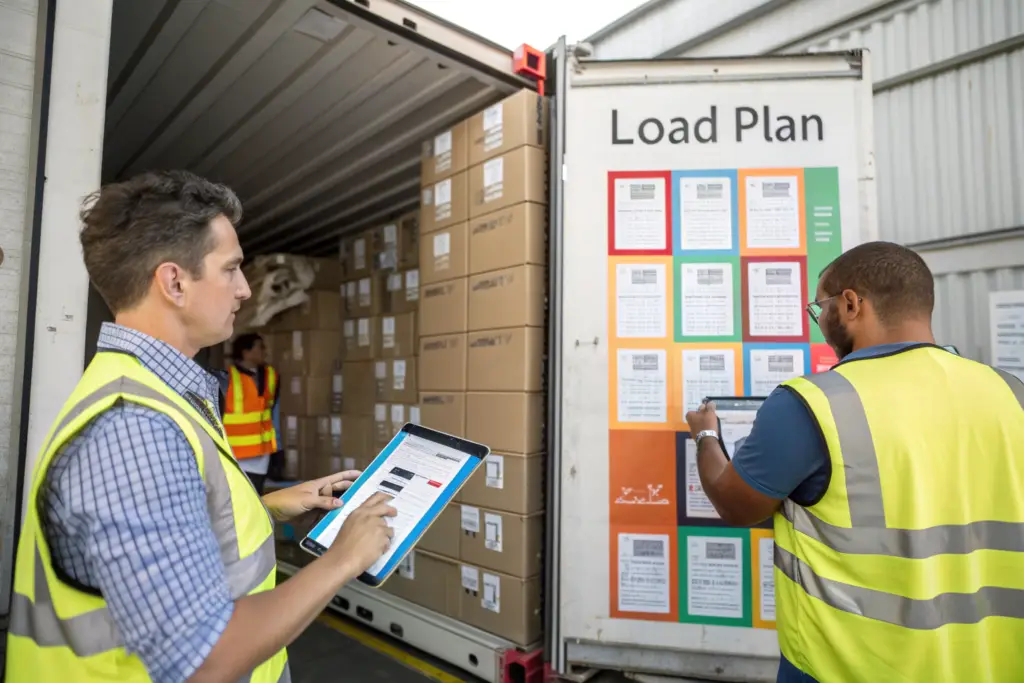
A load plan is a diagram showing the physical placement of each pallet or group of cartons within the container. It is created before the container is loaded. The distributor provides the load plan to the factory, specifying which products should be loaded where.
The load plan reflects the distributor's downstream logistics. The distributor knows that Style A and Style B are going directly to a major retail customer as soon as the container arrives. Those cartons should be at the rear of the container, accessible without unloading the entire container. Style C and Style D are going into the distributor's warehouse for later distribution. Those cartons can be deeper in the container.
The load plan also reflects weight distribution. Heavy cartons of denim jeans should be loaded on the bottom, at the front of the container near the tractor. Lighter cartons of silk dresses should be loaded on the top, toward the rear. Proper weight distribution is a safety requirement for road transport.
The factory's loading team follows the load plan exactly. The container is loaded as designed. The distributor's receiving team knows where every product is located before the doors are opened. The unloading process is efficient and directed, not chaotic and exploratory.
A distributor client sends us a load plan for every mixed container. His plan is simple but effective. He divides the container into three zones. Zone A, at the rear, contains pre-sold goods for immediate cross-docking. Zone B, in the middle, contains his core replenishment styles. Zone C, at the front, contains new test styles with no immediate urgency. The loading team marks the floor of the container with chalk lines indicating the zones. The cartons are loaded accordingly. When the container arrives at his warehouse, the team unloads Zone A, cross-docks it immediately, and puts Zones B and C into storage. The entire process takes hours, not days.
How Do You Allocate FOB Costs Fairly Across Multiple Styles in One Container?
The FOB price quoted by the factory typically includes the cost of the goods plus the cost of transporting them to the port of export. The ocean freight from the port of export to the destination port is a separate cost, often paid by the distributor directly to the freight forwarder. However, in a mixed container, the allocation of shared costs, the inland trucking in China, the consolidation fee, the freight forwarder's handling charges, must be allocated fairly across the different styles in the container.
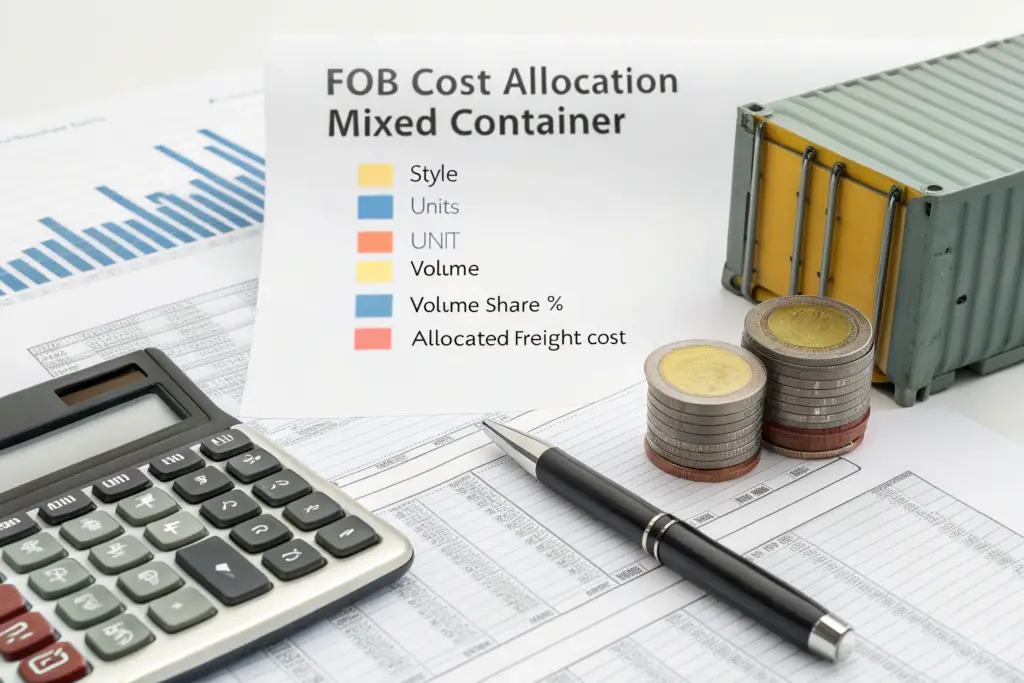
The fairest method for allocating shared FOB and freight costs across multiple styles is by volume share. Each style consumes a certain amount of the container's total cubic meter capacity. A style that occupies 30% of the container's volume pays 30% of the shared freight and handling costs. A style that occupies 5% of the volume pays 5%. This volume-based allocation accurately reflects the economic cost each style imposes on the logistics system. A heavier style might consume less volume but more weight capacity. For sea freight, volume is typically the binding constraint for apparel, but weight can be the constraint for dense garments like denim. The allocation method should reflect the binding constraint.
The FOB cost per unit for each style is calculated by taking the factory's ex-works price for the style, adding the style's share of the inland transportation and export handling, and dividing by the number of units. The result is a fair, transparent FOB price for each style that reflects its true logistics cost.
Two styles with the same unit count can consume vastly different amounts of container space. A style of lightweight silk blouses, packed flat in small cartons, might consume 0.5 cubic meters for 100 units. A style of heavy wool overcoats, packed in large cartons, might consume 3.0 cubic meters for the same 100 units. If the freight cost were allocated by unit count, the silk blouses would subsidize the wool overcoats. The silk blouse distributor would be overpaying. The wool overcoat distributor would be underpaying.
Volume share allocation is fair because it allocates cost based on the actual space consumed. The overcoat consumes six times the container space of the blouse. It should pay six times the freight cost. The volume of each style is measured by the factory during the packing process. The carton dimensions and quantities are recorded. The total volume per style is calculated. The volume share is the style's volume divided by the total container volume.
Weight can be a secondary allocation factor if the container reaches its weight limit before its volume limit. This is rare for apparel, which is generally a volume-constrained, not weight-constrained, cargo. But for certain dense items, like heavily embellished jackets or leather goods, weight can be the binding constraint. In that case, a weight-based allocation is fairer. The allocation method should be discussed and agreed upon before the order is placed.
A distributor client orders a mix of men's wool overcoats and cotton t-shirts in his mixed container. The overcoats consume 60% of the container volume but only 30% of the unit count. The t-shirts consume 40% of the volume and 70% of the unit count. We allocate the shared freight costs 60% to the overcoats and 40% to the t-shirts. The distributor understands and agrees with the allocation because it reflects the physical reality of the container loading. The overcoats take up more space. They cost more to ship. The math is transparent.
How Do You Calculate the True Landed Cost Per Style for a Mixed Shipment?
The true landed cost is the total cost of getting a unit of a specific style from the factory floor to the distributor's warehouse shelf, ready for sale. It includes the FOB cost, the ocean freight, the insurance, the US customs duty, and the inland trucking from the destination port to the warehouse. For a mixed container, each of these cost elements must be allocated to the individual style to calculate its true landed cost and, from that, its required retail price and margin.
The calculation is a sequential allocation. The FOB cost per style is calculated as described above. The ocean freight is allocated by volume share. The insurance, typically a percentage of the invoice value, is allocated by the value share of each style. The US customs duty, calculated as a percentage of the FOB value based on the HS code, is specific to each style. The inland trucking from the port to the warehouse is allocated by volume share or by a flat per-pallet rate.
The sum of these allocated costs is the total landed cost for the style. Dividing by the number of units gives the landed cost per unit. This is the number the distributor must know to set the wholesale price and calculate the margin. A style with a FOB of $12 might have a landed cost of $15.50 after freight, duty, and trucking. A bulkier style with a FOB of $12 might have a landed cost of $17.00 because it consumes more container space. The landed cost calculation reveals the true profitability of each style.
A distributor client was surprised to learn that a beautiful but bulky sweater had a landed cost 18% higher than its FOB, while a compact woven shirt had a landed cost only 12% higher than its FOB. The sweater's bulkiness was consuming a disproportionate share of the freight. The landed cost analysis allowed him to price the sweater appropriately, maintaining his margin. Without the analysis, he would have priced it based on a generic freight estimate and unknowingly eroded his margin on every sweater sold.
How Can Mixed Orders Actually Improve Your Full-Price Sell-Through Rate?
The ultimate purpose of the mixed container model is not logistics efficiency. It is sales performance. The model enables a distributor to offer their boutique and online customers a more compelling product assortment, more frequent newness, and less competitive pressure from identical products flooding the market. These factors directly improve the full-price sell-through rate, the percentage of units sold at the original retail price, which is the single most powerful driver of profitability in apparel.
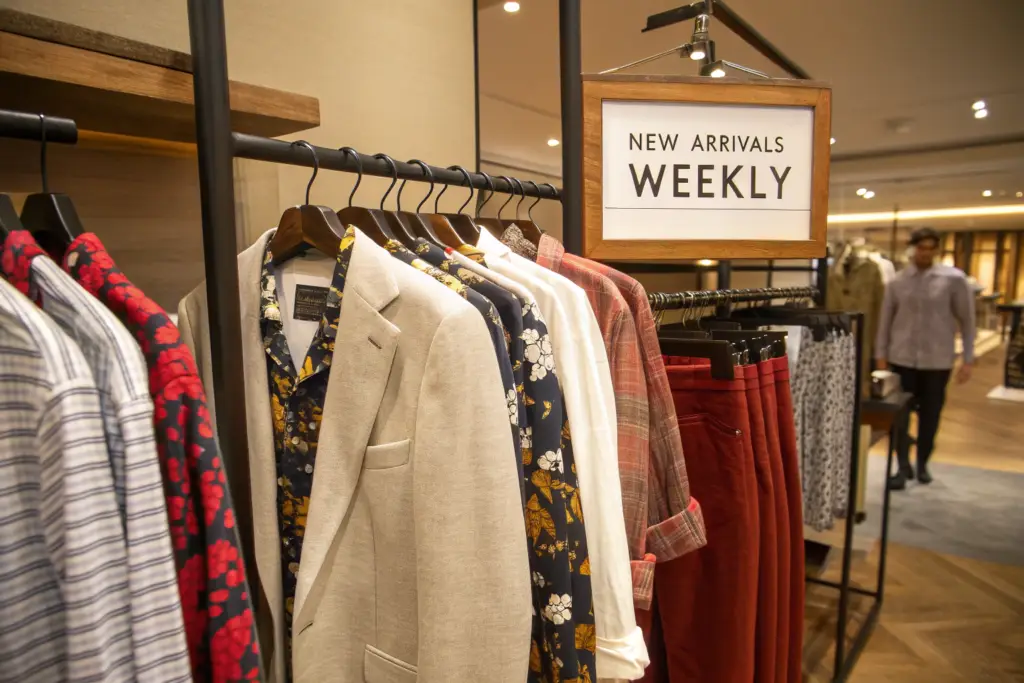
Mixed container orders improve full-price sell-through by enabling assortment breadth and scarcity-driven urgency. A boutique that receives 12 new styles every month, with only 24 units per style, creates a constant sense of newness and a "buy it now or it will be gone" urgency for the consumer. The limited depth per style reduces the risk of markdowns because there is simply less inventory to clear. If a style sells out, it is a success. The distributor reorders the winners and lets the slow sellers quietly disappear without a clearance rack. The model aligns inventory supply with consumer demand more closely than the traditional deep-inventory model.
The traditional model of deep inventory on a few styles creates a structural tendency toward markdowns. The distributor ordered 1,200 units of a style based on a forecast made six months ago. The forecast was imperfect. The style sells 800 units at full price. The remaining 400 units must be cleared at a discount. The markdown cost is baked into the model. The mixed container model, with its small initial buys and rapid reorder capability, reduces the forecast error and the resulting markdown liability.
How Does "Frequent Newness" Affect Boutique Buyer Psychology?
Boutique buyers are a distinct customer segment for a distributor. They are small business owners who curate a selection of products for their local customers. Their primary competitive advantage over large retailers and online giants is their ability to offer a unique, constantly refreshed selection. Their customers visit the boutique not just to buy, but to discover. The boutique that has the same merchandise as last month loses the discovery customer.
A distributor who delivers a mixed container of fresh styles every month is a dream partner for a boutique buyer. The buyer knows that every month, they will see a new collection of styles. They can order small quantities, 4 to 6 units per style, creating a curated, eclectic assortment for their shop. If a style sells well, they can reorder quickly. If a style does not resonate with their customer base, they are only stuck with a few units, not a deep inventory commitment.
The frequent newness also drives more frequent boutique buyer visits, physical or virtual. The buyer checks the distributor's new arrivals more often. They place orders more frequently. The distributor becomes a regular part of the buyer's sourcing rhythm, not an occasional seasonal appointment. The share of the buyer's wallet increases.
A distributor who adopted the mixed container model two years ago told me his boutique buyer reorder rate has increased by 40%. His buyers tell him they love the "treasure hunt" feel of his monthly new arrivals. They never know exactly what they will find, but they know it will be fresh, limited, and interesting. The monthly mixed container has become the engine of his customer engagement.
Why Does "Limited Depth" Create a More Premium Consumer Perception?
Scarcity is a powerful psychological driver of value perception. A consumer who sees a rack of 50 identical dresses perceives the dress as common, mass-produced, and likely to go on sale. A consumer who sees a rack with only 8 of the same dress, and who is told "we only received a few of this style," perceives the dress as special, exclusive, and worth buying now at full price.
The mixed container model, with its intentional limited depth per style, creates this scarcity perception naturally. The distributor is not artificially limiting supply. The supply is genuinely limited by the economics of the model. The consumer's perception of scarcity is accurate. The dress is rare. If she does not buy it today, it may not be there tomorrow.
The scarcity perception also reduces the consumer's inclination to wait for a sale. The consumer has learned that interesting styles at this boutique sell out. Waiting for a markdown means missing out entirely. The consumer is trained to buy at full price. The markdown addiction, the learned behavior of waiting for the inevitable 40% off sale, is broken. The brand's price integrity is maintained.
A distributor selling through his own online store and a network of boutiques adopted the mixed container model and made limited depth a core part of his brand identity. His product pages show a real-time inventory count. "Only 3 left in size Medium." His customers know this is not a marketing tactic. The inventory is genuinely limited. His full-price sell-through rate is over 85%, compared to an industry average of 60% to 70%. The limited depth model has trained his customers to value his products at full price.
Conclusion
The mixed container order is more than a shipping method. It is a fundamentally different approach to inventory risk, market responsiveness, and customer engagement. It replaces the concentrated bet, the large order of a few styles placed months in advance, with a diversified portfolio of small bets that can be scaled rapidly based on real market feedback.
We have seen how the model solves the cash flow problem by reducing the bet size per style, turning a single $15,000 gamble into five $3,000 experiments. We have examined the packing and logistics discipline required to execute a 12-SKU shipment without receiving chaos, the carton-level labeling, the electronic packing list, the strategic load plan. We have clarified the fair allocation of shared costs by volume share, enabling the distributor to calculate the true landed cost and margin for each style. And we have explored how the model's inherent characteristics, frequent newness and limited depth, directly improve full-price sell-through by driving boutique buyer engagement and consumer urgency.
The mixed container model is not the right solution for every product category. Basic commodity items with predictable demand, white t-shirts, black socks, are better served by the traditional large-order, low-cost model. But for fashion-sensitive categories, where consumer preference is unpredictable and novelty is valued, the mixed container is a powerful competitive tool.
At Shanghai Fumao, we have adapted our production planning, our packing processes, and our logistics coordination to serve the mixed container model efficiently. Our minimum order quantities are designed to accommodate the smaller per-style volumes. Our packing team is expert in carton-level labeling and load plan execution. Our shipping department can coordinate a 12-SKU consolidated shipment with the same precision as a single-SKU shipment.
If you are a US distributor looking to test new styles with less inventory risk, or if you are struggling with markdowns on deep inventory and want to explore a more agile model, I invite you to contact our Business Director, Elaine. She can provide a sample cost breakdown for a mixed container, walk you through our packing and labeling standards, and help you assess whether the mixed container model is the right fit for your product categories and your market. Reach Elaine at elaine@fumaoclothing.com. Let's build a smarter, more responsive supply chain together.