
In the autumn of 2022, a brand owner from Chicago called me with a problem that had nothing to do with fabric or fit. He had placed a $120,000 production order with Shanghai Fumao in July, when the exchange rate was 6.70 RMB to the US dollar. By the time his final balance payment was due in October, the dollar had strengthened to 7.30 RMB. His order, priced in dollars, should have cost him the same regardless. But his factory in another country had quoted him in their local currency, and that currency had moved sharply against the dollar. His cost had increased by nearly 9% between order placement and final payment. He asked me, "How do I protect myself from this? I cannot run a business where my cost of goods sold changes by thousands of dollars between seasons based on something I cannot control." He was right. Currency risk is not a finance department abstraction. It is a direct, measurable threat to an importer's gross margin.
Alternative payment structures that mitigate currency fluctuation risks for importers include split-currency contracts that denominate the product cost and the logistics cost in different currencies, forward exchange contracts that lock in an exchange rate at the time of purchase order issuance, multi-currency escrow arrangements that hold funds in a stable intermediary currency until shipment milestones are met, and progressive payment schedules that reduce the time exposure between each payment and the corresponding currency conversion. Each structure addresses a different aspect of the currency risk problem: the timing of exposure, the currency of denomination, and the mechanism of rate protection.
At Shanghai Fumao, I have always priced our production in US dollars. This is a deliberate choice. I want our brand partners to know exactly what their garment cost will be, from the day they place the purchase order to the day they make the final payment. The currency risk that exists in the transaction is borne by us, not by the brand. We manage it through our own hedging and treasury practices. But not all factories operate this way, and even with a dollar-denominated contract, there are currency risks that an importer should understand and mitigate. Let me explain the most effective structures and how to implement them.
Why Do Standard Letter of Credit Terms Fail to Address Currency Risk?
The standard Letter of Credit is the most widely used payment instrument in international garment trade. It provides security to both parties. The buyer knows the bank will not release payment until compliant shipping documents are presented. The supplier knows the bank's obligation to pay is irrevocable once the L/C is issued. This security is valuable. But a standard L/C does nothing to address currency risk. The L/C specifies the payment currency and the payment amount. If the buyer's local currency weakens against the L/C currency during the period between contract signing and payment maturity, the buyer's cost in their local currency increases. The L/C provides payment security. It does not provide price certainty.
A standard Letter of Credit fails to address currency risk because it locks in the payment currency at the contract date but does not lock in the exchange rate at which the buyer will acquire that currency. If the buyer's business operates in US dollars and the L/C is denominated in US dollars, no currency conversion is required, and the risk does not exist. But if the buyer's business operates in euros, pounds, or Australian dollars, and the L/C is denominated in US dollars, the buyer is exposed to the exchange rate movement between the contract date and the date they purchase the dollars to fund the L/C. This exposure period can be 60 to 90 days, during which currency moves of 3% to 8% are common.
The solution is not to abandon the Letter of Credit. It is to add a currency hedge to the L/C structure, or to negotiate a different currency denomination that aligns the contract currency with the buyer's revenue currency. A buyer who sells garments in euros should, where possible, pay for production in euros, or hedge the euro-dollar exposure. Here is how currency denomination decisions are made and what forward contracts can do.

Should Importers Negotiate Contracts in Their Own Currency or the Supplier's Currency?
The optimal currency denomination aligns the contract currency with the importer's primary revenue currency. An American brand that sells in US dollars and pays its factory in US dollars has no currency exposure on the cost side. The price is the price. The currency risk is shifted entirely to the factory, which must convert the dollars into its local currency to pay for labor, fabric, and overhead.
A European brand that sells in euros but pays its factory in US dollars has a currency exposure. If the euro weakens against the dollar between the order date and the payment date, the euro cost of the dollar-denominated payment increases. The brand can either accept this risk, hedge it, or negotiate a euro-denominated contract with the factory. A factory that is willing to accept euro payments takes on the currency risk but may factor that risk into its pricing. The importer must compare the factory's euro price against the expected dollar price plus the cost of hedging. Sometimes the factory's euro price is competitive and the importer achieves risk reduction at no additional cost. Sometimes the factory's euro price includes a risk premium that makes it more expensive than hedging independently.
How Can Forward Exchange Contracts Be Attached to a Purchase Order?
A forward exchange contract is a simple financial instrument. The importer's bank agrees to sell a specific amount of foreign currency at a specific exchange rate on a specific future date. The importer knows, on the day the purchase order is signed, exactly how much the payment will cost in their local currency. The exchange rate is locked. The currency risk is eliminated.
The mechanics are straightforward. An importer signs a purchase order for $80,000, payable in 60 days upon shipment. The current spot rate is 1.10 USD per euro. The 60-day forward rate quoted by the bank is 1.09 USD per euro, reflecting the interest rate differential between the two currencies. The importer books the forward contract. The cost in euros is locked at 73,394 euros. If the dollar strengthens to 1.15 over the next 60 days, the importer is protected. They still pay 73,394 euros. If the dollar weakens to 1.05, the importer does not benefit from the move, but they have certainty. For an importer whose business depends on predictable margins, certainty is more valuable than the chance of a favorable rate move. I recommend importers speak with their bank's trade finance or foreign exchange desk before each seasonal production cycle to set up a forward contract program that covers their projected payment schedule.
What Is a Split-Currency Payment Structure and How Does It Work?
A split-currency payment structure separates the total garment cost into components that are naturally denominated in different currencies, and pays each component in its natural currency. This structure recognizes that different parts of the supply chain have different currency exposures. The factory's costs, labor, domestic fabric, domestic trim, are in the factory's local currency. The logistics costs, international freight, customs duties, destination handling, are often in US dollars or the importer's local currency.
A split-currency contract denominates the FOB product cost in the factory's local currency and the logistics cost in US dollars or the importer's local currency. The importer pays two separate invoices: one in RMB or VND to the factory for the product, and one in USD to the freight forwarder for the logistics. This structure reduces the importer's currency exposure to only the product cost component, and it allows the factory to receive payment in the currency it actually needs to operate its business, eliminating the factory's embedded currency conversion margin. Both parties can achieve a lower total cost than a single-currency contract that forces one party to bear the entire exchange rate risk.
I have implemented split-currency structures for several brand partners who operate their own freight and logistics arrangements. The product is priced in RMB on the FOB cost sheet. The logistics are arranged and paid separately by the brand in USD. The brand's currency exposure is limited to the RMB-denominated product cost. The brand can hedge the RMB exposure independently, or accept the RMB-USD fluctuation as a manageable risk. The brand is not paying a hidden currency conversion margin embedded in a single-currency FOB price. Here is how to structure the product versus logistics split and how to negotiate it with a factory.

How to Separate Product Cost and Freight Cost in a Multi-Currency Invoice?
The commercial invoice or the purchase order should clearly separate the FOB product value and the freight value. The product value is stated in the factory's local currency, for example, RMB. The freight value, if the factory is arranging freight, is stated in US dollars. The two values are separate line items with separate payment instructions.
If the factory is arranging freight, the importer can request a split payment. The product payment goes to the factory's RMB account. The freight payment goes to the factory's USD account or directly to the freight forwarder's account. This separation allows the importer to see exactly what they are paying for product and what they are paying for logistics. It also allows the importer to pay the freight component in a currency that matches their revenue currency, reducing exposure on that portion of the cost. If the importer arranges freight independently, the split is automatic. The factory is paid in RMB for the FOB goods. The forwarder is paid in USD or the importer's local currency for the freight.
What Are the Benefits of Paying the Factory in Their Local Currency?
When a factory quotes a price in US dollars but incurs its costs in RMB, the factory must build a currency conversion margin into its dollar price. The margin protects the factory against the RMB strengthening against the dollar between the quote date and the payment date. The margin is typically 2% to 5% of the product cost. The importer pays this margin without seeing it.
When the importer agrees to pay in RMB, the factory does not need to build in the currency conversion margin. The factory's quote is its actual RMB cost plus its target RMB profit. The factory's price is lower because the currency risk is removed from its calculation. The importer then manages the RMB-USD conversion themselves, either by purchasing RMB at the spot rate when payments are due, or by using a forward contract to lock in the RMB cost. The importer can typically acquire RMB at a better rate than the factory's embedded margin, because the importer has access to competitive foreign exchange markets. The net result is a lower total cost for the importer and a simpler, more transparent transaction for the factory.
How Can Multi-Currency Escrow Accounts Protect Both Parties?
An escrow account is a neutral holding account, typically at a bank or a licensed escrow service provider, that holds the buyer's payment and releases it to the supplier only when agreed conditions are met. The traditional escrow model is single-currency. The buyer deposits funds in the contract currency, and the funds sit in the escrow account until the release conditions are satisfied. A multi-currency escrow account allows the funds to be held in a currency that is stable relative to both the buyer's currency and the supplier's currency, or to be converted at the moment the escrow is funded, locking in the exchange rate at that point.
A multi-currency escrow arrangement mitigates currency risk by requiring the buyer to fund the escrow at the time of order placement, converting their local currency into the contract currency at the spot rate on that date. The exchange rate is locked. The funds sit in escrow, denominated in the contract currency, until the shipment milestones are met. The supplier knows the funds exist and are irrevocably allocated to the order. The buyer knows the cost in their local currency and cannot be surprised by a rate move between order placement and shipment. The escrow provider manages the currency holding and conversion, for a fee that is typically lower than the currency risk premium embedded in a standard deferred payment arrangement.
Escrow services for international trade are offered by specialized fintech companies, some traditional banks, and some Alibaba-affiliated services. The fee structure varies, typically 0.5% to 1.5% of the transaction value. The fee must be weighed against the currency risk being mitigated. For a $200,000 order with a 90-day exposure period, a 1% escrow fee of $2,000 is significantly less than the potential loss from a 5% adverse currency move of $10,000. Here is how escrow compares to direct wire transfer and how milestone releases work.

What Is the Difference Between Escrow and Direct Wire Transfer for Currency Protection?
A direct wire transfer requires the buyer to acquire the foreign currency at the time of payment. If the payment is due 60 days after order placement, the buyer acquires the currency at the exchange rate prevailing on day 60. The buyer has no protection against a rate move during the 60-day period.
An escrow arrangement requires the buyer to acquire the foreign currency at the time of order placement, day zero. The currency is purchased and deposited into escrow. The exchange rate is locked on day zero. The buyer's cost in their local currency is fixed and known. The currency risk during the 60-day production and shipping period is eliminated. The trade-off is that the buyer must fund the payment earlier, which has a working capital cost. The buyer must weigh the working capital cost of early funding against the currency risk of deferred payment. In a volatile currency environment, the currency risk typically outweighs the working capital cost.
How to Structure Milestone-Based Releases from a Currency Escrow?
A milestone-based escrow release ties the disbursement of funds to specific, verifiable production and shipping milestones. This structure protects both parties. The buyer knows that funds are not released until the supplier has demonstrated progress. The supplier knows that the funds are in escrow and will be released upon meeting the milestones.
A typical milestone structure for garment production has three releases. Release one, 30% of the escrow amount, upon the buyer's approval of the pre-production sample and the fabric cutting commencement. Release two, 40%, upon the buyer's receipt of the pre-shipment inspection pass report or the bill of lading. Release three, 30%, upon the buyer's confirmation of delivery or after a specified number of days following the shipment date. Each milestone is documented with a specific, verifiable document. The escrow provider releases funds only upon presentation of the document. The currency is converted and held at the initial escrow funding, so all releases are at the locked exchange rate.
What Progressive Payment Schedules Reduce Currency Exposure Over the Production Cycle?
The standard payment schedule in garment manufacturing is a deposit with the order and a balance payment before shipment. The deposit is 20% to 30% of the order value. The balance is 70% to 80%. The balance payment is made 60 to 90 days after the order is placed. The entire balance is exposed to currency movement during that period. A progressive payment schedule breaks the total payment into smaller, more frequent installments that are spread across the production cycle. Each installment is exposed to the exchange rate at its specific payment date, reducing the average exposure period for the total order value.
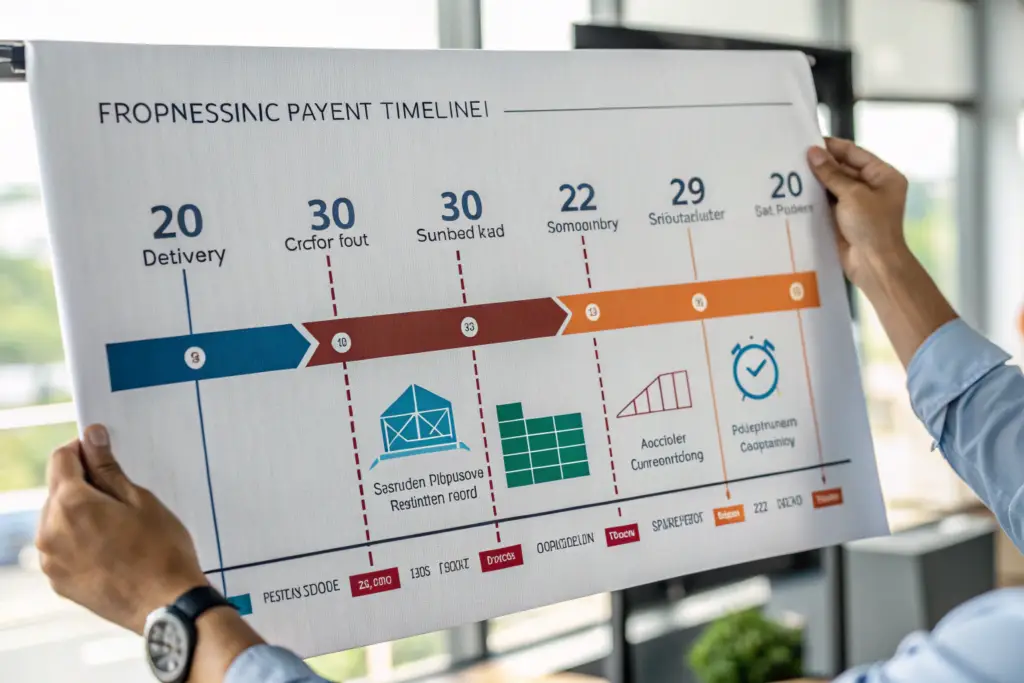
A progressive payment schedule reduces currency exposure by shortening the time between each payment and the corresponding currency conversion. Instead of exposing 80% of the order value to a 90-day currency movement, the importer exposes 30% to a 30-day movement, another 30% to a 60-day movement, and the final 20% to a 90-day movement. The average exposure is reduced. The importer also has the flexibility to purchase the currency for each installment as it comes due, potentially benefiting from favorable rate movements on later installments, rather than being forced to purchase the entire amount at a single rate.
This structure requires a factory that is willing to accept a progressive payment schedule. The factory's working capital needs, paying for fabric, trim, and labor during the production cycle, must be met by the progressive payments. A factory that receives 30% at order, 30% at cutting, and 30% at shipment has a steady cash inflow that matches its cash outflow. The factory's working capital burden is actually reduced compared to a standard 30/70 schedule, where the factory must finance the entire production cost until the single large balance payment arrives. Here is how to structure the payment installments and what triggers the factory needs to agree to the schedule.
What Is an Ideal Payment Schedule for Reducing Currency Risk on a 90-Day Order?
An ideal progressive payment schedule for a 90-day production cycle has three to four installments, each tied to a production milestone that provides the factory with the cash it needs for the next phase of work.
Installment one: 25% at purchase order confirmation. This payment covers the fabric deposit and initial pattern-making labor. The currency is converted at the spot rate on the PO date. The exposure period for this installment is zero. Installment two: 30% at fabric cutting commencement. This payment covers the balance of the fabric cost and the cutting labor. The currency is converted at the spot rate on the cutting date, approximately 30 days after the PO date. The exposure period for this installment is 30 days. Installment three: 30% at pre-shipment inspection pass. This payment covers the sewing and finishing labor. The currency is converted at the spot rate on the inspection date, approximately 60 days after the PO date. The exposure period for this installment is 60 days. Installment four: 15% at delivery confirmation. This final payment provides the factory's profit margin and is converted at the spot rate approximately 90 days after the PO date.
What Milestones Should Trigger Each Payment Release?
The milestones must be objectively verifiable and under the factory's control, not the buyer's subjective approval. A milestone defined as "buyer approval of sample" introduces a delay risk that is unfair to the factory. A milestone defined as "presentation of the cutting report with photographs" is objective and within the factory's control.
Recommended milestones for a garment production payment schedule are: purchase order issuance and return of signed contract, fabric receipt at the factory with photographic evidence and mill delivery note, cutting commencement with photographic evidence of the first spread on the cutting table, sewing completion of 50% of the order quantity with inline production data, final inspection pass with a third-party or factory inspection report, and shipment with the bill of lading. Each milestone triggers a specific payment percentage. The total of all payments equals the order value. The schedule is documented in the purchase order or a separate payment schedule annex. Both parties sign it.
Conclusion
Currency fluctuation is not a peripheral risk in international garment sourcing. It is a core cost variable that can swing the gross margin on an order by five to ten percentage points between the day the order is placed and the day the payment clears. Importers who treat currency risk as a finance department afterthought are gambling with their profitability. Importers who proactively structure their payment terms to mitigate currency exposure are protecting their margins and building more stable, predictable businesses.
At Shanghai Fumao, I work with brand partners to find the payment structure that fits their business model and their risk tolerance. For brands that want maximum simplicity, we price in US dollars and absorb the currency management on our side. For brands that want to optimize their currency costs, we offer RMB-denominated product pricing with split-currency logistics. For brands that want maximum security, we work with escrow providers and accept progressive milestone payments. The right structure is the one that aligns the incentives of both parties and removes currency anxiety from the production conversation.
If currency fluctuation has hit your margins on a recent shipment, or if you are planning your next production cycle and want to explore payment structures that reduce your exposure, let us discuss the options. We can walk you through how we manage currency risk on our side and help you design a payment schedule that works for your business. Reach out to our Business Director, Elaine, at elaine@fumaoclothing.com. The exchange rate should not determine whether your season is profitable.