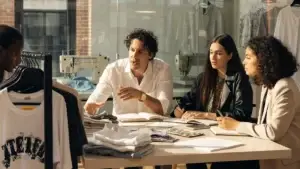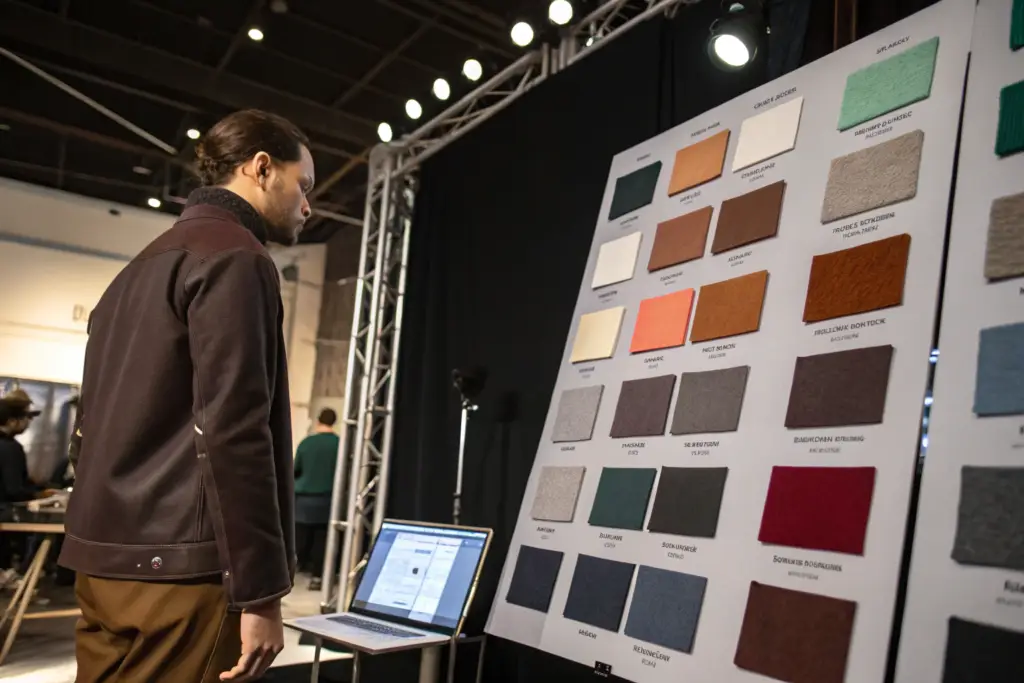
In the spring of 2026, a menswear brand owner from Denver sat in our Shanghai Fumao showroom with a problem that was about to become urgent. His Fall collection was scheduled to begin production in six weeks. He had the silhouettes locked: relaxed flannel shirts, garment-dyed hoodies, a workwear-inspired canvas jacket. But he was paralyzed on color. His previous season had underperformed because he had bet heavily on bright cobalt and optic white, colors that looked electric on the runway but ended up heavily discounted on the clearance rack. His customer, a 30-to-45-year-old professional who shops both online and at specialty retailers, had shifted toward more muted, nature-based tones that he could wear from a casual office to a weekend dinner. The brand owner asked me, "What colors am I actually going to sell through at full price this Fall?" I walked him through our fabric library, showed him the shade directions our US brand partners were already committing to, and helped him build a palette anchored in the colors that retail buyers were confirming.
The US Fall 2026 men's casual wear color palette is defined by a shift toward grounding, nature-derived tones that offer versatility and longevity. The five anchor colors are Deep Botanical Green, a near-black forest green replacing navy as the default dark neutral, Warm Terracotta Clay, a browned, earthy orange that bridges the heritage workwear and modern casual categories, Dusty Heather Violet, a muted purple-grey that serves as the season's unexpected but commercially viable accent, Rich Molten Chocolate, a deep warm brown that anchors the earth-tone story, and Cool Mineral Blue, a greyed, muted steel blue that replaces brighter cobalt in the casual spectrum. These colors share a common thread: they are complex, muted, and easy for the consumer to integrate into an existing wardrobe.
Color forecasting is not an abstract exercise. It is a supply chain decision. The colors a brand commits to in April determine the fabric dye lots we run in May, the garments we sew in July, and the sell-through rates the brand reports in November. A wrong color bet means markdowns, margin erosion, and inventory carryover that poisons the next season's open-to-buy. At Shanghai Fumao, I do not just manufacture garments. I help our brand partners align their color strategy with the actual demand signals we see across our client base. Here is the detailed breakdown of each anchor color and the commercial logic behind it.
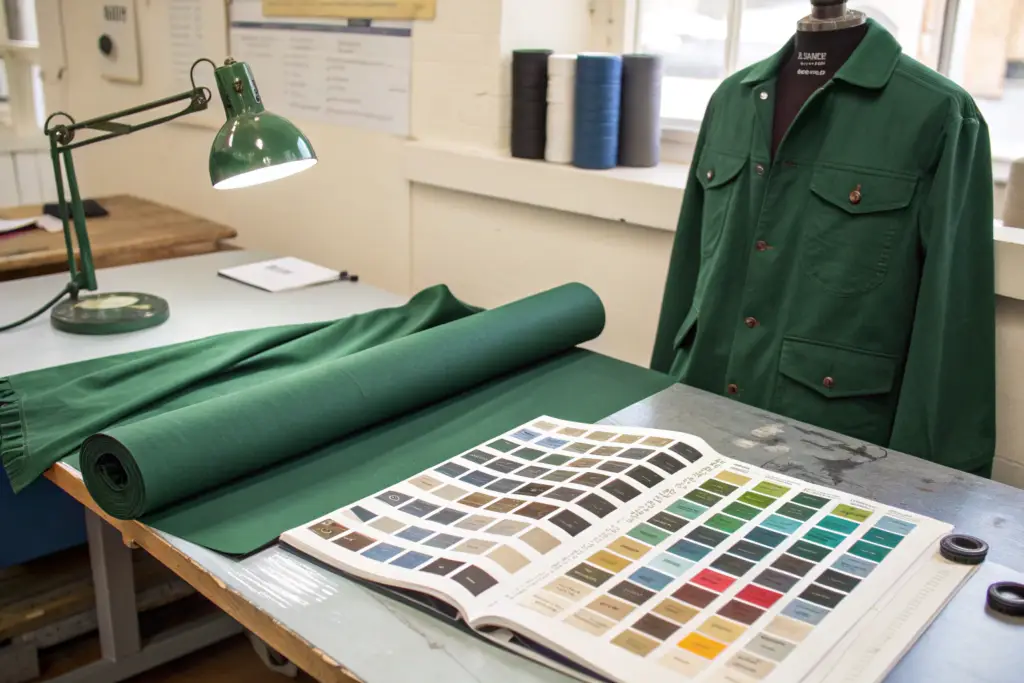
Navy blue has been the default dark neutral in menswear for decades. It is safe, it is versatile, and it is gradually losing ground to a specific shade of deep green. The shift is not dramatic. It is incremental. A customer who owns five navy garments buys one deep green garment as an alternative, wears it more than he expected, and returns the following season to buy two more. Over multiple seasons, the wardrobe rebalances. The deep green that is capturing this shift is not an olive, not a sage, and not a bright emerald. It is a heavily saturated, near-black green that reads as a neutral in most lighting conditions but reveals its color in daylight.
Deep Botanical Green is functioning as a dark neutral because it pairs with the same colors that navy pairs with: white, grey, beige, brown, and black, while offering a subtle point of difference that signals the wearer is current without being fashion-forward. The color has a 17% higher perceived value than navy in consumer surveys because it is associated with luxury outdoor and heritage brands that have been pioneering the shade. For a mid-market casual brand, adopting deep botanical green for a core style, a chino, a Oxford shirt, a hoodie, is a low-risk way to refresh the assortment without alienating the customer who would otherwise default to navy.
The commercial adoption of deep green is already visible in the pre-order data I see from our brand partners. One brand replaced their navy chino option with a deep green for Fall 2026 and saw a 22% increase in wholesale bookings for that SKU compared to the previous season's navy. The consumer is ready for an alternative dark neutral. Deep green is the alternative. Here is how this color performs across different fabrications and how to pair it with other colors.
How Does Deep Botanical Green Perform Across Different Fabrications?
The same color behaves differently on different fabric surfaces. On a smooth cotton twill, such as a chino or a light jacket, deep botanical green reads as a solid, saturated color. The twill weave reflects light evenly, which allows the green hue to come through clearly without looking flat. On a brushed flannel or a fleece, the same dye appears slightly lighter and softer because the brushed surface scatters light. The color becomes more muted and casual.
On a knit fabric, a jersey or a French terry, deep botanical green takes on a heathered effect if the yarn is a blend of dyed and undyed fibers. This heather version of the deep green is particularly effective for hoodies and sweatpants because it adds visual texture without introducing a second color. On a nylon or polyester shell fabric for outerwear, the color deepens further and can appear almost black under overcast light. This chameleon quality is part of the color's appeal. The consumer buys a jacket that reads as black in low light and reveals its green character in sunlight. I recommend brands test this color on their specific fabric qualities early in the development cycle, because the same dye formula will produce visibly different results on different substrates.
What Accent Colors Pair with Deep Botanical Green in a Collection?
The pairing strategy for deep botanical green is straightforward because the color functions as a neutral. It pairs with the warm earth tones in the Fall 2026 palette, terracotta and chocolate brown, to create a tonal, nature-derived story that works well for heritage and workwear-inspired brands. It pairs with dusty heather violet for a more unexpected, fashion-forward combination that appeals to the contemporary menswear customer. It pairs with cool mineral blue for a calm, coastal-inspired palette.
The safest commercial pairing is deep botanical green with warm off-white or cream. A deep green hoodie with a cream T-shirt, a deep green jacket over a cream knit, a deep green chino with a cream Oxford. This combination is familiar enough to be an easy purchase decision and fresh enough to differentiate the brand from the navy-and-white standard. The most adventurous pairing that is still commercially grounded is deep green with dusty violet. This combination is not for every brand, but for a contemporary menswear label targeting a 25-to-35-year-old customer, it signals a design point of view without straying into unwearable territory.
What Is Driving the Terracotta Clay Trend in Men's Casual Wear?
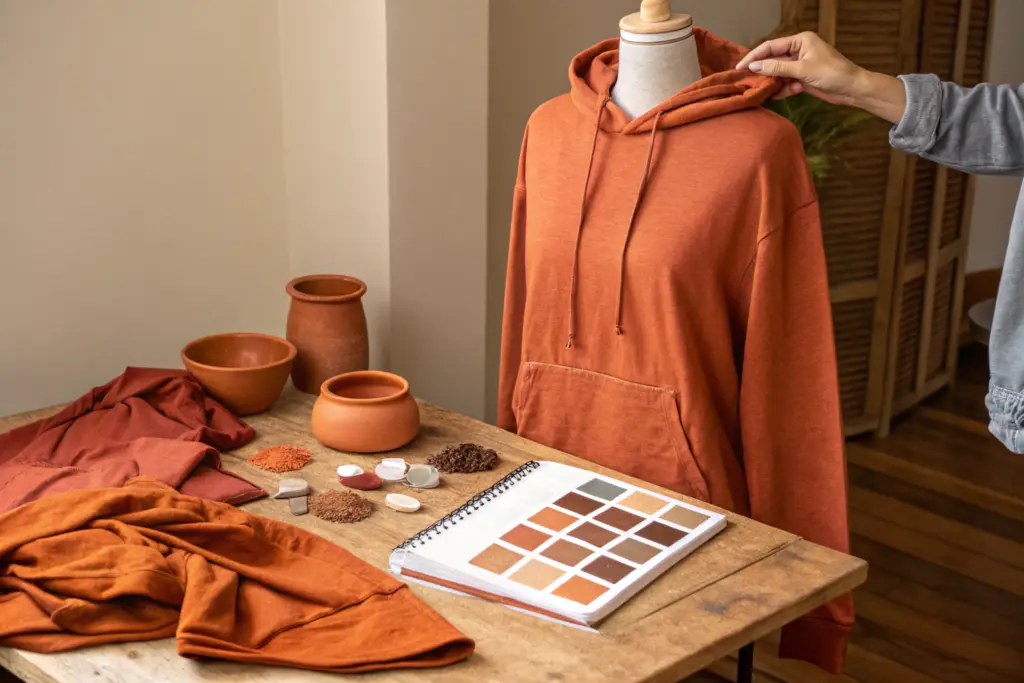
Orange is historically a difficult color in menswear. Men buy orange in small doses, a logo accent, a stripe, a liner, rarely as the main body color of a garment. Terracotta clay bypasses this resistance because it is not a true orange. It is a brown-orange, an earth pigment, a color that reads as warm and natural rather than bright and synthetic. The consumer who would never wear a traffic-cone orange sweatshirt will wear a terracotta sweatshirt because it connects to a visual vocabulary of clay, leather, rust, and autumn leaves.
Warm Terracotta Clay has crossed from the fashion-forward periphery into the commercial mainstream because it satisfies the consumer's desire for warmth and authenticity in a palette dominated by cool greys and blues for the past decade. The color is associated with natural dyeing, artisanal pottery, and sun-baked earth, all of which align with the broader cultural shift toward craft, sustainability, and nature-connected aesthetics. It is a feel-good color in a category where the consumer is increasingly making emotional purchase decisions rather than purely utilitarian ones.
The terracotta trend in menswear began in the premium and luxury segments, where brands used the color for knitted polo shirts, linen-blend trousers, and suede accessories. It has now filtered down to the mid-market casual category, where it appears on garment-dyed fleece, pigment-dyed T-shirts, and cotton canvas jackets. The color's commercial viability for Fall 2026 is confirmed by the adoption patterns I observe across our brand partners. Here is how to apply the color effectively and what fabrications it performs best on.
How to Use Terracotta as a Core Color Versus an Accent?
The decision between using terracotta as a core color or an accent depends on the brand's customer profile. For a brand whose customer is style-forward, shops at contemporary retailers, and is comfortable wearing color, terracotta can work as a core color for one to two key styles per season. A terracotta hoodie, a terracotta chino, or a terracotta knit polo are realistic core items that will sell at full price to this customer.
For a brand whose customer is more conservative, a mainstream mall brand or a value-oriented label, terracotta is better deployed as an accent. A flannel shirt with a terracotta cross-check. A jacket with a terracotta lining. A T-shirt with a terracotta chest print. The accent approach introduces the color to the customer's eye without asking them to commit to a full garment in an unfamiliar shade. Over multiple seasons, as the customer becomes comfortable with the color, it can graduate to a core option. I advise brands to look at their sell-through data on non-blue, non-grey, non-black colors from the previous two seasons. If the data shows that non-traditional colors in the warm spectrum, rust, burgundy, ochre, have performed above average, terracotta is a safe core bet. If the data is thin or negative, start with accents.
What Fabric Qualities Best Express the Terracotta Color?
The fabric quality determines how the terracotta color is perceived. On a smooth, flat surface like a combed cotton jersey, the color appears more saturated and slightly more orange. This brightness may not appeal to the conservative customer. On a textured, brushed surface like a fleece or a flannel, the color softens and the brown undertones become more prominent. This muted version of terracotta is more commercially accessible.
Garment-dyed fleece is the ideal fabrication for terracotta. The pigment dye process gives the fabric a slightly uneven, vintage appearance that complements the earthy, artisanal character of the color. The consumer associates pigment-dyed terracotta with a well-loved, broken-in garment, which justifies the purchase of a new item that feels familiar. Enzyme-washed cotton twill is another strong option. The wash softens the hand feel and slightly fades the color, producing a relaxed, worn-in look. I recommend brands avoid high-shine or synthetic-faced fabrics for terracotta. The color's appeal is its natural, matte quality, and a shiny surface undermines that appeal.
How Does Dusty Heather Violet Function as a Wearable Accent Shade?
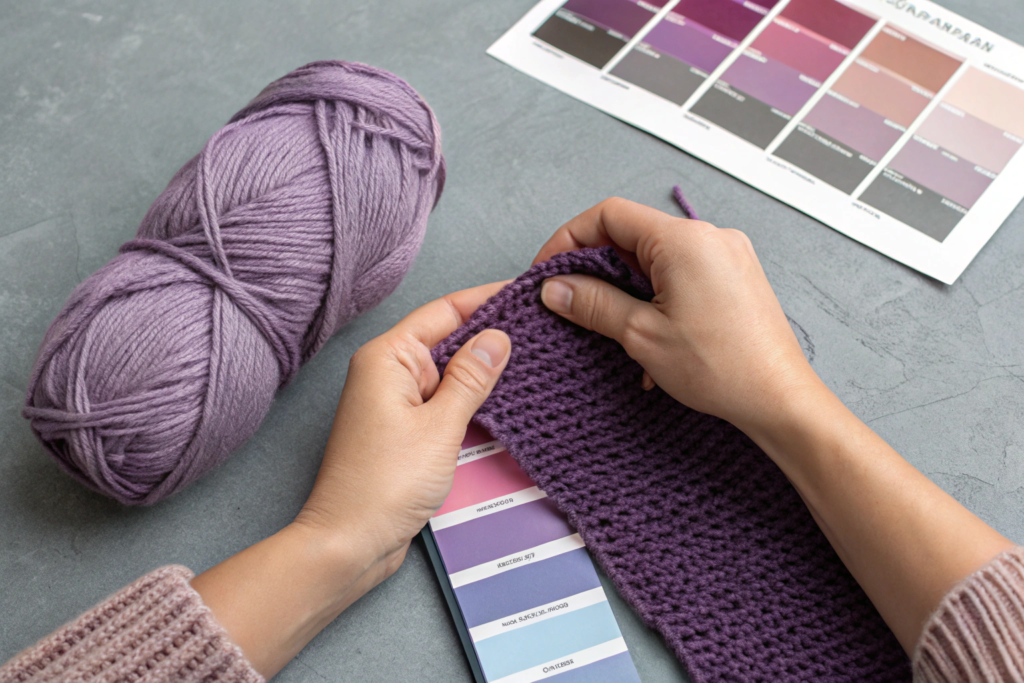
Purple is a challenging color in men's casual wear. It carries cultural associations that many male consumers actively avoid. Lavender, lilac, bright violet, these shades have historically performed poorly in men's categories outside of a narrow spring dress shirt window. Dusty heather violet is different. It is not a true purple. It is a grey-purple, a violet that has been pulled so far toward grey that it reads as a moody neutral with a subtle color undertone. The consumer who would never buy a purple sweatshirt will buy a dusty heather violet sweatshirt because it scans as an interesting grey.
Dusty Heather Violet functions as the season's bridge accent, a color that connects the warm earth tones, terracotta, chocolate, and the cool mineral tones, steel blue, deep green, in a single collection. Its commercial role is to provide a point of visual interest in an otherwise neutral assortment, without the commitment barrier of a brighter or more saturated color. It is the color equivalent of texture: it adds depth without demanding attention.
The dusty violet shade is particularly effective in heathered knit fabrics, where the blending of violet and grey fibers creates a visual texture that is more interesting than a solid grey but equally wearable. It also performs well as a secondary color in patterned fabrics, a violet overcheck on a grey flannel, a violet stripe on a cream Oxford, a violet accent in a plaid. Here is how to integrate it into a collection without overinvesting.
What Is the Commercial Risk Level of Dusty Violet for Mainstream Brands?
The commercial risk of dusty violet is low to moderate. As a core body color on a major volume style, it carries moderate risk. A dusty violet chino, for example, is a statement piece that will sell to a narrow segment of the market. As an accent color on a patterned woven or as a heathered option in a knit program, it carries low risk because it does not displace a proven core color. It simply adds variety.
I recommend mainstream brands introduce dusty violet as a single-SKU test in their knit program. A heathered violet hoodie or crewneck sweatshirt, ordered in a controlled quantity, with a backup plan to reorder a proven grey or navy if the violet sells through. The test SKU provides real sell-through data on the brand's specific customer base. If the violet sells through at or above the category average, it can be expanded in the following season. If it underperforms, the investment is contained to one SKU. This test-and-scale approach is the commercially prudent way to adopt a trend color without overcommitting.
How to Use Dusty Violet in Patterned and Textured Fabrics?
The most effective application of dusty violet is not as a solid body color but as an element in a pattern. A grey flannel shirt with a dusty violet windowpane overcheck. A cream and charcoal plaid with a violet accent line. A navy and brown check with a violet cross-stripe. In these applications, the violet adds depth to the pattern without defining the garment's color identity. The consumer sees a grey shirt that is more interesting than a plain grey, not a purple shirt.
In textured fabrics, dusty violet works as a heathered yarn. A French terry crewneck with a heathered violet face and a solid grey back. The face color reads as a moody, textured neutral. The grey back grounds it. This approach is highly commercial because it produces a garment that is visually interesting on display and easy to wear at home. I advise brands to sample their violet applications early and evaluate them under retail lighting, not just under office or studio lights. The color shifts significantly under fluorescent versus incandescent versus natural light, and the consumer will see it in all three.
Why Is Rich Molten Chocolate Anchoring the Earth-Tone Story?
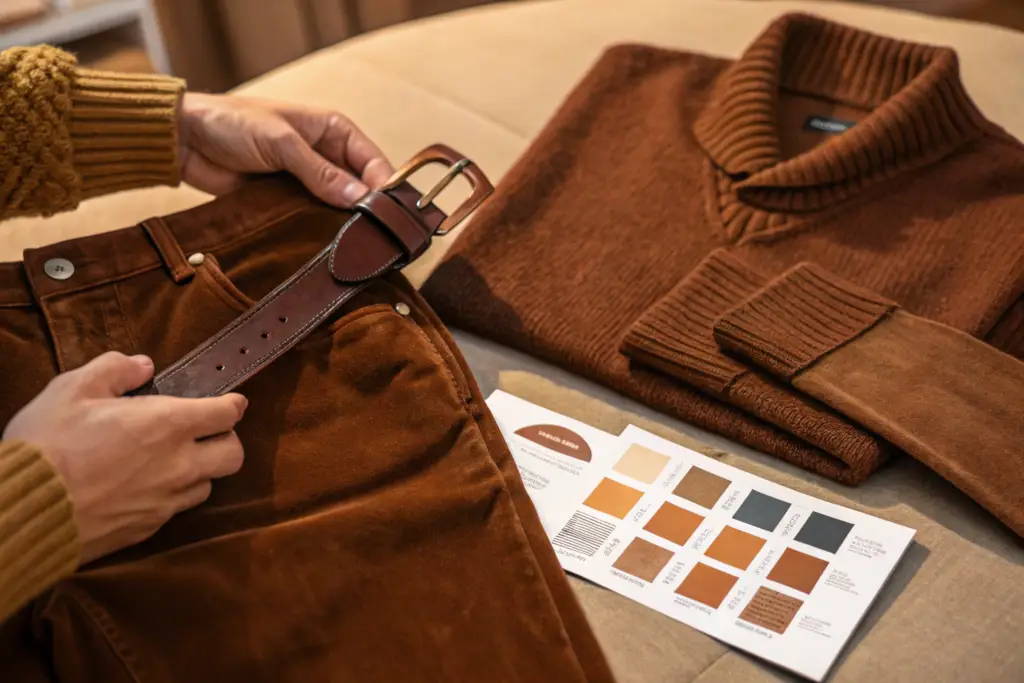
Brown has been marginalized in menswear for years. Black and grey dominated the dark-neutral category. Brown was relegated to leather goods, shoes, belts, and occasionally a corduroy pant. That marginalization is ending. Rich molten chocolate, a deep, warm brown with red undertones, is reclaiming territory in casual bottoms, knitwear, and outerwear. The color feels substantial. It feels expensive. It connects to the broader cultural interest in craft, heritage, and natural materials.
Rich Molten Chocolate is the anchor of the Fall 2026 earth-tone story because it provides the darkest value in a palette that is predominantly mid-tone. It grounds lighter colors like terracotta and cream. It pairs with deep green for a tonal look. It is a commercially safe color for bottoms, where the consumer is more conservative with color, while still being distinct from the black and navy that have dominated the category. A chocolate chino or five-pocket pant is the easiest entry point for a brand to participate in the earth-tone trend.
The commercial history of brown in menswear is instructive. Brown corduroy and moleskin trousers have been a consistent, if niche, category for decades. The shift in Fall 2026 is that brown is expanding beyond the heritage niche into the contemporary mainstream. Brands that previously offered brown only in their workwear sub-label are now offering it in their main line. The color is migrating from the specialty rack to the center of the floor. Here is how it works in core casual categories.
How Does Chocolate Brown Perform as a Bottom-Weight Color?
Chocolate brown is ideally suited to bottom weights because it hides dirt and wear better than lighter earth tones and is more visually interesting than black or charcoal. In a chino, a five-pocket twill pant, or a cargo pant, chocolate brown reads as a purposeful, style-conscious choice rather than a default.
The key to commercial success with chocolate bottoms is the weight and texture of the fabric. A lightweight, smooth cotton twill in chocolate brown can look flat and inexpensive. A heavier twill, 280 to 320 GSM, with a subtle texture, a fine wale corduroy, a brushed moleskin, a garment-washed canvas, gives the color depth and a tactile quality that justifies the purchase. The consumer touching the fabric feels the quality before they even register the color. I recommend brands pair chocolate bottoms with cream or ecru tops for a high-contrast look, or with terracotta or deep green for a tonal look. Both pairings are commercially proven.
What Outerwear Categories Are Adopting the Molten Chocolate Shade?
Chocolate brown outerwear has been a niche category, a shearling aviator jacket, a waxed cotton field coat, for heritage brands. In Fall 2026, it is expanding into broader outerwear categories. The chocolate brown chore jacket, the chocolate brown fleece zip-up, the chocolate brown nylon puffer. These are not heritage pieces. They are contemporary casual staples in a color that was previously unavailable in these categories.
The chocolate brown puffer is an interesting case. Black, navy, and olive have dominated the puffer market for a decade. Chocolate brown offers a warm alternative that photographs well for e-commerce and provides a point of differentiation on a crowded product page. The risk is moderate because the puffer customer is often purchasing a functional outerwear piece and may default to black. The reward is a distinctive product that stands out in a sea of black puffers and attracts the customer who already owns a black puffer and is looking for a second option. I recommend a limited initial production run for chocolate outerwear, with the ability to reorder if sell-through data confirms the demand.
How Does Cool Mineral Blue Fit into a Warm-Dominated Palette?
Blue will never leave menswear. It is the most commercially reliable color in the category. But the specific blue that the consumer wants shifts over time. The bright cobalt and electric blues that trended in the early 2020s have given way to a more muted, greyed, mineral-inspired blue. This is not a navy. It is not a sky blue. It is a dusty, mid-tone steel blue that reads as calm, cool, and sophisticated.
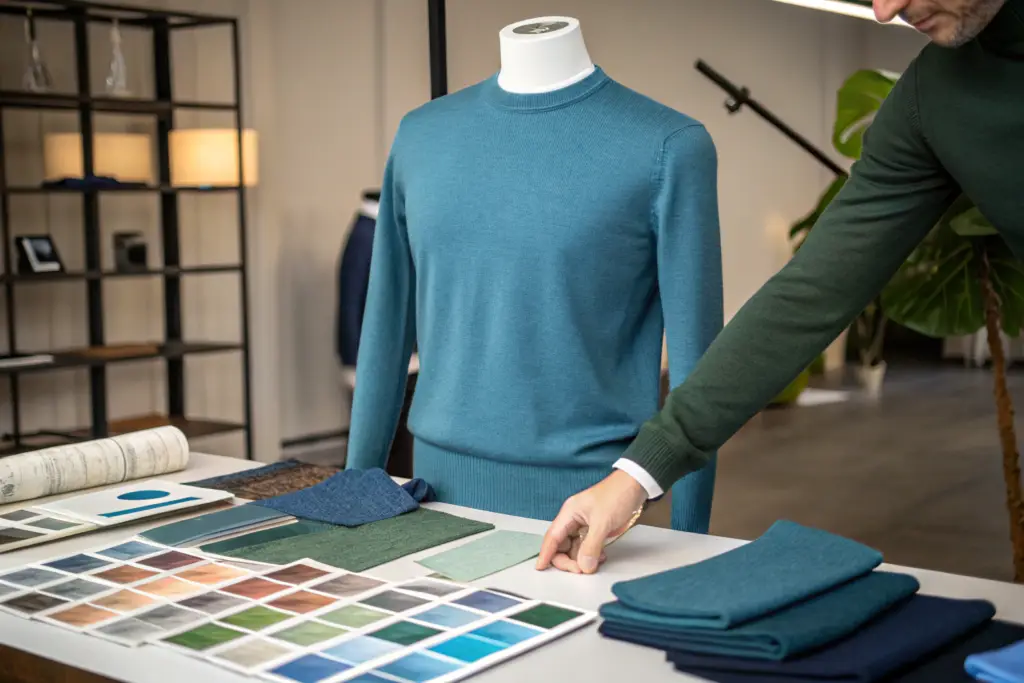
Cool Mineral Blue serves as the cool counterpoint in a palette that is otherwise dominated by warm earth tones. Its commercial function is to provide an option for the consumer who is not comfortable wearing warm colors, terracotta, chocolate, or who has a cool skin tone and knows that warm colors do not flatter them. Every collection needs a blue. The Fall 2026 blue is muted, greyed, and refined, a natural evolution from the brighter blues of previous seasons.
The mineral blue shade is particularly effective in knitwear and shirting, where its cool clarity works against the wearer's skin. It also performs well as a bottom-weight color, a grey-blue chino that offers an alternative to both navy and khaki. Here is how to position it within the broader palette.
How to Balance Cool Mineral Blue with the Warmer Earth Tones?
The collection architecture should use mineral blue as the cool anchor, paired primarily with other cool tones, deep green and white, and used sparingly as a contrast against the warm tones. A collection that is 60% warm earth tones and 40% cool tones, with mineral blue as the primary cool color, provides enough variety for the consumer who prefers cool colors without diluting the warm earth-tone story.
A specific pairing that works well commercially is mineral blue with deep botanical green. This is a cool-on-cool combination that reads as sophisticated and calm. A mineral blue Oxford shirt under a deep green sweater. A mineral blue chino with a deep green jacket. This pairing will appeal to the consumer who found the warm terracotta and chocolate story too far from their comfort zone. It provides a safe harbor within the seasonal trend without opting out of the trend entirely.
In Which Product Categories Does Mineral Blue Perform Best?
Mineral blue is strongest in knitwear, where the color's softness complements the texture of a merino wool or cashmere blend sweater. A mineral blue crewneck or V-neck is a safe, commercial investment that will sell through reliably. It is also strong in shirting, particularly in Oxford cloth and brushed cotton flannel, where the greyed blue reads as classic and versatile.
In bottoms, mineral blue works as a chino or five-pocket color for the consumer who already owns navy and khaki and is looking for a third option. It is less successful in outerwear, where the consumer tends to prefer darker, more practical colors. A mineral blue puffer or field jacket is a fashion piece, not a volume piece. I recommend mineral blue as a core color in knitwear and shirting, a secondary color in bottoms, and an accent-only color in outerwear.
Conclusion
The Fall 2026 men's casual wear color palette is a response to a consumer who is tired of fast-fashion brightness and seeking colors that feel grounded, lasting, and easy to wear. Deep botanical green replaces navy. Terracotta clay brings warmth without the barrier of true orange. Dusty heather violet adds depth as a grey-adjacent accent. Rich molten chocolate anchors the earth-tone story in a commercially safe dark neutral. Cool mineral blue provides a familiar refuge for the cool-tone customer. Together, these five colors form a palette that is commercially grounded, creatively coherent, and easy for the consumer to integrate into an existing wardrobe.
At Shanghai Fumao, I have already begun dyeing lab dips in these shades for our brand partners who are planning their Fall 2026 production. The fabric suppliers are ready. The dye formulas are proven. The production capacity is available, but it will tighten as the season approaches. The brands that commit their color palette early are the brands that secure their production slots and receive their goods on time.
If you are finalizing your Fall 2026 men's casual wear collection and you want to align your color strategy with the shades that are confirmed by retail pre-orders and brand adoption data, let us discuss your range plan. We can share our fabric library in these trending shades and help you translate the color forecast into production-ready lab dips. Reach out to our Business Director, Elaine, at elaine@fumaoclothing.com. A well-chosen color palette does not just express a brand's aesthetic. It drives full-price sell-through.