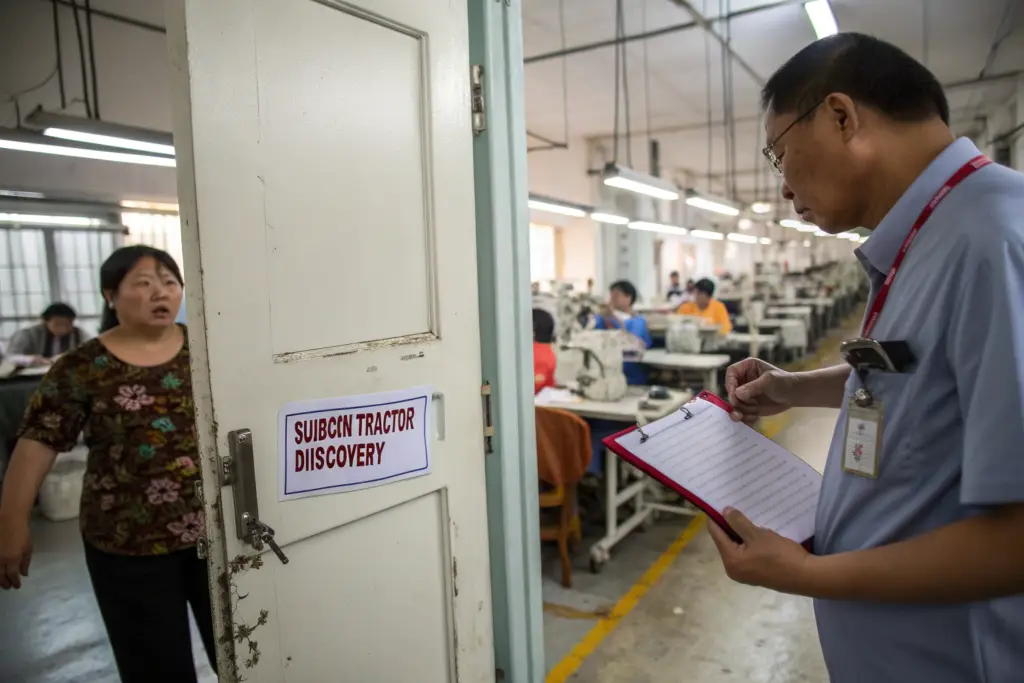
In the summer of 2023, a brand partner from London called me with an urgent problem. Their retail buyer had conducted an unannounced social compliance audit at their cut-and-sew supplier in another country. The main factory floor passed. The audit team then discovered an unmarked door at the back of the finishing area. Behind that door, 35 workers were pressing and packing garments for three different brands in a windowless room with no ventilation, no fire exit, and no time records. The workers were subcontractors, hired by the factory's production manager without the brand's knowledge. The factory had never disclosed this arrangement. The brand had never asked. The retail buyer immediately suspended all purchase orders and demanded a full supply chain audit of every tier. The brand lost six months of production and nearly lost the retail account entirely.
Ensuring subcontractor ethical compliance requires a proactive, contract-based approach that begins before production starts. The brand must include a subcontractor disclosure and audit clause in the manufacturing agreement, require pre-approval of any subcontractor before work begins, maintain the right to conduct unannounced audits of all subcontractor facilities, and verify subcontractor compliance through direct worker interviews conducted off-site. A factory that resists these requirements is a factory that is likely hiding subcontracting practices. A factory that welcomes them is a factory that manages its supply chain transparently.
At Shanghai Fumao, I do not use unauthorized subcontractors. Every production process, from fabric inspection to cutting to sewing to finishing to packing, happens within our own facility under our own quality and compliance management system. I made this decision because I have seen what happens when brands trust factories that outsource work to unvetted workshops. The financial and reputational damage hits the brand, not the hidden subcontractor. But even a factory that does not subcontract internally must manage subcontracting risk in its upstream supply chain, fabric mills, dye houses, printers, embroiderers. The brand needs assurance that the entire chain is clean. Here is how to build that assurance.
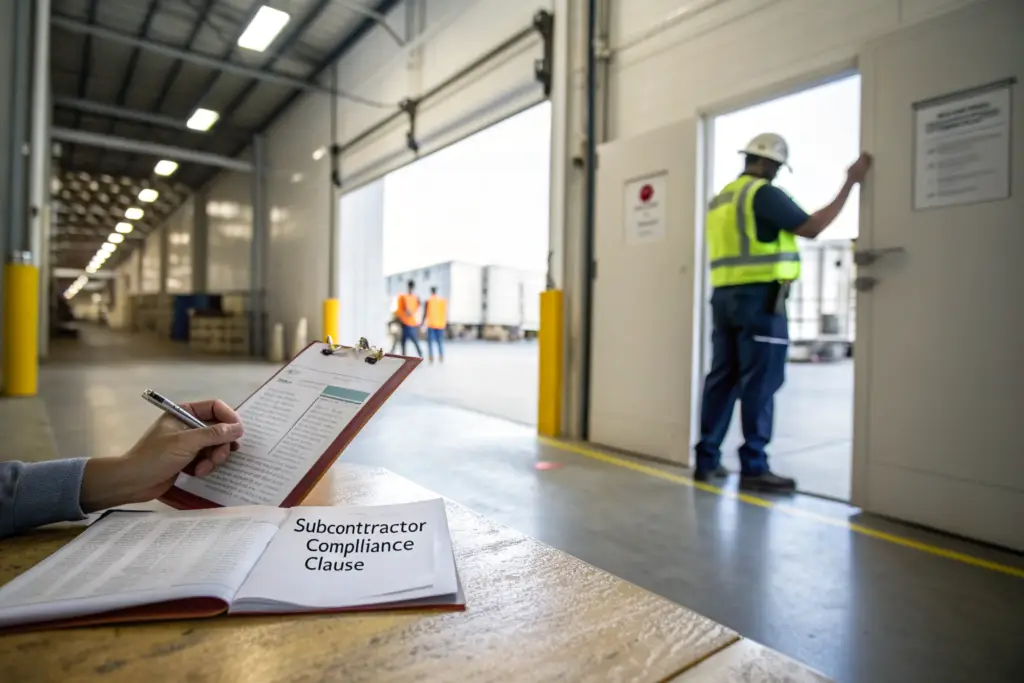
The manufacturing agreement is the first line of defense. A brand that does not address subcontracting in the contract has no legal standing to object when subcontracting occurs. The contract must be explicit. It must define what constitutes a subcontractor. It must state that subcontracting is prohibited without prior written approval. It must specify the consequences of unauthorized subcontracting, including the right to cancel the order, require a full refund, and seek damages for any compliance violations that occur at the unauthorized facility.
The three essential subcontracting clauses in a garment manufacturing agreement are: the disclosure clause, requiring the factory to disclose the identity, location, and scope of work of any subcontractor before production begins, the approval clause, granting the brand the right to approve or reject any proposed subcontractor based on a social compliance audit, and the penalty clause, establishing clear financial and commercial consequences for unauthorized subcontracting, including order cancellation, chargebacks, and liability for any resulting brand damage. Without these clauses, a brand's subcontractor compliance policy is a request, not a requirement.
I recommend that brands work with a lawyer who specializes in international manufacturing agreements to draft these clauses. The language must be enforceable in the factory's jurisdiction. A clause that works in US contract law may not be enforceable in a Chinese or Vietnamese court. The contract should specify the governing law and the arbitration forum. In my experience, the most effective enforcement mechanism is not litigation, which is slow and expensive, but the commercial consequence of losing future orders. A factory that knows unauthorized subcontracting will result in immediate delisting as an approved vendor has a powerful incentive to comply. Here is how to define subcontracting broadly enough and how to set penalties that are both enforceable and proportionate.
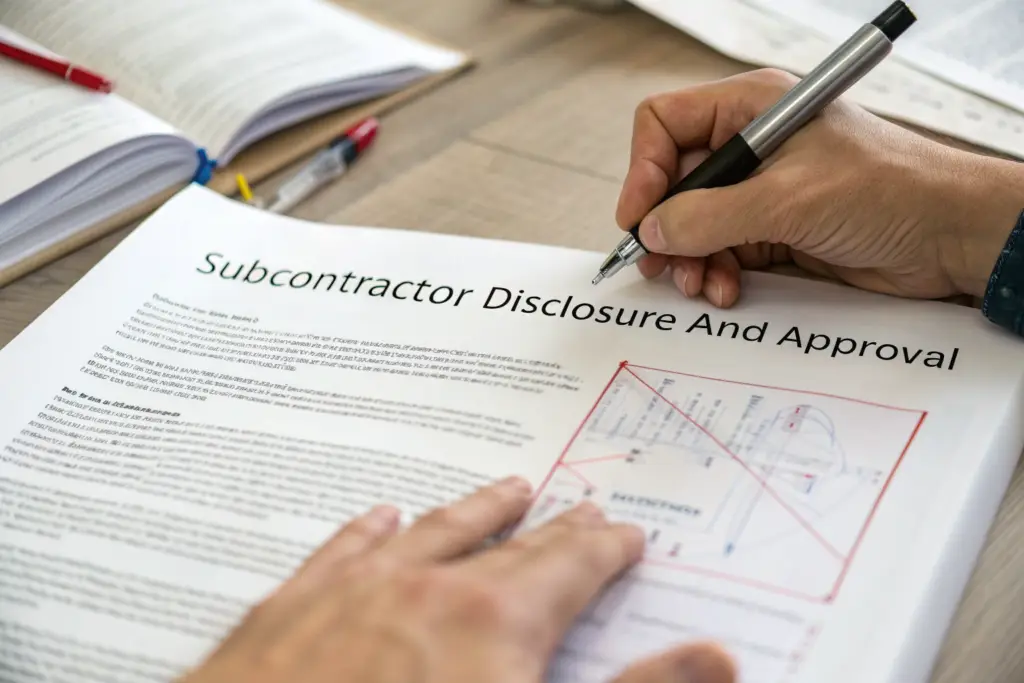
How to Define "Subcontracting" Broadly Enough to Cover All External Work?
A narrow definition of subcontracting only covers the final assembly. A factory could send fabric cutting to an external shop, or finishing to an external laundry, and argue that it is not subcontracting because the main sewing was done in-house. The contract definition must cover any production process performed outside the factory's owned and operated facility.
The definition I recommend is: "Subcontracting means the engagement of any third party, whether an individual, a company, or an unregistered workshop, to perform any part of the production process for the goods covered by this agreement, including but not limited to fabric spreading and cutting, sewing, printing, embroidery, washing, dyeing, finishing, pressing, inspection, packing, and labeling." This list covers every step from raw fabric to finished carton. It eliminates the ambiguity that a factory might exploit. If the work touches your garments, and it is not done in the factory's own facility by the factory's own employees, it is subcontracting.
What Penalties Are Effective Without Being Unenforceable?
A penalty that is too extreme will not be enforceable in practice. A contract that demands a million-dollar penalty for a single instance of unauthorized subcontracting will be challenged and potentially voided by a court or arbitration panel. The penalties must be commercially proportionate and structured as liquidated damages that reflect the actual harm the brand would suffer.
Effective penalties include: immediate cancellation of all open purchase orders with no financial liability to the brand, a chargeback on the current order equal to the cost of a third-party audit of the unauthorized facility plus the cost of re-inspection of the affected goods, and suspension of the factory from the brand's approved vendor list for a defined period, typically 12 months, after which the factory must pass a comprehensive re-audit before being reinstated. The most powerful penalty is the loss of future business. A factory that knows unauthorized subcontracting means no orders for a year will think carefully before hiding a subcontractor. The commercial consequence is more immediate and more impactful than any legal threat.
How Can Unannounced Audits Uncover Hidden Subcontracting Networks?
Announced audits are a performance. The factory has weeks to prepare. The fire exits are cleared. The overtime records are adjusted. The unauthorized subcontractors are temporarily sent home. The auditor sees a compliant facility and issues a passing report. Three days later, the subcontractors return. The only way to discover hidden subcontracting networks is through unannounced audits, conducted at times when production is active, by auditors who are trained to look for physical evidence of off-site production.
Unannounced audits are the only reliable method for detecting unauthorized subcontracting. The audit must include a physical walkthrough of the entire facility, including all rooms, basements, and adjacent buildings, a comparison of the factory's claimed production output against the visible machine count and worker headcount, and a review of production records, purchase orders, and shipping logs that can reveal more garments being produced than the factory's capacity could physically output. Discrepancies between claimed capacity and actual output are the mathematical signature of subcontracting.
I have accompanied auditors on factory visits where the subcontractor workspace was hidden behind a false wall, accessed through a bathroom, or located in a separate building three streets away that was not on the factory's floor plan. The auditors found these spaces by following the flow of goods. If cut fabric enters the cutting room but there is no corresponding output of finished garments from the sewing floor, the missing units are being sewn somewhere else. The physical trail of materials leads to the hidden subcontractor. Here is how to follow that trail and how to verify production records against physical evidence.
How to Spot Discrepancies Between Production Records and Physical Capacity?
The production records tell a story. The daily output log, the cutting records, the piece-rate payroll data, and the shipping manifests should all be internally consistent. An auditor who compares these records can identify a factory that is producing more than its physical capacity allows.
The calculation is straightforward. A factory has 50 sewing machines. Each machine can produce, on average, a certain number of units per day for a given product type. If the factory's shipping records show that it ships 2,000 complex jackets per day, and the auditor calculates that 50 machines can physically produce a maximum of 400 such jackets per day, the excess 1,600 jackets are being produced by a subcontractor. The factory may claim that it is running three shifts, but a headcount check and a payroll review will confirm or refute that claim. The auditor should also check the electricity meter. A factory that claims to be running three shifts but has electricity consumption consistent with one shift is falsifying its production records. These quantitative checks are harder to hide than qualitative conditions. Numbers do not lie.
What Worker Interview Techniques Reveal Subcontracting Practices?
Workers know where the work goes. An auditor who interviews workers off-site, away from the factory premises, and in the workers' own language, through an independent interpreter who is not connected to the factory, will hear about subcontracting practices that management hides.
The interview questions should be indirect. "Have you ever worked at a different location for this factory?" "Do you know if some of the production is done at other workshops?" "Are there times when the factory is busier and they bring in extra workers from outside?" Workers will often describe subcontracting without using the word. They will say they were sent to a "sister factory" or that work is "taken out" during peak season. These phrases are indicators of subcontracting. The auditor should document the specific location, if the worker can describe it, and cross-reference it against the factory's disclosed facility list. The Fair Labor Association provides detailed guidance on conducting worker interviews that are safe for the worker and productive for the auditor.
How to Audit Tier 2 and Tier 3 Suppliers That Your Factory Uses?
The Tier 1 factory is only the beginning of the supply chain. The fabric comes from a mill. The dyeing is done at a dye house. The printing is done at a printer. The embroidery is done at an embroiderer. Each of these is a separate entity with its own labor practices, its own environmental controls, and its own subcontractors. A brand that audits its Tier 1 factory but ignores Tier 2 and Tier 3 has not secured its supply chain. It has only secured the final assembly step.
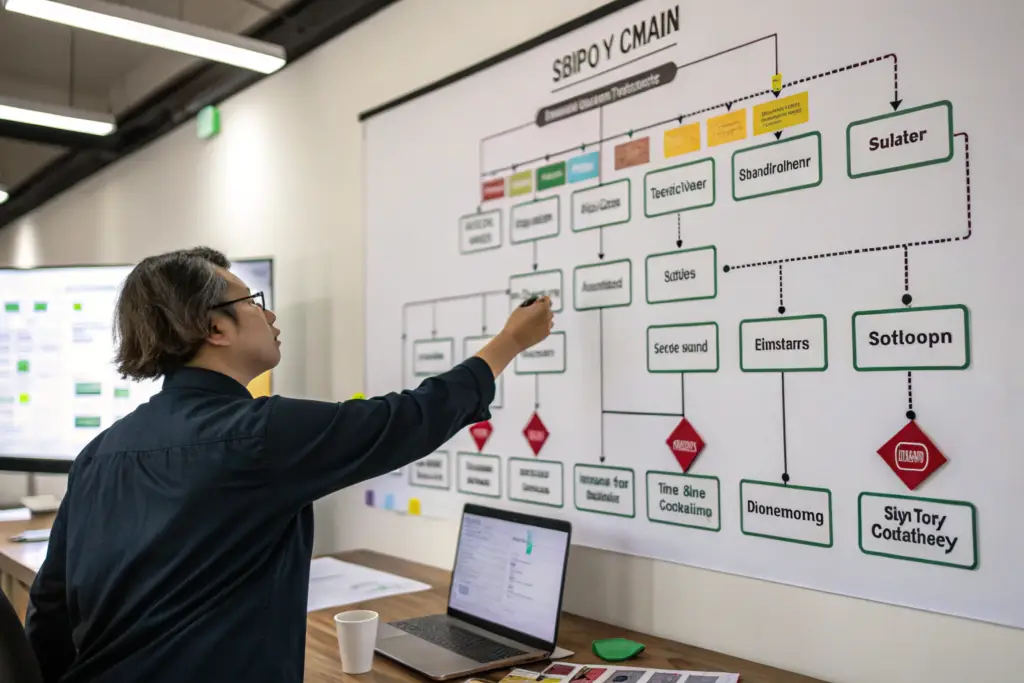
Tier 2 and Tier 3 supplier auditing requires the brand to demand a complete supply chain map from the Tier 1 factory, showing every entity that contributes to the production of the brand's goods, and then to exercise audit rights over those entities directly or through the Tier 1 factory's own compliance team. The audit protocol must be the same standard applied at Tier 1. The consequences of non-compliance must be the same: corrective action plan or delisting. The brand can delegate the audit execution to the Tier 1 factory's compliance team, but the brand must retain the right to review audit reports, conduct its own verification audits, and make the final compliance determination.
At Shanghai Fumao, we manage our upstream compliance by including audit requirements in our fabric and trim purchase agreements. We audit our key mills annually, either with our own compliance team or with a third-party auditor. We share the audit reports with our brand partners upon request. This upstream auditing is part of our value proposition as a vertically integrated partner, but any brand working with any factory can and should demand the same. Here is how to build a supply chain map and how to manage the cost of upstream auditing.
How to Create a Complete Map of All Production Inputs?
The supply chain map starts with a simple question to the Tier 1 factory: "Name every facility that will handle our goods, from raw material to finished carton." The answer must include the legal entity name, the physical address, the scope of work performed, and the contact information for the facility manager. If the factory resists or provides incomplete information, the brand should treat that resistance as a compliance red flag.
The map should be verified, not just accepted. The brand or its auditor can cross-check the fabric supplier's name against shipping documents and invoices. If the fabric mill named in the map does not match the mill named on the fabric delivery note, the factory is hiding a supplier. The map should be updated each season. A mill that was compliant last season may have changed ownership or management this season and may no longer meet the standard. I recommend brands use a digital supply chain mapping platform that allows real-time updates and document storage. The Open Supply Hub is a free, open-source platform that allows factories to share their facility data with brands in a standardized format.
How to Manage the Cost and Logistics of Upstream Auditing?
Auditing an entire supply chain is expensive. A single third-party audit can cost $1,500 to $3,000. Multiply that by five or ten upstream suppliers, and the audit budget can become a barrier, particularly for mid-size brands. The solution is to share audit costs across multiple brands that use the same suppliers.
Industry initiatives like the Social & Labor Convergence Program allow brands to share audit data, reducing duplication. A mill that has been audited by one brand using an SLCP-verified assessment can share that assessment with other brands, eliminating the need for each brand to commission its own audit. The brand should also require the Tier 1 factory to bear some of the upstream audit cost. If the factory selects the mill, the factory should be responsible for verifying the mill's compliance. This cost allocation is negotiated in the manufacturing agreement. A factory that is confident in its upstream partners will not object to sharing the audit burden.
What Industry Certifications Provide Credible Subcontractor Oversight?
Industry certifications provide a baseline of assurance, but they are not a complete solution. A factory that holds a WRAP certificate has passed an audit of its own facility. That certificate says nothing about the factory's subcontractors unless the certification scope explicitly includes subcontractor facilities. The brand must verify that the certification covers the entire production chain, not just the primary facility.
The most credible certifications for subcontractor oversight are those that require full supply chain disclosure and include unannounced audit rights. WRAP and SA8000 require the certified facility to disclose all subcontractors and grant auditors access to them. GOTS and GRS certification includes chain-of-custody verification that traces the material through every processing step, making hidden subcontracting difficult. SMETA audits, when conducted to the full 4-pillar standard, include an assessment of subcontractor management as part of the audit scope. Brands should verify the certification's scope statement directly on the certifier's online database before relying on it.
Certifications are a tool, not a guarantee. A factory can pass a certification audit and still have problems that the auditor missed or that developed after the audit. The brand should use certifications as part of a broader compliance strategy that includes contractual clauses, unannounced audits, and direct worker engagement. Here is how to verify certifications and how to integrate them into a compliance program.

How to Verify That a Certification Covers All Subcontractor Facilities?
The scope statement on the certification certificate lists the facilities covered. The brand should request a copy of the certificate directly from the certifier's online database, not from the factory. Factories have been known to alter certificates before sending them to brands. The certifier's database is the source of truth.
The brand should compare the facilities listed on the certificate against the supply chain map provided by the factory. If the factory's disclosed supply chain includes a dye house that is not listed on the GOTS scope certificate, the dye house is not certified, and the GOTS claim for the finished garment may be invalid. This cross-check takes ten minutes per certificate and prevents a non-compliance that could lead to a retailer rejection. I maintain a digital folder for every certification we hold, with the certificate number, the issuing body, the scope, and the expiry date. Our brand partners can access this folder at any time. The GOTS public database and similar certifier databases are the verification tools.
What Is the Difference Between a Certification and a Compliance Program?
A certification is a snapshot. It says that on the day of the audit, the facility met the standard. A compliance program is a continuous process. It includes the certification audit, but it also includes internal monitoring, worker grievance mechanisms, management training, and corrective action tracking between audits.
A brand should not rely on a certification alone. A brand should require its suppliers to have a compliance program that operates between audits. The program should include a designated compliance officer with the authority to stop production if a violation is discovered, a worker hotline that allows anonymous reporting of labor issues, a regular internal audit schedule, and a corrective action log that tracks issues from identification to resolution. These program elements demonstrate that the factory is managing compliance as an ongoing operational function, not as a pre-audit cleanup exercise. At Shanghai Fumao, our compliance program operates 52 weeks a year. The certifications are the external validation. The program is the internal reality.
Conclusion
The question of subcontractor compliance is ultimately a question of factory character. A factory that hides subcontractors is a factory that prioritizes short-term production convenience over long-term brand partnership. A factory that discloses subcontractors, invites audits, and manages its upstream supply chain with the same rigor it applies to its own facility is a factory that understands that its business depends on the brand's trust.
At Shanghai Fumao, I built a vertically integrated operation precisely because I wanted to eliminate the subcontracting risk for our brand partners. Every process happens under our roof, under our quality system, and under our compliance program. For the upstream processes we do not own, fabric dyeing and finishing at our partner mills, we audit those mills, we include compliance requirements in our purchase agreements, and we share the audit reports with our brand partners. There is no dark room at the back of our facility. There is only the production floor you are welcome to walk at any time.
If you are concerned about subcontracting risk in your current supply chain, or if you are building a new sourcing relationship and want to establish compliance protocols from the start, let us discuss how we manage subcontractor compliance at Shanghai Fumao. We can share our upstream audit reports, our certification portfolio, and our approach to supply chain transparency. Reach out to our Business Director, Elaine, at elaine@fumaoclothing.com. Your brand's reputation deserves a supply chain with no hidden rooms.