Your best-selling men's woven shirt landed at $18.50 per unit under last year's tariff rate. The new season's production is quoted at $21.30. The difference is a tariff increase your factory passed through without explanation, alternative, or mitigation strategy. Your retail price must rise or your margin must shrink. Neither option feels acceptable. You are absorbing a cost you had no hand in creating, managed by a factory that treated the tariff change as your problem to solve alone.
A top clothing manufacture navigates US tariff changes on China apparel through a multi-layered strategy: proactive HS code optimization to ensure the lowest legally applicable duty rate, supply chain flexibility that allows shifting production of tariff-sensitive components, partial cost absorption where factory efficiencies offset tariff impacts, and transparent landed cost modeling that gives the brand full visibility into the tariff component and the mitigation actions being taken. The factory treats tariff management as a shared challenge, not a brand's sole burden.
At Shanghai Fumao, tariff navigation is not a periodic crisis response. It is an ongoing operational discipline. The US tariff landscape on Chinese apparel has been dynamic and is likely to remain so. Factories that treat tariff changes as external events to be passed through to the buyer are abdicating their responsibility as strategic partners. Let me explain the specific mechanisms we use to manage, mitigate, and in some cases neutralize the impact of tariff changes on our brand partners' landed costs.
How Does HS Code Optimization Reduce the Legal Tariff Burden?
Tariff rates are not applied to "clothing" as a generic category. They are applied to specific 10-digit Harmonized System codes that classify products by fiber composition, construction method, gender, and intended use. A men's cotton knitted polo shirt has a different HS code than a men's cotton woven dress shirt, which has a different code than a women's synthetic fiber knitted blouse. Each code carries a different duty rate. A factory that applies generic HS codes to shipments is likely overpaying duties. A factory that optimizes HS codes legally and precisely reduces the tariff burden without any change to the garment or the supply chain.
HS code optimization is the practice of classifying each garment to the most specific, most favorable legally applicable HTSUS code. This requires detailed knowledge of the fiber composition by weight, the construction method, the garment's features, and the binding rulings issued by US Customs and Border Protection. A top manufacturer employs compliance specialists who review every product's classification before shipment, identifying opportunities for legal duty reduction that a factory using generic codes would miss.
What Is the Financial Impact of Precise Fiber Content Classification?
A jacket made of 52% polyester and 48% cotton, knitted construction, is classified differently than a jacket made of 52% cotton and 48% polyester. The fiber content percentage by weight determines the classification, and the duty rate difference between the two classifications can be 5% to 8% ad valorem. On a $50,000 order, an 8% duty difference is $4,000. The garment looks the same. The construction is the same. The fiber content, precisely measured, determines the duty.
Our compliance team does not rely on the fabric mill's stated composition. We conduct independent fiber content testing on every fabric lot before production begins. If the mill claims a 55% cotton, 45% polyester blend, our lab verifies the exact percentage using ASTM D629 standard quantitative fiber analysis. We have identified cases where the actual fiber content differed from the mill's claim by 3-5 percentage points, shifting the garment into a different and more favorable tariff classification. The testing cost is minimal compared to the duty savings over a production run. This fiber content testing for tariff classification discipline is a small operational investment that generates measurable duty savings for our brand partners.
How Do Binding Rulings Provide Certainty and Protection?
A factory that classifies a garment based on its own interpretation of the HTSUS is exposing the brand to risk. If US Customs determines the classification was incorrect, the brand is liable for back duties, penalties, and interest. A binding ruling from CBP eliminates this risk. The factory submits a sample garment, detailed specifications, and a proposed classification to CBP. CBP issues a legally binding ruling that confirms the correct classification. The brand can rely on this ruling for all future shipments of the same product.
For a new product category or a complex hybrid garment, we recommend and facilitate the binding ruling process. A women's apparel brand we serve developed a unique garment—a jacket with a knitted wool body and woven synthetic sleeves. The classification was ambiguous because the garment combined two constructions and two fiber types. We submitted a binding ruling request with detailed fiber content breakdowns by surface area and weight. CBP issued a ruling confirming a lower duty rate than the brand had budgeted, based on the predominant fiber and construction. The ruling protects every future shipment of that garment from reclassification risk. This CBP binding ruling process is a strategic tariff management tool that factories committed to compliance and cost optimization offer proactively.
How Can Supply Chain Flexibility Mitigate Tariff Exposure?
Tariffs on Chinese apparel apply to the country of origin of the garment. The country of origin is generally where the garment is substantially transformed—cut and sewn into its final form. However, the fabric and trim components may come from countries with different trade statuses. While the garment itself carries the China tariff, strategic sourcing of components can support future tariff mitigation scenarios and positions the brand for supply chain flexibility if rules of origin requirements evolve.
Supply chain flexibility for tariff mitigation involves developing a network of qualified fabric and trim suppliers in countries with favorable trade relationships with the US, maintaining the ability to shift component sourcing while keeping final assembly in China, and preparing for potential changes to trade preference programs. While a China-assembled garment currently pays the applicable China tariff regardless of fabric origin, maintaining a diversified supply base provides options for future tariff scenarios and demonstrates proactive risk management to brand partners.
How Does Fabric Sourcing Diversification Prepare for Tariff Scenario Changes?
The current tariff structure applies to the country of origin of the finished garment. The fabric source does not change the tariff rate today. However, trade policy is dynamic. Rules of origin for preferential tariff treatment under potential future trade agreements could include fabric origin requirements. A factory that sources all fabric domestically within China has no flexibility to adapt. A factory that has qualified mills in Vietnam, India, Turkey, and other countries has options.
We have developed relationships with quality mills across multiple countries not as a current tariff mitigation strategy but as a preparedness measure. If trade policy shifts to include fabric origin in duty calculations, or if preferential programs emerge that require regional fabric content, we can shift fabric sourcing within a production cycle rather than spending months qualifying new suppliers. A brand partner that sources through us benefits from this diversified mill network without managing the supplier relationships themselves. This supply chain diversification strategy is an investment in resilience that pays dividends when trade policy shifts unexpectedly.
What Role Does Component Sourcing Play in Overall Cost Competitiveness?
While fabric origin does not change the garment's tariff rate, component cost is a significant portion of the total landed cost. A garment produced with Chinese fabric and Chinese trims carries a certain base cost plus the applicable tariff. If the same garment can be produced with fabric from a lower-cost origin, the base cost is lower, and the tariff is applied to a lower value. The absolute tariff paid in dollars decreases even though the tariff rate remains the same.
We continuously evaluate fabric and trim sourcing options across our qualified supplier network to identify cost-competitive materials that reduce the pre-tariff base cost. For a men's chino program, we shifted pocketing fabric sourcing from a domestic Chinese mill to a Vietnamese mill that offered a 12% lower price for equivalent quality. The garment's tariff rate was unchanged because it was assembled in China, but the base cost was lower, so the total landed cost decreased. The brand saved approximately $0.18 per unit without any change to the garment's appearance or quality. This global fabric sourcing approach treats tariff exposure as one variable in a total-cost optimization equation.
How Does the DDP Model Protect Brands from Tariff Uncertainty?
The most stressful aspect of tariff changes for a brand owner is the uncertainty. A tariff increase announced mid-production creates an unplanned cost that was not factored into retail pricing, wholesale agreements, or margin forecasts. The brand is forced to either absorb the cost, raise prices, or renegotiate with wholesale accounts. None of these options are good. The DDP model eliminates this uncertainty by transferring the tariff risk from the brand to the factory.
Under DDP terms, Shanghai Fumao quotes a single landed cost that includes all duties and tariffs at the time of order confirmation. If the tariff rate increases between the quote and the shipment date, we absorb the increase. The brand's cost is locked. This risk transfer is the most powerful tariff protection mechanism available to apparel brands. It converts a variable, unpredictable cost into a fixed, known cost that the brand can plan around with confidence.
What Happens When a Tariff Increases Mid-Production Under DDP?
In early 2025, the USTR announced an increase in Section 301 tariffs on certain apparel categories. The effective date fell in the middle of several brands' production cycles. Orders that had been quoted, approved, and put into production were suddenly subject to a higher duty rate. Brands working with FOB factories received emails informing them of the tariff increase and the revised landed cost. They had no choice but to pay.
Our DDP partners received no such emails. Their landed cost was locked at the quoted price. We absorbed the tariff increase on those orders. The aggregate cost to us was significant, but it was a cost we had planned for by maintaining a tariff contingency reserve as part of our DDP pricing model. We build a small risk premium into our DDP quotes to cover potential tariff fluctuations during the production cycle. When tariffs remain stable, that reserve contributes to our margin. When tariffs increase, the reserve absorbs the impact. The brand's cost remains constant either way. This DDP tariff risk transfer is not a theoretical benefit. It is a financial hedge that pays out when the tariff environment deteriorates.
How Does Tariff Certainty Support the Brand's Retail Pricing Strategy?
A brand that sells to wholesale accounts sets prices at the beginning of the selling season, often six to nine months before the goods are delivered. If the landed cost increases between the wholesale pricing decision and the delivery date, the brand's margin on those wholesale orders shrinks. The brand cannot go back to the wholesale buyer and ask for a price increase.
DDP tariff certainty allows the brand to set wholesale prices with confidence. The landed cost quoted at the time of order is the landed cost at the time of delivery, regardless of tariff changes. The brand knows the exact margin on every wholesale order before the order is placed. A men's apparel brand we work with uses our DDP pricing to lock wholesale pricing for their entire season during the line review period. They present prices to their wholesale accounts with confidence because their costs are fixed. Their competitors, who work with FOB factories, must either build a large tariff contingency into their wholesale prices (making them less competitive) or risk margin erosion if tariffs increase. The brand's wholesale relationships are stronger because their pricing is reliable. This retail and wholesale pricing stability is a competitive advantage rooted in DDP tariff protection.
How Does Production Cost Optimization Offset Tariff Increases?
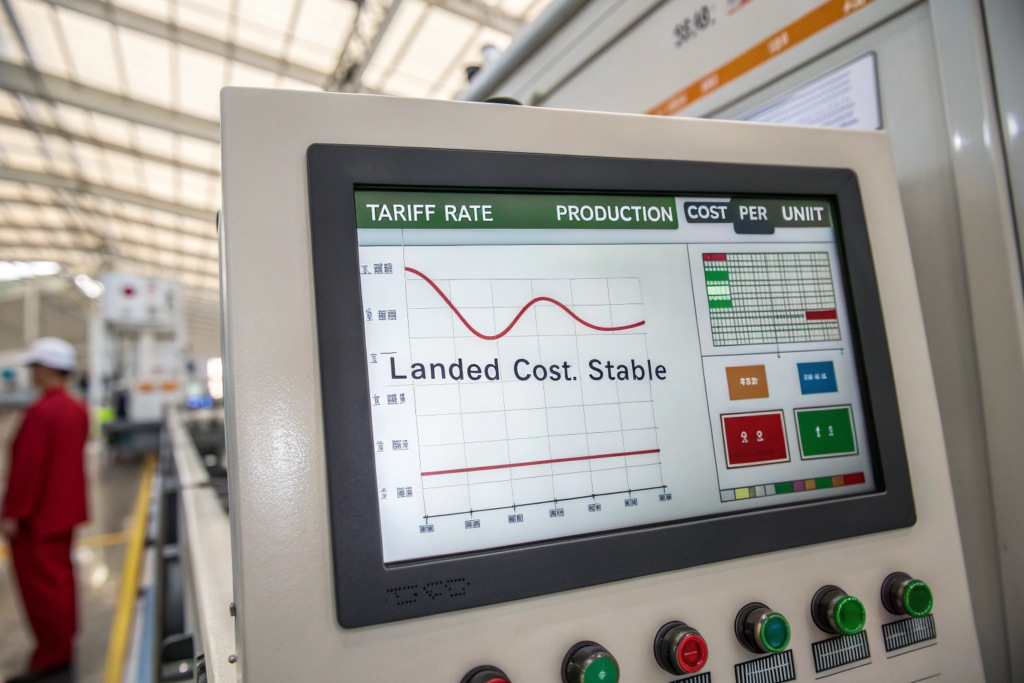
Tariff increases add cost to the landed product. A factory that simply passes the increase through to the brand is not providing value beyond basic manufacturing. A factory that continuously improves its internal efficiency to offset external cost pressures is a strategic partner. The goal is not to eliminate the tariff—that is beyond any single factory's control—but to reduce the pre-tariff production cost so that the total landed cost remains stable or increases only minimally.
Production cost optimization to offset tariff increases involves continuous improvement in cutting efficiency to reduce fabric waste, workforce training to increase sewing line productivity, energy efficiency investments to reduce overhead costs, and value engineering of garment construction to reduce labor minutes without compromising quality. Each efficiency gain reduces the pre-tariff cost base, partially or fully neutralizing the impact of a tariff increase on the total landed cost.
How Does Cutting Efficiency Directly Reduce the Pre-Tariff Cost Base?
Fabric is typically 50-60% of a garment's total production cost. A 5% improvement in fabric utilization—getting more garment pieces from each meter of fabric—reduces the fabric cost per unit by 5%. This reduction flows directly to the pre-tariff cost base. When a tariff increase adds 3% to the landed cost, a 5% fabric cost reduction neutralizes it completely.
We invest in cutting efficiency as a continuous improvement discipline. Our automated spreading machines minimize fabric tension during spreading, reducing distortion that leads to miscut pieces. Our marker-making software optimizes pattern piece placement to maximize fabric utilization. We track the actual fabric consumption against the planned consumption for every order and investigate variances. Over the past two years, our average fabric utilization rate has improved from 82% to 86%. On a garment with a fabric cost of $6.00 per unit, that 4% improvement saves $0.24 per unit. That $0.24 offsets a significant portion of a typical tariff increase. This fabric utilization optimization is a quiet, continuous process that produces measurable cost savings without any change to the garment's design or quality.
How Does Workforce Productivity Investment Reduce Labor Cost Per Unit?
Labor is the second-largest production cost after fabric. A sewing line that produces 100 units per hour has a certain labor cost per unit. A sewing line that produces 115 units per hour through better training, improved workstation layout, and more efficient methods has a 13% lower labor cost per unit. The savings offset tariff increases.
We invest in workforce productivity through ongoing training programs, workstation ergonomics improvements, and production engineering. Our training program cross-trains operators on multiple operations, allowing us to balance the production line more efficiently. When one operation is a bottleneck, a cross-trained operator from a lighter station can assist, increasing the overall line output. Our industrial engineers regularly review workstation layouts to reduce wasted motion, bringing materials closer to the operator's hands. These incremental improvements compound over time. Our average line output has improved 8% over the past three years through these methods. The labor cost savings contribute to the pre-tariff cost reduction that protects landed costs. This garment manufacturing efficiency discipline is part of our operational culture, not a response to any single tariff announcement.
Conclusion
US tariff changes on Chinese apparel are not temporary disruptions that will eventually stabilize into predictability. They are a permanent feature of the sourcing landscape that requires ongoing management, not periodic crisis response. A top clothing manufacture treats tariff navigation as a core operational competency, integrating HS code optimization, supply chain flexibility, DDP risk transfer, and continuous production efficiency into its standard operating model.
At Shanghai Fumao, our approach to tariff management is transparent, proactive, and shared with our brand partners. We do not surprise our partners with post-hoc tariff surcharges. We lock costs under DDP terms. We optimize classifications legally and precisely. We invest in efficiency gains that offset external cost pressures. We diversify our supply base to prepare for policy shifts. And we communicate openly about the tariff environment and our mitigation strategies so that our partners can plan their businesses with confidence.
If tariff uncertainty is complicating your financial planning and eroding your margins, let us provide a binding DDP quote for your upcoming production. We will show you a single landed cost that includes all duties and tariffs, locked from order confirmation to delivery. Contact our Business Director, Elaine, at elaine@fumaoclothing.com. Let us manage the tariff risk so you can focus on building your brand.