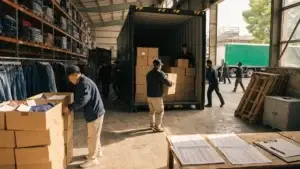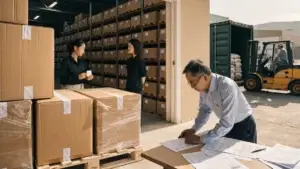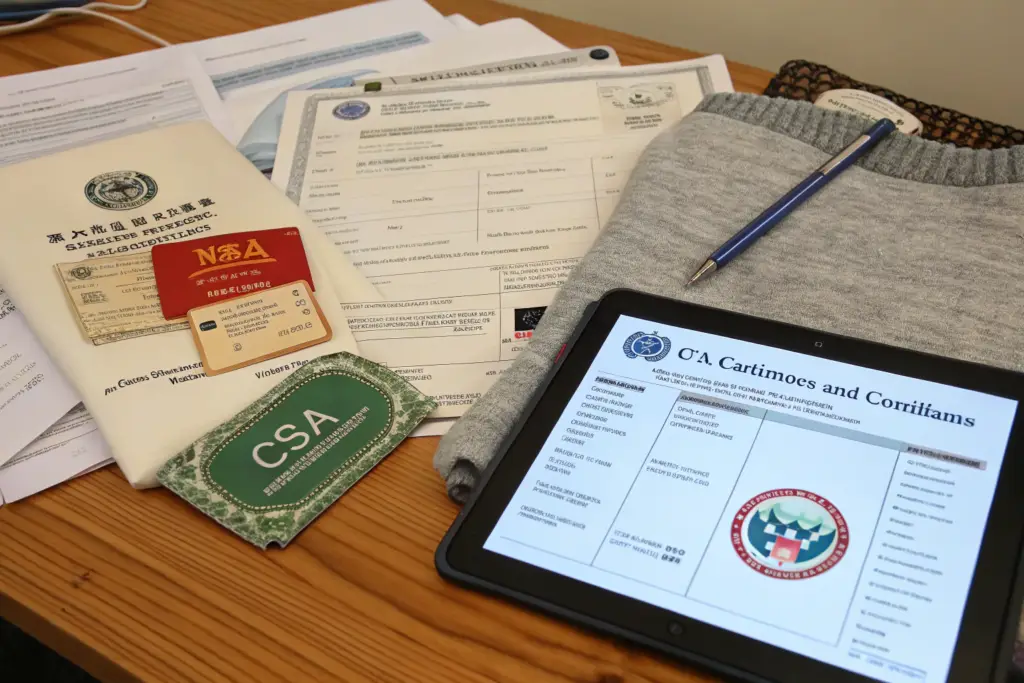
You are a U.S. brand owner. You have found a factory in China that makes great denim shorts. The samples look good. The price is right. The communication has been professional. You are ready to place your first bulk order. Then your customs broker sends you a list of required documents. CPSIA compliance. Flammability testing. Country of origin marking. Fiber content labeling. Customs bond. You realize that importing apparel into the United States is not just about finding a good factory. It is about navigating a web of federal regulations enforced by multiple agencies. If your shipment lacks the required certifications, it can be detained at the port, refused entry, or even destroyed. Your inventory never reaches your warehouse. Your selling season is lost.
A top clothing manufacturer must provide, or enable you to produce, five categories of certification and documentation for USA apparel imports in 2026. First, the product safety certifications required by the Consumer Product Safety Commission, including CPSIA compliance certificates for children's products and flammability compliance for all apparel. Second, the customs and border protection documentation, including the commercial invoice, packing list, bill of lading, and the customs bond. Third, the textile labeling compliance, including fiber content labels and country of origin markings in the format prescribed by the FTC and CBP. Fourth, the social compliance and supply chain documentation, including proof of compliance with the Uyghur Forced Labor Prevention Act. Fifth, the buyer-issued Children's Product Certificate for any children's apparel, supported by third-party test reports from CPSC-accepted laboratories.
I run Shanghai Fumao. I have shipped tens of thousands of denim shorts to the United States. I have learned the documentation requirements the hard way, by making mistakes and fixing them. In this article, I will explain every certification and document your shipment needs, who provides it, and how a top factory supports the process. This is not legal advice. It is operational knowledge from a factory owner who clears U.S. customs every month.
What Product Safety Certifications Does the CPSC Require for Apparel?
The Consumer Product Safety Commission is the federal agency responsible for protecting the public from unreasonable risks of injury from consumer products. For apparel, the CPSC enforces two main sets of requirements. The flammability standards under the Flammable Fabrics Act, and the lead, phthalates, and tracking label requirements under the Consumer Product Safety Improvement Act for children's products.
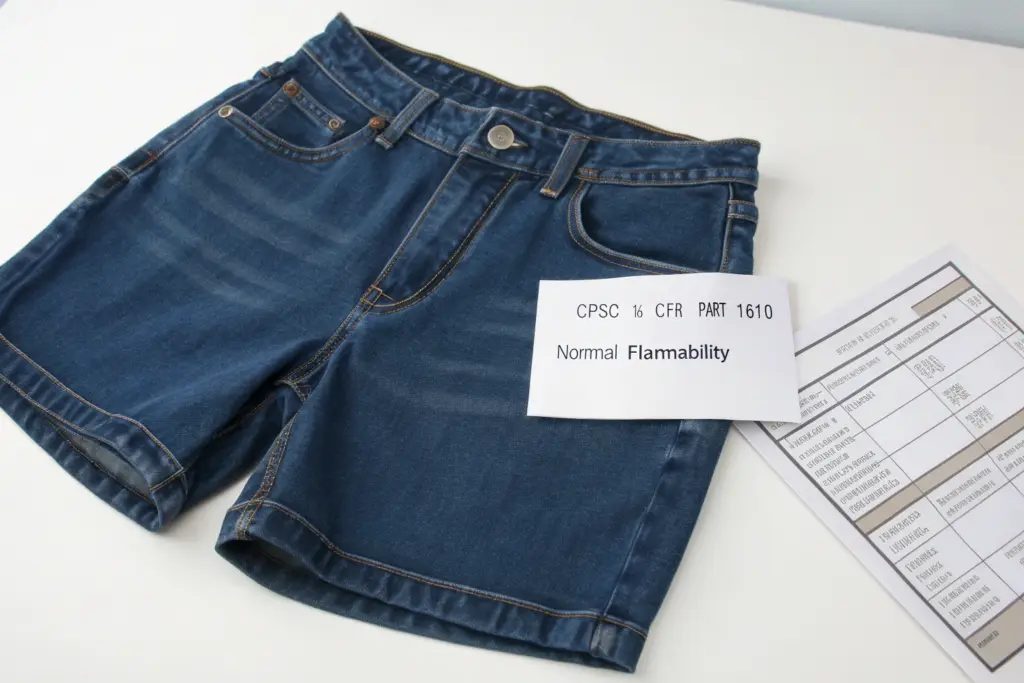
Apparel is subject to flammability standards. The standard that applies to most denim shorts is 16 CFR Part 1610, the Standard for the Flammability of Clothing Textiles. This standard classifies fabrics into three classes based on their burn rate. Class 1 is normal flammability and is acceptable for apparel. Class 2 is intermediate flammability. Class 3 is rapid and intense burning and is prohibited for apparel. Most denim fabrics, being heavy and 100% cotton, pass the flammability test easily and fall into Class 1. However, lightweight fabrics, raised surface fabrics like fleece, and certain blends may be more flammable and require testing. The importer, meaning you, the brand, is responsible for ensuring the product complies. The factory can support by providing a flammability test report from a CPSC-accepted laboratory, but the legal responsibility is yours.
Let me explain the specific safety certifications and who provides them.
What Is a General Certificate of Conformity and When Is It Needed?
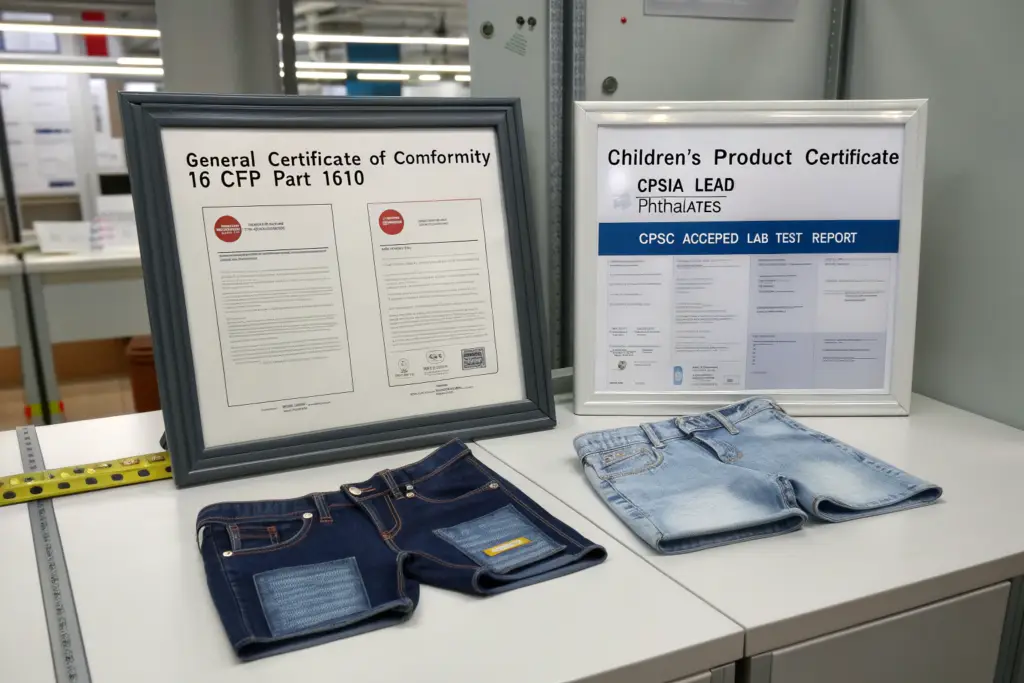
A General Certificate of Conformity, or GCC, is a document required by the CPSC for certain consumer products that are not children's products. It certifies that the product complies with all applicable CPSC-enforced safety regulations. For adult denim shorts, the applicable regulation is the flammability standard, 16 CFR Part 1610.
The GCC must contain specific information. The product identification, a description of the product covered by the certificate. The citation to each CPSC regulation to which the product is being certified. The identification of the importer or domestic manufacturer issuing the certificate, including name, address, and telephone number. The contact information for the individual maintaining the test records, including name, address, telephone number, and email. The date and place where the product was manufactured. The date and place where the product was tested for compliance. The identification of the third-party laboratory that performed the testing, if applicable. The GCC is issued by the importer, meaning the U.S. brand, or the domestic manufacturer. The factory does not issue the GCC. However, the factory provides the underlying test data, the flammability test report, the material composition data, that the brand uses to support the GCC. Without the factory's cooperation in providing test data, the brand cannot issue a valid GCC. A top manufacturer provides the flammability test report proactively. The CPSC General Certificate of Conformity requirements are published on the CPSC website.
How Does a Children's Product Certificate Differ from a General Certificate of Conformity?
A Children's Product Certificate, or CPC, is required for any product designed or intended primarily for children 12 years of age or younger. The requirements for a CPC are stricter than for a GCC. The product must be tested by a CPSC-accepted third-party laboratory. The testing must cover lead in surface coatings, lead in substrates, phthalates, and the applicable safety standards, such as small parts, sharp edges, and drawstrings.
The CPC must contain the same information as the GCC, plus the identification of the CPSC-accepted third-party laboratory that performed the testing. The CPC is issued by the importer or the domestic manufacturer, not by the factory. However, the factory plays a critical role. The factory must provide the product samples to the third-party lab. The factory must use materials, fabric, hardware, trims, that comply with CPSIA limits. The factory must produce the product consistently with the tested sample. A top manufacturer manages this process for the brand. We ship the pre-production sample to the brand's chosen CPSC-accepted lab. We provide the material composition data. We ensure the bulk production uses the same compliant materials as the tested sample. We provide the tracking label with the manufacturer's identification and the production batch code. The brand issues the CPC based on the passing test report. The CPSIA Children's Product Certificate guide explains the full requirements. A top manufacturer makes the CPC process straightforward for the brand.
What Customs and Border Protection Documentation Is Mandatory?
U.S. Customs and Border Protection is the federal agency responsible for regulating goods entering the United States. CBP requires a specific set of documents for every commercial import shipment. These documents are not optional. They are mandatory. If they are missing or incorrect, the shipment will not clear customs.
The mandatory CBP documents include the commercial invoice, the packing list, the bill of lading or airway bill, the entry manifest or Entry Summary, CBP Form 7501, and evidence of a customs bond. The commercial invoice and packing list are prepared by the factory. The entry summary and the customs bond are handled by the importer's licensed customs broker. The bill of lading is issued by the shipping line. The factory must provide accurate, complete information for the commercial invoice and packing list. Errors on these documents cause customs delays. A top manufacturer has an experienced shipping department that prepares export documentation correctly.
Let me explain the specific CBP documents and the factory's role in each.
What Information Must the Commercial Invoice and Packing List Contain?
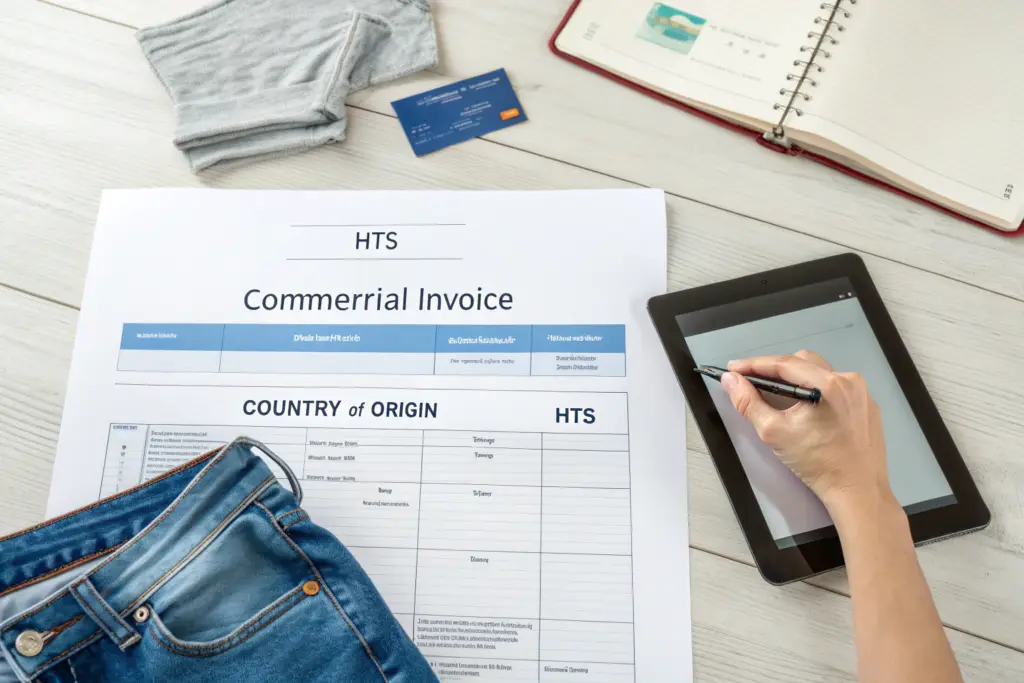
The commercial invoice is the primary document used by CBP to assess duties, determine the admissibility of the goods, and compile trade statistics. It must be in English and must contain the port of entry, the names of the buyer and seller, a detailed description of the merchandise including the HS code, the quantity, the unit price, the total value, the currency, the country of origin, and the Incoterm.
The packing list is a detailed inventory of the shipment's contents. It lists each carton, its dimensions, its weight, and its contents. CBP uses the packing list to verify the shipment and to select cartons for physical examination if needed. The information on the packing list must match the information on the commercial invoice. Discrepancies trigger inspections and delays.
Our shipping department prepares the commercial invoice and packing list for every shipment. We classify the product under the correct Harmonized Tariff Schedule code. For women's cotton denim shorts, the HTS code is typically 6204.62. We declare the accurate value. We state the correct country of origin. We package the goods so that the packing list accurately reflects the carton contents. The CBP commercial invoice requirements are published on the CBP website. A professional factory's documentation meets them.
How Does a Customs Bond Work and Who Provides It?
A customs bond is a financial guarantee between the importer, the surety company, and CBP. It guarantees that CBP will receive the duties, taxes, and fees owed on the imported goods, and that the importer will comply with all applicable laws and regulations. A customs bond is required for all commercial imports valued over $2,500, and for many imports under that threshold if they are regulated goods.
The importer, meaning the U.S. brand, is responsible for obtaining the customs bond. The bond is typically arranged through the brand's licensed customs broker. The factory does not provide the bond. However, under our DDP shipping model, we act as the Importer of Record. We arrange the customs bond through our own U.S. customs broker. The brand does not need to obtain a bond. This is one of the significant advantages of DDP shipping for brands that do not have their own customs infrastructure. Under FOB terms, the brand must arrange the bond themselves. The CBP customs bond requirements explain the types and amounts of bonds. A top manufacturer who offers DDP shipping handles the bond on the brand's behalf, simplifying the import process.
What Textile Labeling Requirements Does the FTC and CBP Enforce?
The Federal Trade Commission enforces the Textile Fiber Products Identification Act, which requires that most textile products sold in the United States carry a label disclosing the fiber content. The label must be attached to the product at the point of sale. It must disclose the generic fiber names, such as cotton, polyester, spandex, in descending order of predominance by weight. It must disclose the country of origin. It must identify the manufacturer or the RN number.
CBP enforces the country of origin marking requirements under 19 U.S.C. 1304. Every article of foreign origin imported into the United States must be marked with its country of origin in a conspicuous, legible, and permanent manner. For denim shorts, the country of origin is typically marked on a label sewn into the waistband or the side seam. The marking must be in English. It must be visible and readable by the ultimate purchaser. "Made in China" or "Made in Vietnam" are acceptable formats. The factory is responsible for attaching the country of origin label and the fiber content label correctly. A mistake on these labels can result in the shipment being detained at the border and the brand being required to re-label the goods before they can be sold.
Let me explain the specific labeling requirements and how we ensure compliance.
What Are the FTC Fiber Content Labeling Rules for Denim Shorts?
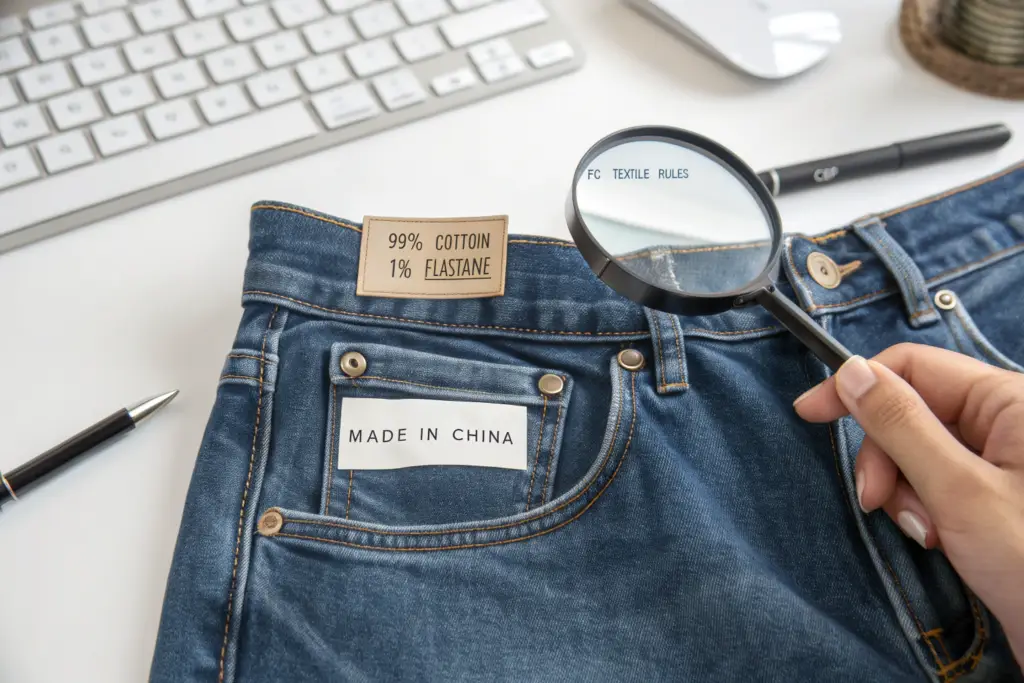
The FTC Textile Fiber Products Identification Act requires that denim shorts sold in the U.S. carry a label disclosing the fiber content. The label must list the generic fiber names in order of predominance by weight. For our standard denim short, the label reads "99% Cotton, 1% Elastane" or "100% Cotton" for rigid denim. The label must be attached securely to the garment until it reaches the consumer. It is typically a woven or printed label sewn into the inside waistband or the side seam.
The label must also disclose the identity of the manufacturer or another responsible company. This can be the brand's name or the brand's Registered Identification Number, or RN, issued by the FTC. The RN is a number that identifies the company responsible for the product's labeling. Many brands use their RN instead of their full company name on the label. The RN is obtained from the FTC by the brand. The factory does not provide it.
We ensure that the fiber content label is printed or woven with the correct information, sewn into the correct location, and made from a material that will survive washing and wearing. We verify the fiber composition of our fabrics with a third-party test report, which we provide to the brand. The FTC textile labeling rules are published on the FTC website. A top manufacturer ensures the labels are accurate and compliant.
How Do We Ensure Country of Origin Marking Meets CBP Standards?
CBP requires that the country of origin marking be conspicuous, legible, and permanent. Conspicuous means the marking must be seen easily by the consumer. A label sewn into the inside waistband is conspicuous because the consumer will see it when they put on the shorts. A label hidden inside a pocket is not. Legible means the letters must be clear and readable. Permanent means the marking must survive until the product reaches the consumer. A hangtag that can be removed is not a permanent marking. A sewn-in label is.
The marking must state the country of origin in English. "Made in China" is the standard format. The marking must be on the product itself, not just on the packaging. For denim shorts, we sew a country of origin label into the waistband. We also print the country of origin on the care label, which is typically combined with the fiber content label. The CBP country of origin marking requirements are detailed. A professional factory's labeling meets them. We check every order's labels before packing to ensure the country of origin is correctly stated and properly attached.
What Forced Labor Compliance Documentation Is Now Required?
The Uyghur Forced Labor Prevention Act, or UFLPA, took effect in June 2022. It creates a rebuttable presumption that any goods mined, produced, or manufactured wholly or in part in the Xinjiang Uyghur Autonomous Region of China are made with forced labor and are therefore prohibited from entering the United States. The presumption applies to goods produced by entities on the UFLPA Entity List.
For apparel imports, the highest-risk area is cotton. Xinjiang produces a significant percentage of the world's cotton. CBP has detained shipments of apparel made with Xinjiang cotton. To overcome the presumption and gain entry, the importer must provide clear and convincing evidence that the goods are not made with forced labor. This evidence typically includes supply chain traceability documentation, transaction certificates showing the origin of the cotton, and factory audit reports demonstrating compliance with labor standards. A top manufacturer provides this documentation proactively.
Let me explain the specific documentation required and how we support the brand's compliance.
What Supply Chain Traceability Documents Prove Cotton Origin?
To prove that cotton is not from Xinjiang, the importer must provide documentation tracing the cotton back to its country of origin. The most robust documentation is the GOTS transaction certificate, which provides chain of custody from the certified organic cotton farm or gin to the finished garment. The certificate specifies the country of origin of the cotton.
For conventional cotton, the Better Cotton Initiative chain of custody model provides some level of traceability, though BCI is a mass balance system rather than physical traceability. For physical traceability of conventional cotton, we can source from specific non-Xinjiang origins, such as Australian or Brazilian cotton, and provide the mill's purchase records and shipping documents showing the cotton's origin. We also provide our mill partners' declarations, stating that the cotton used in the fabric is not sourced from Xinjiang. These declarations are supported by the mills' own supply chain documentation.
The level of documentation required depends on the shipment and CBP's assessment of risk. We work with our brand clients to provide the documentation that CBP requests for their specific shipments. The UFLPA compliance and documentation guide from CBP provides guidance on what evidence is acceptable. A top manufacturer maintains a documented, traceable cotton supply chain and provides the evidence proactively.
How Do Our BSCI and Social Compliance Audits Support UFLPA Compliance?
Social compliance audits like BSCI and SMETA demonstrate that the factory has been independently assessed for labor standards, including the prohibition of forced labor. While an audit report alone does not prove the cotton's origin, it is an important piece of the overall compliance picture. It shows that the factory's own operations are free from forced labor, and it supports the credibility of the factory's supply chain claims.
Our BSCI audit report, with a B rating and valid date, provides documented evidence that our factory has been audited for forced labor, child labor, working hours, wages, and health and safety. Our SMETA unannounced audit provides additional assurance. We provide the full audit report to clients who need it for their UFLPA compliance documentation. The audit report is not the complete answer to UFLPA compliance. The cotton traceability documentation is the primary evidence. But the audit report strengthens the overall compliance submission. The BSCI and forced labor due diligence framework aligns with international labor standards. A top manufacturer holds current, highly rated social compliance certifications and provides the audit reports transparently.
Conclusion
A top clothing manufacturer for USA apparel imports in 2026 must provide, or enable the brand to produce, a comprehensive set of certifications and documentation. The CPSC safety certifications, flammability compliance for all apparel, and CPSIA compliance including a Children's Product Certificate for kids' wear. The CBP customs documentation, the accurate commercial invoice, packing list, and bill of lading. The FTC and CBP labeling compliance, the fiber content label and the country of origin marking. The UFLPA forced labor compliance documentation, including cotton supply chain traceability records and social compliance audit reports. And for brands using our DDP service, the customs bond and the Importer of Record responsibility.
We provide all of this. Our shipping department prepares the customs documentation. Our quality lab provides the test data for the GCC and CPC. Our sourcing team provides the cotton traceability documentation. Our compliance team provides the audit reports. Our DDP service handles the customs bond and the import clearance. The brand's responsibility is to review the documentation, issue the certificates where required, and maintain the records. We make that responsibility easy by providing complete, accurate, and timely information.
If you are planning to import denim shorts into the United States and you want a factory that understands the documentation requirements as well as you do, contact our Business Director, Elaine. She can provide a sample documentation package for a recent U.S. shipment, so you can see exactly what you will receive. Her email is elaine@fumaoclothing.com. At Shanghai Fumao, we do not just make the shorts. We provide the paperwork that gets them through customs. That is part of the manufacturing service.