Fast communication is not the secret. Fast communication is the symptom. The secret is a factory structured so that the person answering your email is standing fifty meters from the sewing line, not five thousand miles away in a sales office. When you ask a technical question, she does not forward it to a production manager and wait two days for a reply. She walks to the production floor, speaks to the person doing the work, and answers you within hours. That is not a communication policy. That is an operational design. The speed is a byproduct of the structure.
The secret behind Shanghai Fumao's status as a top clothing manufacturer is not fast communication in isolation. It is a combination of three structural factors that enable fast, accurate communication. First, our factory-direct model eliminates intermediaries. You communicate with a dedicated merchandiser who works inside our factory, not a sales agent in a separate office. Second, our merchandisers are garment technical professionals, not generalist customer service representatives. They understand pattern making, fabric behavior, wash processes, and production scheduling. They can answer technical questions without forwarding them. Third, our digital production tracking dashboard provides real-time visibility, so many questions are answered before they need to be asked. The buyer sees the status of their order on the dashboard and does not need to send an email.
I run Shanghai Fumao. I have spent fifteen years thinking about how information flows between a factory and its clients. I have watched deals fall apart because a buyer's urgent question sat in an inbox for four days. I have seen production errors compound because a specification change was communicated unclearly through three layers of translation. I decided that the only way to fix communication was to fix the structure of the factory. In this article, I will explain that structure, how our merchandiser model works, how our digital tools support it, and what this means for a brand owner who is tired of chasing suppliers for answers.
Why Is Factory-Direct Communication Structurally Faster Than the Trading Company Model?
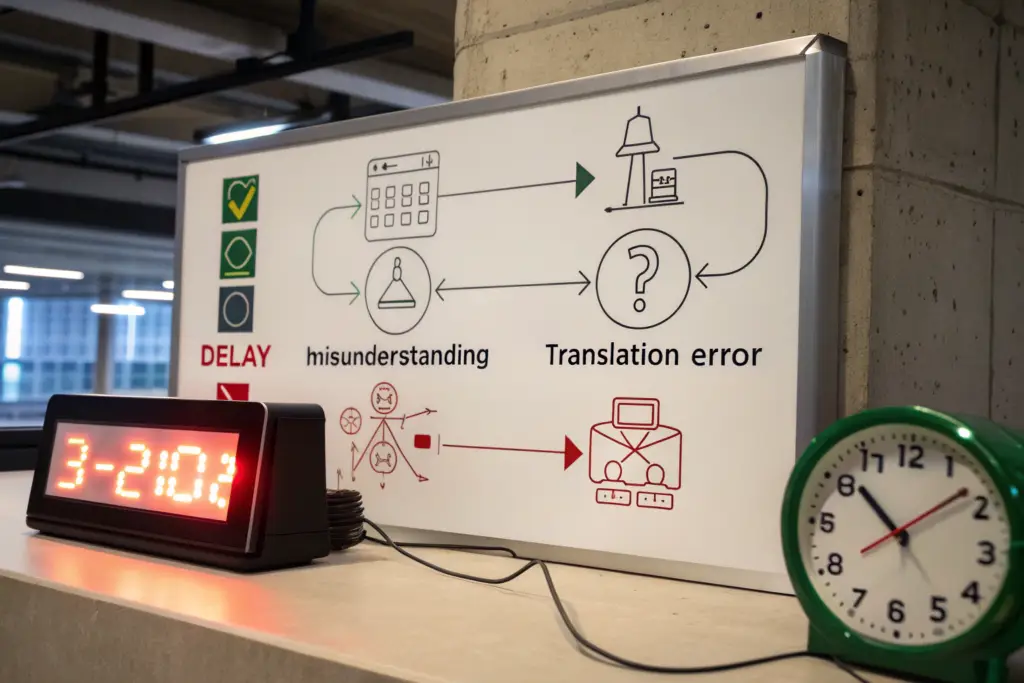
The traditional apparel sourcing model is a chain. The buyer talks to a trading company. The trading company talks to a factory. The factory talks to its production team. The production team does the work. Information flows back up the chain. Each link adds time. Each link adds the potential for distortion. A simple question takes two days to answer. A complex question generates confusion because the person answering did not hear the question directly. The model is slow because the structure is slow.
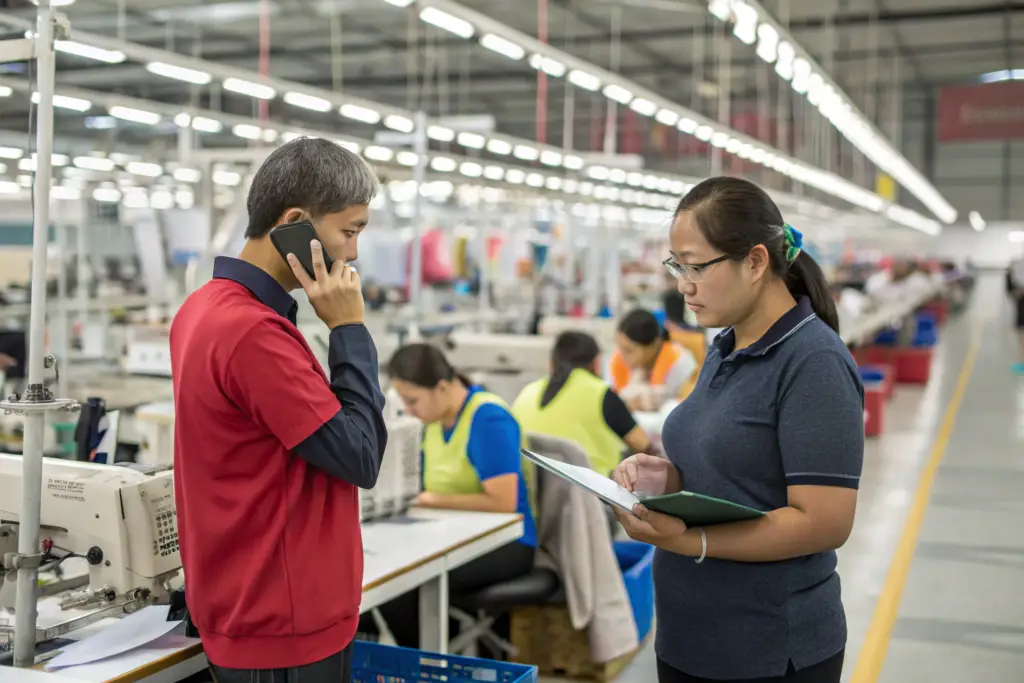
The factory-direct model is a point-to-point connection. The buyer talks to a merchandiser who sits inside the factory. The merchandiser talks to the production team directly. There is no intermediary. There is no translation through a sales agent who does not understand garment construction. There is no delay while an email sits in a forwarding queue. The structure is fast because the path is short. When a buyer emails us with a question about the wash on their order, our merchandiser reads the email, walks to the wash house, speaks to the wash technician, and replies. The entire loop can close in under an hour. A trading company cannot match this because the person who answers the buyer's email is not in the same building as the person doing the work. They are in a different company, often in a different city. They must send an email and wait for a reply, just like the buyer would. The trading company adds no value to the communication chain. It adds only delay.
Let me explain the specific structural differences and why they matter for your order.
How Does Eliminating the Middleman Reduce Response Time and Errors?
A middleman, a trading company, a sourcing agent, an intermediary, is a relay station in the communication chain. The relay adds time. The relay introduces the risk of a dropped message. The relay introduces the risk of a mistranslation, both linguistic and technical.
Consider a typical scenario. A buyer notices that the wash on the pre-production sample is slightly lighter than the approved lab dip. The buyer emails the trading company with a photo and a description of the issue. The trading company's salesperson does not understand garment wash. They look at the photo. They do not see the difference. They forward the email to their contact at the factory, adding their own interpretation. "Client thinks color is too light." The factory's production manager reads the email. They do not understand what "too light" means in technical terms. They email back, asking for a spectrophotometer reading. The trading company forwards the question to the buyer. The buyer does not have a spectrophotometer. The loop continues. Days pass. The production window shrinks.
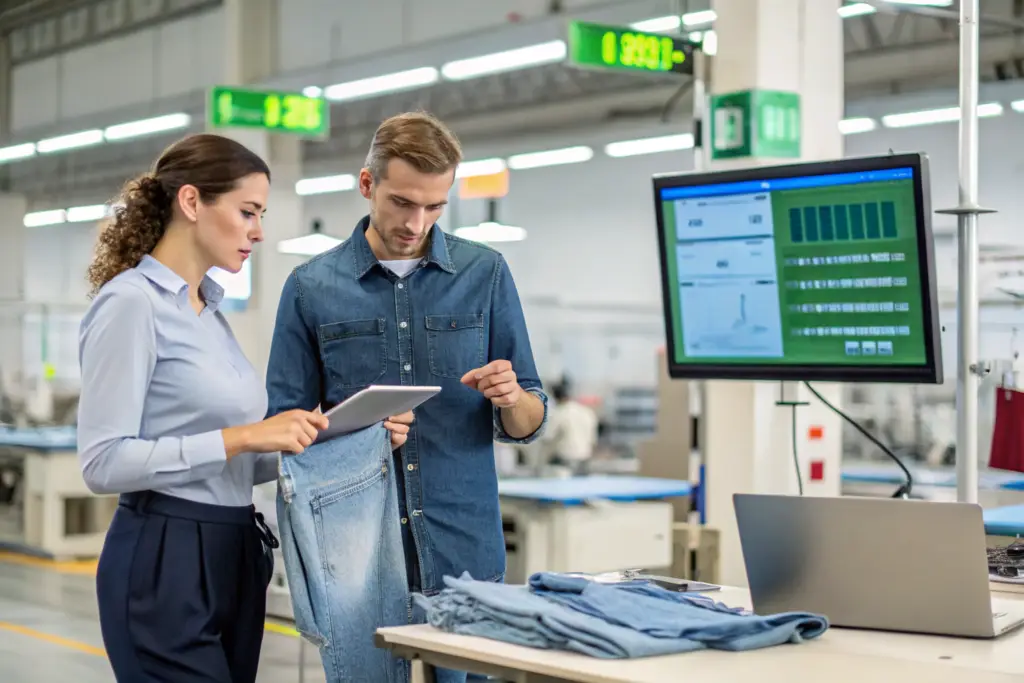
In our model, the buyer emails their dedicated merchandiser with the same photo. The merchandiser understands the issue because she has worked with our wash technician for years. She walks to the wash house. She pulls the approved lab dip from the sealed standard file. She and the wash technician compare the production sample to the standard under the D65 lightbox. They measure both on the spectrophotometer. The Delta E is 2.1, above the 1.5 tolerance. The wash technician adjusts the recipe. The merchandiser emails the buyer within two hours. "We measured the sample. Delta E was 2.1. We have adjusted the enzyme concentration by 0.2%. We are running a new sample now. I will send the new reading this afternoon." The problem is identified, diagnosed, and solved in a single workday. The direct factory communication benefits are speed, accuracy, and accountability. The merchandiser owns the problem from start to finish.
What Happens When Your Contact Is Inside the Factory, Not in a Separate Sales Office?
When your contact is a sales agent in a separate office, their knowledge of the production status is secondhand. They receive a daily or weekly update from the factory. They relay that update to you. If you ask a question that is not covered by the update, they must send a new query to the factory and wait. They cannot walk to the production floor because they are not in the building. They cannot check the fabric inventory because they have no access. Their answers are limited to what the factory has told them, which is often incomplete or outdated.
When your contact is our merchandiser, her knowledge is firsthand. She sits on the production floor. She sees the production lines operating. She sees the cutting table. She sees the wash house. She sees the packing area. When you ask "has the fabric for my order arrived?", she does not check a spreadsheet. She walks to the fabric warehouse and looks at the rolls. She can send you a photo of the roll label with your order number and the receipt date within ten minutes. When you ask "is the sewing on schedule?", she walks to Line 3, checks the output whiteboard, and tells you the exact number of pieces produced that morning.
This firsthand knowledge changes the nature of the buyer-factory relationship. The buyer stops asking for status updates because the status is visible. The buyer starts asking higher-value questions about design improvements, cost optimization, and market trends. The on-site merchandiser model in garment manufacturing is a differentiator that trading companies cannot replicate. The person who answers your email is the person who can walk to your order and see it with her own eyes.
What Makes Our Merchandiser Model Different from Standard Customer Service?
A standard customer service representative in a garment factory is a salesperson. Their skills are conversational. They are friendly, polite, and persistent. Their technical knowledge is limited. They know the price list. They know the lead times. They know how to write a friendly email. They do not know how a pattern is graded. They do not know what enzyme concentration produces a specific wash effect. They do not know how to read a tensile strength test report. When you ask a technical question, they say "let me check with our production team and get back to you." The response is delayed, and the answer may be garbled in translation.
Our merchandisers are not salespeople. They are garment technical professionals. They have backgrounds in fashion design, pattern making, or production management. They understand how garments are made. They can read a tech pack. They can discuss fit adjustments with a pattern maker. They can explain wash recipes to a buyer. They can interpret a lab test report. They are stationed on the factory floor, not in a remote call center. They are your eyes, ears, and voice inside the factory.
Let me explain the specific qualifications and responsibilities of our merchandiser team.
What Technical Expertise Do Our Merchandisers Bring to Client Conversations?
Each of our merchandisers has a specific technical background. Elaine, our Business Director, holds a degree in fashion design and has eight years of experience in garment manufacturing. Before joining our factory, she worked as a pattern maker for a women's wear brand. She understands fit. She can discuss a rise measurement or a leg opening adjustment with precision. She can look at a photo of a fit sample on a model and identify the pattern corrections needed.
Another merchandiser, who handles many of our U.S. distributor accounts, spent five years as a production coordinator in a wash house. She understands enzyme chemistry, ozone cycles, and color fastness standards. When a client asks about the crocking resistance of a specific wash, she can answer from her own knowledge. She does not need to forward the question. A third merchandiser, who manages our European accounts, previously worked in quality control. She understands AQL sampling, defect classification, and testing protocols. When a client asks about our inspection standards, she can explain the system in detail and provide the relevant documentation immediately.
This technical expertise means that conversations between our merchandisers and our clients are substantive. They are not exchanging pleasantries and waiting for answers. They are solving problems together, in real-time. The technical merchandiser role in apparel is a specialized function. Most factories fill this role with salespeople. We fill it with technicians. The difference is felt by the client in every interaction.
How Does a Dedicated Merchandiser Become an Extension of Your Team?
A dedicated merchandiser is assigned to your account for the long term. She is not a rotating customer service agent. She is your permanent point of contact. Over multiple orders, she learns your brand. She learns your fit preferences. Your preferred wash palette. Your quality standards. Your communication style. She internalizes your brand's DNA. She becomes an extension of your team, sitting inside our factory.
After a year of working together, you do not need to explain your waistband measurement tolerance every time you place an order. She knows it. You do not need to remind her that your branding uses a specific foil color on the leather patch. She has the foil stamping die on file. You do not need to ask for a status update because she sends you a weekly summary with the dashboard link. The communication becomes proactive rather than reactive. She alerts you to potential issues before they become problems. She suggests fabric alternatives that could improve your margin. She proposes wash innovations based on trends she has observed. She is not waiting for your instructions. She is anticipating your needs.
This level of integration is only possible with a dedicated, long-term merchandiser. It is not possible with a rotating team of customer service agents or a salesperson who handles fifty accounts. The dedicated account management in manufacturing model builds institutional knowledge on both sides. The buyer learns how the factory operates. The merchandiser learns how the brand operates. The relationship deepens. The communication accelerates.
How Does Our Digital Dashboard Complement Human Communication?
Fast human communication solves problems. A digital dashboard prevents them. When a buyer can see the real-time status of their order, the fabric receipt date, the cutting completion percentage, the sewing output, the wash status, the inspection result, they do not need to send an email asking for an update. The information is already in their hands. This eliminates the most common category of communication between buyers and factories. The "where is my order" email. This email is a waste of time for both parties. The buyer is anxious. The factory is interrupted. The dashboard eliminates it.
The dashboard also provides data that human communication cannot provide efficiently. A trend line of in-line defect rates over the production run. A comparison of the current order's output rate to the planned rate. A notification when a milestone is at risk of delay. This data allows the buyer to manage by exception. They do not need to monitor every detail. They need to be alerted when something deviates from the plan. The dashboard provides that alert. The buyer's attention is focused where it is needed, not scattered across routine updates.
Let me explain how the dashboard works and how it changes the buyer's experience.

What Real-Time Information Does Our Production Dashboard Provide?
Our production tracking dashboard is a web-based platform that each client can access with a secure login. For each active order, the dashboard displays the production milestones. Fabric In-House. Cutting Complete. Sewing In Progress, with percentage complete. Wash Complete. Final Inspection Passed. Packing Complete. Shipment Booked. Shipped. Each milestone is timestamped when completed.
The dashboard also displays quality metrics. The in-line defect rate for the order, updated hourly based on the line auditor's tablet entries. The lab test results for the fabric and hardware lots associated with the order, with a green pass or red fail indicator. The final AQL inspection result, with the sample size, the number of defects found, and the accept/reject decision. The dashboard displays production output data. The daily production quantity versus the planned quantity. A cumulative output chart showing the production progress against the timeline. A projected completion date based on the current output rate.
The dashboard provides a single source of truth for the order's status. The buyer, the merchandiser, and the production manager are all looking at the same data. There is no disagreement about whether the order is on track. The data answers the question objectively. The real-time production tracking for garment manufacturing technology is a transparency tool. It replaces subjective status reports with objective data.
Before we implemented the dashboard, our merchandisers spent an estimated 30% of their time answering status update emails. "Where is my order?" "Has the fabric arrived?" "When will sewing be complete?" "Can you send me a photo of the finished goods?" Each email interrupted their work. Each reply took time to compose. The time was not spent solving problems. It was spent reporting status.
After implementing the dashboard, status update emails dropped by over 80%. The buyers who log in to the dashboard can see the status themselves. They only email when the dashboard shows a potential issue, a milestone that is yellow or red, a defect rate that is trending up. The emails they send are more focused and more productive. "I see the sewing rate dropped yesterday. Is there a machine issue?" The merchandiser can address the specific issue rather than providing a general status summary.
The shared dashboard also reduces misunderstandings. An email that says "production is on track" is subjective. One person's "on track" is another person's "two days behind." The dashboard data is objective. The milestone is either completed or it is not. The output is either at 100% of plan or it is at 85%. There is no room for interpretation. The data aligns expectations. The shared data reducing supply chain miscommunication principle is well-established. A single source of truth eliminates the disputes that arise from multiple, conflicting status reports.
Conclusion
Fast communication is not the secret behind our status as a top clothing manufacturer. It is the visible result of an invisible structure. The structure has three pillars. A factory-direct model that eliminates intermediaries and places the person who answers your email inside the factory, not in a remote sales office. A merchandiser team composed of garment technical professionals, not generalist customer service representatives, who can answer your technical questions without forwarding them. A digital production tracking dashboard that provides real-time visibility into your order's status, eliminating the need for routine update emails and aligning everyone on a single source of truth.
This structure produces a communication experience that feels fast, accurate, and effortless to the buyer. But the speed is not magic. It is not a policy that says "respond to emails within two hours." It is the natural outcome of placing a knowledgeable person close to the work and giving her the tools to share information transparently. When the distance between the question and the answer is fifty meters, not five thousand miles, the answer arrives quickly. When the person answering knows the subject, the answer is accurate. When the data is visible on a dashboard, the question does not need to be asked.
If you are tired of chasing suppliers for answers, I invite you to experience the difference. Contact our Business Director, Elaine. Ask her a technical question. See how quickly and accurately she responds. Ask for a demonstration of our production tracking dashboard. See for yourself what real-time visibility looks like. Her email is elaine@fumaoclothing.com. At Shanghai Fumao, we do not just communicate fast. We are structured to communicate fast. That structure is the secret. The speed is just the proof.