China has tens of thousands of garment factories. Comparing Shanghai Fumao to all of them is meaningless. A village workshop with ten sewing machines is not our competitor. A publicly traded mega-factory with 50,000 workers is not our competitor either. We compete in a specific tier. Mid-sized, privately owned, export-oriented, specializing in woven garments and denim, serving small to medium brands and distributors in North America and Europe. Within this tier, there are perhaps a few hundred factories that a serious buyer would consider. The question is not whether we are the best factory in China. There is no such thing. The question is how we compare to the other factories in our tier on the criteria that matter to a brand owner or a distributor.
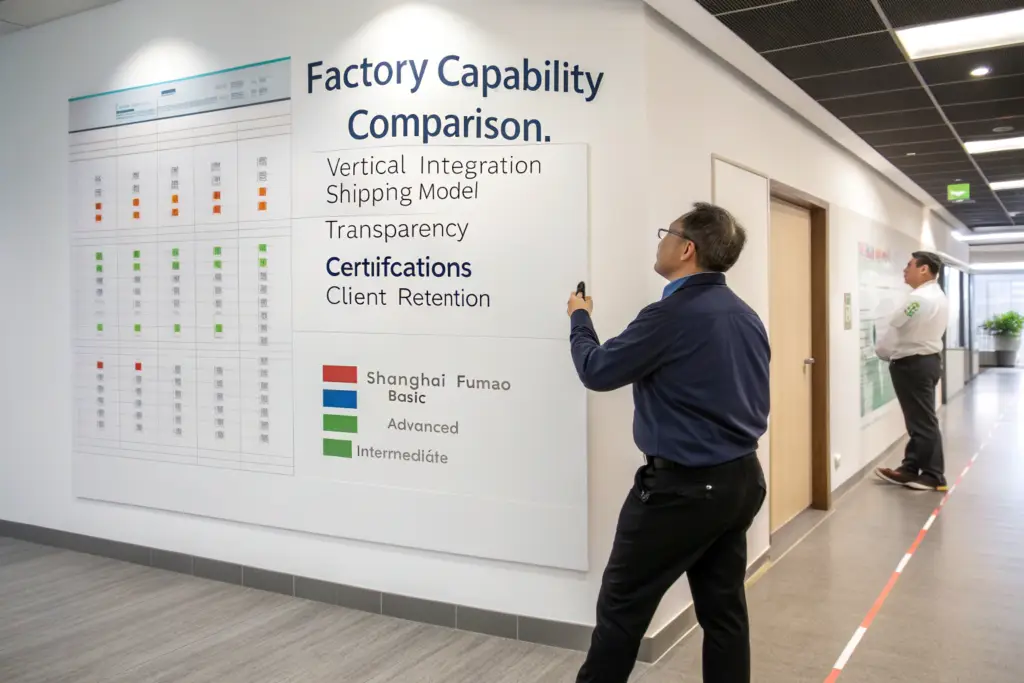
Shanghai Fumao differentiates itself from other top Chinese clothing manufacturers through five structural advantages. First, we are factory-owned and vertically integrated, with five production lines, an in-house testing lab, and an in-house wash development center, while many competitors outsource testing, washing, or even production to subcontractors. Second, we operate on a DDP-first shipping model, providing a single landed cost and acting as the Importer of Record, while most competitors sell FOB and leave logistics to the buyer. Third, we practice radical transparency, sharing real-time production data, full audit reports, and internal test results, while most competitors share a price list and a ship date. Fourth, we hold a comprehensive suite of certifications, OEKO-TEX Class I, BSCI, SMETA unannounced, GOTS, ZDHC, while many competitors hold only one or two, often with lapsed validity. Fifth, our client retention rate exceeds 80%, with multi-year partnerships and dedicated production lines for long-term clients, while many competitors operate on a transactional, order-by-order basis.
I run Shanghai Fumao. I know my competitors. I respect many of them. Some are excellent factories that do specific things better than we do. A factory in Xintang may have deeper wash expertise for extreme vintage effects. A factory in Shandong may have lower fabric costs due to proximity to cotton mills. A factory in Jiangsu may have faster lead times for basic products. I will not pretend we are the best at everything. In this article, I will provide an honest, structured comparison of our factory against the typical top-tier competitor in our market. This is not a takedown of other factories. It is an attempt to help a buyer understand where we fit in the landscape and whether our strengths align with their needs.
How Do We Compare on Factory Ownership and Vertical Integration?
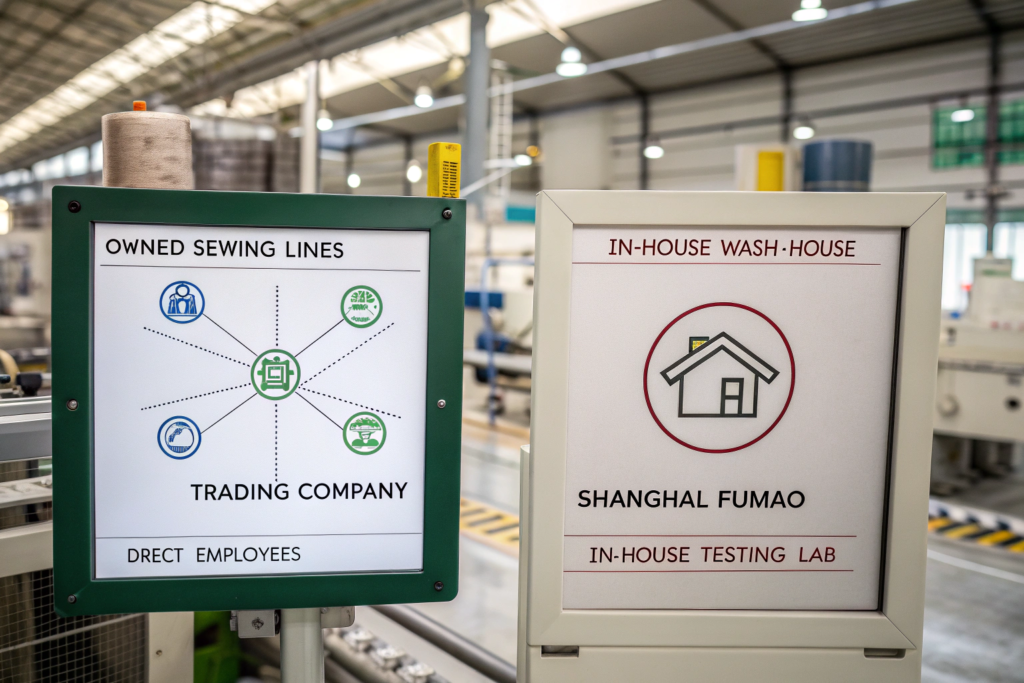
Vertical integration means how much of the production process happens under our roof and under our control. A fully vertically integrated factory does its own pattern making, cutting, sewing, washing, finishing, quality control, and packing. A minimally integrated factory does only the sewing and outsources everything else. The degree of vertical integration directly affects quality control, lead time, and communication efficiency.
In our tier of the market, most factories are partially integrated. They have their own sewing lines, but they outsource washing to a third-party laundry, testing to a third-party lab, and sometimes even cutting to a specialist cutting service. This outsourcing creates handoff points. Every handoff is a potential delay, a potential quality issue, and a communication barrier. When the wash house ruins a batch of shorts, the sewing factory and the wash house blame each other. The buyer is caught in the middle. When the external lab takes a week to return a fabric test result, the cutting is delayed. The buyer waits. We have invested in bringing these processes in-house precisely to eliminate these handoffs.
Let me compare our vertical integration to the typical competitor in our tier.
What Does Our In-House Lab and Wash House Mean for Lead Time and Quality Control?
The typical competitor in our tier outsources fabric testing to a commercial laboratory. The lab is off-site. The test takes three to five working days, plus courier time. If the fabric fails, a new lot must be sourced and tested. The delay compounds. The typical competitor outsources garment washing to a third-party commercial laundry. The laundry serves multiple factories. The factory's order is one of many in the queue. If the laundry is busy, the factory waits. The wash quality is controlled by the laundry, not the factory. If the wash is off-color or inconsistent, the factory has limited ability to fix it quickly.
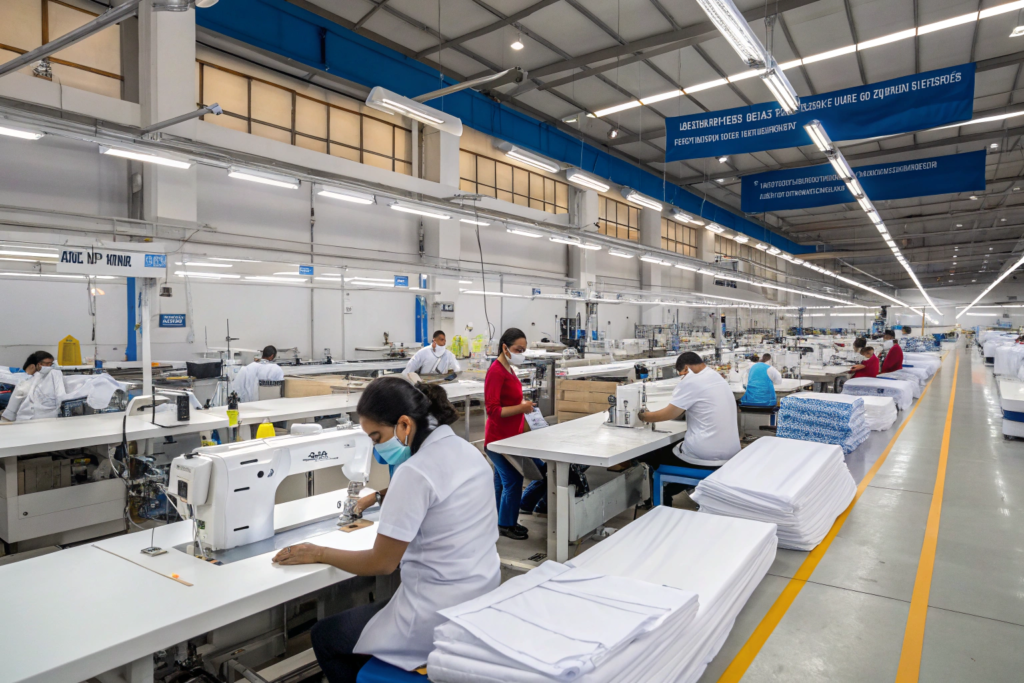
We test fabric in our own laboratory, on our own equipment, with our own technicians. A fabric lot is tested within hours of arrival. A failing lot is rejected and the mill is notified the same day. There is no courier delay. There is no lab queue. We develop and execute washes in our own wash house. Our wash technicians are our employees. The wash machines are dedicated to our production. The wash recipes are developed in our lab and executed under our quality control. If a wash batch is off-color, our wash technician adjusts it immediately. There is no third-party blame game. There is no queue. The result is that our lead times are shorter and our quality is more consistent because we control the critical path. The vertical integration benefits in garment manufacturing include faster turnaround, tighter quality control, and single-point accountability. Our integration is deeper than the typical competitor in our tier.
Why Does Factory Ownership Matter More Than a Trading Company's Promises?
Many factories in China are not actually factories. They are trading companies that present themselves as factories. They have a showroom with samples, a professional website, and a sales team. They do not own a single sewing machine. They take your order, mark it up, and subcontract it to the cheapest workshop that will take it. You have no control over where your shorts are made, who is making them, or what conditions they are made under.
We own our factory building. We own our 140 sewing machines, our cutting tables, our wash machines, our testing equipment. Every person working on your order is our employee, trained by us, paid by us, managed by us. This ownership is verifiable. You can visit. You can do a live video tour. You can check the property deed or the business license. A trading company cannot provide this verification.
Factory ownership matters for three reasons. Quality control. We set the standards and we enforce them. A subcontractor has their own standards, which may not match yours. Ethical compliance. We are audited to BSCI and SMETA standards. A subcontractor may not be. You cannot audit a factory you do not know exists. Continuity. We will be here next year and the year after. A subcontractor may be replaced by the trading company at any time, changing the production conditions of your order without your knowledge. The factory vs trading company verification is a critical step in supplier due diligence. A top manufacturer owns their production assets.
How Do Our Certifications and Compliance Compare?
Certifications are a proxy for a factory's commitment to standards. They are not a guarantee of quality, but they are evidence that an independent third party has audited the factory and found it to meet specific criteria. The quantity, quality, and validity of a factory's certifications are a useful comparison tool.
In our tier, most factories hold at least one social compliance certification, typically BSCI, and at least one product safety certification, typically OEKO-TEX. The difference is in the details. Is the certification current or expired? What is the audit rating? Is the audit announced or unannounced? Does the factory share the full audit report, or just the cover page? A top manufacturer has current, highly rated certifications, is willing to be audited unannounced, and shares the full audit findings transparently.
Let me compare our certification profile to the typical competitor.
What Does Our Certification Portfolio Include That Most Competitors Lack?
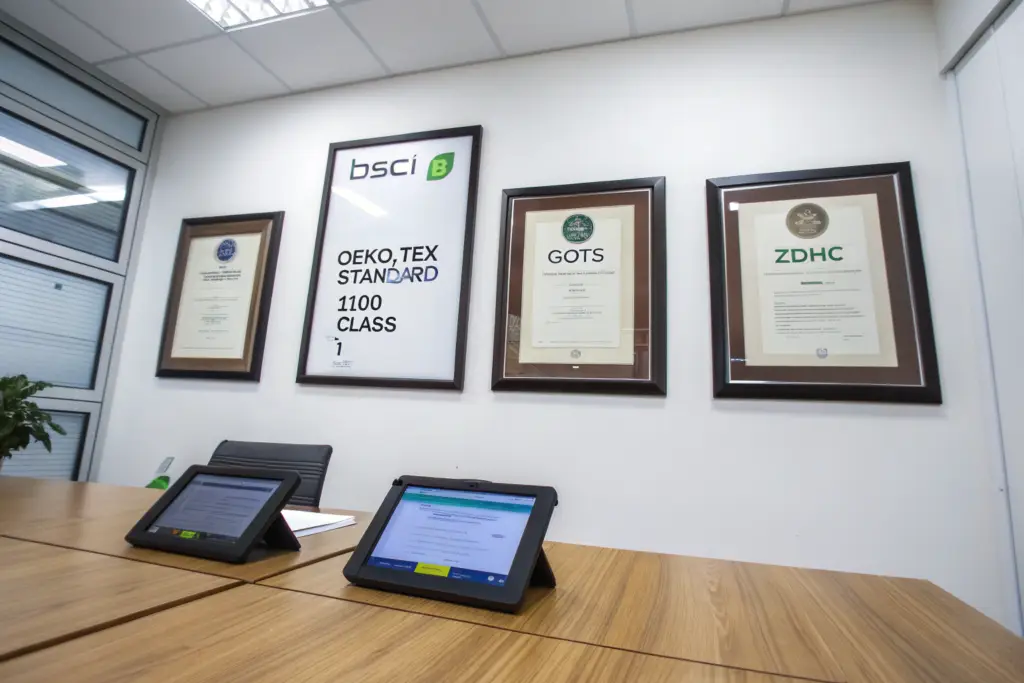
Our certification portfolio covers the four areas that matter to North American and European buyers. Social compliance, product safety, organic content, and chemical management.
For social compliance, we hold a valid BSCI audit with a B rating. B is a good rating. It means the auditor found minor non-conformities that were addressed with a corrective action plan. Many competitors hold a C rating, which is the minimum acceptable to most Western buyers, or a BSCI certificate that is near expiry. We also participate in the Sedex SMETA program with the unannounced audit option. Unannounced audits are the gold standard for social compliance. The auditor arrives without notice. The factory cannot stage a show. Many competitors will not agree to unannounced audits. We actively offer them.
For product safety, we hold OEKO-TEX Standard 100 Class I certification. Class I is the strictest level, certifying the product is safe for babies. Many competitors hold OEKO-TEX Class II, which is for adult products and has slightly less strict limits. Our certificate number is publicly verifiable on the OEKO-TEX website. We provide the number proactively. For organic content, we hold GOTS certification for our sewing and finishing operations. We can produce GOTS-certified organic cotton garments with full chain of custody documentation. Many competitors do not have GOTS certification because the audit requirements are stringent and the organic supply chain is more expensive to access. For chemical management, we maintain a ZDHC Gateway account and upload our wastewater test results. The results are publicly accessible. Many competitors do not have a ZDHC account because it requires regular, expensive testing by approved laboratories. The apparel factory certification comparison guide explains the value of each certification. Our portfolio is comprehensive and current.
How Do We Use Unannounced Audits as a Competitive Advantage?
Most factories fear unannounced audits. An unannounced audit reveals the factory as it is on a random Tuesday, not as it is after three weeks of preparation. A factory that is cutting corners on overtime, safety, or chemical handling will be exposed by an unannounced audit. A factory that is compliant every day will pass.
We welcome unannounced audits because we are compliant every day. Our fire exits are never blocked. Our chemical storage is always labeled. Our working hours are always within legal limits. Our payroll records always match our timecard data. We do not need three weeks to prepare for an audit because we are always audit-ready. This is a competitive advantage because it gives our clients confidence. A brand that sources from us can tell their compliance team, "Fumao does unannounced SMETA audits. We can send an auditor any day." The compliance team's risk assessment drops. The brand's sourcing decision becomes easier. A competitor who refuses unannounced audits creates a compliance risk for the brand. The unannounced supplier audits value is in the honesty of the findings. A factory that embraces unannounced audits is signaling that it has nothing to hide.
How Does Our DDP-First Model Compare to Industry Standard FOB?
The standard shipping model for Chinese garment factories is FOB. The factory produces the goods, delivers them to the port, and hands them to the buyer's freight forwarder. The factory's responsibility ends at the port. The buyer is responsible for ocean freight, insurance, customs clearance, duties, and inland trucking. This model has been the norm for decades.
Our DDP-first model is a structural departure from the norm. We handle everything from our factory floor to the buyer's warehouse door. We book the freight. We clear customs. We pay the duties. We arrange the trucking. The buyer pays one price per unit, delivered. This model is standard in our service offering, not a special request. Most competitors can arrange DDP if the buyer asks, but it is not their default model. Their systems, their pricing, and their team are set up for FOB. DDP is an accommodation, not a core competency. For us, DDP is the core competency.
Let me compare the two models from the buyer's perspective.
What Hidden Costs and Risks Do Buyers Face with FOB Suppliers?
Under FOB, the buyer's financial exposure begins at the port. The buyer pays a freight forwarder, a customs broker, a port terminal, and a trucking company. Each of these is a separate vendor with a separate invoice. Each invoice is a potential surprise. A freight rate increase. A customs exam fee. A port congestion surcharge. A chassis shortage fee. These costs are unknown at the time the buyer places the order. They are discovered when the invoices arrive, after the goods have shipped. The buyer cannot go back to their retail accounts and ask for more money. The buyer absorbs the cost. The margin shrinks.
Under FOB, the buyer also bears the customs compliance risk. If the goods are classified incorrectly, the buyer is liable. If the goods lack the required documentation, the buyer is liable. If the goods are found to be non-compliant with product safety regulations, the buyer is liable. The buyer is the Importer of Record. The legal responsibility is theirs.
Under our DDP model, we bear these costs and these risks. The price we quote is the price the buyer pays. Freight rate fluctuations are our problem. Customs exam fees are our problem. Port congestion charges are our problem. Compliance documentation is our responsibility. We are the Importer of Record. The legal liability is ours. The FOB vs DDP cost and risk comparison demonstrates that DDP provides superior cost predictability and risk protection for the buyer. This is the structural advantage of the DDP-first model.
How Does Our DDP Model Simplify the Sourcing Process for Busy Buyers?
A buyer managing FOB imports is a part-time logistics coordinator. They spend hours emailing freight forwarders for quotes, reviewing customs broker invoices, tracking containers, and resolving port delays. This time is not spent on design, marketing, sales, or strategy. For a small or medium brand, this administrative burden is significant. It pulls the founder away from the work that grows the business.
Under our DDP model, the buyer manages one relationship and one invoice. They send a purchase order. They receive a production tracking link. They receive a delivery notification when the goods arrive. That is the extent of their involvement in logistics. The time saved is redirected to revenue-generating activities. This simplification is particularly valuable for brands that are scaling. A brand that has grown from a 300-unit first order to a 5,000-unit reorder does not want to also scale their logistics department. They want to outsource logistics entirely. Our DDP model allows them to do that. The DDP logistics simplification for importers value proposition is strongest for small and medium brands without in-house logistics teams. These brands are our core clients.
How Do Our Transparency and Client Communication Compare?
The traditional factory communication model is a black box. The buyer sends a purchase order. The factory acknowledges it. Then silence for weeks. The buyer sends an email. "How is the order progressing?" The factory replies, after a delay, "Everything is on schedule." The buyer has no way to verify this. The ship date arrives. The goods are late. The buyer was lied to. This model is toxic. It creates adversarial relationships built on distrust.
Our communication model is a glass box. The buyer can see inside. They have a link to a real-time production tracking dashboard. They can see the milestone status of their order. Fabric in-house. Cutting complete. Sewing in progress, 65% done. They can see the in-line defect rate for their production line. They do not need to email us to ask for an update. The data is visible 24/7. This transparency eliminates the anxiety of the waiting period. It also eliminates the need for us to send status update emails. Our merchandisers spend their time solving problems, not writing "everything is on schedule" emails.
Let me compare our transparency practices to the industry norm.

How Does Real-Time Production Tracking Differ from Email-Based Updates?
Email-based updates are passive, infrequent, and often inaccurate. The buyer asks for an update. The factory responds, usually within 24 to 48 hours. The response is a summary written by a salesperson who may not have visited the production floor that day. The information is already old by the time the buyer reads it.
Real-time production tracking is active, continuous, and accurate. The data is generated by the floor supervisor scanning barcodes at each production milestone. The dashboard updates instantly. The buyer can check the status at any time, from any device. The data is objective. It is not filtered through a salesperson's optimistic interpretation. If the dashboard shows that sewing is at 65% when it should be at 80%, the buyer can ask a specific question. "I see sewing is running behind. What is the issue, and what is the recovery plan?" This is a much better conversation than the generic "Is everything on track?" email.
The tracking dashboard also displays quality data. The in-line defect rate for the order, updated hourly. The lab test results for the fabric and hardware lots. The final AQL inspection outcome when it occurs. The buyer has a comprehensive view of their order's production health, not just its location in the pipeline. The real-time supply chain visibility value is in early problem detection. A delay that is visible at the cutting stage can be mitigated. A delay that is discovered at the ship date is a crisis. Real-time tracking enables mitigation. Email updates enable crisis management.
Most factories share the cover page of their audit report. The page that says "BSCI Audit - Rating B." They do not share the detailed findings section. The buyer does not know what non-conformities were found. They do not know if the findings are minor, like a missing exit sign, or major, like systematic overtime violations. The cover page is a marketing tool. The detailed report is the truth.
We share the full audit report with clients who request it, under a non-disclosure agreement. The buyer can read the auditor's specific observations. They can see the corrective action plan and the evidence of closure. They can make an informed judgment about our compliance, not rely on a single letter grade. We apply the same principle to test data. We share the full lab test report, not a summary. The buyer can see the test method, the test date, the specific parameter results, and the pass/fail criteria. This level of transparency is rare. Most factories treat their audit reports and test data as confidential, to be shared only when absolutely necessary. We treat them as marketing assets. They prove our quality and compliance claims. We want buyers to see them. The supplier transparency as a competitive advantage is a relatively new concept in the apparel industry. We are an early adopter.
Conclusion
Shanghai Fumao is not the largest factory in China. We are not the cheapest. We are not the fastest for basic products. In those categories, other factories outperform us. Where we lead is in the combination of capabilities that matter most to a specific type of buyer. The buyer who values vertical integration because they want a single accountable partner, not a network of subcontractors. The buyer who values DDP shipping because they want predictable costs and simplified logistics, not a part-time job as a freight coordinator. The buyer who values transparency because they want to see their order's progress and quality data, not receive vague email updates. The buyer who values comprehensive certifications because they need to satisfy retail compliance requirements. The buyer who values long-term partnership because they want to build a brand, not just place an order.
These buyers are our clients. Our client retention rate proves that the combination works. A client who experiences vertical integration, DDP simplicity, radical transparency, and technical expertise rarely goes back to the old model of FOB uncertainty and email-based communication. The value of the combination exceeds the sum of its parts.
I encourage you to compare us to other factories you are evaluating. Ask them about their vertical integration. Ask them about their DDP capability. Ask them for their full audit report. Ask them for a live demonstration of their production tracking system. Ask them to put their pattern maker on a video call. The answers will reveal where they stand relative to us. If you want to begin that comparison with our factory, contact our Business Director, Elaine. She can provide our capability overview, our certification portfolio, a demonstration of our production tracking dashboard, and a DDP landed cost quote for your specific product. Her email is elaine@fumaoclothing.com. At Shanghai Fumao, we do not claim to be the best factory in China. We claim to be the best factory for a specific kind of buyer. You will know, after comparing us to the alternatives, whether that buyer is you.