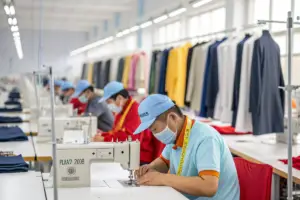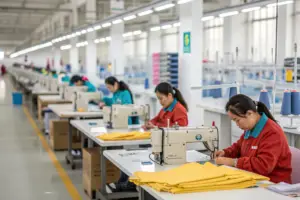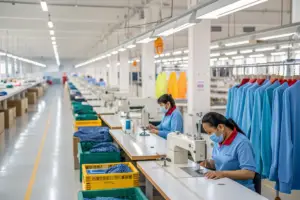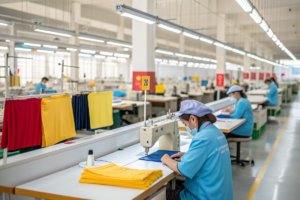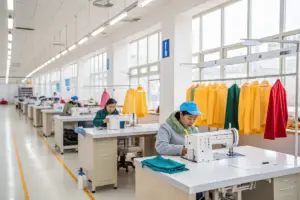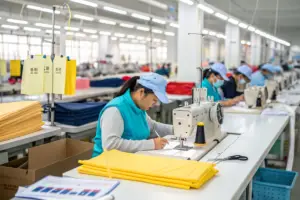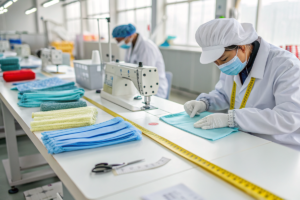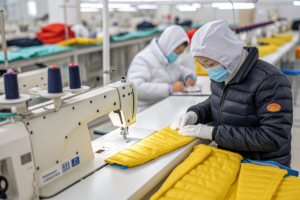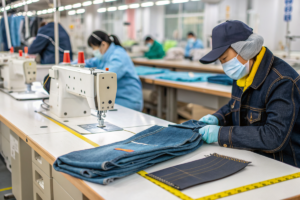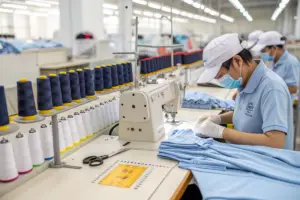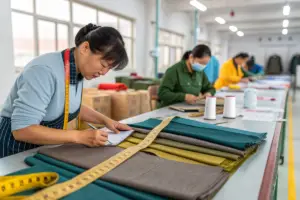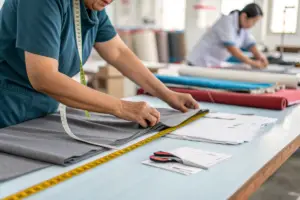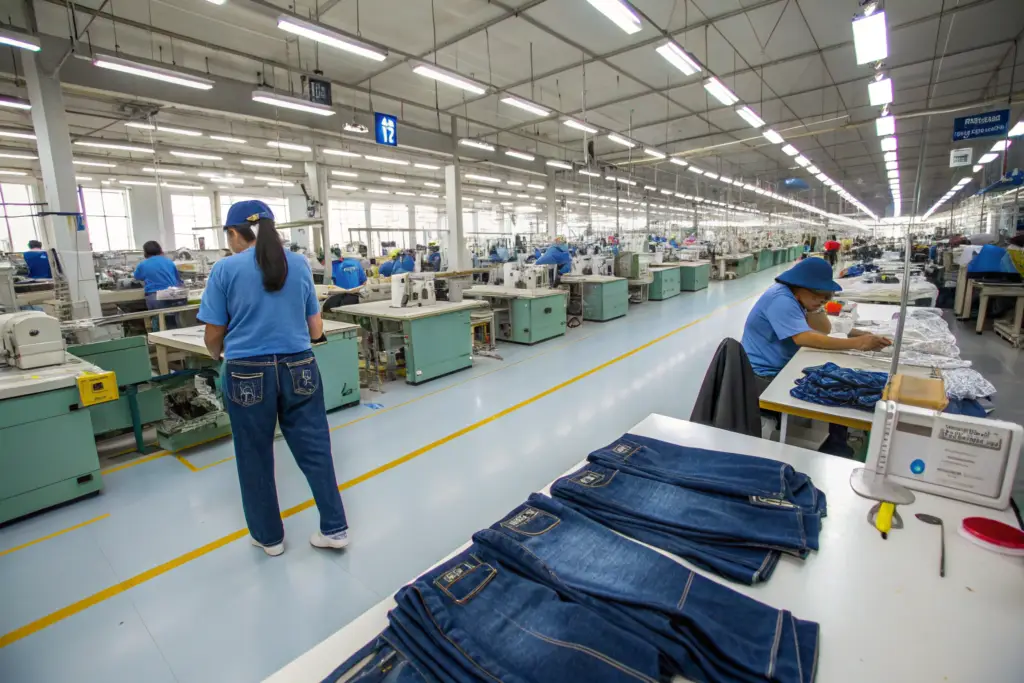
I’m going to be very direct with you. If you’re importing denim shorts and you don’t have eyes on the factory floor, you’re gambling with your brand’s reputation. A single photo of an unsafe fire exit or underage worker can destroy a company you’ve spent ten years building. I’ve seen it happen. The hard truth is that many importers rely on a piece of paper—a PDF audit certificate a supplier emails them—and they call it "due diligence." That’s not due diligence. That’s wishful thinking. I’ve been manufacturing apparel for over fifteen years, and I run Shanghai Fumao. I’m writing this from inside a factory that I walk through every single morning. I want to show you exactly how to verify ethical production, not just buy a story about it.
What Certifications Prove a Denim Factory Is Actually Ethical?
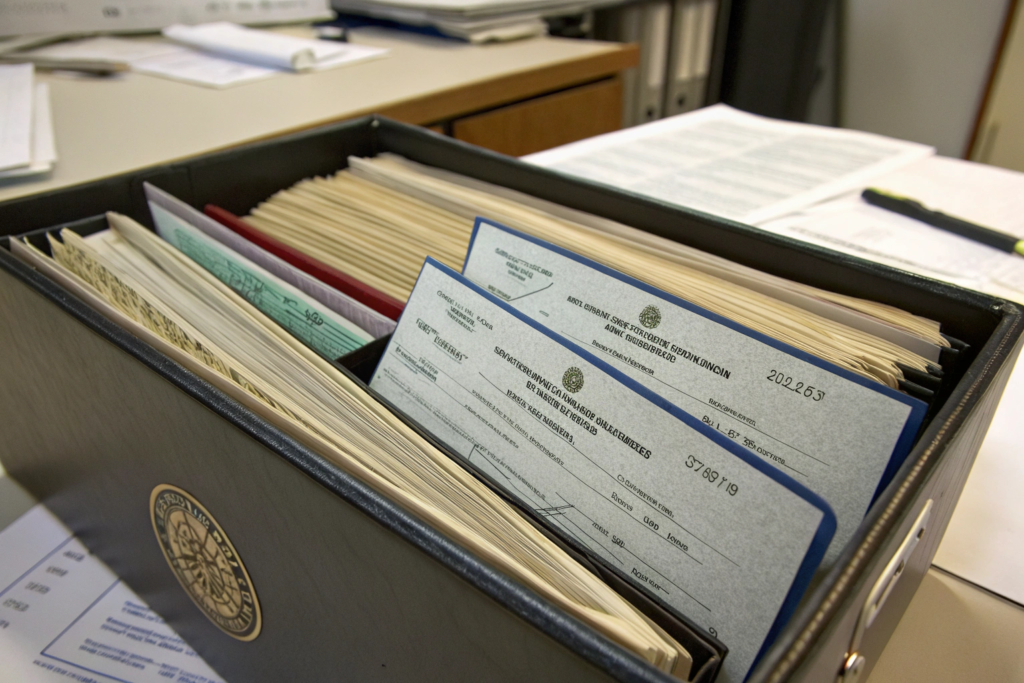
I keep a folder in my desk drawer. It’s thick and heavy. It holds every certificate my factory has earned, and I update it constantly because the standards keep changing. But I’ll tell you a secret that most factory owners won’t admit in public: not all certificates carry equal weight. Some of them are basically bought, not earned. A supplier can pay a small fee to a weak local auditor and get a paper that looks impressive to an uninformed buyer. I’ve watched this happen. I’ve lost bids to factories that waved fake "eco-certifications" printed off a home computer. So, you need to know which logos actually represent real, unannounced inspections and real worker protection.
The certifications that truly hold a factory accountable share a few traits. They require physical, on-site audits. They interview workers privately, without managers hovering in the background. They check payroll records against actual hours worked. They test the fire alarms while the audit is happening. A meaningful certification isn't a reward for a perfect score on a planned visit. It's a system of continuous monitoring. When I talk to brand owners who import from developing countries, I tell them to look for the big, recognizable frameworks first, and then dig deeper into the factory's own internal grievance log. A certificate on a wall means nothing if the workers underneath it are too scared to report a problem.
Why Is a Social Compliance Audit More Important Than a Quality Audit?
A quality audit tells you if the buttonholes are straight and the denim weight matches the spec sheet. That protects your customer returns rate. A social compliance audit tells you if the person sewing those buttonholes is safe, paid fairly, and old enough to be working. That protects your entire business from legal and public relations disaster.
I learned this distinction the hard way about a decade ago. We were subcontracting a portion of our wash process to a nearby facility. Their sample work was beautiful. I visited once, looked at the washing machines, and left satisfied. I didn't check their chemical handling room. It turned out they were storing potassium permanganate in unmarked buckets on a dirt floor. A worker got a chemical burn. It wasn't my direct employee, but the guilt of enabling that supply chain hit me hard. I pulled our contract immediately and invested in our own in-house wash facility.
This experience taught me that a social audit focuses on the soft infrastructure that a quality audit ignores. It looks at emergency exit routes, drinking water access, and whether the overtime hours, even if voluntary, are exceeding the legal maximum. For you, the importer, a failed social audit doesn't just mean bad PR; it means your shipment could be detained by customs. There's a direct link now between labor rights and trade compliance. If you demand a valid, recent social compliance report—and I recommend you check it’s less than 12 months old—you're not just being moral. You're being smart. Ask your supplier to see the specific Corrective Action Plan from their last audit. A real factory will have one with time-bound fixes. A fake factory will look confused when you ask.
Does a Factory Need ISO 45001 to Produce Denim Safely?
ISO 45001 is the global standard for occupational health and safety management. It's not a simple checklist; it's a whole management system. Does a factory need it specifically for denim? Legally, no. You can sew five-pocket shorts without it. But practically, I believe it's becoming essential if you want to work with serious U.S. and European brands.
Denim production has specific hazards that a generic safety talk doesn't cover. We deal with heavy rolls of fabric that can crush a foot if a trolley fails. We deal with the micro-dust from fabric cutting. We deal with the chemical mist in the spray booth. ISO 45001 forces the factory leadership to do something that most small factories skip: the hazard identification and risk assessment process. It's a formal document where you walk the floor, list every possible way a worker could get hurt, and then design a control for it.
When we implemented ISO 45001 at Shanghai Fumao, the biggest change wasn't the new fire extinguisher brackets. It was the worker consultation part. The standard requires that workers actively participate in identifying risks. A sewing machine operator came to me and pointed out that the new LED task lights were creating a glare on the needle plate if you sat at a certain angle. This was causing eye strain. My production manager had never noticed it, but the operator did. We adjusted the light angles and the complaint stopped. That's the value of the system. So, when you're evaluating a supplier for wholesale denim shorts, ask them, "Can you walk me through your current OHS risk register?" If they can produce a living document that gets updated quarterly, you’re dealing with a professional operation. If they just point to a fire extinguisher, proceed with caution.
Can You Audit a Denim Shorts Supplier Without Visiting in Person?
I get this question from small and mid-sized brand owners almost every week. They don't have the travel budget to fly to Vietnam, Bangladesh, or even to Shanghai. They have $3,000 for their first purchase order, not $5,000 for a plane ticket and hotel quarantine. They feel stuck. They think they either have to trust the supplier blindly or give up on the order. I’m here to tell you that you can build a reliable, ethical verification system remotely, but it requires being more clever than just asking for "pictures of the factory."
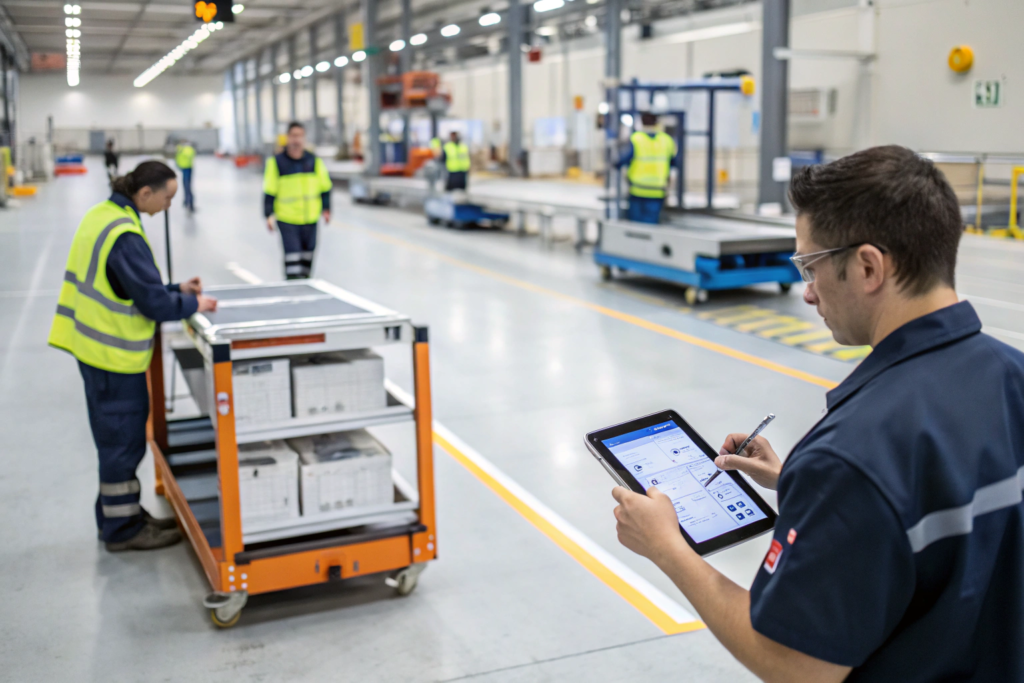
Digital verification is my reality now. Since the travel disruptions a few years ago, I've watched the entire inspection industry pivot. We've hosted video tours where we strapped an iPad to a rolling cart and pushed it through our cutting room. But I'll be honest with you: a single curated video call is still just a show. A factory can clean up one section of the floor, put all the fire extinguishers in that aisle, and keep you on a scripted path. True remote verification is about data triangulation. It's about combining live video, worker voice surveys, and third-party transaction data to see if the story matches the reality.
A brand we worked with from Austin, Texas, did a brilliant thing during their remote check. They asked us to pan the camera slowly across a random row of sewing machines and zoom in on the serial number plates. Then, they asked us to email them a photo of the machine maintenance log for those specific serial numbers. They wanted to see if the log entries matched the physical dirt and wear on the machines. That's a smart check. It proved we actually maintained our equipment and that the workers running them had a system for reporting breakdowns. Remote auditing is not about seeing a spotless floor. It's about seeing the management systems at work. You want to see the notice board where overtime hours are posted, the first-aid kit with a checkmark from last week, and the raw material inventory that matches recent production claims.
How Can You Use Live Video Calls to Spot Red Flags?
A live video call is your best available substitute for a physical walkthrough. But you must control the camera. If you let the factory owner point their phone where they want, you will only see the polished areas. I recommend you use a video conferencing tool that has a "request control" function or you specifically instruct them to use a wide-angle lens and walk a set path you design.
Here is what I would look for if I were in your shoes:
| What to Ask Them to Film | Red Flag | Green Flag |
|---|---|---|
| The circuit breaker box | Loose wires, dust covering it, blocked by fabric rolls | Clean, labeled switches, clear space in front |
| The washing machine floor | Standing water, slippery ground, harsh chemical smell | Dry, anti-slip mats, visible ventilation fans |
| A random payslip (blur the name) | Net wage doesn't match the local minimum threshold | Clear breakdown of regular and overtime hours |
| The lunch break area | No chairs, dirty water source | Clean seating, filtered water, shaded area |
I remember a specific video call with a potential U.S. partner last winter. He asked me to point the camera at the ceiling. I was confused for a second, but I did it. He was looking for sprinkler heads. He’d had a bad experience where a supplier showed him fake smoke detectors that were just battery-operated shells screwed into the drywall. I laughed and told him to wait while I got a ladder. I climbed up and tapped the sprinkler pipe so he could see the vibration and hear the metallic sound of the connected system. That interaction built more trust than any certificate I could have attached to an email. You're looking for that kind of verifiable physical detail. Ask to see the inspection tags on the fire extinguishers. They should have a date punched within the last month. Ask to see the needle guard on the sewing machines; missing guards indicate a total disregard for basic safety.
Why Should You Request a "Live Worker Interview" via Video?
This is the most intrusive request you can make, and it's the most revealing. A social auditor will always pull workers aside for a confidential chat. You can do a version of this remotely. You ask the factory manager to call a random worker over to the screen, or you ask them to walk into the middle of the sewing line and you choose someone yourself.
The goal here is not to interrogate someone. The goal is to gauge their body language and the factory's reaction. Does the manager hover right behind them, feeding them answers? Do the workers all look at the floor and refuse to make eye contact? Do they freeze up? These are terrible signs. In a healthy factory, a worker might be shy to talk to a foreign camera, but they won't be terrified.
When you get a worker on the screen, don't ask yes-or-no questions. A scared worker will just nod along with whatever they think you want to hear. Ask open-ended questions. "What safety training did you have this month?" "Show me the closest exit from your station." "How do you report a problem with your machine?" Their ability to answer these questions demonstrates the factory's training culture. At my factory, I sometimes watch these remote interviews from my office. I know my team leaders can answer these questions because we drill them weekly. A client from Chicago once asked one of my younger stitchers, "What happens if you notice a loose screw on your chair?" She immediately said, "I tag it red and take it to the maintenance bench." It was such a specific, correct answer that the client told me later it was the moment he decided to proceed with his $45,000 order. You can't fake that kind of embedded safety culture. If you ask a worker a simple safety procedure and they look confused, the entire management system is broken, no matter how many certificates the boss has framed in the office.
Which Labor Red Flags Do Unethical Denim Factories Hide Best?
I need to be careful how I write this section, but I also need to be honest. Unethical factories spend as much time hiding their sins as ethical ones spend fixing them. They are sophisticated. They know the audit checklists by heart. They know exactly what triggers a fail, so they build a Potemkin village around those specific points. They will put a clean, new fire extinguisher at the front door and hide the blocked emergency exit with a rolling fabric rack that they move two minutes before the inspector walks in.
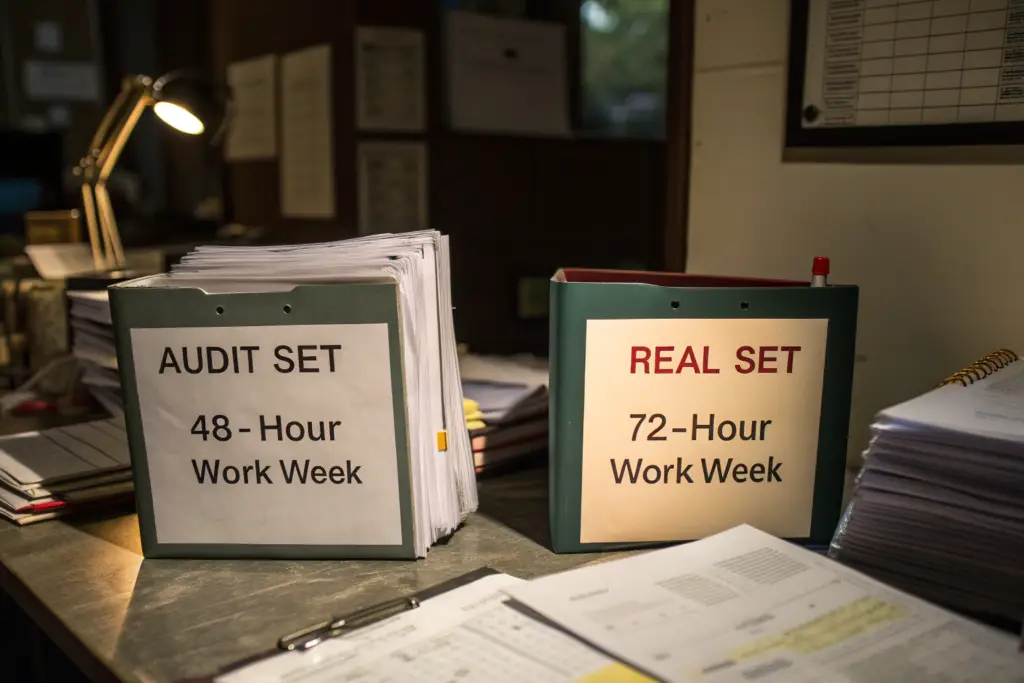
The most common hidden red flag I hear about from colleagues and from buyers who switch to us is the manipulation of working hours. It is incredibly easy to keep two sets of payroll records. One set, the "audit set," shows a perfect 48-hour week with mandatory breaks. The other set, the real one, shows a grueling 72-hour week during peak season. I'm not going to pretend that peak season isn't intense; in this industry, we all feel the pressure of a Black Friday deadline. But the systematic falsification of records is a sign of a deep ethical rot. If they lie about the hours, they will lie about the fabric content and the chemical testing.
Another deeply hidden red flag is the misclassification of workers. You might walk onto a floor and see fifty people sewing. The factory owner claims they are all formal employees with social insurance. In reality, thirty of them might be "temporary" or "probationary" staff who have actually been employed for three years with no contract. They get paid cash in hand, slightly lower than the minimum wage, and if they get injured, the factory disowns them. This is a global problem, not just a Chinese one. I've heard the exact same stories from peers manufacturing in Turkey, India, and Eastern Europe. For you, the brand owner, this hidden mess creates a liability time bomb. If a labor rights group investigates and finds these practices, your beautifully marketed ethical collection becomes a symbol of exploitation.
How Do Factories Disguise Excessive Overtime During Peak Seasons?
Peak season overtime is the original sin of garment manufacturing. The client pushes for a shorter lead time, the fabric arrives late from the mill, and suddenly there are 15,000 units that need to ship by Tuesday. The ethical factory navigates this by being transparent: we negotiate the deadline or we pay the legally mandated high overtime premium and cap it safely. The unethical factory hides it.
A common trick is the "double card" system. A worker clocks in with their official ID card for the first shift. For the second, unauthorized shift, they clock in with a handwritten name on a paper log that never enters the digital payroll system. The wages for these ghost hours are paid in cash from a separate, undeclared fund. If an auditor looks at the electronic records, everything seems perfectly compliant. The factory might also lock the external gates during this illegal shift to hide the lights and noise from the outside world. That's a fire trap of the highest order.
To spot this remotely or in person, you need to look for signs of overproduction. Ask to see the production planning board. If the weekly output numbers on the board are significantly higher than what the official headcount and legal working hours could possibly achieve, the math doesn't add up. Let's say a factory has 100 workers, working a legal 48-hour week. The industrial engineering plan says one worker can make 15 pairs of shorts a day. That's a maximum output of 9,000 units a week, assuming perfect efficiency. If the shipping log shows 14,000 units consistently exiting the warehouse every week, those extra 5,000 units were made on stolen time. I do this math check in my own factory to ensure our planning is realistic and within our ethical boundaries. You can do it too. Ask for the shipping documents and the employee headcount, and then do the simple multiplication. A reputable factory like Shanghai Fumao will have no problem walking you through this production capacity calculation.
Is Subcontracting Without Consent a Common Ethical Breach?
Absolutely, and it's one of the hardest things for an importer to catch. You do your due diligence on Factory A. You approve their lines, their workers, and their wash house. You place your order. Unbeknownst to you, Factory A quietly sends 40% of your cut-work to a tiny, unlicensed Factory B three blocks away. Factory B is a dark, cramped space with no fire exits and home-based workers finishing seams on old, unsafe machines.
This happens because the supplier wants to take your order volume but doesn't have the in-house capacity to meet your deadline. They are terrified of losing your business by asking for a time extension, so they roll the dice and subcontract. You pay the fair price, Factory A keeps the margin, Factory B gets the scraps, and your brand inherits all the ethical risk.
You can guard against this by demanding a "no unauthorized subcontracting" clause in your manufacturing agreement. But a clause is just paper. You need active verification. A practical method I've seen from German clients is the "cutwork reconciliation" request. At the end of production, ask the supplier to provide the total weight of denim fabric they received, the total weight of the finished shorts, and the weight of the cutting waste. These numbers should balance roughly, accounting for standard cutting efficiency losses (about 15-18% for denim). If the "weight of finished goods" shipped out is vastly higher than what the "weight of fabric" in-house could have produced, the excess fabric was cut and sewn somewhere else. This mass balance calculation is a basic tool in the industry, and a factory that refuses to provide it is likely hiding something.
What Systems Protect Workers' Rights in Denim Manufacturing?
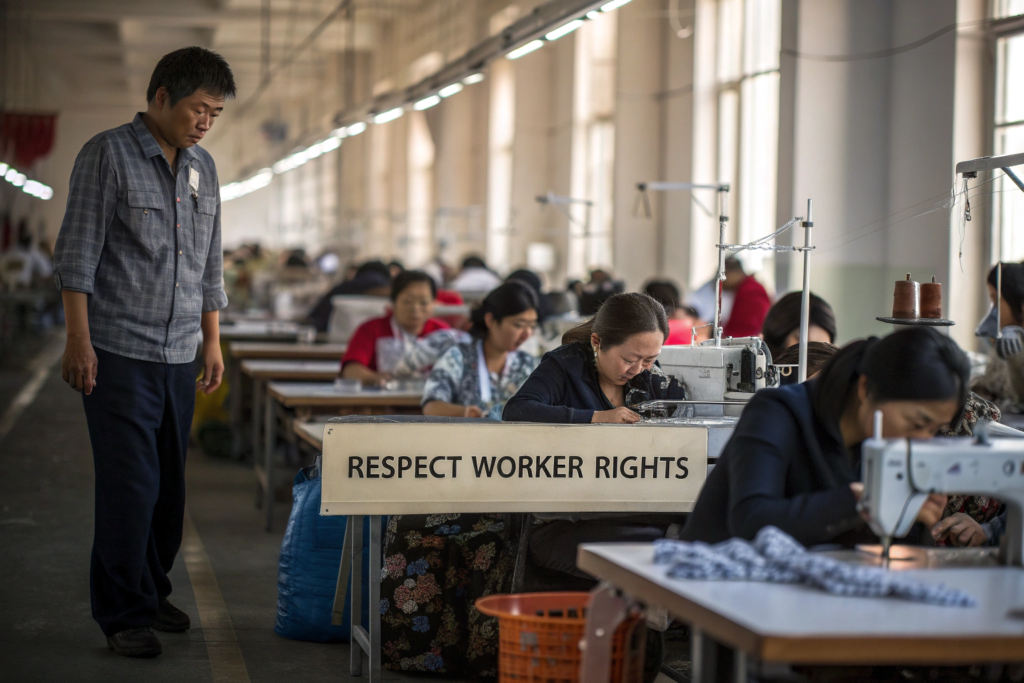
When you look past the certificates and the audits, what actually keeps a worker safe on a Tuesday afternoon in July? It's not the framed policy on the wall. It's the living systems that hum in the background. I've spent years building these systems, and I can tell you they are not glamorous. They are things like a functioning grievance box that doesn't just collect dust, a safety committee that actually cancels a production shift if a machine smokes, and a payroll software that flags unusual overtime spikes automatically.
The protection of workers' rights starts with the recognition that a factory is a power structure. The manager has the power, the brand has the power, and the worker sits at the bottom. An ethical factory builds upward pressure. It gives the worker a way to push back without fear. This is in our direct self-interest as factory owners. A terrified, exhausted, or injured worker cannot sew straight lines. They make mistakes. They damage fabric. They cause the quality claims that eat into your profit. So, protecting their rights isn't just charity; it's the most fundamental form of quality control I know.
A worker protection system needs three legs to stand. First, the prevention leg, which is training and hazard removal. Second, the voice leg, which is the grievance mechanism and union or committee representation. Third, the remediation leg, which is the insurance, the medical care, and the corrective action when something goes wrong. If any of these three legs is missing, the stool falls over. I see too many factories focus only on prevention—posting safety signs—and ignore voice and remediation entirely. That's not worker protection; that's just interior decorating.
How Does an In-House Grievance Mechanism Actually Function?
A grievance mechanism sounds very bureaucratic. In reality, it's a locked box on the wall and a phone number that goes directly to the HR director's personal mobile. But the design of this box matters more than you might think. If you put the complaint box directly under the security camera, or right outside the boss's office door, it will stay empty. The worker needs to know that submitting a complaint is anonymous and private.
Our system at my factory has two channels. There is a physical, locked wooden box in the changing room, a camera-free zone. There is also a QR code, printed on a small sticker stuck to the back of every toilet stall door. A worker can scan it with their phone and type a complaint directly into a form that goes to an external HR consultant, bypassing the internal management structure entirely. I set up this dual system after a worker told me she was too shy to be seen putting a paper into a box. The QR code in a private space solved that.
But the mechanism is useless if the complaints vanish into a black hole. We have a 48-hour acknowledgment rule. Within two days of a complaint, the worker receives an anonymous, case-numbered receipt via the system. The factory then has a set number of days to implement a fix or explain why it can't be fixed immediately. We track the resolution rate. Last quarter, we had four complaints about the ventilation in the ironing section. The workers said the steam was making it hard to breathe. We installed two additional exhaust fans within ten days. We posted a photo of the new fans on the canteen notice board with the case number, so the anonymous filer could see the result. That closes the loop. When you source from a supplier, ask them to describe their grievance loop closure. If they stare at you blankly, their system is just a box with a hole in it.
What Role Do Worker-Led Safety Committees Play in Denim Factories?
A worker-led safety committee is the engine that makes all the other systems run. It can't be a management puppet show. I sit in on the first meeting of the year, but I don't run it. The committee members are elected by the sewing, cutting, and finishing teams. They have a small budget for low-cost fixes and the authority to stop a production line if they see an imminent danger, though thankfully, that has only happened once.
Their most valuable work is boring. They do a monthly walk-around inspection with a clipboard. They check every needle guard, every eyewash station, every fire exit push-bar. They document the findings in a logbook. This logbook is gold for you, the brand owner. It's not a polished audit report. It's a hand-written, messy document that shows real, ongoing engagement.
During a visit from a UK ethical fashion brand, their sustainability officer spent twenty minutes flipping through our committee logbook. She saw an entry from March where a committee member noted that the floor marking tape near the cutting tables was peeling up and could be a trip hazard. The entry had a date, a photo, and a maintenance sign-off from two days later. She told me it was the single most convincing piece of evidence she saw all day. It proved that safety wasn't just a reaction to her visit; it was a weekly habit. If you are checking a denim shorts supplier, ask for a photo of the safety committee logbook entry from last week. A real factory will have it. A fake factory will say, "Oh, the secretary is on leave" or "We update that annually." Walk away from those.
Conclusion
Ensuring your denim shorts supplier has ethical production lines is not a one-time checkbox exercise. It's a continuous investigative process. You start by verifying the right certifications, recognizing that a social compliance audit with a robust corrective action plan tells you far more than a generic quality report. You dig into specific systems like ISO 45001, which reveals whether a factory actually manages hazards or just decorates around them. But you don't stop at documents. You use live video calls to walk the production floors, checking the physical reality of fire extinguishers, sprinkler heads, and machine needle guards. You push for live worker interviews, listening not just for the words they say, but for the confidence in their answers and the distance the manager keeps from the camera. You learn to spot the deeply hidden red flags—the double payroll books, the excessive overtime masked by ghost shifts, and the unauthorized subcontracting that can be uncovered through a simple mass balance calculation of fabric weight. And you look for the living systems that truly protect workers, from the grievance QR codes in private spaces to the hand-written entries in a safety committee logbook.
This level of scrutiny might feel intense. You might worry that a supplier will push back. The right supplier won't. The right supplier will see your questions as a sign of a serious, professional partner who values brand safety as much as they do. I want to be that partner for you. At Shanghai Fumao, we've built our production lines around the principle that an empowered, safe, and well-rested worker makes a better product. Our compliance is not a locked file cabinet; it's visible in the clean floor tape, the tested alarms, and the open communication channels we maintain daily.
If you have questions about verifying a current supplier, or if you're ready to start a new denim program with a factory that meets these ethical standards, please reach out to our Business Director, Elaine. She can walk you through our latest third-party audit reports, arrange a live, unscripted video tour of our lines, and answer any technical questions you have about our worker protection systems. You can contact her directly at elaine@fumaoclothing.com. Let's build a supply chain that you can be proud to show your customers.