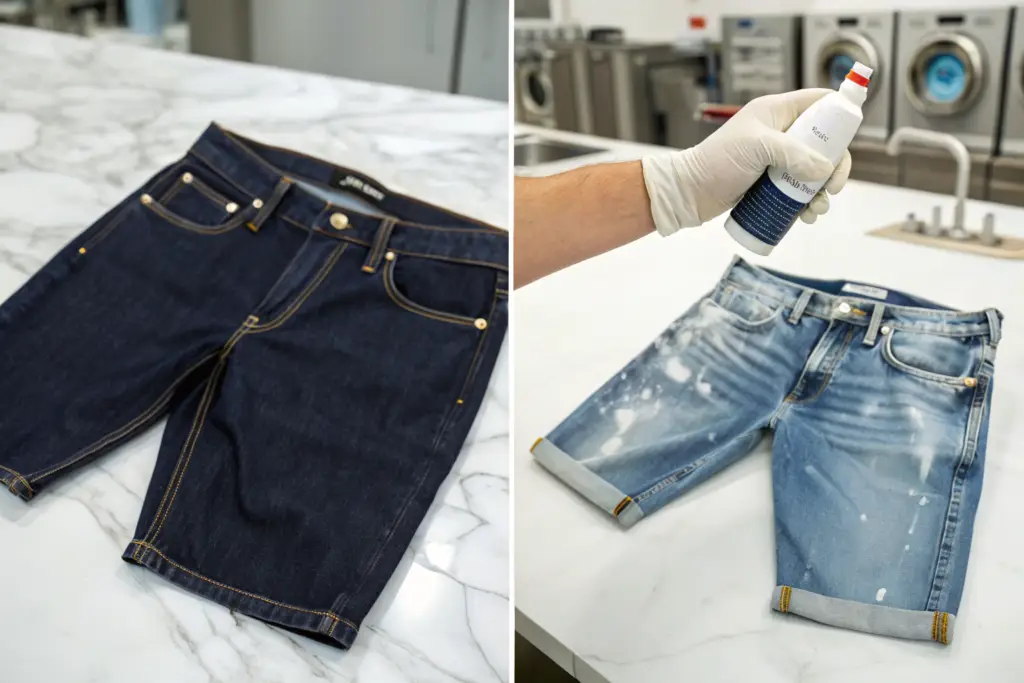
I want to take you inside our wash house. Not the polished version you see in a corporate brochure, but the real place where we mix chemicals, ruin test samples, and occasionally create something that makes a brand owner lean back and say, "I've never seen that wash before." That's the reaction we chase. In a market flooded with generic light stone and medium blue denim shorts, a rare wash style is the only thing that stops a consumer from scrolling past your product. It's the texture, the tint, the cloud pattern that signals "this is different" before they even read the price. I'm Richard, and I run Shanghai Fumao. We've spent years building a wash development capability that produces finishes most factories won't attempt, either because they lack the chemical knowledge or because they're afraid of the risk. This article is my attempt to explain exactly how we do it.
What Makes a Denim Wash "Rare" in Today's Wholesale Market?
A "rare" wash isn't just a different shade of blue. It's a wash that a competitor cannot easily replicate by looking at a photo and guessing the formula. When a brand owner sends me an Instagram screenshot and asks, "Can you do this?", I can usually tell within thirty seconds whether the wash is rare or generic. A generic wash is a single-step, straightforward process. You toss the shorts in a washing machine with some pumice stones and a standard enzyme, run it for forty minutes, and you get a predictable result. Any factory with a washing machine can do that. There's no competitive moat.
A rare wash, by contrast, is a multi-layered construction. It might involve a base tint, a manual spray application, a partial stone wash, a localized enzyme brushing, and a final tint over the top. Each layer interacts with the previous ones in ways that are difficult to predict without experience. The color on the thigh crease might be a product of four separate chemical reactions, not one. I define rarity by the number of controlled variables a factory must manage simultaneously. If the wash requires precise humidity control in the spray booth, or a specific dwell time after a potassium permanganate application, or a neutralization step that stops the reaction at an exact color point, it's rare. The barrier to entry is not the equipment; it's the accumulated knowledge of how these variables interact.
I worked with a streetwear brand from Atlanta last year that wanted a wash they described as "concrete gray with a rusty underglow." That sounds like poetry, but it's actually a chemical instruction. The concrete gray was a base pigment dye. The rusty underglow was a controlled, partial discharge of that pigment using a localized spray of a reducing agent, followed by a warm rinse that shifted the discharged areas toward a warm, oxidized brown. We went through eleven lab samples before we nailed the balance. The brand owner told me that two other factories had declined the project entirely, saying it was too complex. That's the space we operate in. The washes other factories refuse.
Why Do Multi-Layer Washes Create a Competitive Moat?
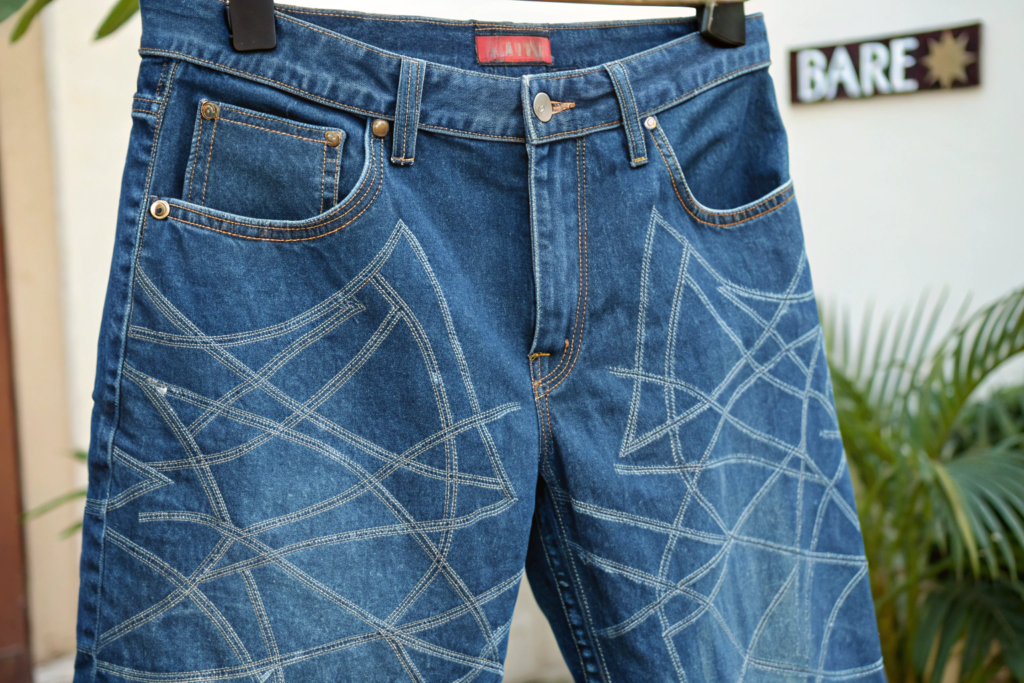
A single-layer wash is a commodity. Any factory can buy a drum washer, load it with stones, and produce a light blue short. The wholesale price for that service converges toward the lowest bidder. There's no brand loyalty, no premium pricing, no reason for a distributor to stick with you when a cheaper option appears. A multi-layer wash changes that calculus. When a wash involves five separate stages, each one requires a decision. What concentration of enzyme? What stone-to-garment ratio? What spray pressure? What drying temperature between stages? If a competitor tries to reverse-engineer that wash from a photo, they have to guess at all five decisions. The odds of guessing all five correctly are close to zero.
This complexity is a protective barrier around our clients' products. A distributor who sells a rare-wash short isn't just selling denim; they're selling a proprietary finish that a fast-fashion copycat cannot duplicate in two weeks. I've seen this play out in the market. One of our clients, a mid-sized brand from California, built their entire summer identity around a "salt-wash" denim short we developed together. It was a three-stage process involving a coarse sea salt abrasive tumble, a light indigo over-dye, and a silicone softener finish. A larger, competing brand tried to knock it off. They produced a version that looked vaguely similar in a compressed online photo, but in person, the hand feel was completely wrong and the color lacked the depth. The knockoff failed. Our client had a protected season.
The development of these moats requires a partnership model. The brand owner has to trust us with their vision, and we have to invest the lab time to translate that vision into a repeatable industrial process. It's not a transactional relationship. It's a collaboration. When I meet a new distributor who's tired of competing on price alone, I often suggest we start with a wash exploration project. Let's find a finish that belongs uniquely to them. That's how you escape the commodity trap.
How Do We Source Uncommon Chemical Agents for Unique Finishes?
The chemicals we use in our wash house are not the same standard enzymes and bleaches that every denim laundry stocks. Some of the finishes our clients request require specialty agents that are not available from general textile chemical suppliers. Finding these agents and validating them for production use is a significant part of our R&D function.
I maintain relationships with several boutique chemical formulators, mostly in Japan and Germany, who develop experimental finishing agents for the high-end denim market. These are small companies run by chemists who are denim obsessives. They create things like a neutral-pH bleaching catalyst that lifts indigo without damaging the cotton fiber, or a reactive tint that bonds to the fabric at a lower temperature, saving energy and giving a slightly different surface effect. Accessing these materials requires relationships, not just a purchase order. The formulators want to know that their chemicals will be used by a skilled team that can handle the complexity. They don't sell to just anyone.
A practical example: two years ago, we wanted to create a wash effect that mimicked the look of denim that had been buried in volcanic ash for decades. It sounds absurd, but a Japanese brand had done something similar as a limited art project, and a client of ours wanted a commercial version. We contacted a German chemical partner who developed a pumice-like synthetic abrasive with a specific pH and mineral content. We tumbled it with the shorts under controlled humidity. The result was a dry, dusty, mineral-crusted surface that flaked off slightly with wear, revealing the indigo beneath. It was a completely unique finish. No competitor could touch it because the abrasive compound wasn't commercially available; it was a bespoke formulation made for our specific project. That's the level of sourcing we bring to rare wash development.
Can a Factory Replicate Vintage Denim Shrinkage and Puckering?
Vintage denim has a specific look that is very difficult to fake. It's not just the color fading. It's the physical distortion of the fabric. Old pairs of denim shorts develop subtle puckering along the seams, a slight rippling of the denim between stitch lines, and a three-dimensional texture that comes from decades of washing and wearing. A brand owner who wants a true vintage reproduction doesn't just want a print or a wash; they want the fabric to move and feel like a garment that's been alive for thirty years.
We can replicate this, but it requires manipulating the fabric at a structural level, not just a surface level. The key is understanding the difference between warp and weft yarn shrinkage. In a standard denim, the warp yarns are indigo-dyed cotton and the weft yarns are white cotton. They respond to washing differently depending on their twist level and tension history. To create authentic vintage puckering, we have to deliberately induce uneven shrinkage between the warp and the weft, and between the fabric and the sewing thread. This creates that beautiful, irregular surface texture that vintage denim collectors obsess over.
A men's heritage brand from Portland came to us with a pair of 1993 denim shorts that had been worn for a decade and then stored in a drawer. They wanted to reproduce the exact texture. We analyzed the original garment under magnification. We measured the yarn twist, the seam puckering amplitude, and the fade pattern. Then we designed a process to recreate it. We used a combination of high-temperature stone washing to aggressively shrink the cotton, followed by a specific tumble-dry cycle that set the puckers, and then a hand-sanding stage to highlight the raised ridges. The result was remarkably close to the original. The brand sold the shorts at a $225 retail price point, and they sold out.
What Is the "Boil and Tumble" Technique for Authentic Puckering?
This is not a technique you'll find in a standard denim processing textbook. It's something we developed through trial and error, and it's become one of our signature methods for achieving extreme vintage texture.
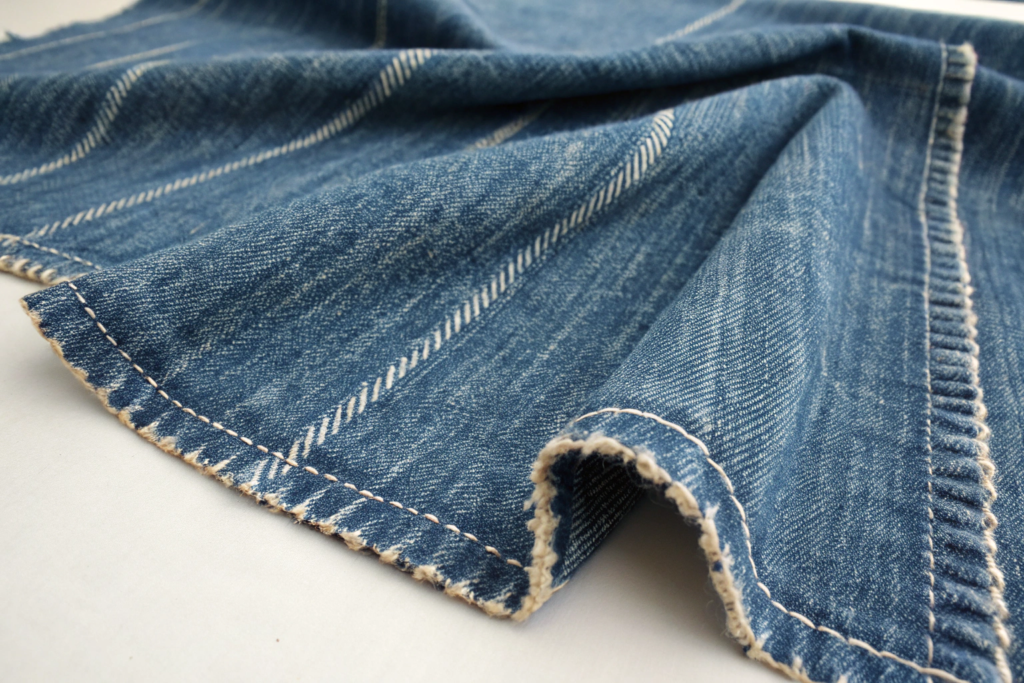
The "boil and tumble" process starts with a fully sewn, unwashed denim short. We load it into a specialized machine that can heat water well above the standard washing temperature. We bring the water to a near-boil, around 90 to 95 degrees Celsius, and agitate the shorts in this extreme heat for a short, controlled period. The intense heat shocks the cotton fibers. The yarns contract violently, and because the warp and weft yarns were under different tensions during weaving, they contract at slightly different rates. This differential shrinkage is what creates the deep, irregular puckering.
Immediately after the hot cycle, we transfer the steaming shorts directly into a cold rinse tumbler. The thermal shock locks in the puckered structure. If we allowed the shorts to cool slowly, the cotton fibers would relax and some of the texture would smooth out. The rapid temperature drop is critical. After the cold rinse, we do a standard enzyme wash to soften the hand feel, because the boil-and-tumble leaves the fabric feeling quite stiff and harsh. Then we apply any tinting or localized abrasion.
This technique is risky. If the shorts are left in the hot cycle too long, the excessive shrinkage can distort the sizing beyond recovery. We lost an early test batch this way; the waistband shrank nearly two inches and the shorts looked like they belonged to a child. We now run the boil-and-tumble in small batches with continuous monitoring. It's expensive, it's energy-intensive, and it requires a skilled technician to manage. But the texture it produces is unmistakable. When a distributor shows a boil-and-tumble short to a retail buyer, the buyer can immediately feel the difference. It's not a printed-on vintage effect; it's a physical transformation of the denim.
How Do We Match the Fading of a 20-Year-Old Pair of Shorts?
Matching a vintage fade is part science and part art. The science is the color measurement. We use a spectrophotometer to read the exact color values at multiple points on the original garment: the deep, unfaded areas under the back pockets, the heavily faded thigh, the crease lines around the crotch. We map the color gradient from dark to light.
The art is understanding how that gradient was created over twenty years of wear. Sunlight fading produces a different color shift than abrasion fading. A short worn by a truck driver fades differently than one worn by a student walking across campus. The fade pattern tells a story, and our job is to read that story and translate it into a manufacturing process.
Once we have the color map, we build the wash recipe backwards. We start with the base shade, and then we apply localized discharge techniques to hit each point on the gradient. We use a combination of laser mapping for the high-contrast whisker lines, manual hand-sanding for the broader abrasion zones, and spray gun applications of potassium permanganate for the mid-tone transitions. Each technique removes indigo in a slightly different way. The laser vaporizes the dye instantly, creating a crisp, sharp line. The hand-sanding physically abrades the surface yarns, creating a fuzzy, soft transition. The spray creates a feathered, misty fade. Layering these three techniques in the correct sequence and intensity is how you recreate the organic complexity of twenty years of living in a pair of shorts.
I remember a specific project for a premium brand in London. They sent us a vintage Levi's short from the 1980s, beautifully faded with a honeycomb pattern behind the knees and a wallet outline on the back pocket. They wanted their production run to replicate that exact fade. We spent two days in the lab, running laser calibration tests and spray pressure trials. The final sample was so close to the original that the brand owner held them side by side and said he couldn't tell which was which without checking the inside labels. That's the precision we aim for. It's not magic. It's a methodical, layer-by-layer reconstruction of a decades-long aging process, compressed into a few hours of manufacturing time.
Why Is Manual Spraying Still Superior to Full Automation?
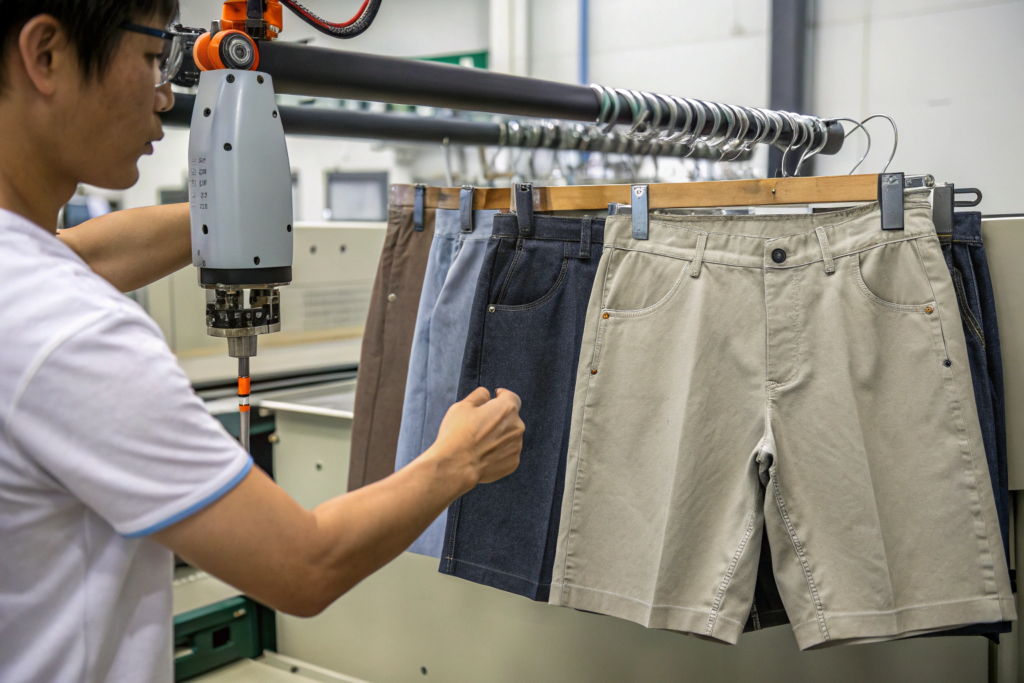
I've invested heavily in automation. Our laser machines, our automated dosing systems, our robotic spray arms—they are essential tools. But I will argue strongly that for the very rarest, most nuanced denim finishes, the human hand still beats the robot. There is a subtlety to a hand-sprayed application that a programmed arm cannot yet replicate. The pressure variation, the slight wrist rotation, the instinctive feathering at the edge of a spray zone—these are micro-adjustments that a skilled artisan makes based on what they see happening on the fabric in real time.
Automation is brilliant for consistency across large volumes. If you need 20,000 pairs of shorts with an identical, uniform fade, a robotic spray system is the right choice. But if you want a finish that looks organically worn, with slight, beautiful imperfections that the human eye reads as "authentic," you need a manual touch. The rarity we offer at Shanghai Fumao often comes from this combination: we use automation for the base layer and manual artistry for the highlight layer.
I have a spray technician named Lao Chen who has been doing this work for eighteen years. He can look at a reference photo of a vintage short and instinctively know the spray gun pressure, the distance from the fabric, and the hand speed required to match the fade pattern. He adjusts his technique based on the fabric weight. A heavy 15oz denim absorbs the spray differently than a lightweight 10oz denim. He compensates for humidity in the air, which affects how the chemical dries on the fabric surface. I've watched engineers try to program a robot to replicate Lao Chen's output. They can get close, about 85% of the way there. But that final 15%—the organic, slightly irregular edge that makes a fade look like it happened naturally over years of wear—that's still a human domain. For the distributors who come to us seeking a wash that doesn't look factory-made, Lao Chen's hands are our most valuable piece of equipment.
How Does Hand-Spraying Create a Unique "Aura" Around Fade Lines?
When a robot arm sprays a line, it traces a mathematically defined path. The spray density is consistent along the entire path. The edge of the spray zone is uniform. The result is a technically perfect, but visually sterile, fade line. Nature doesn't work that way. When a human thigh creases a pair of shorts over hundreds of wears, the crease isn't a perfectly straight line. The pressure varies slightly along the crease. The body heat and sweat distribution vary. The resulting fade has a soft, irregular aura around the core line.
A skilled hand-sprayer can recreate this aura. They do it by varying the distance of the spray gun from the fabric as they move along the line. They pull back slightly to widen the spray cone and create a softer edge, then push in slightly to create a more intense core. They might overlap passes at a slightly different angle to build density in the center while letting the edges breathe. The wrist motion is fluid, not mechanical.
This technique is particularly effective on the "whisker" fades around the front hip area. A robot-sprayed whisker looks like a series of uniform lines radiating from the crotch point. A hand-sprayed whisker, done well, looks like the ghost of a thousand sitting-down motions. The lines are subtly different lengths, slightly different intensities, and they have a feathered softness at the tips. This difference might sound subtle when I describe it in words. In a retail setting, side by side on a shelf, it's immediately obvious. The hand-sprayed pair looks expensive and authentic. The robot-sprayed pair looks like it came from a discount department store. For a brand owner chasing a premium price point, the manual spray technique is the justification for that higher margin.
What Training Do Our Wash Artisans Undergo?
You can't hire a spray artisan from a job board. There's no university degree in denim spray artistry. We build our team through a long apprenticeship model. A new trainee spends their first three months simply observing. They watch Lao Chen and our other senior artisans work. They learn to mix the chemical solutions to the exact concentration. They learn to maintain the spray guns, cleaning the nozzles and checking the pressure regulators. They don't touch a garment.
After the observation period, they begin on scrap fabric. We have bins of rejected denim pieces that we use for training. The trainee spends months just spraying lines on scrap denim, trying to match a reference image. Lao Chen reviews their work daily. He points out where the density is uneven, where the edge is too sharp or too soft, where the hand speed was inconsistent. The trainee repeats the exercise until they can produce a consistent, matched spray pattern on flat scrap fabric.
Only then do they move to actual garments. A three-dimensional short is completely different from a flat piece of fabric. The contours of the hip, the thigh, the knee area all affect how the spray lands. The trainee learns to follow the contours with the spray gun, maintaining a consistent distance from the fabric surface as it curves. This takes another six months of daily practice under supervision before they are allowed to work on production garments independently.
The entire apprenticeship takes about eighteen months before a spray artisan is trusted to work on a premium client's order without close oversight. It's a slow, expensive investment. Most factories won't make it. They'll buy a robot arm instead. That's precisely why manual spray artistry is a competitive advantage for us and for our clients. It cannot be quickly replicated.
How Are We Developing 2027 Denim Wash Prototypes Right Now?
The wash styles that will hit the market in Spring/Summer 2027 are being developed in our lab today. Fashion moves fast, but chemical finishing development moves slowly. A genuinely new wash technique takes months of testing before it's production-ready. The brand distributors I work with closely get an early look at these prototypes. They can incorporate a novel finish into their line plan before their competitors even know it exists. This is the R&D function of a factory, and I consider it one of the most valuable services we offer.
Right now, in June 2026, our lab is running trials on three main prototype directions for the 2027 season. I can't reveal the specific formulations of active client projects, but I can describe the general themes we're exploring. The market signals we're reading from trend forecasting, trade show observations, and early adopter brand inquiries all point toward a shift to more ecological visual languages, more tactile surface interest, and a continued blurring of the line between new and vintage.
One prototype direction we're excited about is what we're internally calling "mineral-cast denim." The goal is to create a surface that looks like it has absorbed the colors of a specific landscape—not a uniform dye, but a varied, mineral-like patina with subtle greens, ochres, and rust undertones. This involves a base dye derived from natural mineral pigments, followed by a selective application of reactive modifiers that shift the hue in localized areas. The technical challenge is achieving colorfastness with these mineral-derived pigments, which historically have poor wash fastness. We're working with a new fixation agent from a Swiss chemical supplier that shows promise in early trials.
What Is "Bio-Washed" Denim and Why Will It Trend in 2027?
Bio-washing is the use of natural enzymes, rather than synthetic chemicals or physical abrasives, to achieve the faded, worn-in look of denim. Cellulase enzymes eat the cellulose on the surface of the cotton yarn, releasing the indigo dye and creating a soft, faded effect. This technology has been around for years, but the 2027 iteration is different. The new generation of bio-wash is about specificity and visibility.
The trend we're anticipating is for "traceable bio-wash." The consumer wants to know not just that enzymes were used, but what kind of enzymes, from what source, and with what environmental impact. We're working with a biotechnology company that produces a fungal-derived cellulase enzyme that operates at room temperature. Standard enzymes require heated water to activate, which consumes energy. This new enzyme works in cold water, dramatically reducing the carbon footprint of the wash process. The finished garment can legitimately carry a hangtag that says "Cold-Water Bio-Finished" with a measurable reduction in energy consumption.
The visual effect of a bio-wash is also distinct. Unlike stone washing, which creates a uniform surface abrasion, an enzyme wash works at the microscopic fiber level. The resulting fade has a soft, almost velvety appearance. There's no visible surface damage, just a gentle cloudiness. For the 2027 season, we anticipate a consumer preference shifting away from aggressively destroyed denim toward this softer, more subtle bio-finished look. It signals quality and environmental consciousness without shouting. We're currently running lab trials to optimize the enzyme concentration and dwell time for different denim weights, so that when a brand partner comes to us in September with a bio-wash brief, we already have the recipe calibrated.
How Are We Combining Laser and Ozone for a Truly Circular Wash?
Laser finishing has become standard. Ozone washing, which uses ozone gas dissolved in water to bleach denim without chlorine-based chemicals, is also gaining traction. What's rare, and what we're prototyping for 2027, is a fully integrated laser-and-ozone system that eliminates water from the finishing process almost entirely.
The concept is straightforward but the execution is complex. You use a high-precision laser to create all the fade patterns, whiskers, and distress marks on a dry, raw denim short. No water, no chemicals. Then, instead of washing the shorts in water to remove the loose indigo dust and soften the hand feel, you tumble them in a sealed chamber with a controlled atmosphere of ozone gas. The ozone gently bleaches the overall shade to the desired lightness level and simultaneously breaks down any residual laser-burn odor. The shorts exit the chamber ready for a final softening tumble with a minimal amount of water and a biodegradable softener.
This system, if we can fully optimize it, would reduce the water consumption of a denim finishing line by over 80%. It would eliminate the discharge of bleach-laden wastewater. It would be a genuinely circular process from a water perspective. The barrier right now is the ozone chamber's effect on certain accessory materials. Metal buttons and rivets can oxidize and discolor in the ozone atmosphere. We're testing different metal alloys and protective coatings to find a combination that withstands the ozone cycle without tarnishing. We're also fine-tuning the laser power settings to avoid that faint burnt smell that I mentioned can occur. The goal is a pair of shorts that has a complete, beautiful vintage fade, achieved with almost no water and no chlorine. If we crack this, it will be the most sustainable rare wash on the market, and it will be available exclusively to our brand partners before the broader industry catches up.
Conclusion
Creating a rare denim wash style is not a matter of luck or a single secret ingredient. It's a system. It starts with a definition of rarity that focuses on multi-layer complexity and the inability of competitors to replicate the finish. It continues with access to uncommon chemical agents and artisan techniques like hand-spraying and boil-and-tumble that require deep, slow-built expertise. It extends into a methodical approach to vintage replication, where we map decades of fading into a precise, layered manufacturing sequence. And it looks forward to the 2027 prototypes we're developing right now, from mineral-cast dyes to cold-water bio-washes and near-waterless laser-ozone finishing.
The wash house at Shanghai Fumao is the part of our factory where art and chemistry collide. It's where we give a brand owner a proprietary finish that a fast-fashion competitor cannot copy. It's where we justify a higher retail price point with a texture and depth that a consumer can feel in their hands. If you're a distributor or a brand owner who is tired of competing in the commodity blue-jeans market, I'd like to invite you into this conversation. Let's develop a wash that belongs only to you.
To start that conversation, please reach out to our Business Director, Elaine. She can arrange a video tour of our wash house, share our current prototype swatches, and discuss the timeline and cost structure for developing a custom rare wash for your next season. You can contact her directly at elaine@fumaoclothing.com. Let's make something that nobody else has.