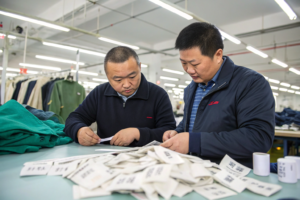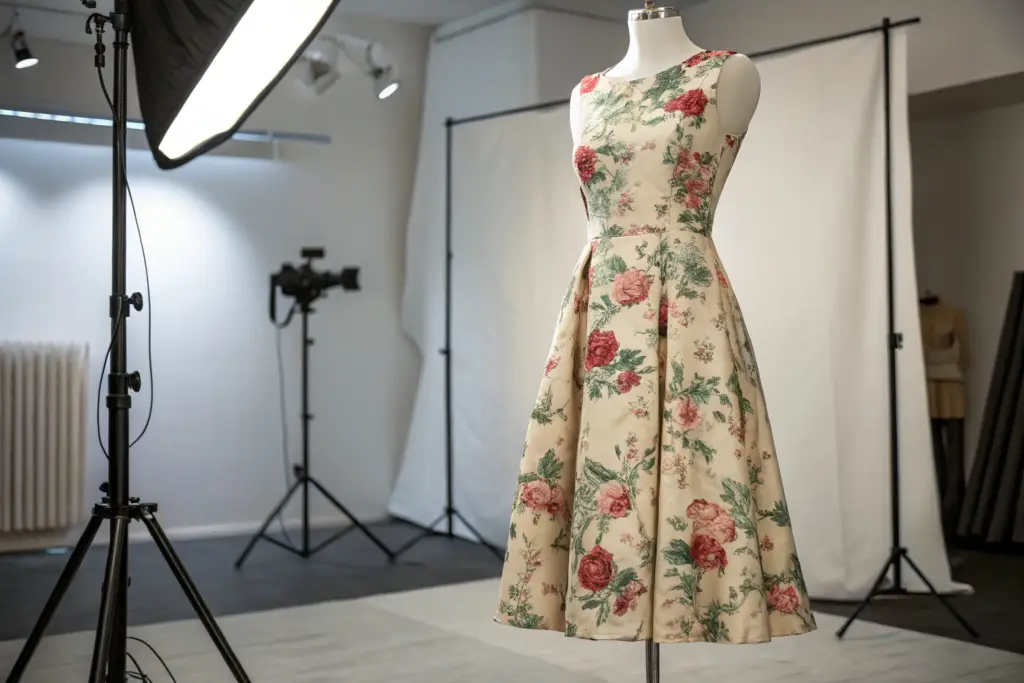
You have seen the numbers on Alibaba. $6.80 FOB for a floral dress. The photos look passable. The price makes your margin spreadsheet light up. Then you order a sample. The fabric feels like a plastic tablecloth. The print is blurry, misaligned at the seams, and fades to a ghostly version of itself after two washes. The dress that looked like a $98 retail product on the screen is a $19.99 fast-fashion commodity in your hands. You realize the $6.80 price is not a bargain. It is the exact cost of a dress that will generate returns, complaints, and chargebacks. The real question is not "how cheap can a floral dress be?" The real question is "what does a genuinely high-quality A-line floral dress cost, and what am I paying for at each price tier?"
A high-quality A-line floral dress, made from premium natural-fiber fabric with a well-engineered custom print, clean interior finishing, and produced in a factory with legitimate quality control and compliance standards, costs between $12.00 and $18.00 FOB from a specialized Chinese manufacturer, depending on the fabric, the print complexity, and the order volume. The total landed cost to a U.S. warehouse, including ocean freight, customs duties, and all logistics fees, ranges from $17.00 to $25.00 per unit for DDP shipments. This price range is not the cheapest available. It is the price of a dress that will sell at full retail margin, generate minimal returns, and build your brand's reputation rather than erode it.
My name is Elaine. I am the co-owner of Shanghai Fumao. I price dresses every day. I know exactly what drives cost at each quality tier because I make purchasing decisions for fabric, trim, and labor that directly determine the final FOB price. I also see the prices our brand partners achieve at retail, and I track the correlation between the wholesale cost they pay and the sell-through rate they achieve. In this article, I will break down the cost structure of an A-line floral dress, component by component, so you understand exactly where your money goes. I will show you what different price tiers actually buy you in terms of fabric, print, and construction quality. And I will give you a framework for evaluating any supplier's quote against the quality they are actually delivering.
What Are the Component Costs That Determine the Wholesale Price of a Floral Dress?
A wholesale dress price is not a single number pulled from the air. It is the sum of specific, measurable component costs, each of which varies based on the quality choices the manufacturer makes. Understanding these components turns you from a passive price-taker into an informed buyer who can evaluate a quote against the quality it represents. A $12.00 dress and a $16.00 dress may look identical in thumbnail photos. The component cost breakdown reveals the invisible differences that determine how the dress will feel, fit, and endure.
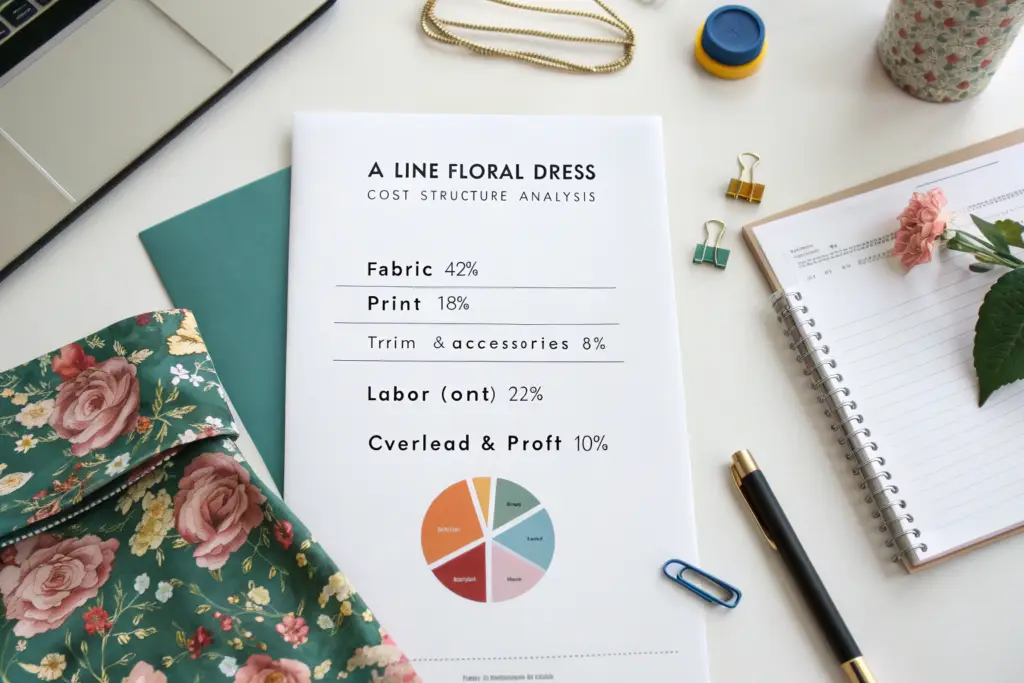
The wholesale FOB price of an A-line floral dress is built from five component categories. Fabric cost, typically 38% to 45% of the FOB price, covers the raw material. A premium 200 GSM European flax linen costs significantly more than a generic polyester crepe. Print cost, typically 15% to 20% of the FOB price, covers the printing method, the ink type, and the color count. A reactive digital print with an extended color gamut costs more than a basic pigment print. Trim and accessories, typically 5% to 10%, cover the zipper, buttons, labels, and hangtags. A YKK invisible zipper and genuine corozo buttons cost more than generic alternatives. Labor, or Cut-Make-Trim (CMT), typically 20% to 28%, covers the sewing, finishing, and quality control. French seams and blind hems require more skilled labor and more time than overlocked seams and topstitched hems. Overhead and factory margin, typically 8% to 12%, covers the factory's operating costs and profit. A factory that invests in a sample studio, a greige fabric bank, compliance audits, and a dedicated QC team has higher overhead than a factory that does not.
How Does Fabric Choice Drive the Largest Single Cost Component?
Fabric is the largest cost component in a dress, and the range of possible fabric costs is wider than most buyers realize. Choosing between a $3.50-per-meter linen and a $1.80-per-meter polyester is not just an aesthetic choice. It is the single decision that most determines your wholesale price and your retail positioning.
A premium 200 GSM pre-washed European flax linen, the standard we use for most of our A-line floral dresses, costs approximately $6.50 to $8.50 per meter at wholesale, depending on the specific weave and the order volume. An A-line dress with a midi-length flared skirt consumes approximately 2.2 to 2.6 meters of fabric, depending on the size and the print repeat. At 2.4 meters per dress, the fabric cost alone is $15.60 to $20.40 per dress at the premium linen price point. A generic polyester crepe, in contrast, costs approximately $1.50 to $2.50 per meter. The fabric cost per dress would be $3.60 to $6.00. The difference in fabric cost between these two options is approximately $12.00 to $14.00 per dress. This difference flows directly through to the FOB price and the retail price. A brand selling a $98 linen dress and a brand selling a $48 polyester dress may be earning the same dollar margin. The difference is entirely in the fabric cost and the customer's willingness to pay for natural fibers. The natural fiber versus synthetic fabric cost comparison for apparel article provides market price data for common dress fabrics. Fabric is not the place to save money if quality is your brand's value proposition.
What Print-Related Costs Do Buyers Often Underestimate?
Buyers frequently underestimate the cost of a quality print. They budget for the fabric and the sewing, and they treat the print as a minor add-on. In a high-quality floral dress, the print can be 15% to 20% of the total FOB cost. Understanding what drives print cost prevents sticker shock and helps you make informed trade-offs.
The print cost is driven by four factors. The printing method. Digital printing with reactive inks on natural fibers costs more per meter than screen printing with pigment inks, but delivers superior color penetration, hand feel, and wash-fastness. The number of colors. In digital printing, the color count affects the ink consumption and the file processing complexity. A twelve-color photorealistic floral costs more to print than a four-color stylized floral. The print repeat size. A large-scale repeat that requires careful placement on the pattern pieces increases fabric consumption because the pattern pieces cannot be nested as tightly. The print placement requirements. A print that must align at the side seams and the waist seam requires additional fabric for matching and additional cutting labor. A typical custom digital floral print on our 200 GSM linen, including file processing, strike-off production, and bulk printing, costs between $2.80 and $4.50 per meter, depending on the color count and the repeat complexity. At 2.4 meters per dress, the print cost is $6.70 to $10.80 per dress. A stock print from a supplier's catalog might cost half as much, but it sacrifices exclusivity and may not be optimized for your specific fabric. The digital textile printing cost structure for fashion article explains the cost drivers in detail. A quality print is an investment in visual differentiation and customer perceived value.
What Price Tiers Exist in the Wholesale Floral Dress Market?
The wholesale dress market is not a continuous spectrum. It is a set of distinct price tiers, each with a characteristic fabric quality, print quality, construction standard, and factory type. A dress at one tier is not simply a slightly better version of a dress at the tier below. It is a fundamentally different product, made in a fundamentally different factory, for a fundamentally different retail channel. Understanding these tiers prevents you from overpaying for a commodity dress disguised as premium, or underpaying for a premium dress that will fail your quality expectations.
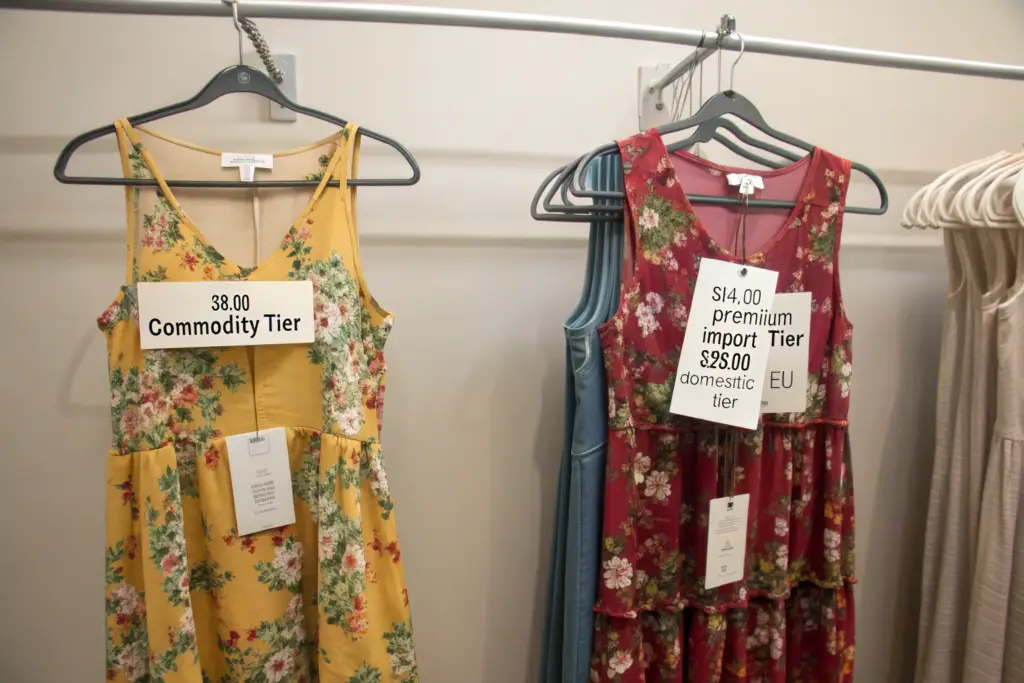
The wholesale A-line floral dress market divides into three primary tiers. The commodity tier, $6.00 to $9.00 FOB, uses polyester or poly-blend fabrics, pigment or basic screen prints, overlocked seams, generic trims, and is produced in high-volume, low-cost factories with minimal QC. The premium import tier, $12.00 to $18.00 FOB, uses natural fibers like linen and cotton, reactive digital prints, French seams and clean interior finishing, branded YKK zippers and natural buttons, and is produced in specialized factories with legitimate QC and compliance. The domestic or EU-manufactured tier, $22.00 to $35.00 FOB, uses similar or identical materials to the premium import tier but carries higher labor costs. The sweet spot for contemporary brands sourcing from Asia is the premium import tier. The commodity tier undermines your brand. The domestic tier erodes your margin. The premium import tier, when sourced from a specialized manufacturer with transparent practices, delivers the optimal balance of quality, cost, and brand integrity.
What Does an $8.00 FOB Dress Actually Deliver?
An $8.00 FOB dress is not a bargain version of a $14.00 dress. It is a different product entirely. The factory that produces an $8.00 dress operates on a different business model, with different material inputs, different labor practices, and different quality standards. Understanding what that $8.00 buys helps you make an informed choice about whether the savings are worth the trade-offs.
An $8.00 FOB floral dress typically uses a polyester crepe or a polyester-cotton blend fabric costing $1.50 to $2.50 per meter. The print is a stock design, pigment-printed, with limited color accuracy and wash-fastness. The seams are overlocked. The hem is a narrow, single-turn topstitch. The zipper is a generic brand, likely with a black or white tape regardless of the dress color. The buttons are generic plastic. The interior bodice facing, if present at all, is poorly understitched and will roll outward. The QC inspection, if performed at all, is a visual glance by the packing supervisor. The factory is likely a high-volume, low-margin operation with limited investment in worker training, equipment maintenance, or compliance. This dress will look acceptable in an online product photo, assuming good styling and photography. It will feel disappointing in the customer's hands. It will generate returns at a rate that erases the margin gained from the low FOB price. It is the right product for a brand whose value proposition is "the cheapest possible floral dress." It is the wrong product for a brand whose value proposition involves quality, longevity, or customer loyalty. The commodity versus premium garment manufacturing comparison article details the operational differences between factories at different market tiers.
How Does a $14.00 FOB Dress Differ From a $24.00 DDP Landed Cost?
A common point of confusion for importers is the relationship between the FOB price and the total landed cost. The $14.00 FOB dress and the $24.00 DDP landed cost may be the same dress, priced differently because the DDP price includes freight, duty, customs clearance, and delivery. Comparing an FOB quote to a DDP quote without understanding what each includes is like comparing the price of a car without wheels to the price of a car with wheels and assuming the wheel-less car is a better deal.
A $14.00 FOB dress, when all logistics costs are added—ocean freight, insurance, customs duty at the applicable rate, merchandise processing fee, harbor maintenance fee, customs bond, broker entry fee, terminal handling charges, port security fee, and inland trucking—typically lands at a total warehouse cost of $20.00 to $23.00 per unit, depending on the duty rate, the port of entry, and the inland trucking distance. A factory quoting $24.00 DDP for the same dress is simply bundling the logistics costs into a single, predictable number. The DDP quote may be slightly higher than the sum of the FOB plus estimated logistics, reflecting the supplier's cost of managing the logistics chain and absorbing the risk of cost fluctuations. The value of that risk transfer—no surprise storage fees, customs exam bills, or port congestion surcharges—often exceeds the small premium. I have written a dedicated article on DDP benefits. The FOB versus DDP total landed cost calculation comparison provides a detailed methodology for calculating the true cost of each option. When comparing quotes, always convert FOB quotes to an estimated landed cost before comparing them to DDP quotes. Otherwise, you are comparing partial prices to full prices and making decisions on incomplete information.
How Do Order Volume and Customization Level Affect the Per-Unit Price?
The price a factory quotes you is not the price they would quote a different brand for the same dress. It is specific to your order quantity and your customization requirements. Two identical dresses, produced on the same line by the same workers, can have different per-unit costs because one order spreads the fixed setup costs across 200 units and the other spreads them across 1,000 units. This is not arbitrary pricing. It is the mathematical relationship between fixed costs, variable costs, and volume.
Order volume affects per-unit price through the absorption of fixed setup costs. The fabric dyeing setup cost, the print file preparation and strike-off cost, and the production line configuration cost are fixed regardless of order size. At 200 units, these fixed costs represent a larger per-unit burden than at 1,000 units. The per-unit price difference between a 200-unit order and a 1,000-unit order for the same custom dress is typically $3.00 to $5.00 FOB. Customization level also affects price. A dress using our existing pattern library and greige fabric bank avoids pattern development and fabric minimum costs, reducing the per-unit price for small orders. A fully bespoke dress with a new pattern, a custom-sourced fabric, and a complex custom print carries higher development costs and higher per-unit costs at low volumes.
What Is the Price Difference Between a 200-Unit and a 1,000-Unit Order?
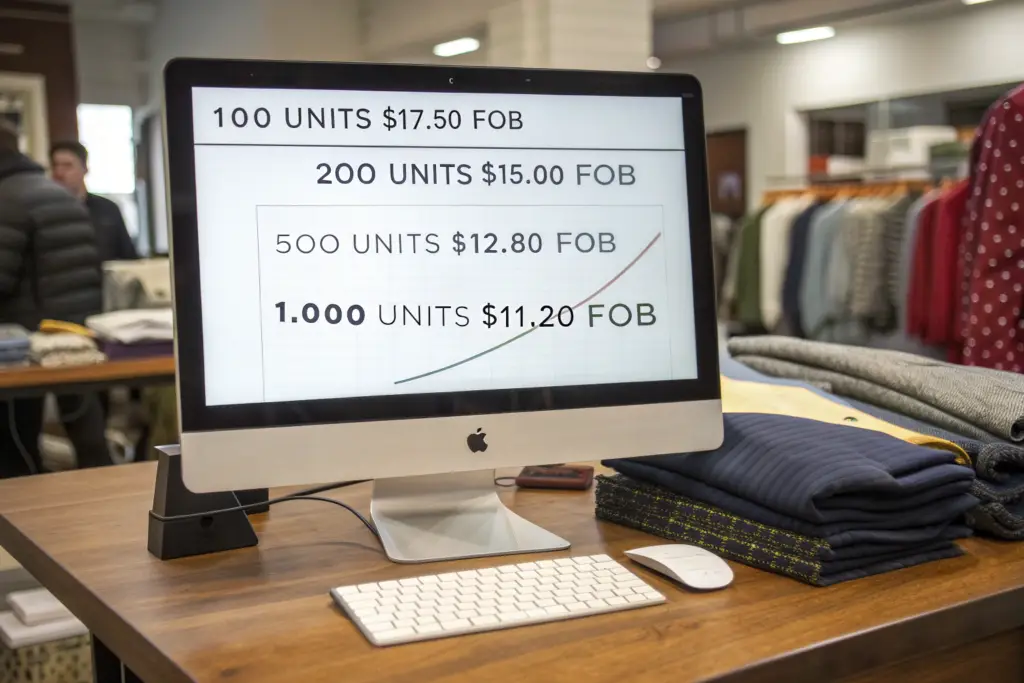
The price-volume curve is not linear. The largest per-unit cost reductions occur between 100 and 500 units, where the fixed setup costs are spread across significantly more garments. The curve flattens at higher volumes, where the fixed costs are already fully absorbed and further reductions come primarily from labor efficiency gains and fabric volume discounts.
For a typical custom-print A-line floral dress on our 200 GSM linen, with a standard pattern adaptation and YKK trims, the approximate FOB pricing by volume is: at 100 to 200 units, $15.00 to $17.00 per unit. At 300 to 500 units, $12.50 to $14.00 per unit. At 500 to 800 units, $11.00 to $12.50 per unit. At 800 to 1,500 units, $10.00 to $11.00 per unit. At 1,500 units and above, custom quote with additional fabric pre-booking discounts available. These are indicative ranges. The specific price depends on the complexity of the dress and the print. A simple sleeveless A-line with a four-color print will be at the lower end. A long-sleeve tiered maxi with a twelve-color photorealistic floral will be at the higher end. The apparel manufacturing cost volume analysis article explains the fixed-cost absorption math that drives these tier differences. Plan your order volumes with these breakpoints in mind. Moving from 180 units to 220 units might only cost an additional $600 in total but could drop your per-unit price by $0.80, saving you $160 on the entire order. Understanding the tier breaks helps you optimize your order quantity.
How Can You Balance Quality and Budget When Funds Are Limited?
If your budget is tight but you refuse to compromise on the quality signals your customer notices—the fabric hand feel, the print vibrancy, the overall fit and drape—there are strategic trade-offs you can make that reduce cost without reducing perceived quality.
Focus your budget on the fabric and the print. These are the two elements the customer experiences most directly. Choose a premium fabric and a high-quality reactive print, even if it means simplifying the silhouette to reduce fabric consumption and labor cost. A simple A-line midi dress with no sleeves, no collar, and a clean, unadorned neckline in a beautiful linen with a stunning floral print will outperform a more complex design in a cheaper fabric every time. The customer notices the fabric and the print. She does not count the number of seams. Reduce trim costs without reducing perceived quality. A YKK invisible zipper is worth the investment. It operates smoothly and lasts. But the buttons on a dress with a side zipper that the customer never uses can be simplified. The internal label can be a simpler woven design. The hangtag can be a single card rather than a multi-piece package. These savings are invisible to the customer but meaningful to the per-unit cost. Consolidate your colorways. Each additional print colorway incurs additional print setup costs and often a higher per-meter print cost due to smaller print runs per colorway. Launching with two strong colorways instead of four reduces your total development cost and increases your volume per colorway, which reduces the per-unit print cost. The cost optimization strategies for small batch apparel production guide provides additional strategies for reducing per-unit cost without reducing quality.
How Should You Evaluate Whether a Wholesale Price Is Fair for the Quality Delivered?
You have quotes from three suppliers. The prices are $9.50, $14.00, and $17.00 FOB. The photos look similar. How do you determine which quote is fair for the quality delivered? You do not do it by comparing the photos. You do not do it by asking the suppliers if their quality is good. Every supplier says their quality is good. You do it by obtaining a physical sample from each supplier and evaluating it against the specific, observable quality criteria that correlate with durability, fit, and customer satisfaction.
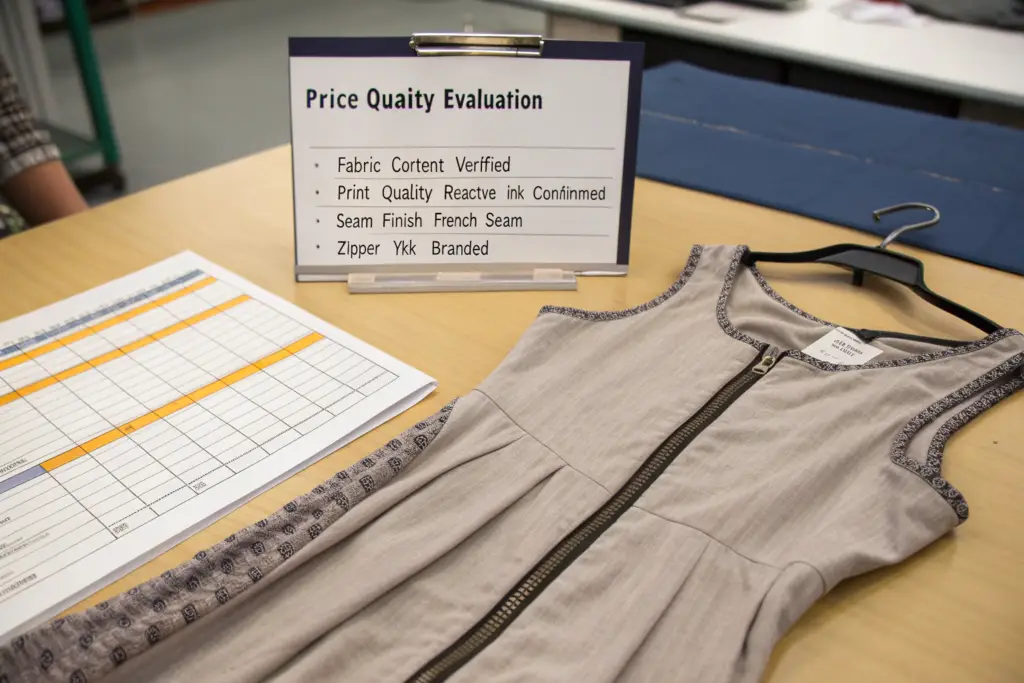
To evaluate whether a wholesale price is fair for the quality delivered, obtain a physical sample from the supplier and perform a structured quality-cost audit. First, verify the fabric content. Perform a burn test or request the supplier's fiber composition lab report. A dress quoted as 100% linen should be 100% linen, not a linen-viscose blend. Second, inspect the seam finishes. Premium-tier dresses have French seams or clean-bound seams on major structural seams. Commodity-tier dresses have overlocked seams. Third, inspect the zipper. A YKK invisible zipper costs more than a generic zipper. Verify the brand marking on the zipper pull. Fourth, evaluate the print quality using the back-of-fabric test. A reactive print shows color penetration on the back. A pigment print does not. Fifth, assess the hem. A deep, double-turn blind hem costs more than a narrow single-turn topstitched hem. The price should be consistent with the quality you observe. If a $9.50 sample passes all five checks, the supplier is losing money or cutting corners you have not yet detected. If a $17.00 sample fails several checks, the supplier is overpriced for the quality they deliver.
What Quality Indicators Justify a Higher Wholesale Price?
A higher wholesale price should correlate with specific, observable quality indicators. If a supplier quotes $16.00 FOB and another quotes $11.00 FOB, the $16.00 supplier should be able to point to the specific material, construction, and process choices that account for the $5.00 difference. If they cannot, the premium is not justified.
Quality indicators that justify a higher price include: certified natural fiber fabric with a documented origin and lab test report, versus generic fabric of uncertain composition. Reactive digital printing with an extended color gamut and calibrated color management, versus basic pigment printing with no color calibration. French seams or clean-bound seams on all major structural seams, versus overlocked seams. A YKK invisible zipper with a color-matched tape, versus a generic zipper with a black or white tape. Genuine corozo, mother-of-pearl, or horn buttons, versus generic plastic buttons. A deep, double-turn blind hem, versus a narrow single-turn topstitched hem. A properly faced and understitched bodice, versus a raw-edged or poorly faced bodice. A hanging QC inspection in addition to a flat QC inspection, versus flat inspection only or no inspection. A third-party tested and certified supply chain with current audit reports, versus self-reported or absent compliance data. Each of these indicators represents a real cost difference in materials, labor, or overhead. The garment quality indicators and their cost implications guide provides a comprehensive framework for linking observed quality to production cost. A factory that can show you these indicators is justifying their price. A factory that charges a premium without these indicators is not.
Conclusion
A high-quality A-line floral dress costs between $12.00 and $18.00 FOB from a specialized Chinese manufacturer, and between $17.00 and $25.00 total landed cost to your U.S. warehouse. This is not the cheapest available price. It is the price of a dress made from premium natural-fiber fabric, printed with reactive digital inks, constructed with French seams and clean interior finishes, and produced in a factory with legitimate quality control and compliance standards. The cost is driven primarily by fabric choice, which represents 38% to 45% of the FOB price, and print quality, which represents 15% to 20%. Volume matters. A 1,000-unit order costs $3.00 to $5.00 less per unit than a 200-unit order of the same dress, due to fixed cost absorption. The premium import tier, where Shanghai Fumao operates, delivers the optimal balance of quality, cost, and brand integrity for contemporary brands whose customers value natural fibers, beautiful prints, and garments that last.
If you are evaluating supplier quotes and want an honest, component-level cost breakdown for your specific A-line floral dress design, I am ready to provide it. Send me your design brief, your target quantity, and your quality expectations. I will return a detailed cost estimate with line-item transparency, so you understand exactly what you are paying for and why. My name is Elaine. My email is elaine@fumaoclothing.com. You should never pay a price you do not understand. Let me help you understand it.