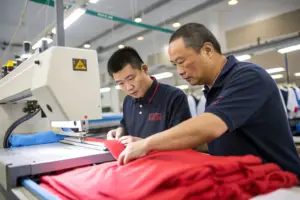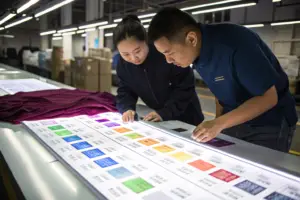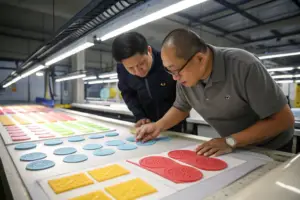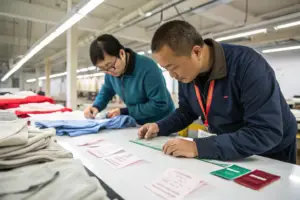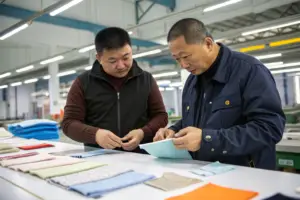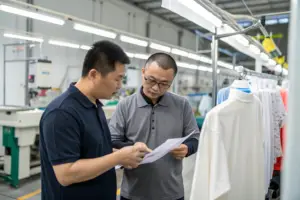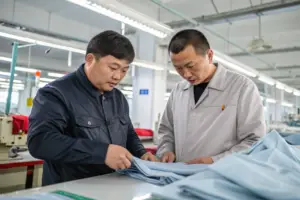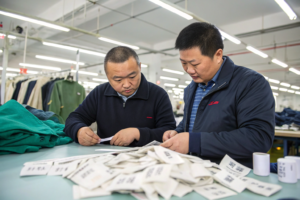
You have a small brand. Maybe you sell through your own website, or through three or four boutique accounts, or through a carefully curated Instagram presence. Your order quantities are not in the thousands. They are in the low hundreds, maybe even under a hundred for a new style you are testing. You have contacted manufacturers before. The responses range from polite rejections—"Our minimum order is 1,000 units per style"—to quotes that are technically within your budget but carry a per-unit price so high that your margin evaporates. You are left with a discouraging conclusion: custom manufacturing is for big brands. Small brands like yours are stuck with stock wholesale, competing on the same generic dresses everyone else is selling. That conclusion is common. It is not true. It is true that many large factories are not set up to serve small brands profitably. It is not true that no factory is.
Yes, small brands can order custom floral dresses from Shanghai Fumao Clothing. We serve brands with order quantities starting at 150 to 200 units per style through a structured small-brand program that uses our existing pattern library, our greige fabric bank, and our pre-approved print and color palettes to reduce the development cost and the fabric minimums that usually price small brands out of custom manufacturing. You do not get the unlimited fabric sourcing and fully bespoke pattern development that a 1,000-unit order commands. You do get an exclusive floral dress, developed collaboratively with our sample studio, made from premium natural-fiber fabrics, and produced on the same quality-controlled lines as our largest clients' orders. The unit cost is higher than our volume-tier pricing, but significantly lower than domestic manufacturing, and the quality is identical to what we produce for established contemporary brands.
My name is Elaine. I am the co-owner of Shanghai Fumao. I started my career as a pattern maker in a small sample room, and I remember what it felt like to be dismissed by large suppliers because my order was too small to matter. When I built this factory, I decided that we would find a way to serve emerging brands without compromising our quality standards or our financial sustainability. I want to explain exactly how our small-brand program works, what the trade-offs are, what the costs and timelines look like, and how the process differs from our volume-tier production. By the end of this article, you will know whether Shanghai Fumao is a viable manufacturing partner for your brand at your current stage, or what you need to grow into before we become the right fit.
What Is the Minimum Order Quantity for Small Brands?
Minimum order quantities are the gatekeeper of custom manufacturing. They exist not because factories want to exclude small brands, but because the fixed costs of production—fabric dyeing, print setup, pattern development, production line configuration—must be spread across enough units to make the per-unit cost viable for the buyer and the operation profitable for the factory. A factory that offers a 50-unit MOQ on fully custom dresses is either losing money on every order, which is not sustainable, or cutting corners on fabric, labor, or quality control, which is not acceptable. The key to serving small brands is to reduce the fixed costs without reducing the quality, so the MOQ can come down while the unit economics still work for both parties.
Our standard MOQ for small brands depends on the level of customization. For a dress using a stock fabric from our greige bank, an existing A-line silhouette from our pattern library, and a stock print from our print catalog, the MOQ is 100 units per style. For a dress using our greige bank fabric, an existing silhouette, and your custom-developed print, the MOQ is 150 units. For a dress using our greige bank fabric, an adapted version of an existing pattern with modifications like a sleeve change or a length adjustment, and your custom print, the MOQ is 200 units. For a fully bespoke dress with a new pattern, a custom-sourced fabric, and a custom print, our standard MOQ of 300 units applies. The 100-unit tier is available for established small-brand clients who have completed at least one successful order and have a relationship with our team.
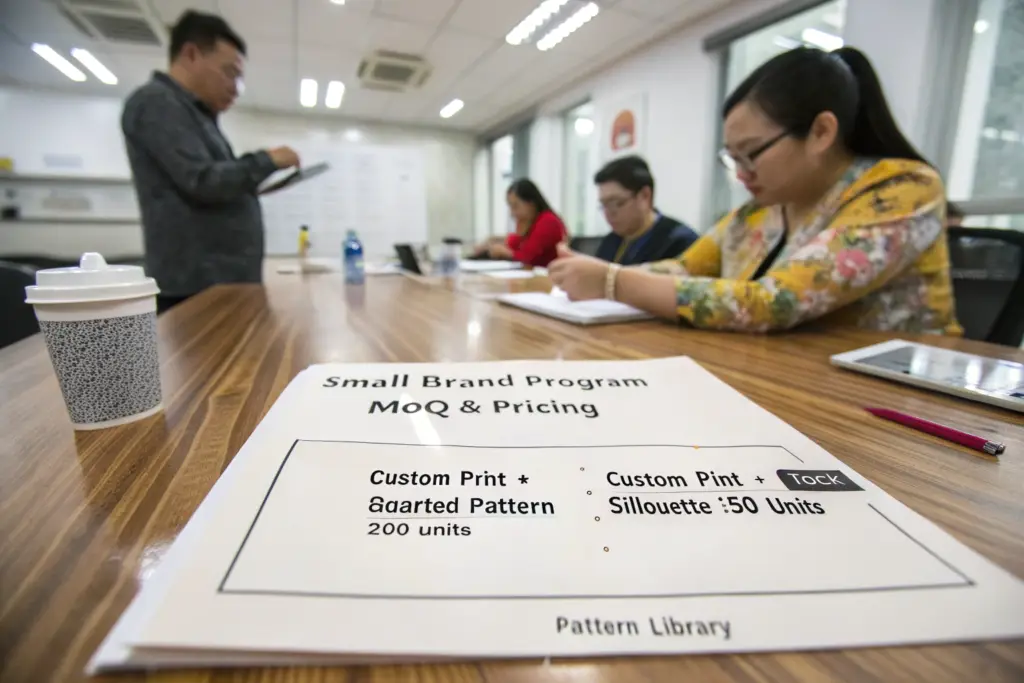
Why Does Using Our Pattern Library and Greige Bank Lower the MOQ?
The fixed costs that drive up minimums come from three sources: fabric minimums, print setup costs, and pattern development labor. The fabric mill requires a minimum meterage to run a custom dye lot. The print partner requires a minimum meterage to set up a custom print run. The pattern engineer requires several days of labor to develop and fit a new pattern. When these three fixed costs are loaded onto a 100-unit order, the per-unit development cost can exceed the production cost, making the project economically unviable for both parties.
By using our existing pattern library, you bypass the pattern development labor cost. Our library contains multiple A-line dress blocks—a classic midi, a tiered maxi, a mini with puff sleeves, a sleeveless version with a fitted bodice—each already fitted, graded, and production-tested. Adapting an existing block with modifications takes hours, not days. By using our greige fabric bank, you bypass the fabric minimum. We stock undyed premium linen and cotton in our most popular weights. We can pull the meterage for a 100-unit order from our existing inventory and dye it in one of our pre-approved colors, or print on it with your custom design. The fabric is already here. There is no mill minimum to meet. The greige inventory management for small-batch apparel manufacturing article explains how buffer stock at the greige stage enables smaller production runs. It is a deliberate working-capital investment that we made specifically to serve smaller and mid-sized brands.
What If Your Brand Needs Only 50 or 80 Units to Test a New Style?
I understand the need to test. Launching a new silhouette with 200 units when you are uncertain of demand is a risk that many small brands cannot responsibly take. A 50-unit test order, however, falls below the threshold where we can run an efficient production line and absorb the fixed costs without pricing the units out of your retail margin structure.
For brands in the 50 to 80 unit range, we recommend a different approach. Start with a style from our stock print and pattern program at 100 units. This is a low-risk entry point. If the style sells well, use the sell-through data to justify a larger order of your custom print on the same proven silhouette. The stock print order validates the silhouette without the development investment of a custom print. If your brand cannot commit to 100 units for a single style, we are not the right manufacturing partner at your current stage. There are excellent small-batch domestic manufacturers and local sample rooms that serve the 30 to 50 unit segment. We encourage you to build your volume with these partners and return to us when your demand supports our minimums. The small-batch versus volume apparel manufacturing decision guide helps brands assess which manufacturing tier is appropriate for their current scale. We want to work with you when the partnership is economically healthy for both sides.
How Does the Small-Brand Development Process Differ From Volume Production?
The development process for a 200-unit small-brand order is not the same as the process for a 2,000-unit volume order. The volume order can absorb multiple sampling rounds, custom fabric sourcing, and extensive fit engineering. The small-brand order requires a more efficient, streamlined process that minimizes development time and cost while still delivering a dress that fits, flatters, and reflects your brand's aesthetic. This is achieved through a curated set of options and a consolidated approval workflow, rather than the unlimited, iterative process available to volume clients.
The small-brand development process is a three-stage, four-to-six-week timeline. Stage one is selection and design alignment. You choose a silhouette from our pattern library, a fabric from our greige bank options, and a print direction from your design or our catalog. We provide a consolidated cost estimate within three business days. Stage two is a combined sample review. We produce a single sample that serves as both the fit sample and the print strike-off, photographed on a dress form with measurements for your remote approval. Revisions are limited to one round of fit adjustments. Stage three is pre-production sample and order confirmation. The revised sample, or the original if no revisions were needed, is approved as the pre-production reference. The bulk order proceeds. This streamlined process reduces the development timeline by two to three weeks and the development cost by 30% to 40% compared to a fully bespoke development.
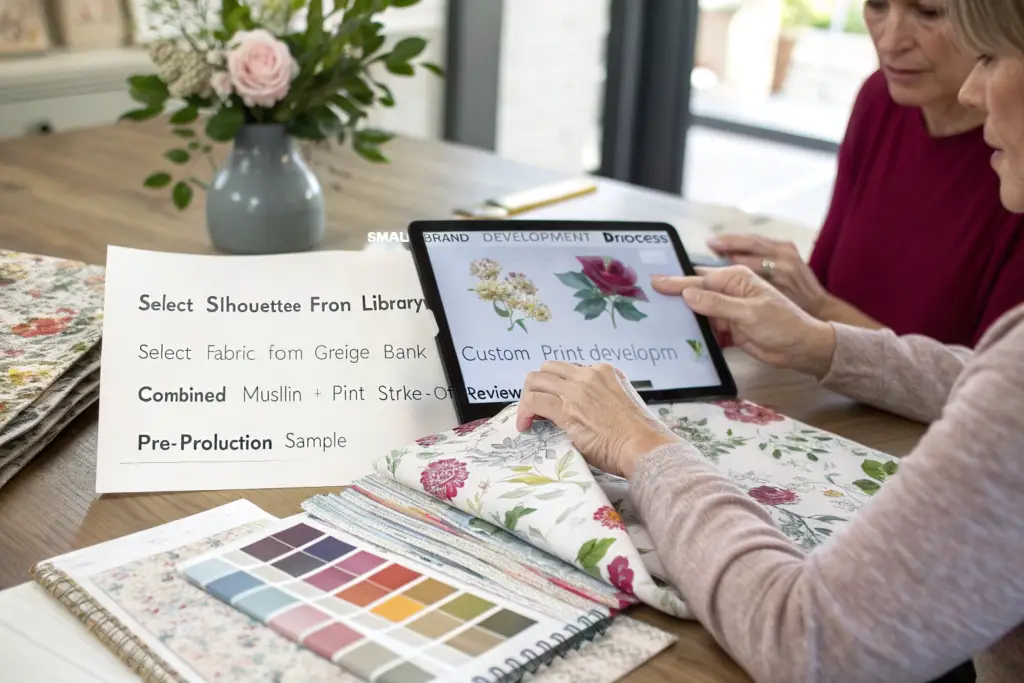
What Choices Are Available Within the Pattern Library and Greige Bank?
Curated options are not limited options. Our pattern library and greige bank have been built over years to cover the most commercially proven A-line dress variations and the most versatile fabric qualities. The choice is structured, but it is genuine.
Our A-line dress pattern library currently includes these base silhouettes, each available in standard sizes and gradable to extended sizes. The Classic Midi A-Line, with a fitted bodice, a defined waist seam, a midi-length flared skirt, and options for sleeveless, short puff sleeve, or three-quarter balloon sleeve. The Tiered Maxi A-Line, with a relaxed bodice, an empire or natural waist placement, and a multi-tiered maxi-length skirt. The Mini A-Line, with a fitted bodice, a short flared skirt, and options for a Peter Pan collar or a simple round neckline. The Wrap-Front A-Line, with a true wrap closure or a faux-wrap surplice bodice and a flared skirt. Each silhouette can be adapted with modifications to the sleeve, the length, the neckline shape, or the skirt fullness. Our greige bank includes these fabric qualities. A 200 GSM pre-washed European flax linen, our premium standard, available for dyeing in our pre-approved color palette. A 100% long-staple cotton voile, lightweight and semi-sheer, ideal for tiered styles. A 100% cotton poplin, crisp and structured, ideal for mini and midi styles. These options cover the core A-line dress category. They do not cover every possible variation, but they cover the variations that sell.
How Does the Combined Fit and Print Review Work?
In a full bespoke development, the fit sample is made in muslin or a solid fabric, and the print strike-off is reviewed separately as a flat fabric swatch. This sequential process takes longer. For the small-brand program, we combine these into a single review step to compress the timeline.
We cut and sew a single sample dress in your chosen fabric, printed with your custom floral design. This sample functions as both the fit evaluation and the print evaluation. We photograph the sample on a standard dress form from the front, side, and back, with measurement annotations overlaid on the images. We also provide close-up photos of the print on the actual fabric, under natural daylight. You review the fit and the print simultaneously. You provide feedback—the waist seam needs to be raised by 1.5 centimeters, the pink in the floral needs to be slightly warmer—in a single feedback round. We produce one revised sample incorporating both the fit adjustments and the print color adjustments. This revised sample, once approved, becomes the pre-production reference. This combined process works because our pattern library blocks are already fitted and proven. The fit adjustments are typically minor—a length change, a sleeve adjustment—rather than fundamental pattern re-engineering. The streamlined sample development for small fashion brands guide explains the trade-offs and the time savings of consolidated approval workflows.
What Are the Costs and Timelines for Small-Brand Orders?
Small brands operate with tighter cash flow and less margin room than established volume buyers. The financial structure of a small-brand order must reflect this reality. The development costs must be transparent and manageable. The per-unit price must leave room for a healthy retail margin. The payment terms must not drain the brand's working capital before a single dress is sold. These are not unreasonable demands. They are the basic requirements of a viable partnership between a manufacturer and an emerging brand.
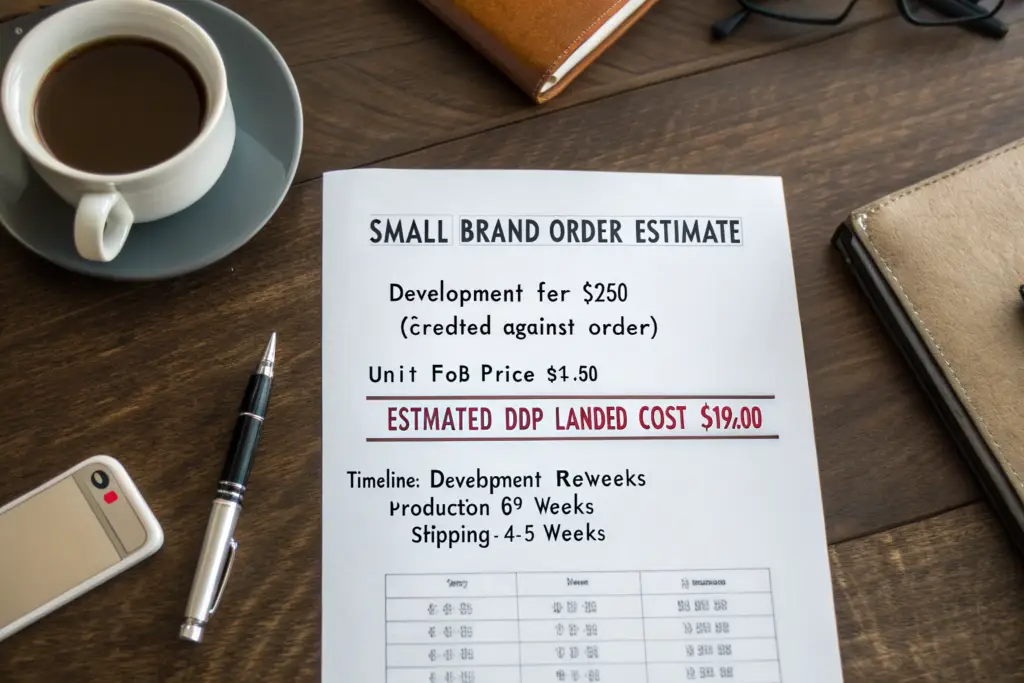
For a typical small-brand order of 200 units of a custom-print A-line dress on our greige bank linen, the estimated costs and timelines are as follows. Development fee: $250 to $400, which covers one round of pattern adaptation, one combined fit-and-print sample, and one revised pre-production sample. This fee is fully credited against your bulk order if you proceed. The unit FOB price for 200 units on 200 GSM linen, including the custom digital print, standard trims, and individual polybag packing, typically ranges from $13.50 to $16.00 depending on the complexity of the silhouette and the print. The estimated DDP landed cost to a U.S. warehouse, including ocean freight, duty, customs clearance, and delivery, typically ranges from $18.00 to $22.00 per unit. The development timeline is four to six weeks from design brief to approved PP sample. The production timeline is six to eight weeks from PP approval to ex-factory. The ocean shipping timeline is four to five weeks to the U.S. West Coast. The total timeline from design brief to goods in your warehouse is fourteen to nineteen weeks.
How Does the Unit Cost Compare to Volume-Tier Pricing?
The per-unit cost for a 200-unit order is higher than for a 1,000-unit order. This is not a penalty. It is the mathematical reality of fixed cost absorption. The same fabric dyeing setup cost, the same print setup cost, and the same production line configuration cost are spread across fewer units. The per-unit contribution to these fixed costs is higher.
For the same dress ordered at 1,000 units, the FOB price might be $11.00 to $12.50 per unit, compared to $13.50 to $16.00 at 200 units. The difference is $2.50 to $3.50 per unit. For a 200-unit order, that is a total additional cost of $500 to $700 compared to the volume price. This is the premium you pay for smaller-scale production. For most small brands, this premium is more than offset by the reduction in inventory risk. Ordering 200 units instead of 1,000 units frees up significant working capital that would otherwise be tied up in unsold inventory. The higher per-unit cost is the price of flexibility and lower inventory exposure. As your brand grows and your order quantities increase, your per-unit cost will decrease. Our pricing tiers are transparent. When your volume reaches 500 units per style, you transition to our mid-tier pricing. When it reaches 1,000 units, you transition to our volume-tier pricing. The apparel manufacturing cost breakdown by order volume article explains the fixed-cost absorption math that drives these tier differences. We are open about our pricing structure because we want you to plan your growth path, not be surprised by costs.
What Payment Terms Apply to Small-Brand Orders?
Cash flow is the lifeblood of a small brand. Payment terms that work for a large, well-capitalized distributor—50% deposit, 50% before shipment—can be painful for a small brand that needs to fund marketing, photography, and sales expenses before the goods arrive.
Our standard payment terms for small-brand first orders are 50% deposit with order confirmation, which funds the fabric procurement and production startup, and 50% against a copy of the shipping documents, which means you pay when the goods are finished, inspected, and in the hands of the shipping line. This structure protects you. You do not pay the balance until there is independent evidence the goods exist and meet your specifications. If you have completed two or more successful orders and demonstrated a reliable payment history, we offer a 30% deposit, 70% against documents for subsequent orders. Our goal is to graduate small brands to more favorable payment terms as the trust relationship develops. The payment terms for small brand apparel manufacturing guide explains the options and the negotiation approach. We structure our terms to protect both parties while acknowledging the cash-flow realities of emerging brands.
How Do You Transition From Our Small-Brand Program to Volume Production?
Our small-brand program is designed as an entry point, not a permanent category. The goal is for your brand to grow beyond it. When your sell-through data justifies larger orders, you should have access to the full range of our capabilities: custom pattern development, exclusive fabric sourcing, bespoke print design with unlimited colorways, and volume-tier pricing. The transition should be seamless, not a renegotiation of the entire relationship. The systems we use for small brands are the same systems we use for volume brands—the same QC protocols, the same production lines, the same communication platform. The only things that change are the development process breadth and the pricing tier.
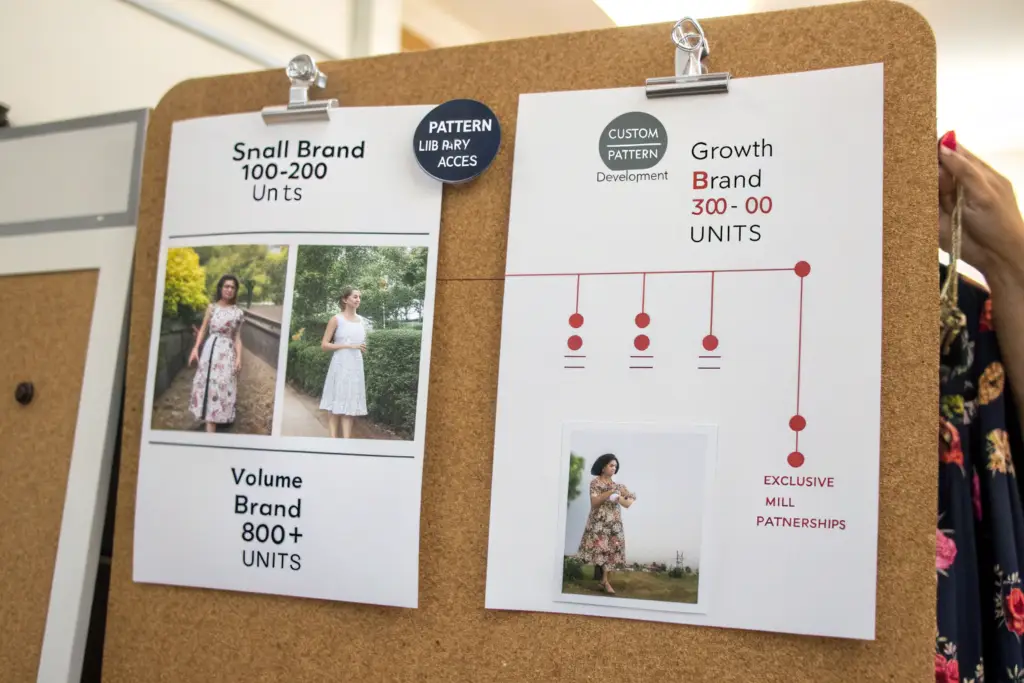
Transitioning from small-brand to volume production occurs naturally as your order quantities increase across successive seasons. The thresholds are transparent. At 300 units per style, you unlock custom pattern development, meaning we can create a new silhouette from your design rather than adapting from our library. At 500 units per style, you unlock custom fabric sourcing from our mill partner network, including exclusive weaves and finishes. At 800 units per style, you unlock full volume-tier pricing and the option for exclusive mill relationships. There is no application process. When your reorder quantity crosses a threshold, the expanded capabilities and improved pricing apply automatically. Your account manager will proactively discuss the new options available to you.
What Capabilities Unlock at Each Volume Threshold?
The path from small brand to volume brand is a path of expanding creative control and improving unit economics. Each threshold unlocks capabilities that allow your brand to differentiate more aggressively and compete more profitably.
At 300 units per style, you unlock custom pattern development. You are no longer limited to adapting our existing A-line blocks. Our pattern engineer will develop a new silhouette from your design sketch, with full muslin fitting and up to two rounds of fit revisions. This is the threshold where your brand's design signature can truly emerge. At 500 units per style, you unlock custom fabric sourcing. You can specify a particular linen weight, weave, or finish from our mill partner network. You can develop an exclusive fabric that competitors cannot access. You also unlock more favorable payment terms at this threshold. At 800 units per style, you unlock volume-tier FOB pricing, typically 20% to 25% below the small-brand unit price. You also unlock the option for exclusive mill relationships, where we collaborate with a specific mill to develop a fabric that is produced only for your brand. This is the threshold where your brand can achieve both creative distinctiveness and competitive margin structure. The scaling apparel production from small batch to volume manufacturing guide provides a broader industry perspective on managing this growth transition. Our internal thresholds are aligned with industry norms and are designed to reward your growth with tangible capability and pricing improvements.
Conclusion
Small brands can order custom floral dresses from Shanghai Fumao Clothing. The path is structured, not fully bespoke. The MOQs start at 100 to 200 units, enabled by our pattern library and greige fabric bank. The development process is a streamlined, four-to-six-week, three-stage collaboration. The per-unit cost is higher than volume-tier pricing but competitive with domestic alternatives and structured to leave room for a healthy retail margin. The payment terms are designed to protect your cash flow. And the entire program is built on a transparent growth path. As your brand's volume grows, your capabilities and your pricing improve automatically.
If you are a small brand ready to move beyond stock wholesale and into custom manufacturing, or if you are uncertain whether your current volume can support a custom program, I am ready to have an honest conversation about what is possible. Send me your design concept, your target quantity, and your questions. I will provide a realistic assessment, not a sales pitch. My name is Elaine. My email is elaine@fumaoclothing.com. Small brands built this industry. We are proud to serve the next generation.