A brand owner from Portland emailed me a photo last year. She had just received 2,000 pairs of her beautiful linen wide-leg pants. The fabric was perfect. The fit was perfect. The label was a disaster. She had designed her logo in a delicate script font on her MacBook. On the screen, it looked elegant. On a 1.5-inch woven label, it was illegible. The letters bled together. You couldn’t read her brand name. She had spent $14,000 on the perfect pants and $200 on labels that ruined the entire premium feel. She had to order replacement labels and pay a local seamstress $3 per unit to swap them. That was a $6,200 mistake caused by one design file.
Designing custom labels for wholesale linen pants from China requires you to think in physical dimensions, not screen pixels. You need to specify the label type, the exact dimensions, the thread colors, the attachment method, and the artwork file format. A woven damask label looks premium on linen but requires thicker fonts. A printed cotton label feels soft and natural but fades over time. The design must be tested at actual size, not zoomed in on a screen.
I have sewn millions of labels into garments. I know which labels look expensive and which ones look cheap. I know which fonts work at 6mm height and which ones disappear. Let me walk you through the entire label design process so your brand mark matches the quality of your pants.
What Types of Labels Work Best for Linen Wide-Leg Pants?
Linen is a natural fabric with texture. It has slubs. It has a matte finish. It breathes. Your label must feel like it belongs on this fabric. A shiny, plastic-feeling label on a $98 linen pant is a discordant note. The customer touches the waistband, feels the scratchy polyester label, and their perception of quality drops. The label is a silent salesperson. It must speak the same language as the garment.
The best label types for linen wide-leg pants are woven damask labels, printed cotton labels, and soft satin woven labels. Woven damask offers the highest perceived luxury with fine detail and a soft hand feel. Printed cotton labels are the most eco-friendly option, perfect for a sustainable brand story. Satin labels are a budget-friendly option that still looks acceptable if the satin is soft and not shiny. Heat transfer and PVC rubber labels are generally poor matches for the natural, breathable aesthetic of linen.
Let me compare these options in detail. The choice affects your brand perception more than you think.
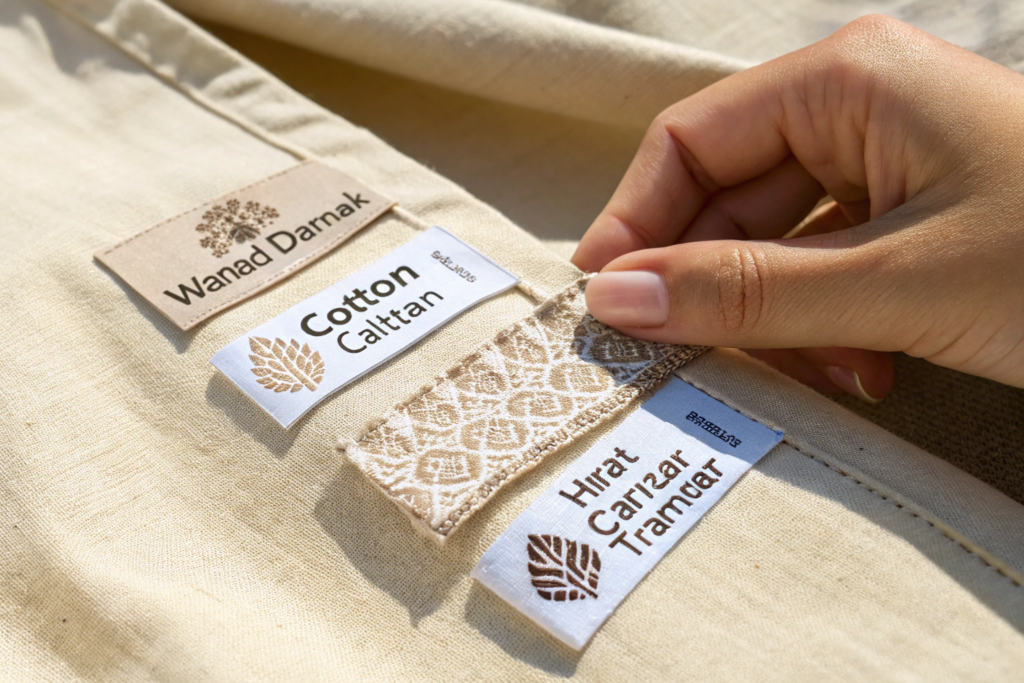
Why Are Woven Damask Labels the Premium Choice for Linen?
Woven damask is a label made on a loom. The design is woven into the fabric with very fine polyester or cotton threads. The background is a tight weave. The text and logo are a different weave. The result is a label with subtle texture, no plastic feel, and incredibly fine detail. A good damask label can reproduce text as small as 4 points clearly. A cheap printed label starts to blur at 6 points.
Damask labels feel soft against the skin. This matters because a waistband label touches the wearer’s lower back. A scratchy label irritates. A soft label is unnoticed. Linen is prized for comfort. The label must not undo that comfort. The cost of a woven damask label is about $0.08 to $0.15 per unit in bulk. It is the most expensive standard label type. But on a $78 retail pant, that $0.15 is the highest-return investment you can make. The label signals luxury before the customer reads a single word.
I recommend damask labels to 80% of my boutique clients at Shanghai Fumao. A client in Austin switched from a cheap satin label to a damask label last year. She told me three customers emailed her specifically to comment on how beautiful the label was. Customers never email about a label unless it is exceptional or terrible. A damask label earns positive attention.
When Should You Choose a Printed Cotton Label?
Choose a printed cotton label when your entire brand story is about natural, raw, unprocessed authenticity. Cotton labels are printed with ink on a cotton tape. They have a matte, slightly textured surface. They feel like a piece of organic fabric. They age with the garment. After ten washes, the label softens further. The print may fade slightly. This is not a defect for a brand that celebrates wabi-sabi and lived-in luxury.
Cotton labels are also the most eco-friendly choice. A 100% cotton label is fully biodegradable. It aligns with a GOTS-certified organic linen pant. The label and the garment share the same end-of-life story. They both return to the soil. A polyester damask label, while soft, is still a synthetic fiber. For a truly plastic-free garment, cotton is the correct choice.
The cost is similar to damask, around $0.10 to $0.18 per unit. The limitation is print resolution. Very fine details and small text can blur. I advise clients to use bold, simple logos on cotton labels. A serif font at 8 points is fine. A thin script font at 6 points is not. Test the artwork at actual size on paper before approving the label proof. A brand from Vancouver uses cotton labels on her organic linen collection. The label reads "100% Organic Linen. Biodegradable. Made with care." The label itself proves the claim. It is a powerful marketing detail.
How to Specify Label Dimensions and Placement Correctly?
A beautiful label sewn in the wrong place is a waste. I have seen labels sewn into the side seam, where they scratch the hip. I have seen labels that are too wide for the waistband, so they bunch and fold. I have seen labels with the care instructions facing outward because the sewer didn’t know which way was front. These are not design failures. They are specification failures. The factory follows your instructions. If the instructions are vague, the result is random.
Standard label dimensions for a waistband label are 30mm to 40mm wide by 15mm to 25mm high. For a side seam label, 20mm by 60mm works well. The placement must be specified as a precise measurement from the center back seam, usually 0mm for center placement or 50mm to the left for an offset brand label. You must also specify the fold type: flat, center-fold, or end-fold. A center-fold label is the most common for waistbands.
Every detail matters. I will give you the exact specifications to send to my team.
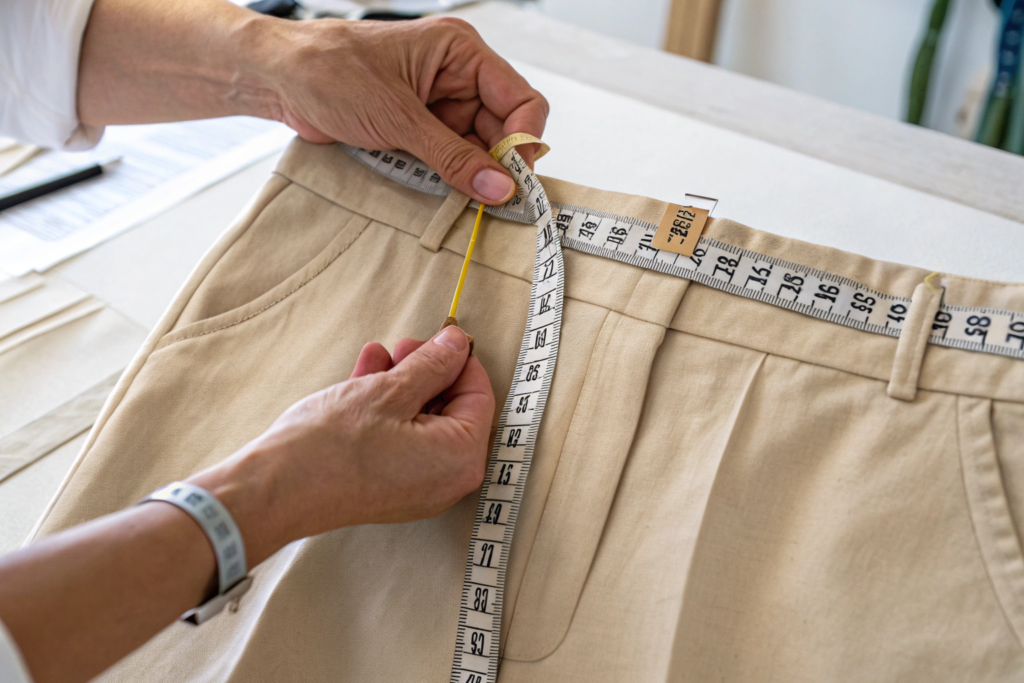
What Are the Most Common Label Positions on Linen Pants?
There are three standard label positions on a pair of linen wide-leg pants. Each serves a different purpose. You can use one, two, or all three.
| Label Position | Typical Dimensions | Purpose | Attachment Method |
|---|---|---|---|
| Center Back Waistband | 35mm x 20mm | Main brand label, most visible | Folded into waistband seam |
| Side Seam or Hip | 20mm x 60mm | Care and content label, legally required | Flat, sewn into left side seam |
| Inner Pocket Bag | 20mm x 40mm | Subtle brand detail, surprise element | Flat, sewn onto pocket lining |
The center back waistband is the prime real estate. This is where your main woven label sits. It is visible when the pant hangs on a rack. It is the first thing a customer sees when they pick up the pant. The side seam label carries the legal information: fabric content, care instructions, country of origin, and RN number if you have one. This label is required by US law. It must be permanently attached.
The inner pocket label is a boutique touch. A small label sewn inside the pocket bag that says something like "Handcrafted for [Brand Name]" or "Wear. Love. Repeat." It is a hidden surprise. It costs an extra $0.05 per unit. It generates social media unboxing content. A client in New York puts a tiny linen care instruction label inside the pocket: "Machine wash cold. Tumble dry low. Wrinkles are beautiful." Her customers photograph the pocket label and post it on Instagram. That $0.05 label is her best marketing investment.
How Do You Specify "Fold Type" for a Waistband Label?
A label arrives from the label factory as a flat piece of woven fabric. It must be folded and sewn into the waistband seam. The fold type determines how the label hangs. The wrong fold type makes the label poke out awkwardly or disappear into the seam.
The standard fold for a waistband label is a "center-fold." The label is folded in half horizontally. The top half is sewn into the waistband seam. The bottom half hangs down inside the pant. The fold creates a clean edge at the top of the waistband. The label sits flat against the body.
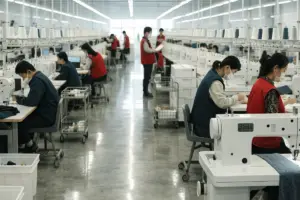
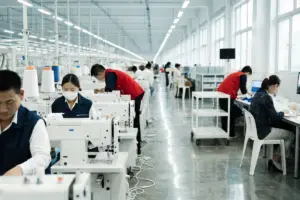
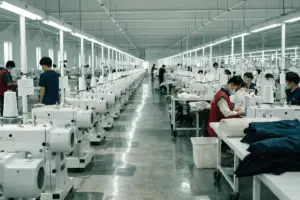
An "end-fold" is when a small portion of one end is folded over and sewn. This is used for loop labels or tags that hang like a small tab. A "flat" label is sewn down on all four sides, usually on a pocket or a side seam. The fold type must be specified in the tech pack. I include a diagram for my clients. A simple sketch with an arrow and the words "Center Fold, sew into waistband seam" prevents any confusion. My sample room sews the label onto the pre-production sample exactly as specified. You approve it. The bulk production copies the sample. This is how you ensure 3,000 pants have the label in the exact right place.
What Artwork Specifications Prevent Label Printing Errors?
The label factory does not guess. They take your file and reproduce it exactly. If your file is wrong, the label is wrong. The most common errors are low-resolution artwork, RGB color mode instead of CMYK or Pantone, and text that is too small for the weaving process. These errors are not the factory’s fault. They are file preparation errors. The factory will print exactly what you send them. You must send them something printable.
The ideal label artwork file is a vector file in Adobe Illustrator format, with all text converted to outlines, colors specified as Pantone TCX numbers, and dimensions shown at 100% scale. A vector file can be scaled without losing resolution. Pantone colors ensure the thread color matches your brand color across different suppliers. Text outlined prevents font substitution errors. The minimum text height for a woven label is 1.5mm for sans-serif and 2mm for serif fonts.
I have seen too many beautiful logos fail at the label stage. Let me give you the technical rules.
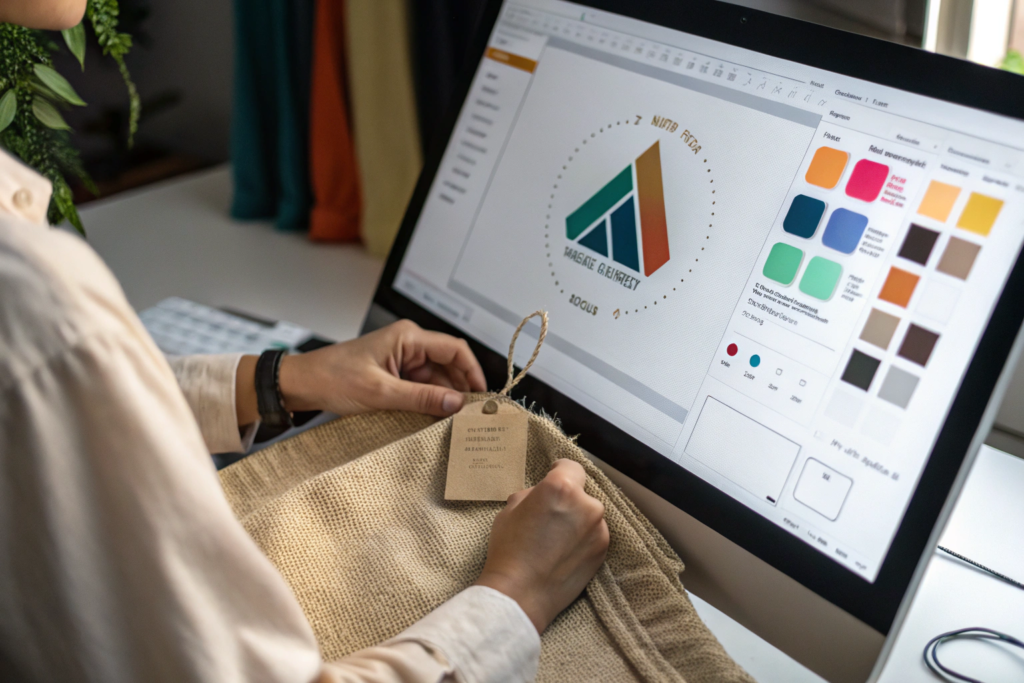
Why Are Vector Files Non-Negotiable for Label Production?
A JPEG or PNG image is made of pixels. When the label factory zooms in to set up the loom or the printing plate, the pixels become visible. The edges of your logo look jagged. The text looks fuzzy. The factory cannot fix this. They reproduce the file.
A vector file, like an .AI or .EPS or .SVG, is made of mathematical paths. It has no pixels. It can be scaled to any size without losing sharpness. The label factory needs a vector file to produce a sharp, professional label. If you don’t have a vector file, hire a graphic designer on Fiverr or Upwork to convert your logo. It costs $20 to $50. It is the best money you will spend on your brand.
I require all clients to submit label artwork as a vector file. A client in Miami sent me a JPEG of her logo. It looked fine on the email. I asked her to zoom in. At 200% zoom, the edges were blocky. She didn’t have a vector file. She had designed her logo on Canva. I connected her with a designer I know. The designer recreated the logo as a vector. The cost was $35. The labels came out sharp and professional. The JPEG would have produced labels that looked like a 1990s dot-matrix print. The $35 vector saved her $400 in label reprints.
How Do You Choose the Right Thread Colors with Pantone?
Your brand has specific colors. Your logo is a particular shade of sage green. The label thread must match that shade. The computer screen shows the color in RGB light. The physical thread is a solid color viewed in real light. They never match perfectly without a color standard.
Pantone is the universal color language. A Pantone TCX number specifies an exact color for textiles. "Pantone 16-6127 TCX" is a specific shade of greenish-gold. The label factory has Pantone thread charts. They match their polyester or cotton thread to the Pantone number you provide. If you don’t provide a Pantone number, the factory guesses. The guess is often wrong.
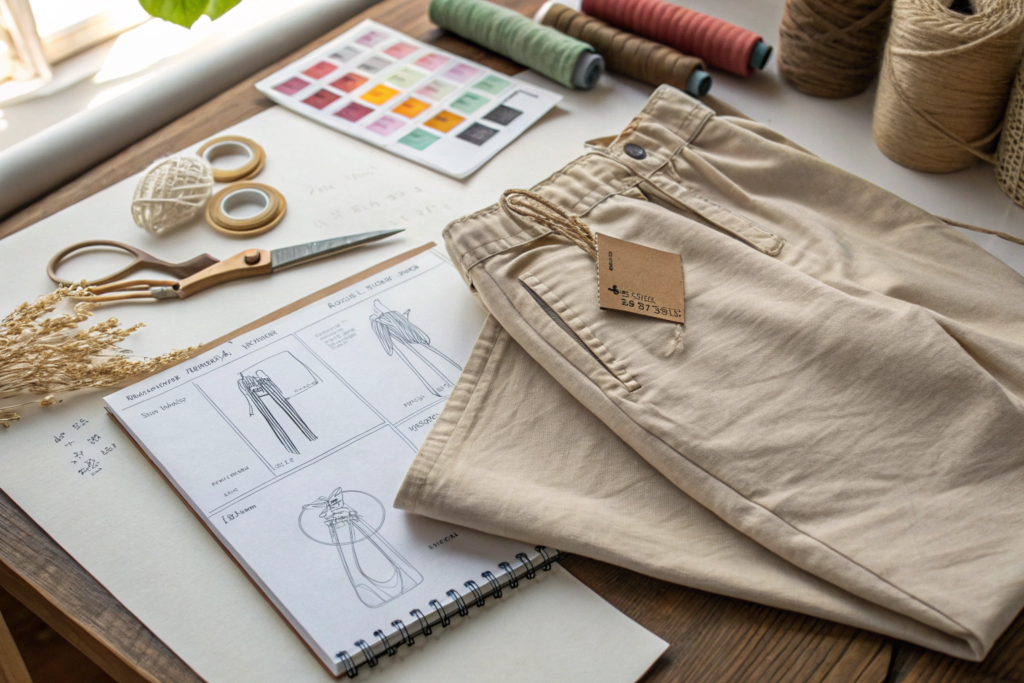
I ask my clients for their brand’s Pantone colors. If they don’t have them, I offer to match a physical color swatch they mail to me. We then agree on the closest Pantone number and document it in the tech pack. That Pantone number becomes the permanent specification for all future labels. Consistency across production runs is guaranteed. A brand in Chicago learned this lesson the hard way. She ordered labels twice without a Pantone number. The first batch was a warm cream. The second batch was a cool white. The inconsistency looked unprofessional on her e-commerce photos. Now she uses Pantone. Every batch matches.
What Are the Content and Care Label Legal Requirements for the US Market?
A beautiful brand label is art. The care label is law. The US Federal Trade Commission requires specific information on every textile garment sold in the United States. If the information is missing, incorrect, or not permanently attached, the garment is illegal to sell. You can be fined. A retailer can reject the shipment. The legal requirements are not optional. They are the cost of entry to the US market.
Every linen wide-leg pant sold in the US must have a permanent care label that includes the fiber content in English, the country of origin, and the manufacturer or importer identity. The fiber content must list percentages in descending order. "100% Linen" is acceptable. "Linen/Cotton" is not. The country of origin must say "Made in China." The care instructions must use ASTM standard care symbols in a logical sequence: washing, bleaching, drying, ironing, and professional care.
I manage this compliance for my clients. Let me show you the exact requirements.
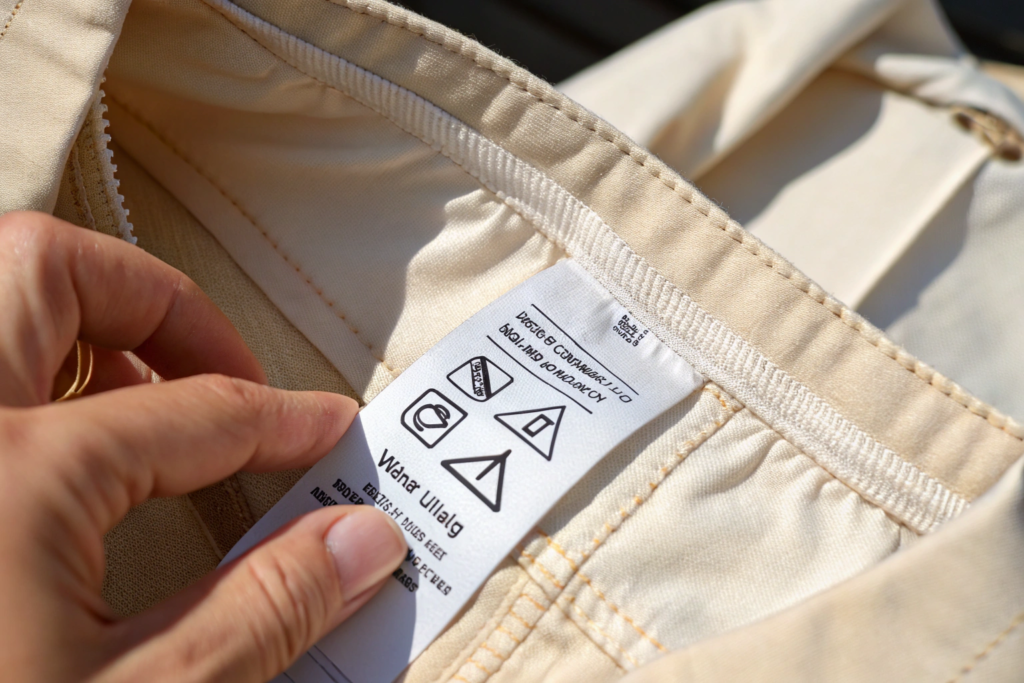
What Exact Information Goes on the Care Label?
The FTC Textile Rules specify four mandatory disclosures. I print them on a single care label, usually placed in the left side seam or attached to the waistband label.
Disclosure 1: Fiber Content. "100% Linen" or "55% Linen, 45% Cotton." The percentages must add up to 100%. Generic names must be used. "Linen" is correct. "Flax" is also correct. "Eco-fabric" is not correct. If the pocket bag is a different fabric, it must be listed separately unless it is the same.
Disclosure 2: Country of Origin. "Made in China." This is required for all imported goods. The label must say "Made in China" clearly, not "China" or "PRC." The phrase "Made in China" is a legal term.
Disclosure 3: Manufacturer or Importer Identity. This is your brand name or your company name, and your city. "[Brand Name], Portland, OR" is sufficient. This allows the consumer to contact the responsible party.
Disclosure 4: Care Instructions. The care label must have washing instructions with a maximum temperature. "Machine wash cold, gentle cycle. Do not bleach. Tumble dry low. Iron on low heat if needed. Do not dry clean." The instructions must be accurate for linen. Linen can be machine washed. Linen can be tumble dried. Linen should not be bleached with chlorine bleach. The care symbols are standardized. A washtub with a number inside, a triangle for bleach, a square with a circle for drying, an iron symbol. The sequence must follow the ASTM D5489 standard.
I provide a care label template to all my clients. You fill in your brand name and city. I handle the rest. The care label is generated by my label supplier and sewn into every pant. The FTC compliance is baked into the production process. You don’t need to think about it. But you do need to know it exists.
What Is an RN Number and Do You Need One?
An RN number is a Registered Identification Number issued by the FTC. It identifies the manufacturer, importer, or distributor of a textile product. It is not required if you put your full company name and city on the care label. The RN number is an alternative to the company name.
If you are a private label brand and you don’t want your company name visible, you can apply for an RN number. The application is free on the FTC website. The RN number appears on the care label instead of your company name. It looks like "RN 123456." The RN number traces back to your business in the FTC database. It adds a layer of privacy.
Most of my boutique clients use their brand name directly. They want the customer to see "Made for [Brand Name], Austin, TX." It builds brand recognition. The RN number is more common for large retailers who want a neutral label. I advise new brands to use their brand name. It is simpler. It requires no application. It is immediate. If you want an RN number, I can wait for it. But it is not a barrier to production. Your brand name and city are legally sufficient.
Conclusion
Custom labels are the smallest physical component of your linen wide-leg pant. They are also the most symbolic. They carry your brand name. They carry the legal truth of the garment. They touch the customer’s skin. A well-designed woven damask label on a center-back waistband, with a Pantone-matched thread color, a clean vector logo, and a legally compliant care label in the side seam, transforms a generic pant into a branded product. The label says, "Someone cared about this garment."
The cost of doing labels right is tiny. The cost of doing them wrong is a rework nightmare. I have guided hundreds of brands through their first label order. I know the label suppliers. I know the fold types. I know the FTC requirements. You don’t need to learn all of this. You need to know your brand identity. I can translate it into a label specification.
If you are ready to design your custom labels, our Business Director, Elaine, can send you our label specification template. It includes a diagram for dimensions and placement, a list of available label types with physical samples, and the Pantone thread chart. Email her at elaine@fumaoclothing.com. Tell her your label idea. She will walk you through the options and get a physical label sample sewn onto a pant for your approval. Your brand deserves a label as beautiful as the linen it sits on. Let’s make it together.