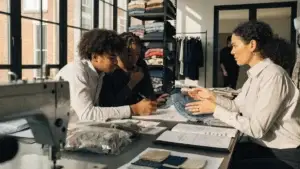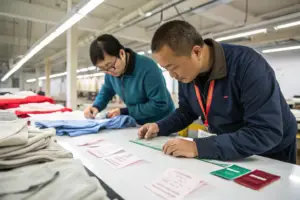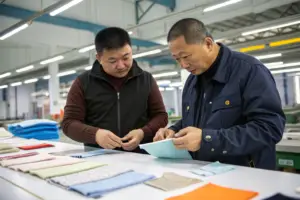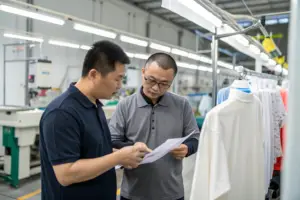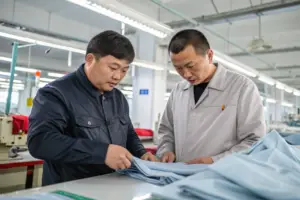
Two years ago, a brand owner from Los Angeles was burned by a small factory. She placed a 5,000-unit linen pant order in February for a May delivery. The factory had one production line. One. In March, a larger client pushed an emergency order onto that same line. Her order was paused for three weeks. No one told her. She found out when she emailed for a status update. The pants shipped in late June. She missed her entire summer window. She told me later, "I didn't just lose a season. I almost lost my business." A factory's production line count is not a technical detail. It is a risk management structure.
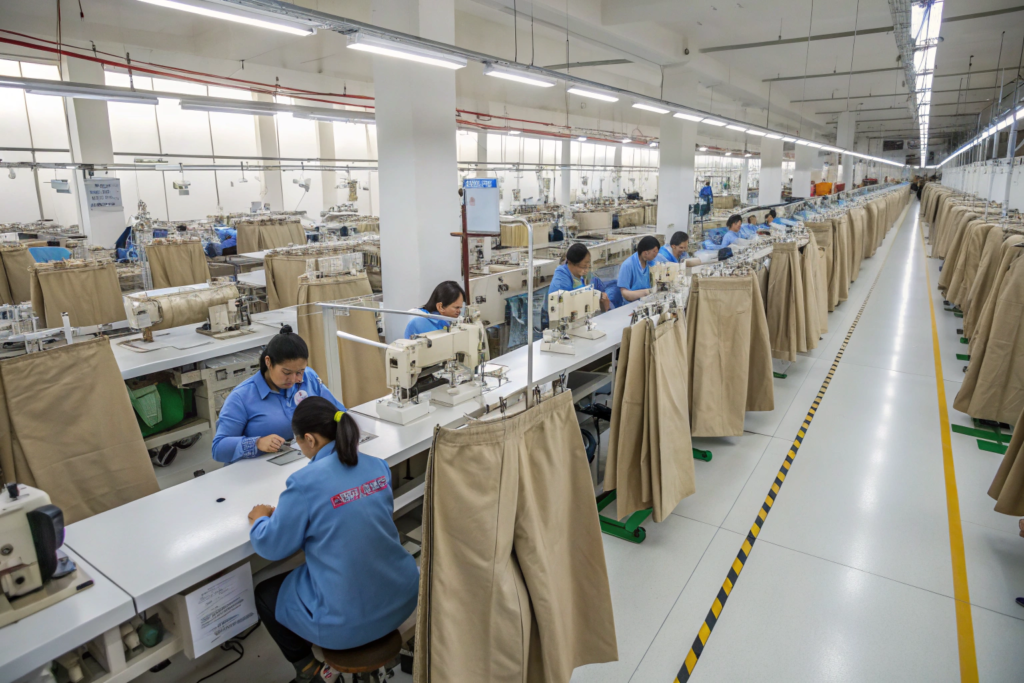
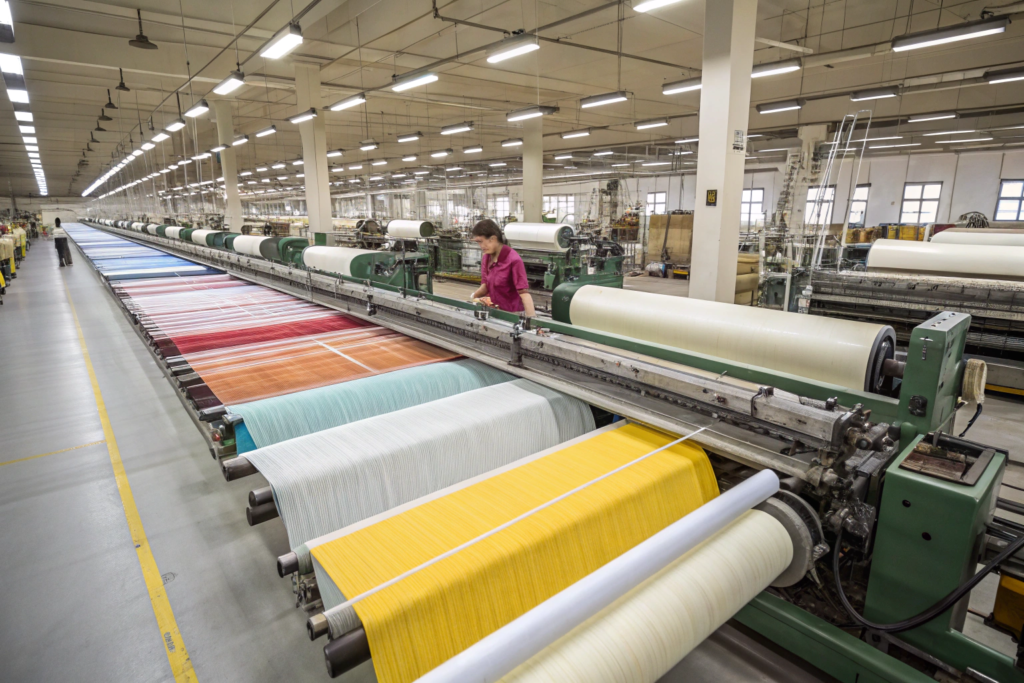
Five dedicated production lines guarantee faster delivery because they eliminate the single biggest cause of factory delays: production line bottlenecks. With five lines, Shanghai Fumao can dedicate one line to your order without pausing other clients' work. We can run multiple styles, colors, or order sizes simultaneously. If one line hits a delay, the other four absorb the overflow. The result is a 30-day bulk production window that holds firm, not a 30-day window that stretches to 45 days when another client's order takes longer than expected.
A factory with one line is a single point of failure. A factory with five lines is a resilient system. Let me show you exactly how this structure protects your delivery date.
How Does Multi-Line Production Prevent Bottlenecks?
A bottleneck is a traffic jam in a factory. Too many pants arrive at one station. The operator can't keep up. The line stops. The whole production schedule slides to the right. Bottlenecks happen because every order is a little different. Some fabrics sew slower. Some styles have more operations. Some trims require hand-attachment. When these variations hit a single production line, they compound. A 2-hour delay on a zipper station becomes a 2-day delay by the end of the week.
Five lines prevent bottlenecks through parallel processing. If your linen wide-leg pant style has complex pockets that require extra sewing time, I assign your order to a line with more pocket-specialist operators. The other four lines continue running their simpler styles without slowing down. Your complex order doesn't block the simpler orders. The simpler orders don't crowd out your complex order. Each line runs at its optimized pace for its assigned style.
This is production load balancing. It is the core advantage of a multi-line factory.
What Is "Dedicated Line Assignment" and How Does It Protect Your Order?
When you place a 3,000-unit linen pant order at a single-line factory, your order joins a queue. It goes behind whatever order is currently running. If the current order runs late, yours starts late. You have no visibility and no control.
At Shanghai Fumao, your order gets a dedicated line assignment. If your order is 3,000 units of a mid-complexity style, I assign it to Line 3, which is configured for mid-weight woven garments. Line 3 has the right machines, the right operator skills, and the right pressing equipment for linen. Your order does not queue. It starts on the scheduled date. The line runs your order from cut to pack without interruption. There is no "priority client" that can bump you. Your production slot is reserved. This is a discipline. I don't oversell my line capacity. If five clients book all five lines for March, the sixth client gets an honest April production date. I lose a sale sometimes by being honest about capacity. But I keep a reputation for on-time delivery. A client in Chicago told me, "You're the only factory that has ever told me 'no' for a good reason. That's why I trust you with my 'yes'."
How Do Parallel Lines Absorb a Sudden Delay?
Delays happen. A fabric dye lot fails a shrinkage test. A batch of custom buttons arrives with a color defect. A key sewer gets sick for two days. In a single-line factory, the entire factory stops. The delay hits the delivery date directly.
In a five-line factory, the other four lines keep running. The delay on one line is contained. But more importantly, I can shift capacity. If Line 2 is waiting for replacement buttons and is idle for 6 hours, I move some pressing work from Line 3 to Line 2. The operators on Line 2 stay productive. Line 3 is relieved of some workload. The overall schedule shifts by hours, not days.
Last year, a trim supplier shipped the wrong zipper color for a client's order on Line 4. The correct zippers were 3 days away. I moved the operators from Line 4 to Line 1 for two days. They helped with a large, straightforward order that needed extra packing labor. When the zippers arrived, Line 4 restarted immediately. The client's order shipped 1 day late instead of 4 days late. The client on Line 1 received their order 1 day early. The multi-line structure turned a potential failure into a minor adjustment. The client never knew there was a zipper problem. That is how a resilient system protects promises.
Can You Run Multiple Styles and Colors Simultaneously?
A boutique brand often needs variety. You are not ordering 5,000 units of one style in one color. You are ordering 300 natural, 200 sage green, and 200 terracotta. Maybe two different silhouettes. A pull-on wide-leg and a zipper-fly wide-leg. A single-line factory struggles with this variety. They must run Style A, finish it, clean the line, set up for Style B, run it, clean the line, set up for Style C. The changeover time between styles is lost production time. Your small, varied order takes longer than a large, uniform order.
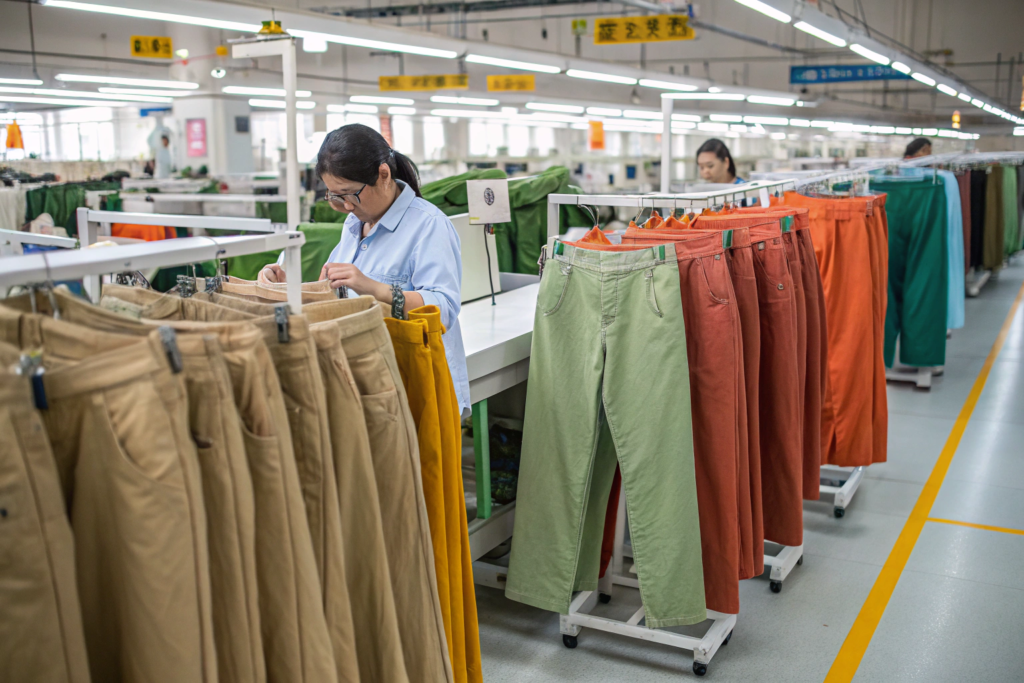
With five production lines, Shanghai Fumao can run up to five different styles or color batches simultaneously. Each line is dedicated to one style-color combination. There is zero changeover time between styles because no changeover is needed. Your 300-unit natural pant on Line 1, your 200-unit sage green on Line 2, and your 200-unit terracotta on Line 3 all progress at the same time. The entire order ships together, not in separate batches weeks apart.
This simultaneous capability is critical for boutique brands that launch a collection, not a single SKU.
What Is "Parallel Batching" and How Does It Speed Up Small Orders?
Small orders are the hardest for a large factory. A 200-unit order does not fill a production line. In a single-line factory, small orders are squeezed between large orders. They wait. They are low priority. They take as long to set up as a large order, so the setup cost per unit is high. The factory is incentivized to delay them.
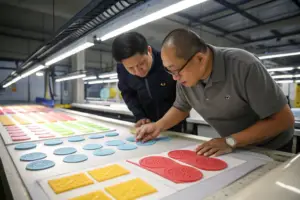
My five-line structure allows "parallel batching." I group your small order with another small order on adjacent lines. Your 200 natural pants run on Line 2. Another client's 250 white pants run on Line 3. They share a cutting schedule. They share the finishing and pressing station. They are separate orders with separate trims and separate packing, but they flow through the factory at the same time. The setup cost is shared. The production speed is the same as a 500-unit order.
A brand from Portland ordered 180 pants in two colors last season. I batched her order alongside a 220-unit order from another boutique brand. Both orders started cutting on the same day. Both orders shipped on the same day. Each brand received their own unique pants, their own labels, their own packaging. They never knew they were part of a batch. The parallel batching system makes small orders viable without punishing the delivery timeline. This is why boutique brands keep coming back to Shanghai Fumao. We don't treat a small order like a nuisance. We treat it like a puzzle piece that fits into our multi-line system.
How Does Color Separation Prevent Dye Contamination in Linen?
Linen is a natural fiber. It sheds. A terracotta linen pant sheds tiny terracotta fibers. If you run terracotta and natural white on the same line, on the same day, the white pants will pick up a faint pink tint from the airborne fibers. This is cross-contamination. It is a nightmare for quality control.
With five separate lines, I can physically separate dark colors from light colors. Line 1 runs natural and white. Line 3 runs terracotta and indigo. The lines are separated by distance and by air filtration. The operators on Line 1 wear light-colored aprons. The operators on Line 3 wear dark aprons. The pressing tables have separate covers. The packing area has separate stations.
This physical separation is impossible in a single-line factory. A small factory might run a dark batch on Monday and a light batch on Tuesday without a deep clean. The light batch picks up fibers. The customer receives "natural" linen pants with a subtle muddy tint. They return them. The brand's quality reputation is damaged. The color separation my five-line factory provides is a quality feature as much as a speed feature. It eliminates a defect category entirely.
How Does Our Factory Layout Reduce Material Handling Time?
A pant spends only 30% of its factory time being sewn. The other 70% is spent moving. Fabric to cutting. Cut panels to sewing. Semi-finished pants to pressing. Pressed pants to packing. In a poorly laid-out factory, these journeys are long. They cross paths. They create delays. The 30% sew time is fixed by the machine speed. The 70% material handling time is determined by the factory layout. A smart layout cuts the handling time in half.
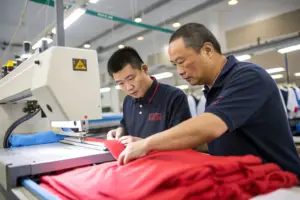
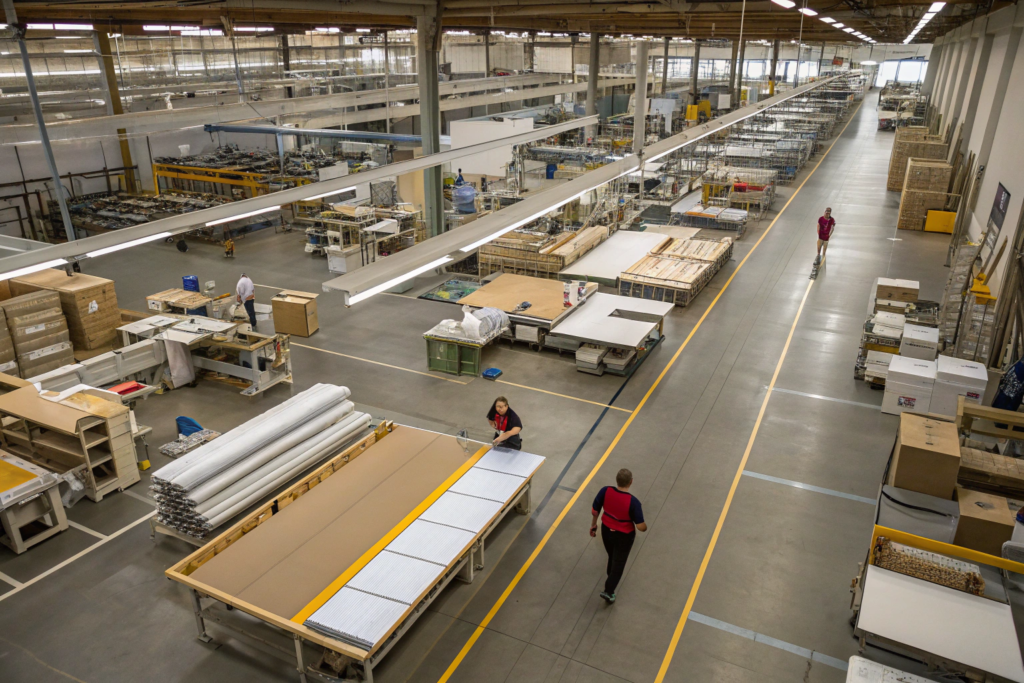
Shanghai Fumao's factory is laid out in a linear flow model. Fabric enters at one end of the building. Finished cartons exit at the other. The five production lines are arranged in parallel, each with its own dedicated cutting zone, sewing zone, finishing zone, and packing zone. Material moves in a straight line, not in circles. A cut panel travels 30 feet to the sewing machine, not 100 feet across a congested factory floor.
This layout is a deliberate investment. It cannot be retrofitted into a small, single-room factory. It is designed for speed.
How Does "Zone-Based" Production Work?
Each production line is a self-contained zone. Zone includes everything the line needs: the machines, the pressing tables, the inspection station, the thread and trim inventory, and the packing materials. The operator does not leave the zone to get supplies. The supplies are brought to the zone.
This eliminates "walking time." A sewer in a traditional factory might walk 50 feet to the thread cabinet three times a day. Over 20 sewers on a line, that is 60 trips. At 2 minutes per trip, that is 2 hours of lost production time per day. Multiply by 25 production days. That is 50 hours of lost sewing time per month. Fifty hours is roughly 300 pairs of linen pants not sewn.
In my zone-based layout, the thread is on a mobile cart that moves along the line. The trim replenishment is handled by a dedicated material handler, not by the sewers. The sewer sews. That is their only job. This specialization of labor feels small. It is actually massive. It is the difference between a factory that produces 1,000 units per day and a factory that produces 800. The zone layout is invisible to the client. You see an on-time delivery. You don't see the material handler who saved 50 hours of walking time. But the delivery date is built on those saved hours.
What Is "In-Line QC" and How Does It Prevent End-of-Line Reworks?
In a traditional factory, quality control happens at the end of the line. An inspector checks the finished pant. If there is a defect, the pant is sent back for rework. The rework queue is a second production line hidden inside the factory. It steals capacity. It delays packing.
My multi-line layout embeds QC stations inside each production zone. There is a checkpoint after pocket attachment. A checkpoint after rise seam. A checkpoint after waistband. The inspector is 10 feet from the sewer, not 100 feet away in a separate room. If a defect is found, the inspector walks to the sewer. The sewer fixes it immediately. The pant continues down the line. It does not enter a rework queue. There is no rework queue.
This inline QC is only possible because each line has its own dedicated QC inspector. In a single-line factory, one inspector handles the entire output. They can't be in five places at once. They check at the end. My layout allows distributed quality control. The result is fewer defects at the final audit and zero rework delays. The production flow is continuous. Continuous flow means faster delivery. The inline QC is a speed mechanism disguised as a quality mechanism.
How Does Factory Scale Support Faster Raw Material Sourcing?
A factory can only sew as fast as it has fabric. The most common delivery delay in the linen industry is not a sewing problem. It is a fabric wait. The client pays the deposit. The factory orders the fabric from the mill. The mill takes 15 to 20 days to dye and finish the fabric. The factory sits idle for three weeks. The delivery date is already behind before a single pant is cut.
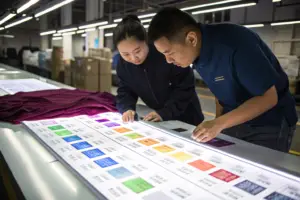
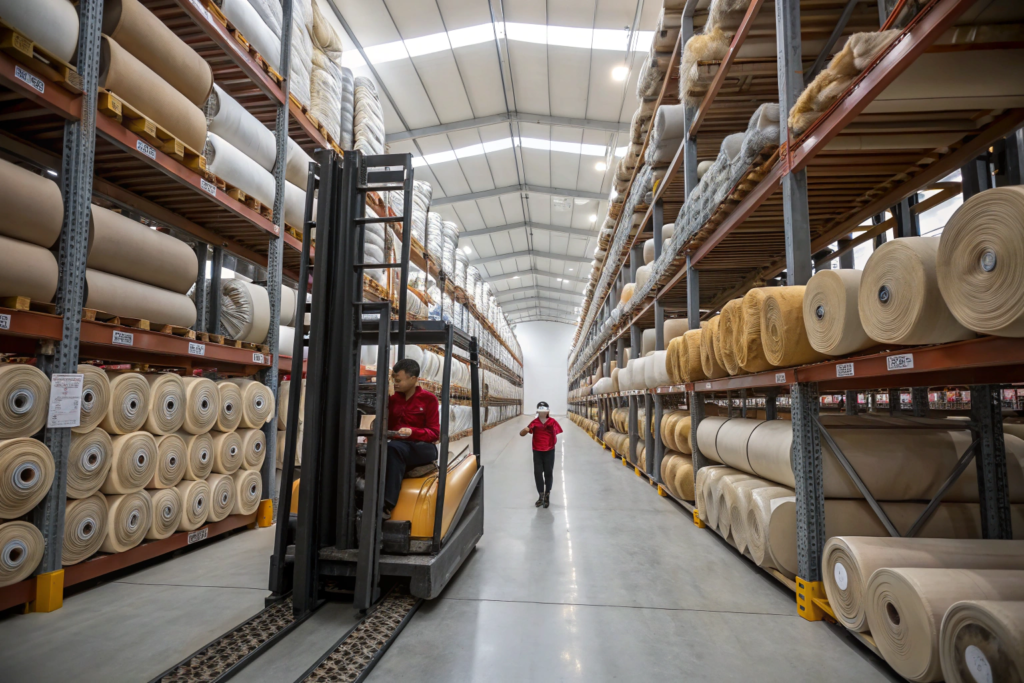
My five-line factory is backed by a strategic fabric inventory program. We stock greige linen fabric in the most popular weights and widths. When your custom color order is confirmed, we send the greige fabric to the dye house immediately. The dye house only dyes, not weaves. The fabric procurement time drops from 20 days to 7 days. The production starts two weeks earlier than at a factory that orders fabric after payment.
This raw material strategy is only possible at a certain scale. A small factory cannot afford to stock greige fabric. They order per client. They wait. I stock for the season.
How Does a Fabric Reserve Reduce Your Order's Start Time?
Here is the real-world timeline comparison for a 3,000-unit linen pant order with a custom terracotta color.
| Process Step | Standard Factory (No Fabric Reserve) | Shanghai Fumao (With Fabric Reserve) |
|---|---|---|
| Deposit Paid & Fabric Ordered | Day 1 | Day 1 |
| Mill Weaves & Finishes Greige | Day 1 - 12 | Skipped (greige in stock) |
| Mill Dyes to Custom Color | Day 13 - 22 | Day 1 - 7 |
| Fabric Shipped to Factory | Day 23 - 25 | Day 8 - 10 |
| Cutting Starts | Day 26 | Day 11 |
| Time Saved | - | 15 days |
Fifteen days saved before cutting even starts. That is half a month. In the seasonal window of linen, half a month is a lifetime. My greige inventory is a financial investment. I tie up capital in fabric rolls that sit on my shelves. But it is the single most powerful lever I have to shorten lead times. A client in Miami needed a rush reorder of 2,000 natural linen pants mid-season. His first factory quoted a 60-day lead time because they had to order the fabric. I had the natural linen greige already in stock. I dyed it. We cut in 5 days. He had the pants at his warehouse in 28 days. He restocked his bestseller while the season was still hot. The fabric reserve turned a dead season into a double order.
How Does Multi-Line Scale Attract Better Mill Partnerships?
Fabric mills prioritize their best customers. A factory that orders 50,000 meters of linen per year gets a different service level than a factory that orders 5,000 meters. The mill allocates production slots. During busy season, the small factory waits. The large factory gets the slot.
My five-line operation consumes roughly 80,000 to 100,000 meters of linen fabric annually. My mill relationships are deep. I have quarterly allocation meetings with two major linen mills in the Yangtze River Delta. They reserve capacity for Shanghai Fumao. If a rush order comes in, the mill will shift my dye lot into an earlier slot. They do this because I am a consistent, high-volume partner. A small factory does not have this leverage. Their rush order goes to the back of the queue.
This scale advantage translates directly to your delivery speed. When you place an order with Shanghai Fumao, you are not just buying our sewing lines. You are buying our mill relationships. The fabric arrives faster. The cutting starts sooner. The pants ship earlier. The delivery date holds. The mill relationship is invisible to you, but it is the foundation of every on-time shipment.
Conclusion
Five production lines are not a vanity metric. They are a structural guarantee. They prevent bottlenecks by isolating delays on one line from the other four. They enable simultaneous production of multiple styles and colors so your entire collection ships together, not in dribs and drabs. They support a zone-based factory layout that reduces material handling time and embeds inline quality control. And they create the purchasing scale to maintain a strategic fabric reserve that shaves weeks off the pre-production timeline.
A single-line factory is a delicate machine. One problem, and the whole delivery schedule collapses. A five-line factory is a resilient ecosystem. Problems happen, but they are absorbed. The client sees only the on-time delivery. The structural redundancy is invisible. That is the point. Good operations are silent.
If you have been burned by late deliveries in the past, I want to show you a different experience. Our Business Director, Elaine, can provide a detailed production timeline for your specific order and show you exactly which line it would run on. Reach her at elaine@fumaoclothing.com. Ask for a video tour of our factory floor. See the five lines in motion. See the fabric reserve. See the zone layout. A reliable delivery date is not a promise. It is a physical system. Come see the system that guarantees it.