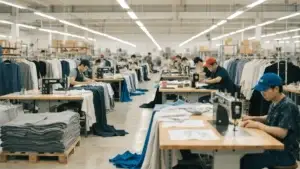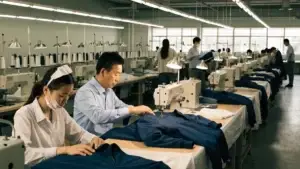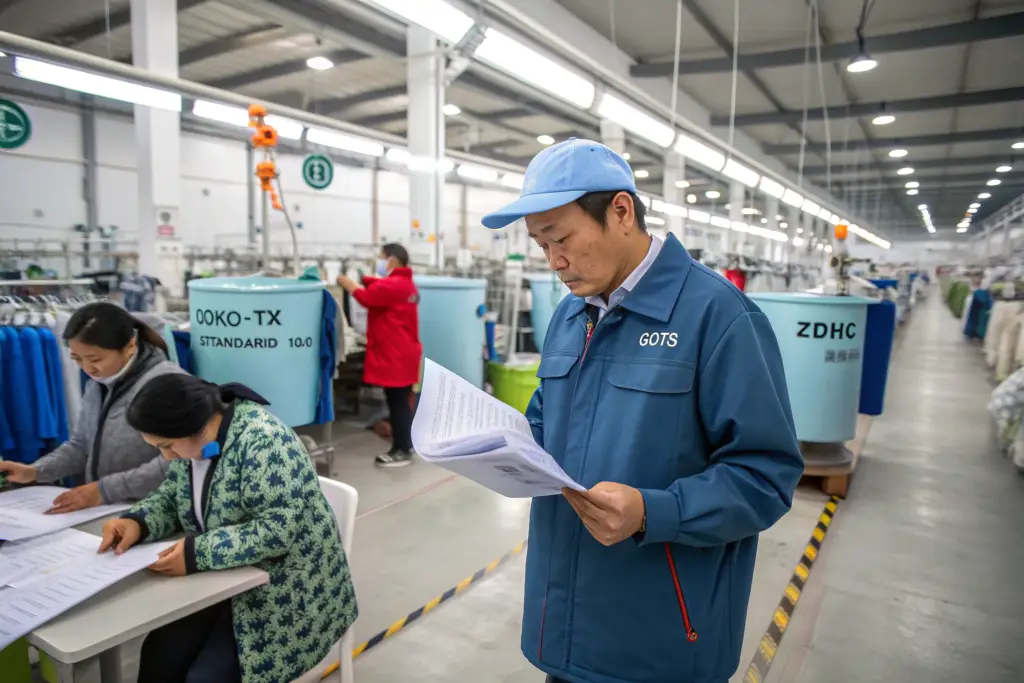
Six months ago, I stood next to a client from Seattle in a dyeing facility just outside Shanghai. She was holding a lab dip of a beautiful rust-colored organic cotton. She turned to me and whispered, "How do I know this isn't just brown water full of heavy metals that's going to poison a river and destroy my brand's eco-friendly story?" She was right to ask. I pointed to the wall. There was a certificate from OEKO-TEX. There was a ZDHC wastewater test report. And there was a real-time monitor showing the pH level of the discharge water. I said, "We don't guess. We verify." The fabric was clean. The brand's reputation was safe.
Ensuring your clothing factory uses environmentally safe fabric dyes requires a four-layer verification strategy. You must require third-party certifications like OEKO-TEX Standard 100 and GOTS. You must demand ZDHC wastewater compliance reports. You must understand the difference between low-impact fiber reactive dyes and toxic azo dyes. And you must occasionally perform unannounced audits or use third-party inspection services to confirm that the dyehouse is not swapping approved dyes for cheaper, hazardous alternatives after you sign the contract.
You are a business owner. You are sourcing from developing countries like China and Vietnam. You are rebranding and distributing in the USA at higher prices. Your customer reads labels. She cares about what touches her skin and what goes into the water. If you get this wrong, you do not just get a return. You get a social media firestorm. At Shanghai Fumao, I run a factory that uses vast quantities of dyed fabric. I have fired dyehouses that tried to cut corners. I want to show you exactly how to protect your brand from the hidden toxins in the textile supply chain.
What Certifications Actually Prove Safe Dye Usage?
You walk into a fabric sourcing meeting. The mill rep slides a stack of papers across the table. There are logos everywhere. Green leaves. Blue globes. It is confusing. Some of these papers are marketing fluff. Some are legal shields. You need to know the difference.
Certifications prove safe dye usage by providing a traceable, third-party verified chain of custody and chemical screening. However, not all certifications cover the same thing. OEKO-TEX Standard 100 certifies the final product is free from harmful substances. GOTS (Global Organic Textile Standard) certifies both the organic fiber and the environmental and social conditions of processing, including strict limits on dye chemicals and wastewater treatment.
You cannot just ask, "Is this dye safe?" The sales rep will always say yes. You must ask for a specific certificate number and verify it online.
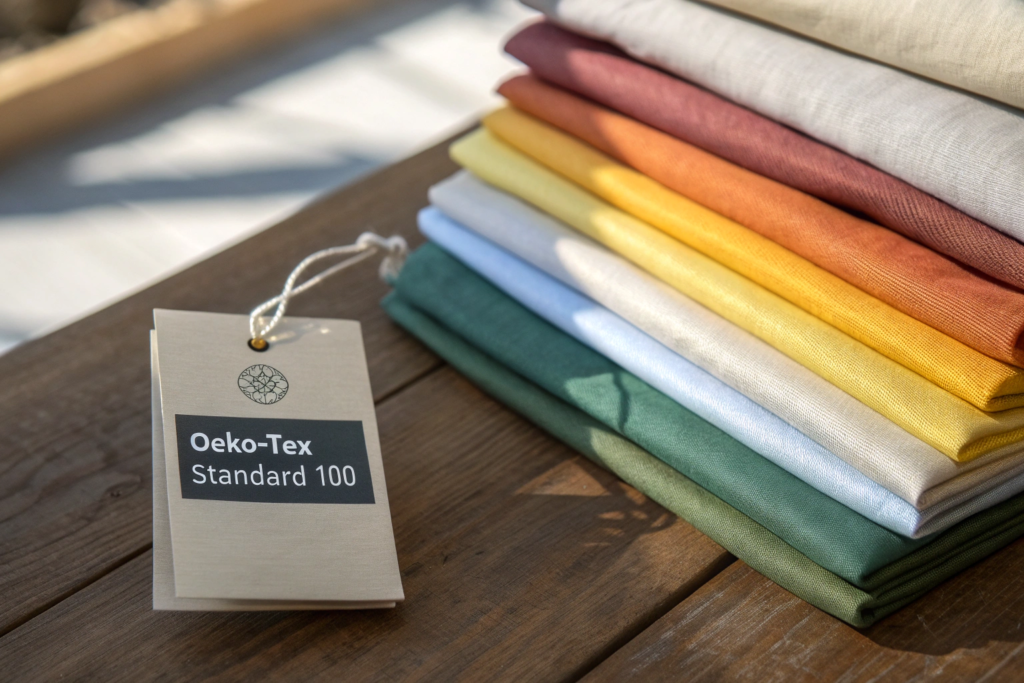
OEKO-TEX Standard 100 vs. GOTS: Which One Protects Me from Toxic Dyes?
This is the most common point of confusion. I explain this to my US clients at least twice a week.
OEKO-TEX Standard 100 is a product certification. It tests the finished fabric or garment for a long list of harmful substances, including:
- Banned Azo Dyes (which can break down into carcinogenic amines).
- Heavy Metals (Lead, Cadmium, Mercury).
- Formaldehyde.
- Phthalates.
The Limitation: OEKO-TEX does not inspect the factory's wastewater. It only tests the dry piece of cloth in a lab. You can have a clean t-shirt made in a factory that is polluting the local river. The shirt will pass OEKO-TEX, but the process was not "environmentally safe."
GOTS (Global Organic Textile Standard) is a process certification. It covers:
- Fiber Origin: Must be at least 70% organic (for "Made with Organic") or 95% (for "Organic").
- Chemical Inputs: All dyes and auxiliaries must meet strict biodegradability and toxicity limits. Toxic heavy metals and azo dyes are completely banned.
- Wastewater Treatment: The factory must have a functional Effluent Treatment Plant (ETP) and the discharge water must meet strict pH and temperature limits.
- Social Compliance: Workers' rights are protected.
The Verdict for a Brand Owner:
- If you just want to assure customers the shirt is safe to wear, OEKO-TEX Standard 100 is the industry baseline. You should demand it. You can verify any certificate number on the OEKO-TEX website.
- If you are building a brand story around sustainability and ethical production, you need GOTS. The GOTS Public Database allows you to look up the exact scope of the factory's certificate.
At Shanghai Fumao, we maintain OEKO-TEX Standard 100 certification for our production. For clients who require GOTS-certified fabric, we source from a vetted network of GOTS-certified mills. I always advise clients: Check the certificate number yourself. Do not trust a photocopy.
Are ZDHC and Bluesign Relevant for a Small US Apparel Brand?
Yes. And they are becoming the new standard for "clean chemistry."
ZDHC (Zero Discharge of Hazardous Chemicals) is not a consumer-facing label. It is an industry Roadmap to Zero program. It focuses entirely on eliminating hazardous chemicals from the supply chain input. They maintain a list called the ZDHC Manufacturing Restricted Substances List (MRSL) . This is the bible for safe dyeing.
Bluesign is similar. It certifies that the entire textile mill operates with safe chemicals, minimal water usage, and safe air emissions.
Why should a small brand care?
Because of Legislation. The European Union and several US states (like California and New York) are passing laws requiring Supply Chain Due Diligence. If your product is found to contain PFAS (forever chemicals) or restricted azo dyes, it can be seized by Customs.
I had a client who imported a batch of water-resistant jackets. The mill used a cheap C8 Fluorocarbon treatment (a type of PFAS). The fabric passed standard OEKO-TEX because OEKO-TEX didn't test for that specific PFAS at that time. When the jackets arrived in California, they were flagged under Proposition 65. The client had to put a cancer warning sticker on a children's jacket. That killed the brand's credibility instantly.
By working with a factory that follows ZDHC MRSL V3.1, you avoid this risk. You ensure that the dyes and finishes are future-proof against tightening regulations.
How to Verify the Dyehouse Process from Thousands of Miles Away?
You are in America. The dyehouse is in Shaoxing, China. You cannot fly there every week. How do you know the water running out of the pipe is clear and not bright red?
Verifying the dyehouse process remotely requires a combination of third-party wastewater test reports, real-time data transparency from the supplier, and an understanding of the physical indicators of safe dyeing. You must ask for lab results that measure Chemical Oxygen Demand (COD) and pH levels, and you must know the difference between a dye that crocks onto your hand and one that is locked into the fiber safely.
At Shanghai Fumao, we do not own our own dyehouse. We partner with specialized dyeing facilities. This means I have to be just as vigilant as my clients. I have walked out of dyehouses that smelled like burning plastic and I have partnered with those that smell like clean steam.
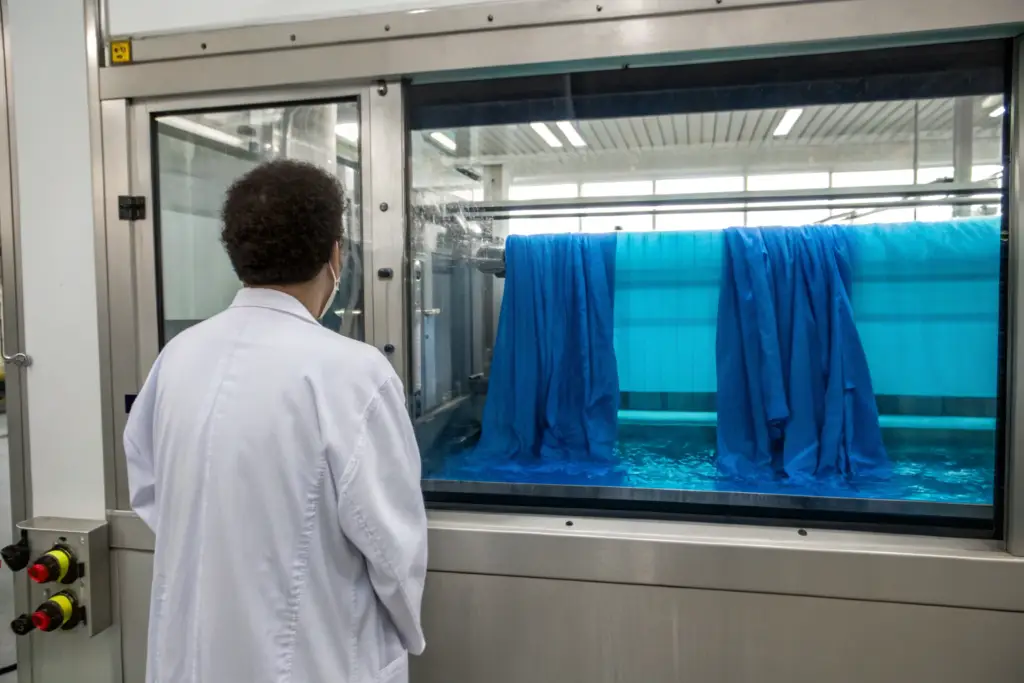
What Should a Legitimate Wastewater Test Report Look Like?
Every legitimate dyehouse has an Effluent Treatment Plant (ETP) . It looks like a small water park with settling tanks and bubbling aeration pools. The output is Treated Wastewater.
A legitimate test report will be issued by an ISO 17025 Accredited Laboratory (like SGS, Intertek, or Bureau Veritas). It will show specific parameters.
Here is a simplified table of what to look for and what the numbers mean for a dyehouse:
| Parameter | What It Measures | Safe Range (Typical ZDHC/GOTS) | Red Flag |
|---|---|---|---|
| pH | Acidity or Alkalinity of water | 6.0 - 9.0 | Below 4 or above 10 (kills aquatic life). |
| COD (Chemical Oxygen Demand) | Amount of organic pollutants (dye stuff) in water | < 150 mg/L | > 250 mg/L (indicates excess dye being dumped). |
| TSS (Total Suspended Solids) | Visible particles/dirt in water | < 50 mg/L | > 100 mg/L (muddy discharge). |
| Temperature | Water temp at discharge pipe | < 35°C (95°F) | > 40°C (Thermal pollution shocks river ecosystem). |
| Heavy Metals (e.g., Antimony) | Toxic elements from polyester catalysts | 0.1 mg/L (Antimony) | Any detection above trace levels without treatment. |
The "Smell Test" (Literally):
I once visited a dyehouse with a client via video call. I asked the manager to walk outside to the discharge pipe. The water looked clear. But the concrete channel was stained fluorescent pink. The manager said it was just "mineral deposits." That is a lie. It is dye buildup from years of non-compliance. Legitimate plants clean their outflow channels. They are gray concrete, not rainbow-colored.
Ask for a recent wastewater report (dated within the last 3 months). Check the lab logo. Check the date. If they cannot provide one, they are not treating their water.
What Is the Difference Between Low-Impact and Toxic Dye Fixatives?
The color of the fabric is only half the story. The Fixative is the chemical that makes the dye bond permanently to the fiber. Without a fixative, the dye would wash out in the first rinse.
- Toxic Fixatives: Historically, Formaldehyde-based fixatives were used. They are cheap and effective. But they leave residual formaldehyde on the fabric, which is a skin irritant and carcinogen.
- Low-Impact Fixatives: Modern reactive dyes for cotton use Soda Ash (Sodium Carbonate) and Salt. These are minerals. They are not toxic. They just change the pH of the water (which the ETP then neutralizes).
The Physical Test for Safe Dyes:
Ask for a Crocking Test Report (AATCC 8). This test rubs the dry and wet fabric against a white cloth to see if the dye transfers.
- If the dye bleeds heavily onto the white cloth, it means the dye did not bond properly. The mill either used too much dye or a cheap fixative. This is not just an environmental issue. It is a quality issue. It will ruin your customer's white sofa.
- Safe dyes bond completely. The crocking test result should be a Grade 4-5 (Excellent).
At Shanghai Fumao, we use only Fiber Reactive Dyes for cotton and Disperse Dyes for polyester that are bluesign approved. We test crocking on every lab dip before bulk production.
Why Does Fabric Handfeel Change with Eco-Friendly Dyeing?
This is a conversation I have with clients almost every season. They want to be eco-friendly. They approve the lab dip. The bulk fabric arrives. They say, "This feels stiffer than the sample from last year. Why?"
Eco-friendly dyeing can alter fabric handfeel because it removes the softening agents and silicone finishes that conventional dyehouses use to mask a rough dyeing process. When you remove harsh chemicals, you also remove the artificial softness. The fabric's true character—slightly crisper and more matte—emerges. It softens beautifully with washing, but it requires managing customer expectations at the point of sale.
You must understand this to avoid a disconnect between the photo on your website and the product in the poly bag.

Does Reactive Dyeing Make Cotton Feel Crisper?
Yes. And that is actually a sign of purity.
The Chemistry:
Conventional pigment dyeing is like painting the surface of the yarn. It sits on top. To make this surface feel soft, factories add Silicone Softeners (which are microplastics) or Cationic Softeners (which can be toxic to aquatic life).
Reactive Dyeing is a chemical bond. The dye molecule becomes part of the cellulose fiber. It penetrates the core. This process requires high temperatures and alkalinity (Soda Ash). After dyeing, the fabric is neutralized with a mild acid (Acetic Acid, basically vinegar).
The Result:
The fabric comes out of the dye bath scoured and clean. It feels like a crisp, new linen shirt. It does not have that slippery, fake softness of a cheap t-shirt that washes away after three wears.
Managing Customer Expectations:
You should add a line to your product description: "Garment is dyed with low-impact, eco-friendly reactive dyes. It will arrive with a crisp, natural handfeel that softens dramatically and becomes your favorite tee after the first wash."
I tested this with a client selling organic baby clothes. We did a wash test. The garment that felt "stiff" out of the box was softer than conventional cotton after just one cycle in a home dryer. The conventional garment had lost its softener coating and felt like sandpaper. The eco-friendly garment had bloomed.
How to Ensure Color Consistency Without Toxic Leveling Agents?
This is the biggest technical challenge in eco-friendly dyeing. Leveling Agents are chemicals that slow down the dye uptake so the color is even across the whole roll of fabric. Without them, you get Cloudy Dyeing or Shade Bars.
Conventional leveling agents are often Nonylphenol Ethoxylates (NPEs) . These are banned in Europe and restricted in the US because they are endocrine disruptors.
The Eco-Friendly Solution:
- Time and Temperature Control: Instead of adding a chemical, the dyer runs the machine slower. They ramp up the temperature at exactly 1 degree Celsius per minute. This requires skill and patience. It costs more in electricity and labor.
- Salt Control: Adding salt in precise, metered doses rather than dumping it all at once.
How to Verify This:
Ask for the Dyeing Recipe Card. This is the "source code" for your color. A clean recipe card will list:
- Dye Stuff Brand (e.g., Huntsman, Archroma).
- Soda Ash.
- Glauber's Salt.
- Time (e.g., 60 mins at 60°C).
A dirty recipe card will list acronyms like "SBL" or "NPE" .
At Shanghai Fumao, we work with dyehouses that share their recipe cards with us. If a client asks for "No NPEs," we audit that card. We might pay an extra $0.15 per yard for the longer dye cycle, but we guarantee the chemistry is clean.
How to Audit Your Factory's Dye Supply Chain on a Budget?
You are a growing brand. You do not have a $100,000 budget for a full-time compliance officer to fly to Asia. You need practical, low-cost methods to keep your dyehouse honest.
Auditing your factory's dye supply chain on a budget involves leveraging free online certification databases, performing "random spot checks" of fabric with affordable mail-in lab testing, and requiring specific invoice transparency for the chemicals used in your orders. You do not need to test every yard. You need to create a credible deterrent against cheating.
The goal is not to catch every molecule. The goal is to make the supplier believe that they will get caught if they cheat.

Can I Use a Mail-In Service to Test for Heavy Metals?
Yes. This is the single best investment a small brand can make for peace of mind. You do not need to hire SGS to come to the factory for $2,000 a day. You can send a swatch to a lab yourself.
The Process:
- Take a Random Sample: When you receive your Top of Production (TOP) sample or a random piece from the bulk shipment, cut a 4x4 inch swatch.
- Use a Certified Lab: There are CPSC-accepted labs that accept mail-in samples from individuals. Intertek and Bureau Veritas offer this service. You can request a "Heavy Metals Screen (Lead, Cadmium)" or a "Total Azo Dye Screen."
- Cost: Expect to pay between $150 and $300 for a basic screen.
- Turnaround: 7-10 business days.
The Strategic Value:
Do this once for a new factory relationship. Tell the factory, "I will be sending a random piece from the first production run to the lab for verification. If it fails, you pay for the rework and the lab fees."
This sets the tone. The factory knows you are not just looking at the surface. You are looking at the chemistry. They are far less likely to substitute cheap azo dyes on your order if they know you test.
I did this for a client making yoga wear. The factory promised "OEKO-TEX certified dyes." We sent a swatch to a lab. It came back with Lead at 120 ppm (which is over the 90 ppm limit for children's products and concerning for adult skin contact). The lead was in the Zipper Paint. The factory had used a subcontractor for the zipper without checking their paint. We caught it before the 3,000 units shipped. The factory replaced the zippers at their cost.
What Are the Red Flags in a Dyehouse That I Can Spot on a Factory Tour?
If you ever do get to visit a dyehouse, you do not need a chemistry degree to spot trouble. Use your senses.
The Sight Test:
- Red Flag: Rainbow-colored puddles on the floor or a brightly colored stream leaving the property.
- Green Flag: Dry floors, designated drainage channels, water being re-circulated in pipes.
The Smell Test:
- Red Flag: Strong smell of Rotten Eggs (Sulfur) or Sweet, Acrid Chemical Smell. This indicates poor ventilation and volatile organic compounds (VOCs).
- Green Flag: Smells like Hot, Wet Cotton or Mild Vinegar. This is normal for reactive dyeing.
The Paper Test:
- Red Flag: The manager shows you a "Safety Data Sheet (SDS)" for a chemical that is handwritten or just a photocopy of a label.
- Green Flag: A thick binder organized by color, with original printouts from Archroma, Huntsman, or Dystar. These are the big, legitimate dye manufacturers.
I took a client to a dyehouse once that smelled so strongly of rotten eggs that my eyes watered. The manager said, "It's just the sulfur dye for black. It's normal." We left. We found another dyehouse for the client's black denim. That first dyehouse was eventually shut down by the local environmental bureau. The sulfur was hydrogen sulfide, which is toxic.
At Shanghai Fumao, we pre-vet all our dyehouses using this exact sensory checklist. It takes 15 minutes and it tells me 90% of what I need to know about their operational integrity.
Conclusion
Ensuring your clothing factory uses environmentally safe dyes is a matter of disciplined verification, not blind trust. The supply chain for textile chemicals is long and opaque. But you have the tools to see through it. You do not need to be a chemist. You need to be a diligent business owner who knows which papers to ask for and which questions to ask.
We covered the critical difference between OEKO-TEX (product safety) and GOTS (process safety), and why you might need both depending on your brand's promise. We looked at the tangible data inside a wastewater report—pH, COD, and TSS—and how that data proves the river is not being poisoned. We explored why eco-friendly reactive dyes make fabric feel crisper and more matte, and how to frame that as a feature of purity rather than a flaw. And we outlined a practical, budget-friendly audit strategy using mail-in lab tests and sensory inspections that can save you from a $50,000 recall.
The dyes in your fabric are invisible to your customer's eye, but they are felt on their skin and in their conscience. Protecting that trust is the foundation of a durable brand.
At Shanghai Fumao, we take this responsibility seriously. We do not just sew garments. We manage the chemistry of the supply chain so you do not have to. Whether you need OEKO-TEX certified basics, GOTS organic collections, or bluesign approved activewear, our five production lines in China are supported by a network of vetted, compliant dyehouses. We provide the transparency and documentation you need to sleep well at night while your goods cross the Pacific.
If you are ready to develop a line that is safe for both your customers and the planet, let's discuss your fabric and dye requirements. Contact our Business Director, Elaine, to start the conversation.
Email: elaine@fumaoclothing.com