Three years ago, a client from Portland called me in a panic. She had built a beautiful custom kids' wear brand from her dining room table. Organic cotton. Wooden buttons. Whimsical prints. She sold 200 units a month on Etsy. Then a mommy blogger featured her. Overnight, she had orders for 2,000 units. She called me to say, "I need you to make 2,000 units. Fast. Same quality. Same price." I had to tell her the truth she did not want to hear. "We can do it. But the buttons will change. The lead time will double. And the cost per unit might go up before it goes down." Scaling is not multiplication. It is transformation.
The most common challenges when scaling a custom kids' wear brand include navigating the steep compliance curve of CPSIA safety regulations, managing the complexity of size grading across a wider age range, maintaining consistent quality while moving from small-batch artisan production to industrial manufacturing, and overcoming the cash flow crunch created by higher minimum order quantities (MOQs) and longer supply chain lead times.
You are a business owner. You understand sales. You know how to sell a $48 organic romper for $68. But you might be discovering that making 50 of those rompers is a completely different business than making 5,000 of them. At Shanghai Fumao, I have guided dozens of children's wear brands through this exact transition. I run a factory with five production lines in China. I have seen where the wheels fall off. This article is not about how to design a cute dress. It is about how to build a supply chain that does not break your brand when you finally get the demand you have been praying for.
Why Does CPSIA Compliance Become Harder as You Grow?
When you make 50 units in your studio, you can hand-write a thank you note and check the buttons yourself. The government largely ignores you. When you make 5,000 units and sell them wholesale to boutiques across state lines, you are now a Manufacturer in the eyes of the U.S. Consumer Product Safety Commission (CPSC). The rulebook changes. The fines become real.
CPSIA compliance becomes harder as you scale because the requirements shift from simple self-certification to rigorous third-party testing and permanent tracking labels. A mistake that was a minor fix in a small batch becomes a recall-level event when it is multiplied across 10,000 units in a warehouse. The cost of non-compliance scales faster than the cost of production.
The Consumer Product Safety Improvement Act (CPSIA) is the federal law governing children's products. It is not optional. It is enforced. I have seen U.S. Customs hold containers at the port because the tracking label was missing a lot number. The demurrage fees alone can wipe out the profit on the entire order.
What Are the Specific Testing Requirements for Children's Sleepwear vs. Playwear?
This is the number one blind spot for growing brands. You might think a pajama set is just a soft outfit. The U.S. government sees a flammability hazard. The requirements for Sleepwear (sizes 9 months to 14) are drastically different and more expensive than for Playwear.
The Critical Distinction:
- Children's Sleepwear: Must meet the strict flammability standards of 16 CFR Part 1615 (Sizes 0-6X) and 16 CFR Part 1616 (Sizes 7-14) . This usually requires the fabric to be Inherently Flame Resistant Polyester or treated with a chemical flame retardant. Tight-fitting Cotton sleepwear is an exception, but it requires specific hangtags and labeling that state: "For child's safety, garment should fit snugly. This garment is not flame resistant."
- Children's Playwear (Daywear): Must meet general wearing apparel flammability standards 16 CFR Part 1610. This is a much easier test to pass for natural fibers like cotton and linen.
Scaling Challenge:
If you are scaling a brand, you might want to launch a "Pajama Day" set for the holidays. Suddenly, your standard organic cotton fabric is illegal for loose-fitting sleepwear unless it passes a very difficult flammability test.
I had a client from Texas who ordered 3,000 sets of a beautiful French Terry hoodie and jogger. She marketed it as "Perfect for lounging and sleepovers." The phrase "sleepovers" triggered a CPSC compliance issue during a retailer's vendor audit. The retailer made her relabel every garment as "Playwear" and remove the word "sleep" from her website. It cost her $4,500 in relabeling labor and a two-week delay.
Cost Implication Table:
| Test Type | Applicable Product | Estimated Lab Cost (Per Style) | Lead Time |
|---|---|---|---|
| 16 CFR 1610 (General Wear) | Playwear, Dresses, Shirts | $75 - $150 | 5-7 Days |
| 16 CFR 1615/1616 (Sleepwear) | Pajamas, Nightgowns | $250 - $500 | 10-14 Days |
| CPSIA Total Lead & Phthalates | All Children's Products | $100 - $200 | 5-7 Days |
| Physical & Mechanical Hazards | Items with Snaps/Buttons | $150 - $300 | 7-10 Days |
At Shanghai Fumao, we use Oeko-Tex Standard 100 certified trims and fabrics. This gives our clients a head start on compliance, but it does not replace the need for final product testing at a CPSC-accepted lab like Bureau Veritas or SGS.
How Do Tracking Labels Differ from Standard Care Labels?
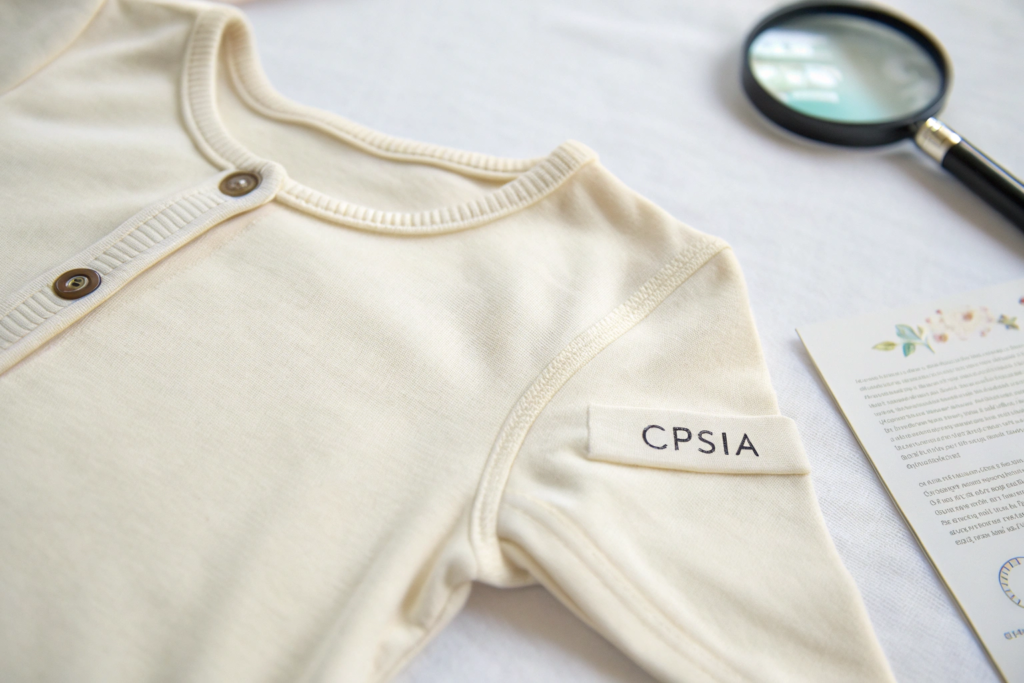
You are used to a care label with washing instructions. For kids' wear, you need two distinct labels or one combined label that serves both purposes.
Standard Care Label (FTC Requirement):
- Fiber Content (e.g., 100% Cotton)
- Country of Origin (Made in China)
- Care Instructions (Machine Wash Cold)
- RN Number (or Company Name)
Tracking Label (CPSIA Requirement for ages 12 and under):
This is a permanent label that must contain:
- Manufacturer or Private Labeler Name (Your brand name).
- Location and Date of Production (City, State/Country, and Month/Year of manufacture).
- Cohort Information (Batch Number, Lot Number, or PO Number).
- Contact Information (Website or Phone Number).
The Scaling Problem:
When you make 50 units, you can use a stamp or a tiny handwritten tag for the batch number. When you make 5,000 units across three different PO numbers and two different fabric dye lots, managing this data becomes a logistics nightmare.
I worked with a brand that ordered 2,000 units of the same dress but in two different shipments—PO#001 (Spring Cotton) and PO#002 (Summer Cotton) . The factory accidentally used the same generic tracking label on both batches. The client could not distinguish the Spring fabric from the Summer fabric. If there had been a recall on the Spring dye lot, she would have had to recall all 2,000 units because the tracking data was not specific enough. That is a $40,000 recall cost instead of a $20,000 recall cost.
At Shanghai Fumao, we have a dedicated CPSIA label verification step. Our QC team photographs every label with the garment before packing. This provides a digital paper trail for our clients.
Why Is Size Grading More Complex for Children Than Adults?
You might think sizing for kids is just "Small, Medium, Large." That works for a small Etsy run. It does not work for wholesale to boutiques or for parents shopping online. The return rate on kids' wear is notoriously high—often 20-30% for new brands—because of poor fit.
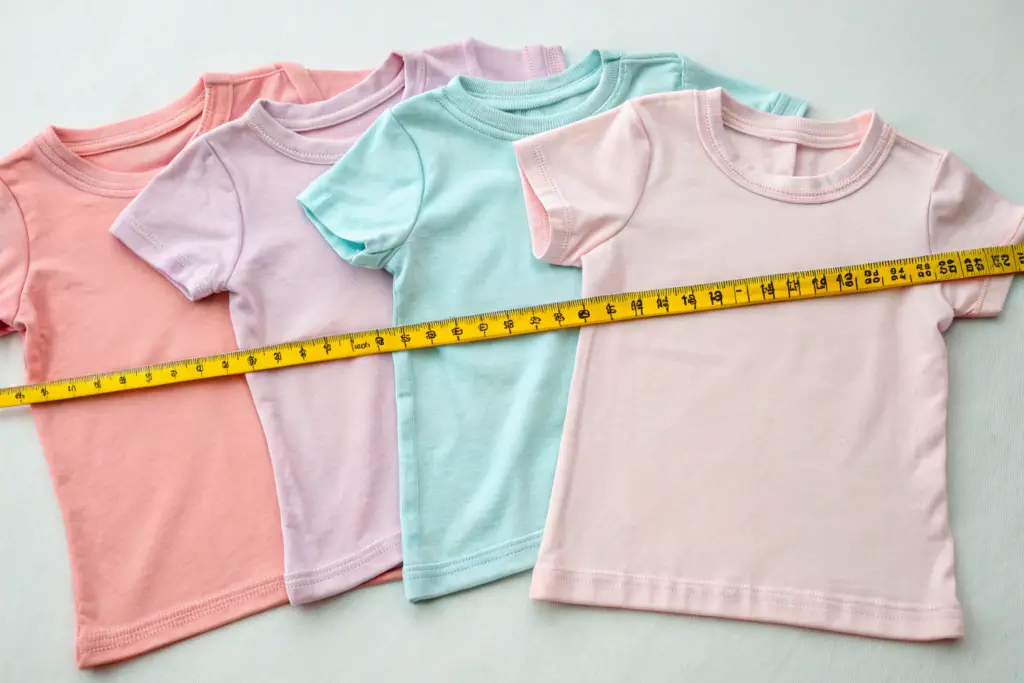
Size grading is more complex for children than adults because children's bodies do not grow in linear, proportional increments. The relationship between chest, waist, height, and arm length changes dramatically between a 2T and a 6X. A simple percentage grade from a base size will result in sleeves that are too long on a toddler or a neck opening that is too tight on a kindergartener.
Adults gain weight in predictable places. Children grow up before they grow out. A 4-year-old is not just a scaled-down 10-year-old. This is a biological fact that breaks standard grading software if you are not careful.
How Do Growth Spurts Affect the Grade Rules for Different Age Brackets?
The industry breaks kids' sizing into distinct Grade Rule Tables because of these physiological differences. You cannot use one set of rules for all sizes.
Here is a simplified view of how the body changes and how the pattern should adjust:
| Age Bracket | Typical Sizes | Body Shape Characteristic | Grade Rule Focus |
|---|---|---|---|
| Baby (0-24M) | NB, 3M, 6M, 12M, 18M, 24M | Diaper room. Large head. Short limbs. | Extra ease in seat and stride. Small neck opening. |
| Toddler (2T-4T) | 2T, 3T, 4T | Potbelly. Short torso. Active movement. | Length increases faster than width. Waist needs elastic. |
| Little Kids (4-6X) | 4, 5, 6, 6X | Slimming down. Legs lengthening. | Inseam increases significantly. Armhole depth adjusts. |
| Big Kids (7-16) | 7, 8, 10, 12, 14, 16 | Pre-puberty. Variance in girth vs. height. | Separate "Slim" and "Husky" fits often required. |
A Real Scaling Horror Story:
A client came to us after a failed production run in Vietnam. She had provided a factory with a Size 5T sample and simply said, "Grade this up to Size 10." The factory used a linear percentage grade. The Size 10 dress had an armhole so deep it showed the child's ribs and a sleeve length that went past the fingertips. She had to donate 800 units. The loss was $12,000.
At Shanghai Fumao, we use Alvanon or ASTM D6860 standard children's body measurements as our baseline. We do not guess. We use decades of fit data to ensure that a 2T fits a toddler and a 10 fits a pre-teen appropriately.
Why Are "Slim" and "Husky" Fits Essential for Wholesale Kids Brands?
If you are selling direct-to-consumer on your own website, you might get away with a single "Regular" fit. If you are selling wholesale to boutiques or department stores, they will demand Extended Sizing or Multi-Fit Options.
This is a major challenge when scaling. You are not just making one size run. You are making three.
The Financial Implication:
A standard size run for a woven pant might be:
- Regular: 4, 5, 6, 6X (4 SKUs)
- Slim: 4, 5, 6, 6X (4 SKUs)
- Husky: 4, 5, 6, 6X (4 SKUs)
Suddenly, one style becomes 12 SKUs. Your minimum order quantity (MOQ) per color multiplies. Your inventory risk multiplies.
Why this matters for US retailers:
According to data from the CDC Growth Charts, approximately 20% of US children fall into the "obese" or "overweight" category for their age. Another 10% fall into the "underweight" or "slim" category. If you ignore Husky fits, you are ignoring roughly 1 in 5 potential customers. Boutique owners know this. They will not carry your line if it only fits the "average" child who doesn't really exist.
I advise my scaling clients to start with Regular fit to prove the concept, but to build the cost of Slim and Husky grading into their Year 2 budget. It is the only way to get into the larger wholesale accounts.
How to Maintain Quality and Safety at Higher Production Volumes?
This is the pain point that keeps brand owners awake at night. You built your brand on "small batch quality." You promised your customers "heirloom pieces." Now you need to make 5,000 units in a factory 7,000 miles away. How do you ensure that the 5,000th unit is as safe and beautiful as the first one you sewed yourself?
Maintaining quality and safety at higher volumes requires a shift from "artisan inspection" to "statistical process control." You must replace your own two eyes with a documented system of AQL (Acceptable Quality Limit) inspections, third-party lab testing, and a clear, contractual quality agreement with your manufacturing partner. Trust is not a strategy. Verification is.
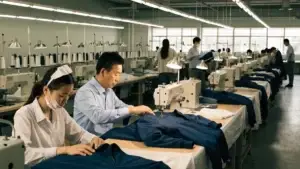
At Shanghai Fumao, we operate five production lines. We know that quality does not happen by accident. It happens by design.
What Is an AQL Level and Why Should a Small Brand Care?
AQL stands for Acceptable Quality Limit. It is the international standard (ISO 2859-1) for random sampling inspection. It tells you how many defective units are "acceptable" in a batch.
When you scale, you cannot open every box. You must sample.
Common AQL Levels for Kids' Wear:
- AQL 2.5 (Normal Inspection): Used for Minor Defects (loose threads, slight shade variation, wrinkles).
- AQL 1.5 (Tighter Inspection): Used for Major Defects (broken stitches, misaligned snaps, zipper issues).
- AQL 0 (Zero Tolerance): Used for Critical Defects (Sharp points, choking hazards, exposed needles, lead contamination). This is non-negotiable for children.
How it works in practice:
If you order 1,200 units, the inspector will pull 80 units at random.
- If they find 2 units with a broken snap (Major Defect), that is a 2.5% defect rate.
- If your contract specified AQL 1.5, this batch FAILS. The factory must rework or replace.
The Mistake Scaling Brands Make:
Small brands often do not specify an AQL in their Purchase Order. The factory defaults to their own internal standard, which is often looser (AQL 4.0). Then the brand owner opens boxes in the US and finds 10% of the goods have issues. They are furious. But contractually, the factory might have met their standard. You must define your standard upfront.
At Shanghai Fumao, we default to AQL 1.5 for Major Defects on all children's wear unless the client requests a stricter level. We want the goods to be right because returns cost us both money.
How to Source Safe Trims and Notions for Large Orders?
This is the silent killer of quality. When you made 50 units, you bought buttons at the local fabric store. They were cute. When you need 10,000 buttons, you buy from a trim supplier in bulk.
The Danger:
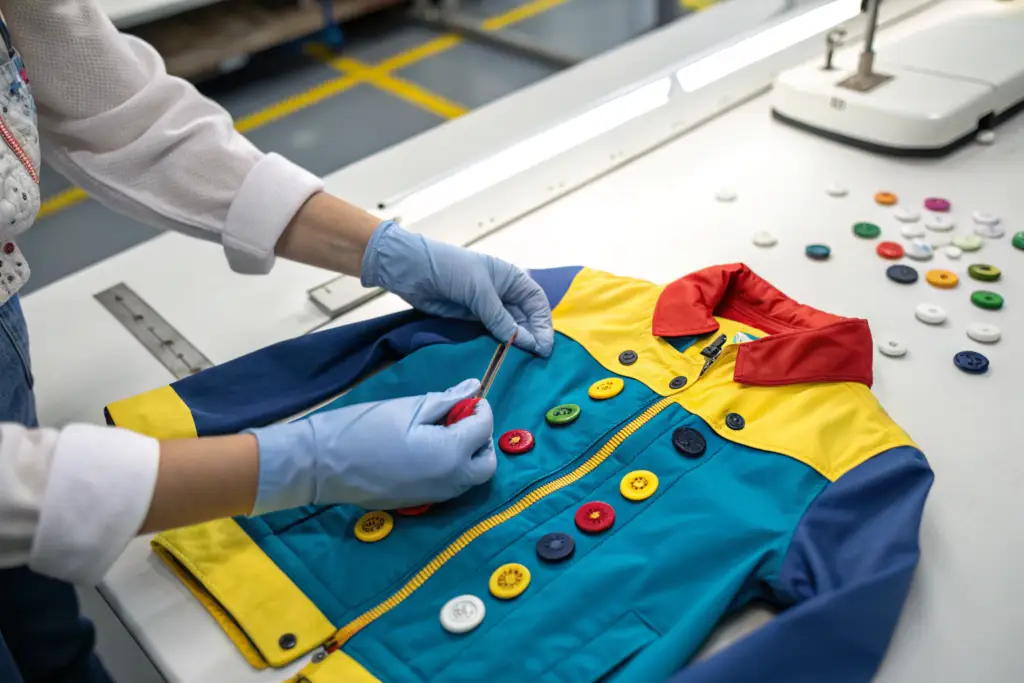
Cheap metal snaps from unverified suppliers can contain Lead. Cheap zipper pulls can have sharp burrs. Plastic buttons can break and become choking hazards.
The Scaling Solution:
You need a Trim and Notions Tracker. For every single component that goes on a child's garment (snaps, zippers, buttons, drawstrings, sequins), you must have:
- A Certificate of Compliance (COC) from the trim supplier.
- Physical Test Report for Lead and Phthalates (if metal or plastic).
- Component Testing done by a CPSC-accepted lab.
I recall a specific case with a client making a cute jacket with a decorative wooden toggle. The toggle was beautiful. The client bought them from a craft supplier. When we asked for the lead test report, the supplier said, "Lead? It's wood. It's natural." But the toggle had a polyurethane coating that contained lead. We had to send the toggles to Intertek for testing. The result: Lead content 120 ppm (Limit is 100 ppm). We had to scrap 5,000 toggles and source new ones. The delay was three weeks.
The lesson: Source trims from suppliers who specialize in children's product safety compliance. They cost 10-20% more, but they prevent a 100% loss.
How to Manage Cash Flow When Minimum Order Quantities Skyrocket?
This is the cold, hard math of scaling. When you were small, you could order 50 yards of fabric. The mill laughed at you, but the jobber sold it to you for $6/yard. Now you need 3,000 yards of custom-dyed organic cotton. The mill requires a 30% deposit before they even turn on the machine. Your cash is tied up for 90 days before you see a single dollar from a sale.
Managing cash flow when MOQs skyrocket requires a strategic shift in financing and production planning. You must move from paying for goods out of last week's Etsy sales to securing either a Purchase Order Financing line or a working capital loan. Additionally, you must negotiate "Cut and Sew Only" contracts where you pay for fabric and trims separately from labor, smoothing out the payment curve.
At Shanghai Fumao, we work with many brands making this transition. We try to be flexible with payment terms for proven partners, but the reality of industrial manufacturing is that fabric mills demand payment upfront.
What Is the Real Cost Difference Between a 300-Unit Order and a 3,000-Unit Order?
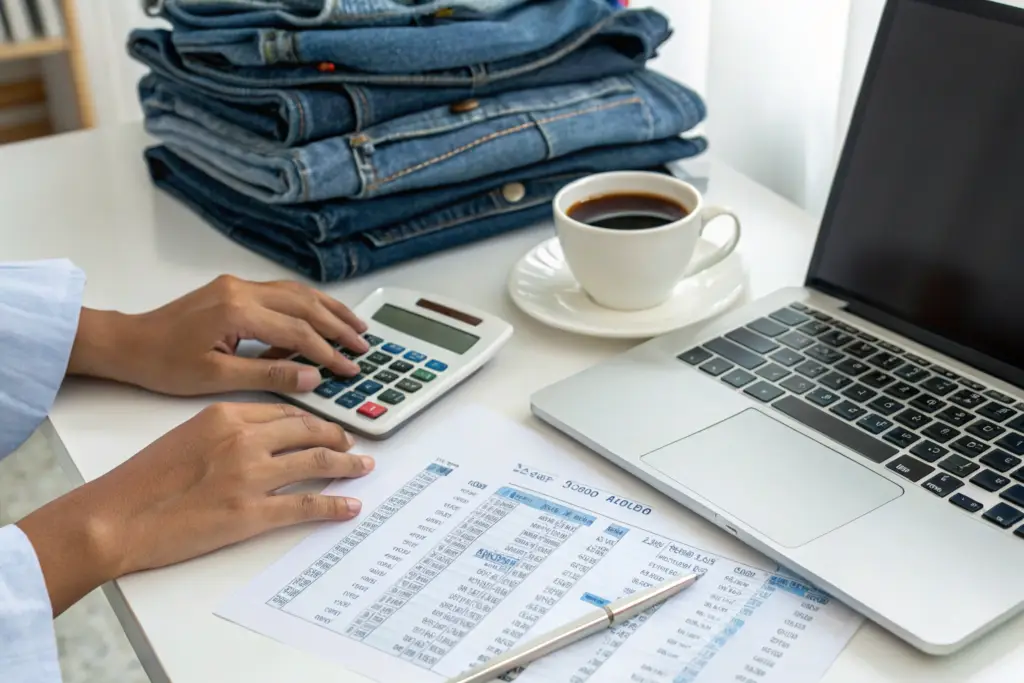
Many founders assume the cost per unit goes down dramatically as volume goes up. In apparel manufacturing, this is true only after you cross a certain threshold.
Here is a realistic cost breakdown for a custom cotton dress (Size 5):
| Cost Component | 300 Units (Small Batch) | 3,000 Units (Scaled Production) | Notes |
|---|---|---|---|
| Fabric Cost (per yard) | $4.50 (Jobber/Stock) | $3.20 (Mill Direct) | 30% savings on fabric. |
| Dyeing Cost | None (Stock Color) | $0.80/yard | Custom color adds cost. |
| Cut & Sew Labor | $3.50 (Small line) | $2.40 (Efficient line) | 30% savings on labor. |
| Trims & Labels | $0.60 | $0.35 | Bulk discount. |
| Freight & Logistics | $0.40 (Air Courier) | $0.90 (Sea + DDP) | Sea freight cheaper per unit, but takes longer. |
| Total Landed Cost Per Unit | $12.50 | $11.50 | Only 8% reduction. |
| Total Cash Outlay | $3,750 | $34,500 | 9x more cash required. |
The Critical Insight:
The cost per unit did not drop from $12.50 to $6.00. It dropped to $11.50. You saved 8% on unit cost, but your cash outlay increased by 900%. This is why brands run out of money when they scale. They have the orders. They just do not have the cash to produce the orders.
How to Negotiate Payment Terms with Overseas Suppliers?
This is where your relationship with the factory matters. A transactional vendor will demand 30% deposit, 70% before shipment. A strategic partner will work with you.
Here is the payment schedule I have seen work best for scaling kids' wear brands:
Option A: Standard Terms (High Risk for Brand)
- 30% Deposit (to confirm order).
- 70% Balance (paid Before Shipment).
- Problem: You have paid 100% of the cost before the goods even leave China. If there is a quality issue or a port strike, you have zero leverage.
Option B: Negotiated Terms (Scaling Friendly)
- 30% Deposit (to book fabric).
- 40% Payment (upon Ex-Factory Inspection Pass).
- 30% Balance (paid 15 Days After Bill of Lading or upon arrival in US).
- Benefit: You retain 30% leverage until the goods are almost in your hands.
Alternative: Purchase Order (PO) Financing
If you have a signed PO from a reputable US retailer (like a boutique chain), there are financial companies that will pay the factory directly. They take a fee (usually 3-6% of the invoice value). This allows you to take a $50,000 order even if you only have $10,000 in the bank. It is a tool for bridging the cash flow gap.
At Shanghai Fumao, we structure our DDP (Delivered Duty Paid) service to simplify this. You pay a deposit, and the final balance is due when the goods clear US Customs. This aligns our interests. We want the goods to arrive quickly and correctly because that is when we get paid.
Conclusion
Scaling a custom kids' wear brand is a rite of passage. It separates the hobbyists from the real business owners. The challenges are not just bigger versions of small problems. They are entirely new species of problems. The CPSIA regulations that were a distant PDF become a Customs hold on your container. The size grading that you used to fudge with a tape measure becomes a mathematical formula for returns. The quality control that you did with your own hands becomes a statistical AQL sample.
We walked through the specific testing firewalls between sleepwear and playwear, and why the word "sleepover" can cost you $4,500 in relabeling fees. We looked at how children's bodies grow in unpredictable spurts, requiring separate grade rules for toddlers and tweens. We examined the hard reality of AQL 1.5 inspections and the necessity of testing every single snap and button for lead. And we did the math on cash flow, revealing that a 3,000-unit order requires nine times more cash than a 300-unit order, even if the unit cost only drops by 8%.
Growth is good. But unmanaged growth is dangerous. The goal is not just to get bigger. It is to get better while you get bigger. It is to build a supply chain that protects the trust you have earned from parents who dress their children in your clothes.
At Shanghai Fumao, we have seen these scaling challenges firsthand. We have helped brands navigate the transition from Etsy to wholesale, from 300 units to 30,000 units. We understand the importance of compliant trims, accurate grading, and transparent communication. With our five production lines in China and our experience shipping DDP to North America and Europe, we are equipped to be more than just a vendor. We can be your production partner in this next chapter of growth.
If you are feeling the pressure of scaling your kids' wear brand and need a manufacturing partner who understands compliance, quality, and the financial realities of apparel production, please reach out to our Business Director, Elaine.
Email: elaine@fumaoclothing.com