You’re an American brand owner, and you have a great design for a new clothing line. But when you talk to suppliers in China or Vietnam, things get confusing. They ask for things you don’t have, and samples come back looking nothing like your sketch. I’ve seen this happen countless times over my 20 years in this industry. The root of the problem is almost always the same: not having a proper tech pack.
A tech pack is the complete instruction manual for your garment. It’s a detailed document that tells the factory exactly how to make your product. It includes everything from technical flat drawings and measurements to fabric specs and stitching details. Think of it as the bridge between your creative idea and the finished product hanging on a store rack.
Last spring, a buyer from New York came to us at Shanghai Fumao with a sketch on a napkin. He had great style but couldn’t communicate the construction details. The first samples were a disaster. After we sat down and built a proper tech pack together, the second sample was perfect. It saved him two months of back-and-forth and thousands of dollars in sample fees. Creating a solid tech pack is the single most important step to ensure your production is smooth, on time, and matches your vision. In this guide, I’ll walk you through exactly how to build one that factories will love.
What Are The Essential Components Of A Tech Pack?
When I ask new clients for a tech pack, sometimes they send me just a few photos from Pinterest. That is not a tech pack. A tech pack is a collection of pages, each serving a specific purpose. Missing even one page can lead to big problems later. A few years ago, a client from Chicago skipped the page for trim because he was in a hurry. Halfway through production, we realized the zipper pulls he wanted were out of stock. We had to find a replacement fast, which delayed his shipment by three weeks. That’s a lesson in why every single detail matters.
A complete tech pack must include these core sections: a cover page with style info, technical flat sketches, a detailed bill of materials, graded specification measurements, and a construction page. These five elements give the factory a complete picture, from the big-picture design down to the smallest stitch.
To really get it right, let’s break down each of these essential parts. A good factory will use every single one of these pages to build your sample and plan your production. If a section is missing, we have to make assumptions. And assumptions, as we all know, can be costly mistakes.

What is a technical flat sketch and why is it so important?
A technical flat sketch, or “flat,” is the blueprint of your garment. It’s a professional, two-dimensional line drawing that shows the garment as if it were laid flat. This is different from a fashion illustration, which is often artistic and stylized. The flat must be accurate and show all the design details. This includes seam lines, pocket placements, topstitching, plackets, and where labels go. For example, if you have a curved seam on the back of a women’s blouse, your flat sketch must show that curve clearly.
Last year, a client sent us a flat sketch for an activewear top. The sketch was very detailed, showing the exact placement of the reflective piping on the sleeves. Because the flat was so clear, our pattern maker understood the design immediately. The first sample was 95% correct. We only had to make one small adjustment to the neckline. This is the power of a good flat. It eliminates guesswork and ensures everyone starts on the same page. Without it, you are relying on words alone to describe a visual product.
How do you create a bill of materials that prevents factory delays?
The Bill of Materials, or BOM, is essentially a shopping list for your garment. It is often the most overlooked part of a tech pack, but it is the one that causes the most delays if done poorly. A good BOM lists every single material that goes into your product. This includes the main fabric, lining, thread, buttons, zippers, labels, hang tags, and even the polybag for shipping. For each item, you need to specify the supplier, the material content, the color code, and the exact place it is used on the garment.
I remember working with a Canadian brand on a line of kids’ wear. Their BOM listed “yellow buttons.” That was it. When our sourcing team started looking, we found fifty different shades of yellow. We had to stop everything, send photos back and forth, and wait for the client to approve a shade. This took ten days. If their BOM had included a specific color code, like “Pantone 123 C,” or a reference swatch, we could have ordered the correct buttons immediately. A detailed BOM keeps the production line moving and your launch date on track.
How Can You Ensure Your Tech Pack Includes Accurate Measurements?
Many new brand owners think saying “medium” is enough. But a “medium” in the United States is different from a “medium” in Vietnam or China. This is where size specifications, or “specs,” become critical. You cannot rely on general size names. You must provide a complete measurement chart. I once had a client who only gave us a sample garment from another brand and said, “Copy this.” The problem was that the sample had stretched out from being worn. We copied the stretched measurements, and the first production run was a size too big. We had to re-cut everything, which cost us both time and money.
To avoid sizing disasters, you must provide a graded specification sheet. This sheet lists all the key measurement points on the garment, like chest width, shoulder width, sleeve length, and waistband. It then shows the exact measurement for every size you plan to sell, from XS to XXL. This gives the factory a clear target for every single size.
Let’s move past the basics and look at how to make your measurement sheet truly effective. This level of detail is what separates a professional brand from a beginner. It shows the factory that you know what you are doing, and it earns you respect and better service from your manufacturing partner.
Which specific points should you measure on your garment?
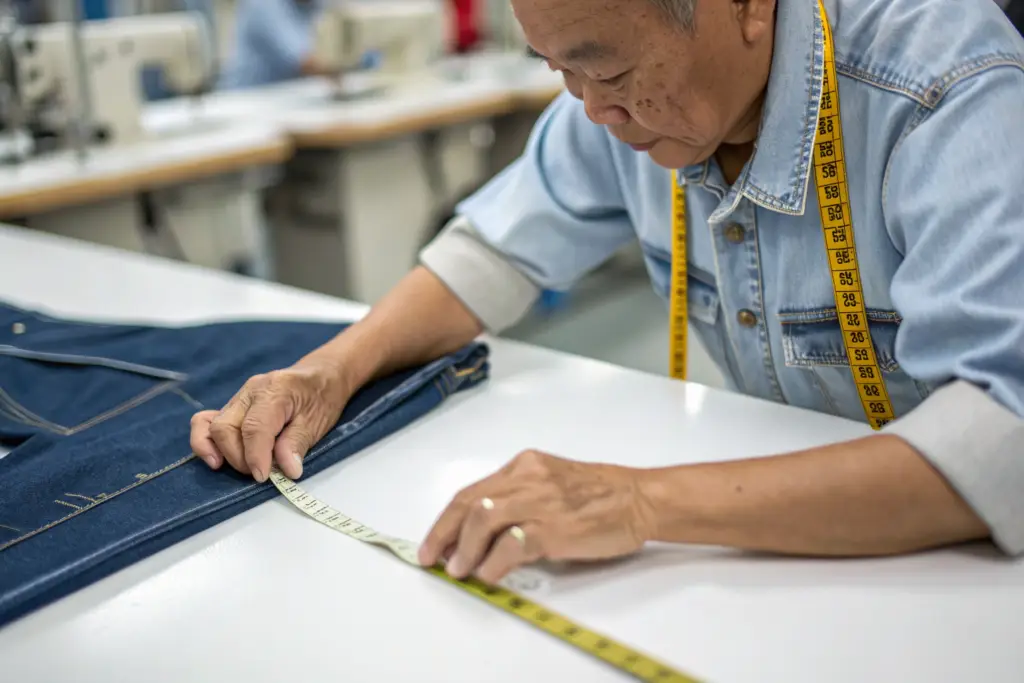
Every garment type has its own set of standard measurement points. For a woven shirt, you measure the chest (1 inch below armhole), the shoulder width, the center front length, the sleeve length from the shoulder point, and the cuff opening. For a pair of jeans, you measure the waist (along the top edge), the front rise, the back rise, the thigh width, the knee width, and the leg opening. You need to list every single one of these points in your tech pack.
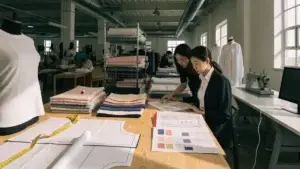
Think of it from our perspective on the factory floor. The quality control team uses this sheet to check every garment. We have a large table where we lay out samples and production pieces. We have rulers and tape measures at every station. If your spec sheet says the chest for a size large should be 22 inches, we check it. If it’s 22.5 inches, the garment fails the check and goes back for alteration. Without those numbers, our team has no standard to work against. Providing a full set of measurements means you get a consistent product that fits your customer’s expectations every time.
What is grading and how does it work in a tech pack?
Grading is the process of increasing or decreasing your sample size measurements to create a full size range. You will typically start by making a sample in one size, usually a medium. This is your “base size.” You then provide the factory with the measurements for your base size. The factory’s pattern maker then uses a set of “grade rules” to calculate the measurements for all the other sizes.
For example, you might decide that for every size increase, the chest measurement goes up by 1 inch, but the sleeve length only goes up by 1/4 inch. These rules are based on standard body proportions, but they can be customized for your specific fit. When you provide a full graded spec sheet, you are essentially telling the factory exactly what grade rules to use. This ensures the fit of your garment stays true across all sizes. A size small should look and feel like a smaller version of the size large, not a completely different shape.
What Information About Stitching And Construction Must Be Included?
A tech pack is not just about how the garment looks; it’s about how it’s built. The construction details tell the factory the “how.” How many stitches per inch? What type of seam do you want? Do you want the hem to be single-needle or twin-needle? These small choices have a huge impact on the garment’s durability, look, and cost. I’ve seen beautiful designs ruined because the factory used the wrong type of stitch, causing the garment to fall apart after one wash.
The construction page of your tech pack should detail the stitch type, seam type, and thread tension for every part of the garment. It should also specify reinforcement details for stress points, like pocket corners or zipper ends. This level of detail ensures the garment is not only stylish but also built to last.
Let’s dive deeper into the specifics of construction. These are the details that a typical buyer might not think about, but a master tailor or experienced sewer will notice immediately. Getting these right is the mark of a high-quality product.
How do you specify stitch and seam types for a factory?
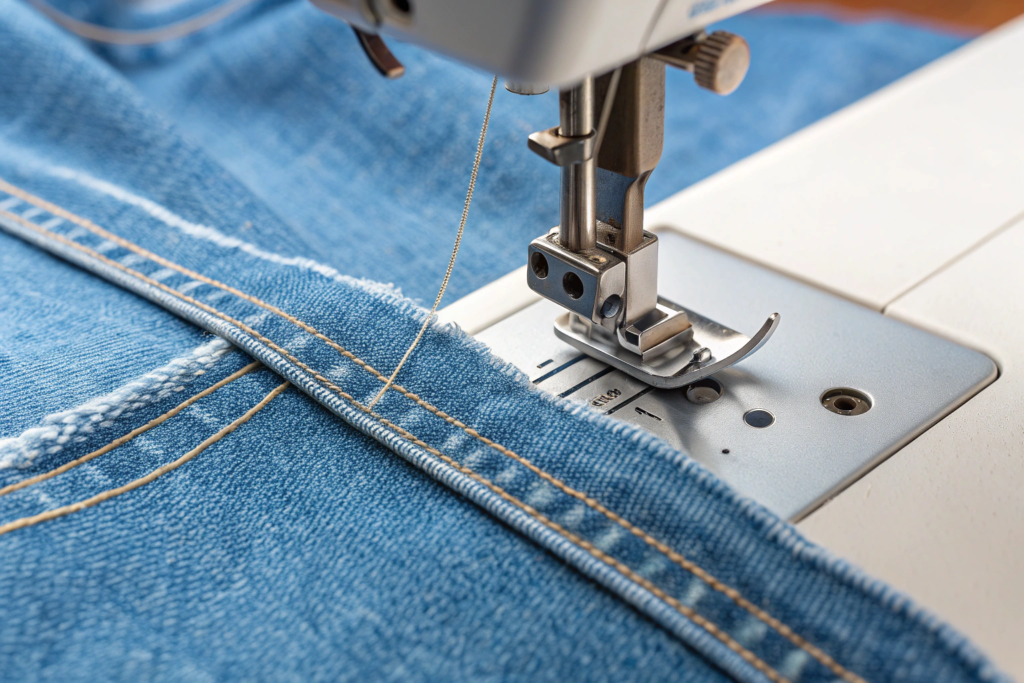
There are standard classifications for stitches and seams used all over the world. A common stitch is the “lockstitch” (ISO 301), which is what you see on most woven garments. A “chainstitch” (ISO 401) is more elastic and is often used on the hems of t-shirts. For seams, a “superimposed seam” (SSa) is a standard seam where two pieces of fabric are sewn together with their edges aligned, like on a shirt side seam. A “lapped seam” (LSa) is often used for attaching yokes to shirts or for stronger seams on workwear.
In your tech pack, you don’t need to know the ISO numbers by heart, but you should use clear language or simple diagrams. You can say, “Use a safety stitch on the inseam of these activewear shorts.” Or, “The side seams on this dress must be a French seam for a clean finish.” If you are unsure, you can ask your factory for their standard construction methods. At Shanghai Fumao, we often help our clients choose the best stitch type for their fabric and design. It is a collaboration. But putting your preference in the tech pack gives you control over the final quality.
Why is it important to include details on trims and labels?
Trims and labels are the finishing touches, but they are crucial for branding and compliance. Your tech pack must specify exactly what type of main label, size label, and care label you need. Do you want a woven satin label, a printed heat transfer label, or a silicone tag? Where exactly should each label be placed? I had a client who wanted a small, leather-like patch on the back of their jeans. In the tech pack, they specified the material (PU leather), the exact dimensions (2″ x 1.5″), the placement (centered on the waistband), and the debossing style. Because it was in the tech pack, the sample was perfect. We ordered the custom patches right away, and they were ready when the jeans were cut.
Also, think about buttons, zippers, and drawcords. A zipper pull can be a major design element. Your BOM should list the zipper supplier, the material (metal, nylon, plastic), the color, and the tooth size. For buttons, specify the material, size in lignes (a standard button measurement unit), and number of holes. Providing physical samples of your trims, or very clear photos with measurements, is always the best practice. This removes all ambiguity and ensures your branding looks professional.
How Can Technology Streamline The Tech Pack Process?
Gone are the days when you had to draw everything by hand and mail a folder to China. Today, technology makes creating and sharing tech packs incredibly fast and accurate. Using the right tools can save you weeks of development time. I’ve seen the industry transform from fax machines to WeChat and cloud-based software. Embracing these tools is key to staying competitive.
Using dedicated tech pack software or even well-organized digital templates allows for real-time collaboration, version control, and error reduction. These tools ensure that your factory in Vietnam and your designer in New York are always looking at the exact same, most up-to-date information. This prevents the costly mistakes that happen when someone works from an old PDF.
Let’s look at the practical ways you can use these technologies to make your life easier and your production smoother. These aren’t just fancy gadgets; they are practical solutions to the communication problems that plague this industry.

What software options exist for creating digital tech packs?
There are many options available, from simple spreadsheet templates to professional cloud-based platforms. Many startups begin with Adobe Illustrator for their flats and Excel for their BOM and spec sheets. This works, but it can become messy when you have to manage different versions. You might email a file, I make a comment, you update it, and then you email it again. It’s easy to lose track.
Professional platforms like CLO-Set, Browzwear, or even some modules within PLM (Product Lifecycle Management) systems are becoming more popular. These platforms allow you to create 3D renderings of your garment, which are incredibly helpful. Last year, a client in Seattle used CLO to show us a 3D rendering of a complex parka with multiple layers. We could see exactly how the baffles should be stitched and where the insulation should go. It was clearer than any flat sketch. The first sample was so accurate that we moved straight to the photo shoot. That is the power of modern tech.
How does sharing a digital tech pack improve communication?
When you share a tech pack through a cloud-based link, everyone is on the same page. You can assign tasks, leave comments, and track progress all in one place. For example, if our pattern maker in Shanghai has a question about a pocket placement, they can tag you and the designer directly in the software. You can answer the question on your phone while you are commuting. The answer is recorded in the system, creating a clear audit trail.
This is a huge improvement over WeChat or email chains. I remember a project for a brand in Texas where we had over 200 emails just discussing changes to a single jacket. It was impossible to keep track. With a digital tech pack, there is one source of truth. You also reduce the risk of a translator misinterpreting a sentence. They see the visual spec and the data right there. This direct, clear communication builds trust and gets your product to market faster.
Conclusion
Developing a solid tech pack might seem like a lot of work at the beginning. But I can tell you from decades of experience, it is the most important investment you can make in your clothing line. It protects your vision, it saves you money by preventing sampling errors, and it builds a strong foundation of trust with your factory. You move from being a buyer with a good idea to a professional partner with a clear plan.
We at Shanghai Fumao have helped hundreds of American brands turn their concepts into best-selling products. We know the ins and outs of tech packs, and we are always happy to guide our clients through the process. When your tech pack is complete and clear, we can focus on what we do best: using our five production lines to manufacture high-quality garments with precision and deliver them to you on time.
If you are ready to start your next project or need help finalizing your tech pack, I encourage you to reach out. You can contact our Business Director, Elaine, at elaine@fumaoclothing.com. Let’s work together to bring your apparel vision to life with the quality and reliability that Shanghai Fumao is known for.