You've approved the sample, signed the purchase order, and now face the critical step of moving a significant sum of money internationally to pay for your production. In this moment, the choice of payment method isn't just administrative; it's a major decision affecting security, cost, speed, and trust. While options like Letters of Credit (L/C) exist, the global apparel trade overwhelmingly operates on Telegraphic Transfer (T/T), also known as wire transfer or bank transfer. Why has this become the default heartbeat of the industry's financial transactions?
T/T payment is preferred in bulk apparel orders because it offers an optimal balance of security, speed, cost-effectiveness, and simplicity for both buyers and manufacturers. It provides a direct, traceable transfer of funds with lower fees than L/Cs, faster clearing times than checks, and a level of finality that facilitates the trust-based relationships essential in apparel sourcing. In an industry built on tight timelines and tangible goods, T/T's practical efficiency is unmatched.
At Shanghai Fumao, a new European client once insisted on using a Letter of Credit for their first $80,000 order. The process took three weeks of document preparation, involved $2,500 in bank fees, and nearly delayed production because of a minor discrepancy in the paperwork. For their next order, we proposed standard T/T terms (30% deposit, 70% before shipment). The payment was completed in two days with a $50 bank fee, and production started immediately. The client's CFO remarked, "We wasted so much time and money on the L/C for no tangible benefit." This experience encapsulates why T/T reigns supreme. Let's analyze its advantages in detail.
How Does T/T Provide a Secure and Traceable Transaction?
Security is the foremost concern when transferring large sums overseas. T/T, while not immune to fraud if proper protocols aren't followed, provides a robust framework of security through the global banking network.
It replaces the physical risk of lost checks or cash with a digital, auditable trail.
The Built-In Security Features of a Bank Wire:
- Bank-to-Bank Verification: Funds move between verified financial institutions. Both the remitting and receiving banks perform Know Your Customer (KYC) checks on their clients, adding a layer of legitimacy.
- Irreversibility (Once Cleared): Unlike credit card payments that can be disputed and reversed, a completed T/T payment is final. This protects the supplier from fraudulent chargebacks after goods are shipped. For the buyer, this finality underscores the need for due diligence before sending payment.
- Full Transaction Traceability: Every T/T generates a unique reference number (like a SWIFT MT103). You can track the payment's progress from your bank to the beneficiary's bank. This provides proof of payment and helps resolve any "funds not received" inquiries quickly.
- Formal Documentation: The bank provides a payment confirmation slip, and the beneficiary's bank issues a credit advice. These are auditable financial documents.
Mitigating the Primary Risk: Correct Beneficiary Details
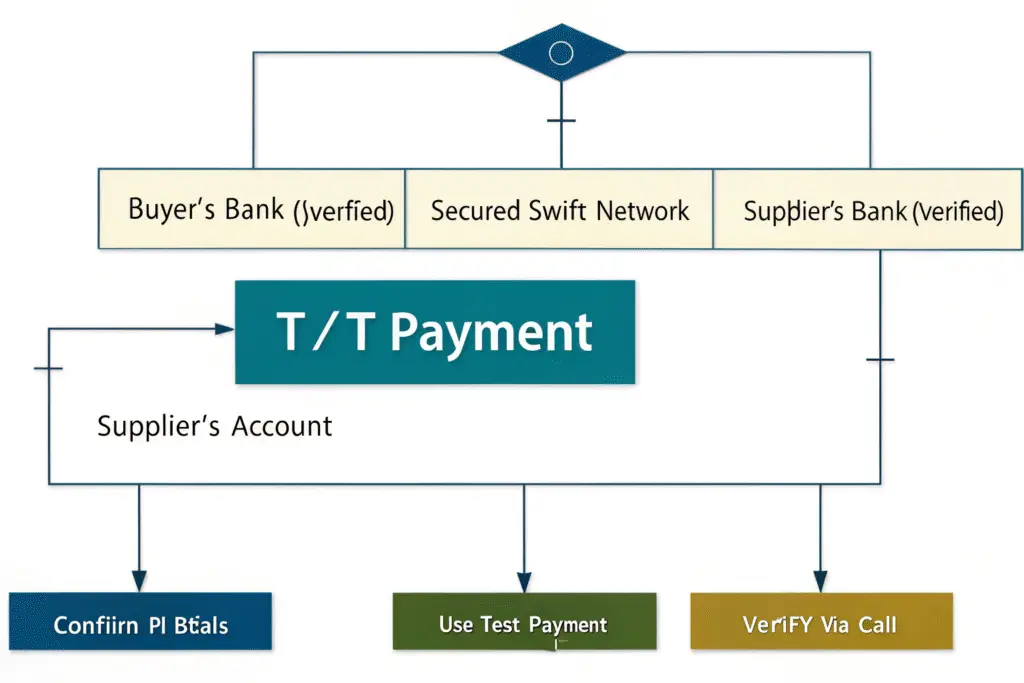
The main risk in T/T is human error or fraud in the beneficiary details. A payment sent to an incorrect or fraudulent account is extremely difficult to recover. This risk is mitigated by:
- Using a Signed Proforma Invoice (PI): The factory's official PI should contain their exact, registered company name and bank account details. Pay only to these details.
- Verifying Details via a Secondary Channel: Before sending a large deposit, confirm the bank details via a separate email or a phone call to a known factory representative.
- Sending a Small Test Payment First: For a new supplier, sending a nominal amount (e.g., $1) to confirm receipt is a prudent step.
This combination of banking infrastructure and simple verification protocols makes T/T a secure choice for transactions that are too large for escrow but don't warrant the complexity of an L/C.
What Are The Significant Cost and Time Advantages Over L/C?
The Letter of Credit (L/C) is often touted as the "safest" method, but this safety comes at a high premium—both in cost and time. For most apparel orders, this premium is unnecessary and detrimental to the fast-paced production cycle.
T/T is the lean, just-in-time financial instrument for a lean industry.
The Hidden Costs of a Letter of Credit:
An L/C involves multiple parties, each charging a fee. Typical costs include:
- Opening Fee (Buyer's Bank): 0.1% - 1% of the L/C value.
- Advising/Confirming Fee (Supplier's Bank): Can be 0.1% - 0.5%.
- Amendment Fees: Any change to the L/C terms incurs a fee.
- Discrepancy Fees: If the presented documents have even a minor error (a typo, an inconsistent date), the bank charges a fee, and payment can be refused.
Total L/C fees can easily reach 1-3% of the order value. On a $100,000 order, that's $1,000-$3,000 wasted.
The Time Sink of an L/C Process:
- Application & Issuance: Buyer applies at their bank (3-5 days).
- Advising & Confirmation: L/C travels to supplier's bank (2-3 days).
- Document Preparation & Presentation: After shipment, the supplier must gather a perfect set of documents (Bill of Lading, Invoice, Packing List, Certificates) and present them to their bank (5-7 days).
- Review & Payment: Banks review documents for strict compliance. Any discrepancy stops the process. Payment can take 5-10 days after document submission.
Total added timeline: 2-4 weeks of financial processing.
T/T's Streamlined Alternative:
- Cost: Typically a flat fee of $25-$50 per transfer from your bank. The supplier's bank may charge a small receiving fee ($10-$20).
- Time: A T/T payment is typically completed within 1-3 business days. The 30% deposit triggers immediate material purchasing. The 70% balance before shipment is paid instantly upon your approval of the inspection report, keeping the shipment on schedule.
For time-sensitive fashion production, the weeks saved by using T/T directly protect your selling season.
How Does T/T Facilitate Trust and Partnership Dynamics?
Apparel manufacturing is not a commodity transaction; it's a collaborative project. The chosen payment method influences the relationship's psychology. T/T, especially with standard milestones (30/70), creates a framework of mutual commitment and graduated trust that aligns perfectly with the production process.
It's a financial handshake that says, "Let's build this together."

The "Milestone Trust" Built into Standard T/T Terms:
The classic 30% deposit, 70% before shipment structure is a masterpiece of balanced incentives:
- The 30% Deposit: Your commitment. It shows the factory you are serious and provides them capital to purchase materials for your specific order. It prevents them from having to finance your production.
- The 70% Balance Before Shipment: The factory's commitment. They complete production and allow you to verify quality (via Pre-Shipment Inspection report) before you release the final funds. You retain leverage until the end.
This structure creates a fair exchange of value and risk at each stage, building confidence with each successful transaction.
The Evolution of Terms as Trust Grows:
T/T terms are not static. They evolve with the relationship, something less flexible with L/Cs.
- First Order: 30% deposit, 70% before shipment. (Standard risk mitigation)
- After 3-5 Successful Orders: 30% deposit, 70% against copy of Bill of Lading. (More trust, better cash flow for buyer)
- Strategic Long-Term Partnership: May involve tailored terms like net 30 after shipment for key clients. This level of trust, built on a history of reliable T/T payments, is a powerful competitive advantage.
This progression is only possible with the flexibility and simplicity of T/T. An L/C does not allow for this nuanced, relationship-based evolution.
At Shanghai Fumao, we view the adherence to T/T terms as a key indicator of a client's professionalism and reliability. Clients who pay deposits and balances promptly via T/T become our priority partners, receiving our best service and flexibility in return.
What Are The Practical Steps and Considerations for T/T Payments?
Executing a T/T payment correctly is straightforward but requires attention to detail. Following a clear process prevents delays and ensures your funds reach the intended account safely.
Here is the standard operational workflow.

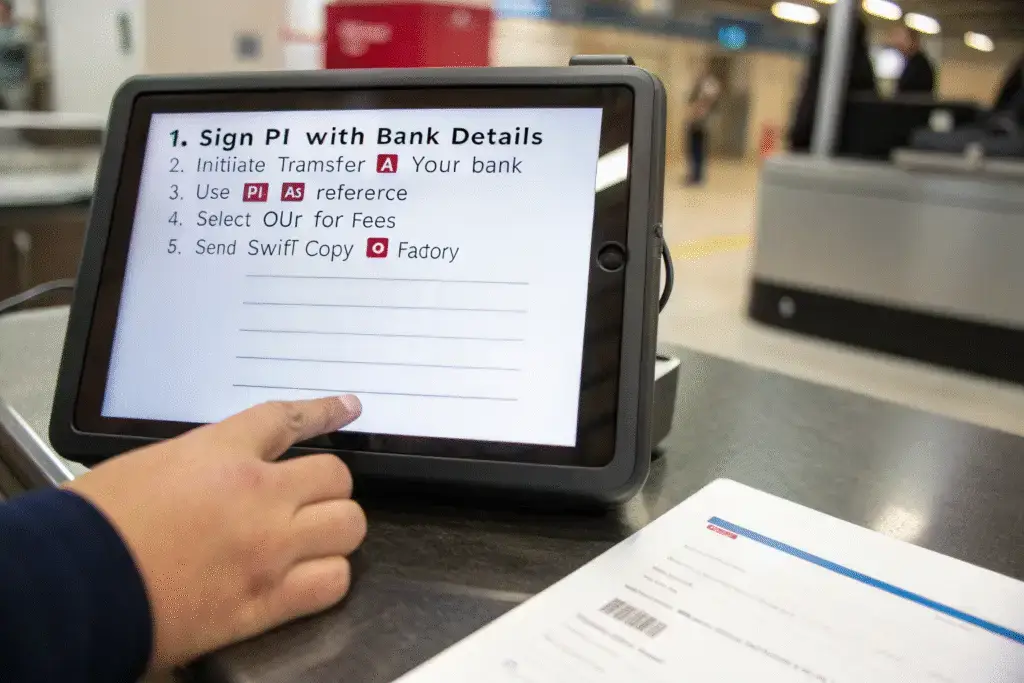
Step-by-Step Guide for the Buyer:
- Receive and Sign the Proforma Invoice (PI): The factory issues a PI detailing prices, quantities, total amount, and their official bank details (company name, bank name, SWIFT/BIC, account number).
- Initiate the Transfer with Your Bank: Provide your bank with the PI. You will need to specify:
- Beneficiary Details: Exactly as on the PI.
- Payment Reference: Use the PI number or your order number. This is crucial for the factory to identify your payment.
- Intermediary Bank (if required): Some banks use a correspondent bank. The factory should provide this info if needed.
- Pay the Deposit: Send the agreed percentage (e.g., 30%). Keep the bank confirmation slip.
- Notify the Factory: Send a copy of the bank's payment confirmation (SWIFT copy) to the factory by email. This allows them to track the funds on their end.
- Pay the Balance: After approving the Pre-Shipment Inspection report, instruct your bank to send the balance payment (70%) using the same process.
Key Considerations and Best Practices:
- Lead Time for Funds: Inform your bank 1-2 days before you need the payment to arrive. International transfers aren't always instant.
- Weekends & Holidays: Banks are closed. A payment initiated on a Friday may not be processed until Monday.
- Shared Costs ("OUR" vs "BEN"): Specify who pays the transfer fees. "OUR" means you pay all fees (your bank's and intermediary fees), ensuring the factory receives the full amount. This is the most common and courteous practice. "BEN" means the beneficiary (factory) pays all fees, which might result in them receiving less than the invoice amount.
- Currency: Agree on the currency (usually USD). Be aware of your bank's foreign exchange rates if you're converting from another currency.
Following this disciplined process makes T/T a reliable and predictable part of your supply chain management.
When Might An Alternative To T/T Be Necessary?
While T/T is preferred for 90% of apparel transactions, there are specific scenarios where its risk profile may not be acceptable, necessitating a more secure (and costly) instrument.
Knowing these exceptions ensures you choose the right tool for the job.
Scenario 1: Extreme Risk or First Transaction with an Unvetted Supplier
If you have serious doubts about a supplier's legitimacy and cannot perform adequate due diligence (e.g., no verifiable company address, no client references, refusal of a video audit), do not use T/T. The irreversibility of the payment is too great a risk. In such cases, you should reconsider the supplier entirely, not just the payment method.
Scenario 2: Very High-Value Orders or Politically Risky Markets
For orders exceeding, say, $500,000, or when dealing with suppliers in countries with unstable banking or political systems, a Letter of Credit (L/C) might be justified despite its cost. The bank's guarantee of payment upon presentation of shipping documents provides a layer of financial security that can be worth the premium.
Scenario 3: Buyer Requires Extended Credit Terms
If a factory is willing to offer net 60 or net 90 payment terms after shipment (common for very large, established brands), this is still technically a T/T payment, just deferred. The trust level here is extremely high. For shorter credit periods, a Standby Letter of Credit (SBLC) might be used as a guarantee, but the actual payment flows via T/T.
The Reality for Most Brands:
For the vast majority of small to medium-sized brands sourcing from established manufacturing hubs like China, Vietnam, or Bangladesh, the supplier risk is managed through vetting (factory audits, references, sample evaluation), not through complex financial instruments. T/T, with its milestone structure, provides the perfect balance of security and efficiency for this environment.
The key is to transfer financial risk through relationship building and due diligence, not just through expensive banking products. T/T is the instrument that enables and rewards that approach.
Conclusion
T/T payment is the preferred and dominant method for bulk apparel orders because it aligns perfectly with the industry's needs: it is secure enough for substantial transactions, fast enough to keep up with production timelines, cost-effective enough to preserve margins, and simple enough to foster rather than hinder trust. Its standard milestone structure (30/70) ingeniously balances risk and commitment between buyer and manufacturer, creating a foundation for partnerships that can grow and evolve.
While alternatives like Letters of Credit have their place in extreme-risk or high-value scenarios, for the dynamic, relationship-driven world of apparel manufacturing, T/T is the pragmatic, efficient, and trusted financial workhorse that keeps the global fashion industry moving.
If you are seeking a manufacturing partner who values transparent, standard T/T terms and the trustworthy relationship they enable, we operate on this principle. At Shanghai Fumao, we believe clear financial dealings are the bedrock of a successful partnership. Contact our Business Director Elaine to discuss your next order and our straightforward payment process: elaine@fumaoclothing.com.